
The first step to overcoming dental anxiety is figuring out why you feel that way in the first place. Once you can identify your specific triggers, you can communicate them to a compassionate dental team and start using proven relaxation techniques to feel more in control. It's about turning a dreaded event into just another manageable part of staying healthy. This guide is designed to empower you with friendly, professional advice to make your next visit a positive one.
Why So Many People Fear the Dentist

If the mere thought of a dental appointment makes your palms sweat, you're in very good company. Dental anxiety is a widespread issue that stops countless people from getting the care they need. This isn't just a simple case of nerves—it’s often a complex response tied to past experiences, sensory overload, and a deep-seated feeling of vulnerability. We understand these fears and want you to know they are completely valid.
This feeling is so common that it’s a recognized challenge in healthcare. It's estimated that dental anxiety affects about 15.3% of adults worldwide. That number shows that what you're feeling is a shared experience, not something you should feel ashamed of. Our goal is to provide a friendly, approachable, and empathetic environment where you feel heard and supported.
Unpacking the Common Triggers
Getting to the root of your fear is the first real step toward managing it. For many, a single bad experience—often from childhood—can cast a long shadow, creating a powerful link in our minds between the dentist and pain or discomfort.
Beyond personal history, the dental office itself is a unique cocktail of sensory inputs that can be totally overwhelming:
- The Sounds: The high-pitched whine of a dental drill is an almost universal trigger. It’s a sound that instantly puts people on edge.
- The Smells: Those clean, antiseptic odors can feel clinical and impersonal, which only heightens the anxiety.
- The Physical Sensations: Leaning back in a chair with your mouth wide open is an inherently vulnerable position to be in. Worried about pain during a procedure? We'll explain exactly what to expect.
This feeling of losing control is a massive contributor to anxiety. Not being able to see what’s happening or anticipate the next sensation can make any existing fear feel ten times worse.
From Avoidance to Action
This fear often leads to a self-defeating cycle. You avoid the dentist because you’re anxious, but that avoidance allows small dental problems to become big ones. Bigger problems often require more invasive—and potentially more stressful—treatments down the road. It’s a classic example of breaking the anxiety and avoidance cycle, where facing the initial fear is the only way to prevent a much bigger one later.
The stress from this cycle can even show up physically. If you find yourself constantly tense, you might be interested in the causes of jaw clench and how to relieve it.
The goal isn't to erase fear completely—that’s not realistic. It’s to give you the tools to manage it. By recognizing your triggers and communicating them, you shift from being a passive patient to an active partner in your own healthcare.
This guide is designed to give you practical, actionable strategies to do exactly that. We’ll cover how to prepare for your visit, what to say to your dental team, and techniques you can use right there in the chair to stay calm, all with a focus on education rather than salesy language.
To help you get started, let’s look at the different strategies we'll be covering.
Your Anxiety Reduction Toolkit at a Glance
Here’s a quick overview of the key strategies this guide covers to help you feel more in control before, during, and after your appointment.
| Strategy Phase | Key Action | Primary Benefit |
|---|---|---|
| Before Your Visit | Find a compassionate dentist and openly discuss your fears. | Builds trust and allows the team to tailor your care. |
| During the Appointment | Use controlled breathing and agree on a "stop" signal. | Gives you immediate control over your physical response. |
| Post-Appointment | Acknowledge your success and plan a small reward. | Reinforces positive behavior and builds future confidence. |
Think of these as the building blocks for creating a new, more positive experience at the dentist's office.
Preparing for a Stress-Free Appointment
Feeling prepared can be a game-changer, dramatically lowering your anxiety before you even walk out the door. When you take proactive steps, you’re not just distracting yourself—you’re reclaiming a sense of control. This simple shift in mindset is a powerful antidote to fear, turning you from a nervous patient into an active partner in your own care.
The journey to a calmer dental visit really starts with finding the right practice. It’s a fact that not all dental offices approach patient anxiety with the same level of empathy and skill. Your single most important decision is choosing a dentist who truly gets it.
Finding the Right Dental Team
When you’re looking for a new dentist, don’t be shy. Get on the phone and be direct about your anxiety. The way the staff responds will tell you everything you need to know about their philosophy of care.
Try asking a few specific questions like these:
- "I have a lot of anxiety about dental visits. How does your team help patients like me feel more comfortable?"
- "What kind of comfort amenities do you offer? Things like blankets, headphones, or sedation options?"
- "Would it be possible to schedule a quick meet-and-greet with the dentist before I book an actual exam?"
A team that’s genuinely compassionate will welcome these questions. They won’t just give you a generic "we're great with nervous patients" line; they'll provide real examples of how they provide support. For instance, our team at our San Diego dental office makes it a priority to create a calm, welcoming environment from the second you arrive. In sunny San Diego, where smiles are always on display, we want you to feel confident and relaxed.
Creating Your Personal Comfort Plan
Once you’ve found a team you trust, you can turn your focus to your own personal prep. A few small, intentional actions in the days leading up to your visit can make a world of difference.
Strategic Scheduling: Think about your week. When are you least likely to feel rushed or stressed? Booking your appointment for a quieter time, like a mid-morning slot on a Tuesday, often means a less crowded waiting room and a more relaxed pace for you and the dental team.
Plan a Post-Visit Reward: Give yourself something to look forward to. Seriously. It could be as simple as grabbing a smoothie, bingeing a new show, or taking a walk somewhere you love. Having a reward waiting for you helps reframe the appointment as just a task to get through before the good stuff happens.
Assemble a 'Comfort Kit': Pack a small bag with things that help you feel grounded. Think noise-canceling headphones pre-loaded with a calming playlist or a favorite podcast, a stress ball to squeeze, or even a small, weighted lap blanket if that's what works for you.
This simple infographic breaks down a three-step process for getting your mind right before your visit.
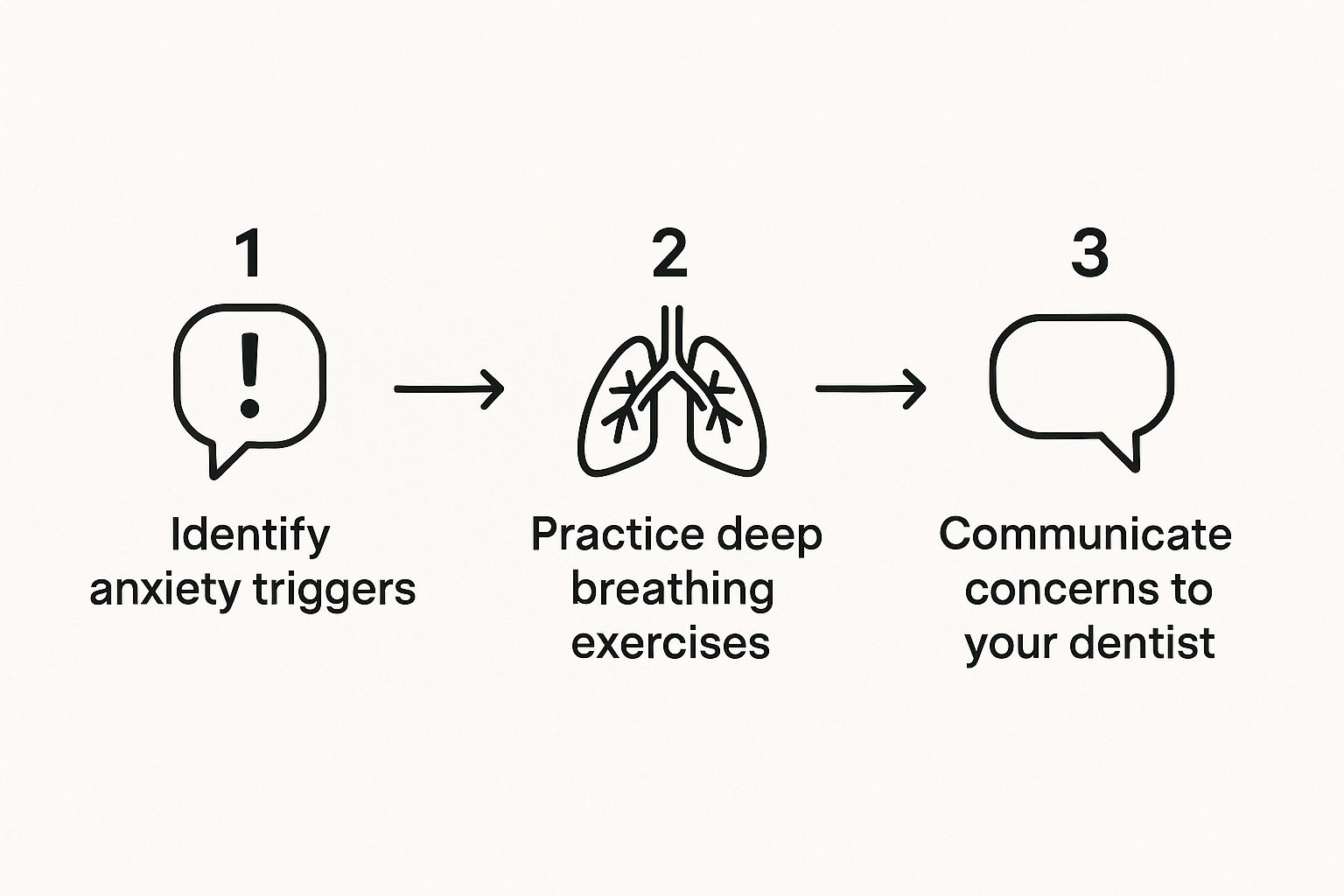
As this visual guide shows, it all starts with understanding your specific triggers. From there, you can practice calming techniques and, most importantly, talk openly with your dental team. Taking these steps helps build a foundation of control and trust that will empower you before, during, and after your appointment.
How to Talk to Your Dentist About Your Fears

One of the most powerful tools you have against dental anxiety is your own voice. It might feel a little awkward at first, but opening up about your fears is the first step toward turning a stressful situation into a true partnership with your dental team. Trust me, a good dentist wants to know how you’re feeling.
Getting the conversation started is usually the hardest part. You don't need to prepare a long speech; a simple, direct statement works wonders.
When you’re on the phone scheduling the appointment, or even when you first sit down, you can just say:
- "I want to let you know that I have significant anxiety about dental work, especially with…"
- "I've had some bad dental experiences in the past, so I get pretty nervous."
- "Could we chat for a minute about how to make this visit as comfortable as possible for me?"
Being upfront like this immediately opens the door for your dentist and their team to give you the support you need. A compassionate, professional response is the best sign that you're in the right place.
Establishing Control in the Chair
Once you've opened that line of communication, you can work together to set some ground rules that put you back in the driver's seat. This isn't just about being heard—it’s about having real, tangible control while the work is being done.
The single most effective strategy here is to agree on a "stop" signal. This is a simple, non-verbal cue you can use at any time to pause the treatment. The most common one is just raising your hand.
Talk this over with your dentist beforehand. Just knowing you can hit the pause button for any reason—whether you need a quick breather, feel a twinge of discomfort, or just want to ask a question—provides an incredible amount of psychological relief. It instantly confirms you’re an active participant in your own care.
By establishing clear communication and a simple 'stop' signal, you fundamentally change the dynamic. It shifts from an experience where things are happening to you to one where you are working with your dental team.
What a Supportive Response Looks Like
A genuinely patient-focused dentist will meet your concerns with empathy and practical solutions. Building trust is essential for creating a safe environment where fear can't thrive, which is why professionals now use techniques like relaxation exercises, sedation, and behavior modification to help manage anxiety. You can find out more about this patient-centered approach to care at MesaDental.com.
Your dentist should listen carefully and might suggest a few things to help, such as:
- Explaining each step: They can walk you through what they're doing and what you can expect to feel or hear before they do it.
- Offering breaks: They might suggest taking a scheduled break every 15-20 minutes during a longer procedure.
- Providing distractions: Many offices now offer headphones for music or podcasts, or even a screen to watch a show.
This kind of teamwork is the bedrock of modern, anxiety-conscious dentistry. Your comfort isn't just a nice-to-have; it's central to providing you with excellent care.
In-the-Chair Techniques for Staying Calm

Alright, you’ve made it to the dental chair. Now what? This is where you need practical, in-the-moment strategies to keep rising anxiety at bay. Think of this as your personal toolkit for staying grounded and feeling in control right through your appointment.
The secret is to give your brain something else to do. When your mind has a specific task to focus on—like breathing or listening to music—it has far less bandwidth to spiral into anxious thoughts.
Master Your Breathing
When anxiety kicks in, our breathing is often the first thing to go. It gets shallow and fast, which only ramps up that feeling of panic. Taking conscious control of your breath is one of the quickest ways to signal to your nervous system that everything is okay.
A go-to method that works wonders is the 4-7-8 breathing technique. It's incredibly simple and you can do it without anyone even noticing.
- Breathe in: Silently inhale through your nose for a count of four.
- Hold it: Hold that breath for a count of seven.
- Breathe out: Exhale slowly and completely through your mouth, making a soft whooshing sound, for a count of eight.
Just repeat this cycle three or four times. You'll literally force your heart rate to slow down, bringing a sense of calm back to your body.
Use Distraction and Grounding to Your Advantage
Distraction isn't about ignoring your feelings—it's about consciously shifting your focus to something more pleasant. This is where that comfort kit you prepared earlier becomes your best friend.
Pop in your headphones and lose yourself in a great audiobook, your favorite podcast, or a playlist you’ve curated just for this moment. The idea is to get so absorbed that the typical dental office sounds just fade away. Some people even find visual or tactile activities helpful, like finding calm with an anxiety coloring book on a tablet.
Grounding techniques are another fantastic tool. They pull you out of your head and back into the present moment by zeroing in on your physical senses.
Try this simple grounding exercise: As you're sitting in the chair, plant your feet firmly on the floor. Pay attention to that sensation—the pressure on the soles of your feet, the feel of your shoes, the solid ground beneath you. It’s a small action, but it can create a powerful feeling of stability.
Consider Modern Comforts Like Sedation Dentistry
Let's be real: sometimes coping strategies need a little backup, especially if you're facing a more complex procedure. This is where sedation dentistry can be an absolute game-changer for managing dental anxiety.
Today’s sedation options are incredibly safe and designed to make your visit as comfortable as possible. They offer different levels of relaxation, from mild to deep.
Nitrous Oxide: You probably know it as "laughing gas." It's a very gentle sedative you breathe in through a small mask over your nose. It just helps you feel relaxed and at ease, and the best part is it wears off almost immediately after your appointment. If you're curious, you can learn more about what laughing gas does to help your anxiety.
Oral Sedation: This is a pill you'd take just before your appointment. It will leave you awake and able to communicate, but in a state of such deep relaxation that you may not even remember much of the treatment later.
Never feel shy about asking your dentist if sedation is a good option for you. It's a completely normal conversation and a key part of building a care plan that puts both your oral health and your peace of mind first.
Handling More Involved Dental Procedures
Let’s be honest: not all dental visits are created equal. A routine cleaning might stir up a few butterflies, but the idea of a root canal, extraction, or dental implant can send your anxiety through the roof. If that sounds familiar, know that you’re not alone. The fear of the unknown is a major anxiety trigger.
The best way to tackle this kind of intense anxiety is to pull back the curtain and understand exactly what's going to happen. It's a known fact that anxiety is tied to specific treatments. Research consistently shows that more invasive work, like drilling and surgical extractions, triggers significantly higher levels of fear in patients. You can read more about these findings on dental procedure anxiety.
This is where a frank, open conversation with your dentist becomes absolutely critical. Don't be afraid to ask for a play-by-play of the entire procedure.
Fine-Tuning Your Coping Plan
For these bigger procedures, your usual go-to coping skills might need a little reinforcement. This is your moment to be your own best advocate and ask for precisely what will make you feel safer and more in control.
Here are a few specific things you can discuss with your dental team:
- Extra Numbing: If pain is your primary worry, just say so. You can always ask for more local anesthetic to make sure you're completely numb before the work begins.
- Planned Breaks: Facing a long procedure? Ask if you can schedule a few short breaks. Just knowing you'll have a chance to pause and take a deep breath can make the whole experience feel less overwhelming.
- A Step-by-Step Narrative: Some people find it incredibly helpful to have the dentist explain what they’re doing as they go. A simple heads-up like, "Okay, now you'll feel some light pressure," can prevent that jump-scare feeling from an unexpected sensation.
The real goal here is to make the experience feel predictable. When you know what’s coming next and have the ability to pause things, you take back control, which is the perfect antidote to feeling anxious and helpless.
Understanding Your Sedation Options
For procedures that are especially long or complex, sedation dentistry can be a game-changer. It’s designed to provide a genuine sense of peace and calm. If you're looking at something significant like oral surgery, learning about what it entails can be incredibly helpful. Our guide on what oral surgery involves breaks it down clearly.
Talk to your dentist about the different types of sedation available. From mild nitrous oxide (laughing gas) that just melts the stress away to oral sedation for a deeper state of relaxation, there's an option that will match your comfort needs. Facing a major procedure doesn't have to be a nightmare. With the right support and preparation, you can get the care you need without all the stress.
Still Have Questions About Dental Anxiety?
It’s completely normal to have lingering questions, even after you’ve started to build a toolkit for managing dental fear. Let's walk through some of the most common concerns we hear from patients just like you in our friendly, professional manner.
"Is Sedation Dentistry Safe? What Are My Options?"
I get this question a lot, and the short answer is yes, absolutely. When administered by a trained and experienced dental team, sedation is an incredibly safe and routine part of modern dentistry. We always go over your full medical history first to make sure it's the right choice for you.
You generally have a few different options, depending on your anxiety level and the procedure:
- Nitrous Oxide: You probably know this as "laughing gas." It's a very mild sedative you breathe in through a small mask. The best part? It helps you relax quickly and wears off almost the second we take the mask off, so you can drive yourself home.
- Oral Sedation: This is a great middle-ground option. We'll give you a prescription for a pill to take about an hour before your appointment. You’ll feel deeply relaxed and maybe even a bit sleepy, but you'll still be awake and able to talk with us.
- IV Sedation: For those with severe anxiety or for more complex procedures, this offers a deeper level of relaxation. The sedative is administered directly into your bloodstream for a more immediate and profound calming effect.
"What If a Bad Dental Experience Is the Root of My Fear?"
First, let me say that your feelings are completely valid. A negative experience, especially one from childhood, can create a powerful fear that sticks with you for years. It's one of the most common reasons people avoid the dentist.
The single most important thing you can do is find a new dentist—one who truly gets it. Look for a practice that emphasizes compassionate care for anxious patients. During your first visit, be upfront about what happened in the past. A good dentist won't judge; they will listen and make it their mission to earn your trust and prove that this time will be different. You are in control now.
"How Do I Deal With Anxiety About the Cost?"
Financial stress is real, and it can make any existing anxiety about a procedure ten times worse. The unknown is often the scariest part. The key is to get complete clarity before any work is done. We believe in being transparent and approachable about payment options.
Serena San Diego Dentist accepts most major insurance plans for covered services. For those preferring out-of-pocket payments for flexibility, we offer several options, including financing plans to make care more affordable. Our team is happy to explain how your insurance can cover specific services.
Don't ever feel awkward about asking the front office for a detailed, line-by-line breakdown of the costs. A transparent treatment plan means no surprises, which puts you back in the driver's seat.
"How Can I Stop My Child from Becoming Afraid of the Dentist?"
You have a massive opportunity to set your child up for a lifetime of positive dental experiences. It all starts with framing the dentist as a friendly, helpful place.
Your first move should be choosing a pediatric dentist. Their offices are built from the ground up to be fun, welcoming, and not the least bit intimidating for kids.
When you talk about their upcoming visit, keep your language positive and simple. Ditch scary words like "shot," "drill," or "pain." Instead, try phrases like, "The dentist is going to count your teeth with a tiny mirror," or "They'll use a special tickly toothbrush to make your smile sparkle." That positive first impression is everything.
At Serena San Diego Dentist, we believe compassionate, patient-first care is the only way to truly help people overcome their dental anxiety. Our professional and empathetic team is dedicated to providing you with a comfortable and stress-free experience. If you're ready to see just how different a dental visit can be, we invite you to schedule your consultation with us today.