
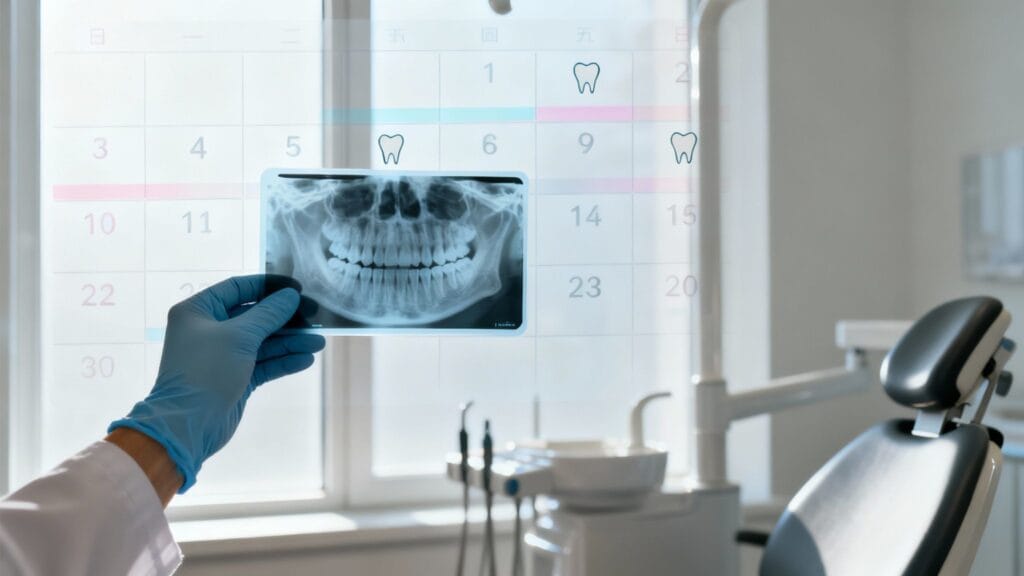
When it comes to dental X-rays, there's no magic number that works for everyone. The right dental X-ray frequency is a tailored recommendation from your dentist, carefully considering your specific oral health, age, and any risk factors you might have.
For a healthy adult with no major dental concerns, getting bitewing X-rays every 12 to 24 months is a common recommendation. A more comprehensive full mouth series might only be necessary every 3 to 5 years. But it’s crucial to remember that this is just a starting point.
Demystifying Your Dental X-Ray Schedule
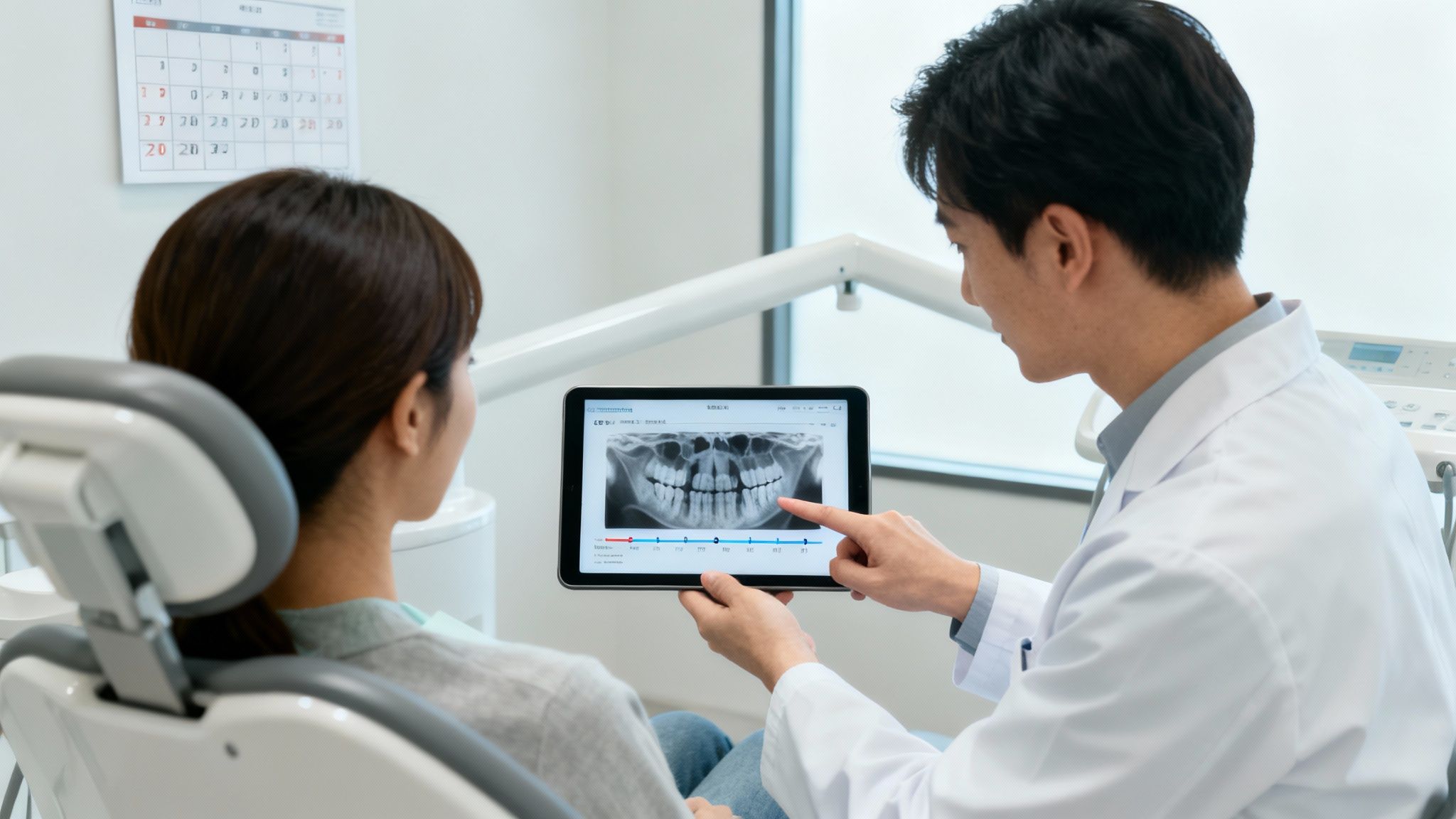
It’s a common question we hear from patients: "Why do I need X-rays every year when my friend only gets them every two?" The answer is that modern dentistry has moved beyond a rigid, calendar-based schedule.
Think of it less like a routine oil change for your car and more like a personalized health plan designed just for you. Your dentist's recommendation is based on a professional assessment of what’s needed to keep your smile healthy, not a generic rulebook.
To give you a better sense of what this looks like in practice, here’s a quick overview of typical schedules.
Quick Guide to Typical Dental X-Ray Schedules
This table provides a general overview of common X-ray frequencies for different patient profiles, giving you a quick reference before we dive into the details.
| Patient Profile | Typical Bitewing X-Ray Frequency | Typical Full Mouth Series (FMS) Frequency |
|---|---|---|
| New Adult Patient | Baseline set taken at the first visit | Baseline set taken at the first visit |
| Healthy Adult (Low Risk) | Every 24-36 months | Every 3-5 years, or as needed |
| Adult with Cavity Risk | Every 6-18 months | As needed to assess issues |
| Adult with Gum Disease | Every 12-24 months (or more often) | As needed to monitor bone loss |
| Child/Adolescent (Low Risk) | Every 12-24 months | As needed for development tracking |
| Child/Adolescent (High Risk) | Every 6-12 months | As needed for development tracking |
This table is just a guide, of course. Your individual needs will always be the final determining factor.
Why A Personalized Approach Matters
At the end of the day, your dentist's goal is simple: use the absolute minimum amount of radiation needed to get a clear and accurate picture of your oral health. A one-schedule-fits-all approach just doesn't work. It could mean unnecessary exposure for people with perfectly healthy teeth or, worse, missed diagnoses for those who really need a closer look.
A tailored schedule is crucial for a few key reasons:
- Catching Problems Early: For someone prone to cavities, more frequent X-rays can spot decay hiding between the teeth long before it becomes a bigger, more painful problem.
- Monitoring Growth and Development: Kids and teens need X-rays more often to make sure their adult teeth are coming in correctly and their jaws are developing as they should.
- Keeping an Eye on Existing Conditions: If you have gum disease, implants, or a history of infections, regular X-rays are essential for tracking bone levels and ensuring everything is stable.
- Setting a Baseline: When you see a new dentist, a comprehensive set of X-rays is non-negotiable. It creates a complete record of your oral health that serves as the benchmark for all future appointments.
Ultimately, your X-ray schedule is a vital part of your preventive care plan. It goes hand-in-hand with the idea that consistent check-ups are the foundation of a healthy smile. By understanding all the factors at play, you can feel confident that your dentist’s recommendation is made with your best interests at heart, a concept we explore more in our guide on how often you should see a dentist.
What Shapes Your Personal X-Ray Schedule?
Ever wonder why your friend gets X-rays once a year, but your dentist suggests a different schedule for you? There's no one-size-fits-all answer. Your dental X-ray frequency is tailored specifically to you. Your dentist pieces together clues about your health, history, and age to create a plan that’s both safe and diagnostically effective.
Think of it this way: a brand-new car might only need a basic annual check-up. But a vintage car, or one that’s driven hard, needs more frequent inspections to catch problems before they turn into a major breakdown. Your oral health is just as unique.
Age and Life Stage
Your age plays a huge role in how often you'll need X-rays. A child's mouth is a very different environment from a settled adult mouth.
For Kids and Teens: This is a time of constant change. Jaws are growing, baby teeth are falling out, and permanent teeth are coming in. X-rays are absolutely essential here to make sure everything is developing correctly and to catch cavities early, which can progress much faster in younger teeth. This is why kids often need X-rays more often.
For Adults: Once your permanent teeth are in place, things usually stabilize. If you have great oral hygiene and a low risk of problems, you might need X-rays less frequently. The focus shifts from tracking growth to maintaining health and catching subtle issues like decay between teeth or early bone loss.
Your Current Oral Health
What your dentist sees during your exam is a major factor. If you walk in with a specific problem, they'll need to look beneath the surface to get the full story.
A regular exam lets your dentist see the surfaces of your teeth they can easily reach. But X-rays show them everything else—what's happening between your teeth, under the gumline, and inside your jawbone. You need that complete picture for a proper diagnosis.
For instance, if your gums are swollen and bleeding, an X-ray is the only way to see if there's been any bone loss, a key sign of gum disease. Or, if your dentist finds a little spot that looks like a cavity, an X-ray confirms it and shows just how deep it goes. This is why a comprehensive dental check-up that includes imaging is so important for catching problems early.
Your Personal Risk Factors
Finally, your overall health and lifestyle habits are part of the equation. Your dentist assesses your individual risk for oral disease by looking at the bigger picture.
What puts someone in a higher-risk category?
- A history of getting cavities often
- Lots of existing dental work, like crowns or large fillings
- Using tobacco, which is a major risk factor for gum disease
- Suffering from dry mouth (a condition called xerostomia), which can be a side effect of medication and leaves your teeth vulnerable to decay
If you have one or more of these risk factors, your dentist will probably recommend a more frequent X-ray schedule. It’s all about staying one step ahead of potential trouble, which leads to easier, less invasive, and more affordable treatment down the road.
A Visual Guide to Different Dental X-Rays
Dental X-rays aren’t a one-size-fits-all solution. Think of them more like a set of specialized camera lenses, each designed to give your dentist a unique and critical view of what’s happening inside your mouth.
What seems like a quick procedure in the chair is actually a very deliberate choice. The type of image we take is always selected for a specific diagnostic reason, helping us piece together the full story of your oral health.
Let's break down the most common types and why we use them.
Bitewing X-Rays: The Cavity Detectives
Bitewings are the workhorses of the dental world and the X-ray you’re probably most familiar with from routine check-ups. Their main job is to give us a crystal-clear view of the crowns of your back teeth—both upper and lower—in one simple shot.
These images are absolute champions at one thing: finding cavities hiding between your teeth. This is a notorious blind spot that a mirror and a probe just can't see. Bitewings also let us check the fit of old fillings and crowns or spot the early stages of bone loss from gum disease.
Periapical X-Rays: The Detailed Single-Tooth View
Sometimes, we need to zoom in on a specific problem. That's where the periapical X-ray comes in. Unlike a bitewing, which just shows the top parts of your teeth, a periapical image captures the entire tooth, from the chewing surface all the way down to the tip of the root and the jawbone holding it in place.
This highly detailed view is essential when we need to diagnose a specific issue, like:
- A suspected abscess or root infection
- Evaluating bone loss around one particular tooth
- Investigating tooth pain that has no obvious cause
Panoramic X-Rays: The Big Picture
If a bitewing is a close-up and a periapical is a portrait, then the panoramic X-ray is the sweeping landscape shot. This machine makes a slow rotation around your head to capture a single, comprehensive image of your entire mouth and jaw structure.
This big-picture view is invaluable for planning more complex treatments. It's no surprise that panoramic systems are projected to make up 42% of market usage by 2025 as more dentists see their value. You can learn more about these dental imaging market trends and their growth projections.
A panoramic X-ray helps us:
- Spot impacted wisdom teeth.
- Assess the jaw joint (TMJ) for any issues.
- Plan for orthodontics or dental implants.
- Detect cysts, tumors, and other jaw abnormalities.
At Serena San Diego Dentist, we've invested in the latest imaging equipment to make sure every diagnosis is as precise as possible. Using modern tools gives us the clearest picture of your health while keeping radiation exposure to an absolute minimum. You can explore more about our state-of-the-art dental technology and see how it directly benefits your care.
Decoding the Official ADA Guidelines
When your dentist recommends an X-ray, that suggestion isn't just coming out of thin air. It's rooted in a solid set of guidelines from the American Dental Association (ADA). Think of these guidelines as the gold standard for dental care, ensuring every patient's imaging plan is based on their unique needs, not just a one-size-fits-all schedule.
The ADA's whole philosophy revolves around a personalized risk assessment. This means how often you need X-rays depends entirely on your specific health situation, not just the last time you had them done. By following this professional framework, your dentist creates a plan that's safer, more effective, and built just for you.
How Dentists Gauge Your Risk Level
The ADA guidelines help dentists sort patients into different risk categories. This isn't about judging your brushing habits; it's about making a smart, evidence-based decision on whether an X-ray is truly necessary right now.
So, what puts you in one category or another? It boils down to a few key things:
- New vs. Established Patient: If you're new to a practice, your dentist needs a complete picture of your oral health. A baseline set of X-rays is the only way to get that.
- What's Visible in Your Mouth: If the dentist sees clear signs of decay, gum inflammation, or a potential infection, you'll naturally fall into a higher-risk group.
- Your Dental Track Record: Have a history of cavities or extensive dental work? That history suggests you might need closer monitoring to catch issues early.
At the heart of the ADA guidelines is a simple but powerful principle: ALARA. This acronym stands for "As Low As Reasonably Achievable." It’s a professional commitment dentists make to use the absolute minimum amount of radiation needed to get the crucial diagnostic information for your care.
The Guidelines in Action
What does this all look like during your actual appointment? Let's say you're an adult who sees the dentist regularly, has great oral hygiene, and no new problems. In that case, the ADA guidelines might suggest getting bitewing X-rays only every 24-36 months.
On the flip side, imagine a patient who has a history of cavities or is showing the first signs of gum disease. For them, the guidelines would support taking bitewings much more frequently—perhaps every 6-18 months—to stay ahead of any developing problems. This risk-based approach ensures every X-ray has a clear purpose.
This handy visual breaks down how dentists decide which type of X-ray to use, whether it's Bitewings, Periapicals, or a full Panoramic, based on what they need to see.
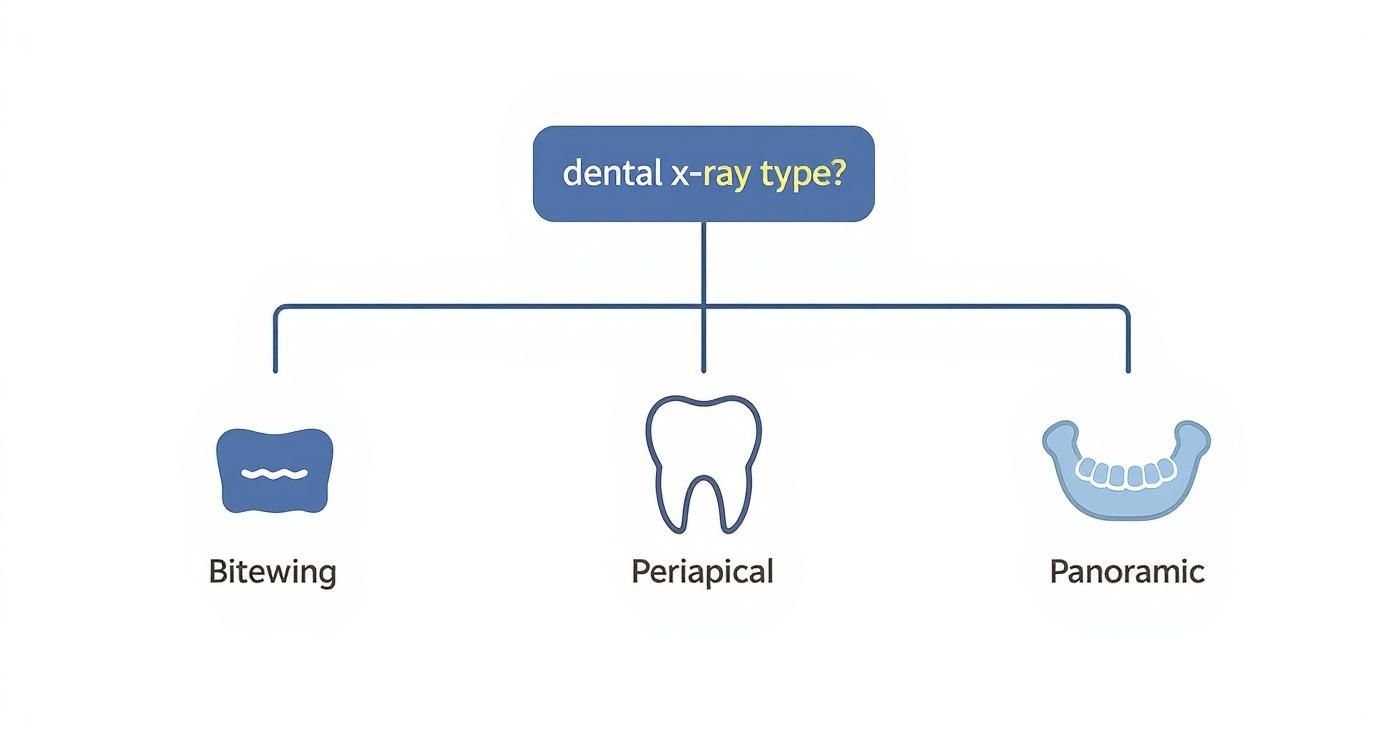
As you can see, the type of X-ray chosen directly matches the diagnostic goal, from spotting tiny cavities between your teeth to getting a big-picture view of your entire jaw.
The Truth About Dental X-Ray Safety
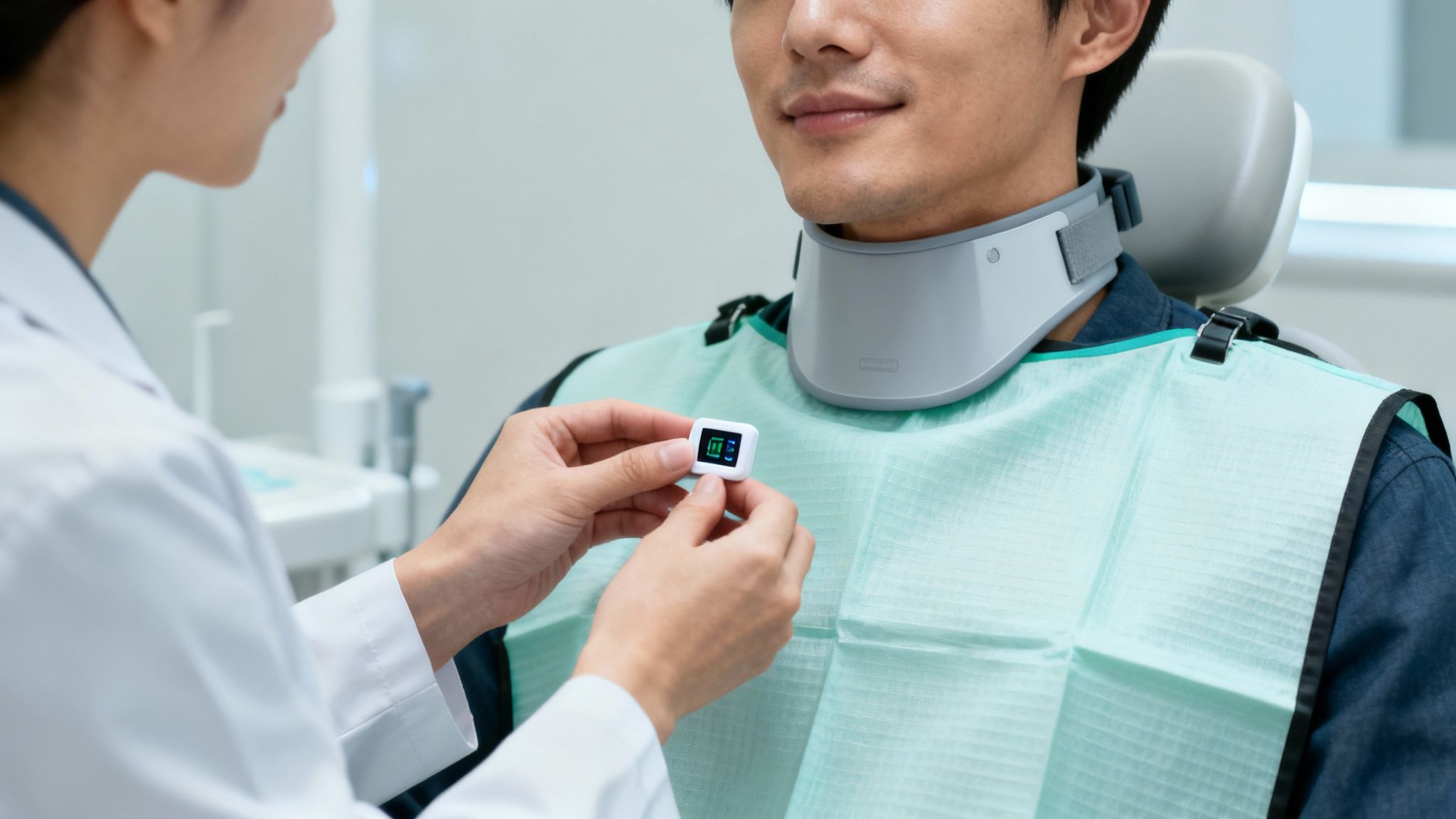
It's completely normal to have questions about radiation. The word itself can sound a bit scary, but when it comes to dental X-rays, the reality is far more reassuring than you might think. Thanks to modern technology, the process is incredibly safe, and the radiation levels are kept to an absolute minimum.
Let's put the dose into perspective. A routine set of four bitewing X-rays exposes you to about the same amount of background radiation you'd naturally get from the environment in a single day. In fact, you often receive more radiation during a short 1-2 hour airplane flight than you do from your check-up X-rays.
How We Prioritize Your Safety
Your well-being is our number one priority. We go beyond just using low-dose technology by layering in specific protective measures during every single imaging session to minimize your exposure even further.
These safety protocols are non-negotiable in our practice:
- Leaded Aprons: We always place a heavy, leaded shield over your chest and abdomen. This protects your vital organs from any scatter radiation, even though the dose is already very low to begin with.
- Thyroid Collars: Your thyroid gland is sensitive, so we use a smaller, specialized shield designed to protect your neck.
- Focused Beams: Today’s X-ray machines use a highly concentrated beam that is aimed only at the small section of your mouth we need to see. This prevents unnecessary exposure to any surrounding areas.
These simple, effective tools ensure that radiation exposure is limited strictly to where it’s needed. We take this commitment seriously, and you can learn more about all our safety protocols by reading our guide on how we ensure a safe dental visit.
The Digital Advantage
One of the biggest game-changers in dental safety has been the shift from old-school film X-rays to modern digital imaging. This single advancement has slashed radiation exposure dramatically—in some cases by up to 90% compared to the methods used just a couple of decades ago.
This isn't just a trend; it's the new standard of care, reflecting a global commitment to better, safer diagnostics.
Ultimately, the immense diagnostic benefit of finding hidden decay, infections, or bone loss early on far outweighs the minimal, well-managed risk associated with a modern dental X-ray. It’s one of the most powerful tools we have for proactive, preventive care.
The Role of X-Rays in Modern Preventive Care

It’s a common misconception that dental X-rays are just for when something hurts. But in reality, their most powerful use is in preventive care. Think of them as your dentist's secret weapon, allowing us to stay one step ahead of problems before they even start.
This proactive mindset is what modern dentistry is all about. X-rays reveal a hidden world beneath your gums and between your teeth—places the naked eye simply can't see. We can spot things like tiny cavities, the beginnings of bone loss, or an underlying infection long before you’d ever feel a thing.
Catching Problems When They Are Small
Let’s put this into perspective. Imagine the difference between finding a small spot of decay versus dealing with a full-blown, painful abscess.
- Early Detection: An X-ray catches a cavity when it’s just getting started. The fix? Usually a simple, quick, and relatively inexpensive filling.
- Delayed Detection: Without that image, the decay silently spreads. By the time pain signals something is wrong, the solution could be a root canal and a crown—a much more involved and costly process.
This simple example highlights the real value of a consistent dental x ray frequency. It's a commitment to your long-term health, and it’s a trend that’s growing. The US dental X-ray market was valued at an impressive USD 2.41 billion in 2024 and is projected to more than double by 2034. This isn't just about technology; it shows a major shift in how we all approach dental wellness, as detailed in recent market analysis.
Your Partner in Long-Term Health
At the end of the day, making routine X-rays a part of your dental care is an investment in yourself. It turns your relationship with your dentist into a true partnership, focused on stopping major issues in their tracks.
When you have open conversations about a personalized X-ray schedule, you’re taking an active role in your own health. It’s the best way to make sure your smile stays healthy and strong for years to come.
Your Top Questions About Dental X-Rays, Answered
Let's dive into some of the questions we hear most often from patients about dental X-rays. Getting clear, straightforward answers is the first step to feeling confident about your care.
Can I Just Say No to Dental X-Rays?
You absolutely can. As a patient, you always have the final say and the right to refuse any medical treatment, including X-rays. But it's really important to understand what that decision means for your health.
Think of it this way: when a dentist can't see X-rays, they're missing a huge piece of the puzzle. They can only see what's on the surface, leaving them blind to problems brewing underneath your gums or between your teeth.
Without these images, serious issues can go completely unnoticed, like:
- Cavities starting to form in those tight spaces between teeth.
- An infection brewing at the tip of a tooth's root.
- Bone loss from progressing gum disease.
- Cysts, tumors, or other abnormalities hidden in your jaw.
Skipping X-rays might mean a hidden problem grows into something much more painful, complicated, and expensive to fix down the road. Because of this, many dental offices will ask you to sign a waiver acknowledging the risks, as treating you without a full picture can be a major liability.
How Often Should My Child Get X-Rays?
This is a great question, and the answer is usually "more often than adults." A child's mouth is a whirlwind of activity—jaws are growing, baby teeth are falling out, and permanent teeth are coming in. This constant change, plus the fact that kids can be more prone to cavities, makes regular monitoring essential.
The American Dental Association (ADA) provides some solid guidelines. For kids at a high risk for cavities, they typically recommend X-rays every 6 to 12 months. If your child has a low risk of decay, spreading them out to every 12 to 24 months is often perfectly fine. These images are invaluable for making sure everything is developing correctly and for stopping cavities in their tracks.
I'm Switching Dentists. Do I Have to Get New X-Rays?
Not always! If you had X-rays taken within the last year and they are clear and high-quality, you can almost always have them sent over to your new dentist's office. It’s a great way to avoid extra radiation and save a little money.
However, don't be surprised if your new dentist still suggests taking their own set. They might need a different angle, or the old images might be too fuzzy or outdated to give them the complete diagnostic picture they need to establish a baseline for your care. The best approach is to simply have a conversation with the new dental team about what makes the most sense for you.
Figuring out the right dental x ray frequency for your unique situation is a cornerstone of great oral health. If you have more questions or you're ready to get a complete picture of your smile, the team at Serena San Diego Dentist is here to help. Contact us today to book your appointment.