
The main difference between a dentist and an oral surgeon comes down to their specific roles and the depth of their training. Your dentist is your primary oral healthcare provider—think routine checkups, cleanings, and common restorative work. An oral surgeon, on the other hand, is a surgical specialist you'll see on referral for complex procedures, like removing impacted wisdom teeth or performing corrective jaw surgery.
Your Guide To Dental Professionals In San Diego

When a dental problem pops up here in sunny San Diego, where a healthy smile is always on display, figuring out whether you need your general dentist or an oral surgeon is the first crucial step. Both are highly trained doctors, but they play very different parts in keeping your smile healthy and looking its best. The easiest way to think about it is that your general dentist is like the family doctor for your teeth—your first call for just about everything.
Your relationship with your general dentist is built over time through consistent care and routine visits. They’re focused on:
- Preventive Care: Regular cleanings, exams, and X-rays to catch issues before they become major problems.
- Restorative Treatments: Fixing common problems like cavities with fillings or repairing damaged teeth with crowns and bridges.
- Cosmetic Dentistry: Helping you love your smile with treatments like professional teeth whitening and veneers.
An oral surgeon, however, has gone through years of intense, hospital-based surgical training after finishing dental school. You usually only see an oral surgeon when your general dentist refers you for a problem that requires specialized surgical intervention. Their expertise is needed for procedures that are well beyond the scope of general dentistry. For a closer look at what they do, you can learn more about the specifics of oral surgery in our detailed guide.
The simplest way to view it is that your general dentist manages your overall and long-term oral health, while an oral surgeon addresses specific, acute surgical needs, often as a one-time procedure.
To make these distinct roles even clearer, a side-by-side comparison can be really helpful.
Dentist Vs Oral Surgeon At a Glance
This table breaks down the key distinctions between a general dentist and an oral surgeon, making it easy to see who does what.
| Aspect | General Dentist | Oral Surgeon |
|---|---|---|
| Primary Role | Primary oral healthcare provider for routine maintenance, diagnosis, and restorative work. | Surgical specialist for complex procedures involving the teeth, jaw, and facial structures. |
| Education | 4-year dental degree (DDS or DMD). | 4-year dental degree plus a 4-6 year hospital-based surgical residency. |
| Common Procedures | Cleanings, fillings, crowns, veneers, root canals, and simple extractions. | Impacted wisdom teeth removal, dental implant surgery, bone grafting, and jaw surgery. |
| Anesthesia | Primarily local anesthesia and sometimes minimal sedation (e.g., nitrous oxide). | All levels of anesthesia, including IV sedation and general anesthesia. |
As you can see, while both professionals are vital to oral health, their day-to-day work, training, and the tools they use are quite different.
How Education And Specialized Training Shape Their Expertise

The single biggest factor that separates a general dentist from an oral surgeon is the years of advanced, specialized training they complete after dental school. While both professionals start on the exact same academic path, their journeys diverge in a major way, which ultimately shapes the scope and complexity of the care they can provide.
The Shared Foundation: Dental School
Both dentists and oral surgeons begin with a bachelor's degree before moving on to four intensive years of dental school. Upon graduating, they earn either a Doctor of Dental Surgery (DDS) or a Doctor of Dental Medicine (DMD) degree. These two degrees are equivalent and certify them as doctors of oral health. At this stage, a new dentist can get their license and start practicing general dentistry.
For an aspiring oral surgeon, however, the education has really just begun.
The Demanding Path Of A Surgical Residency
To earn the title "oral and maxillofacial surgeon," a dentist must get into a highly competitive, hospital-based surgical residency. These programs are grueling, lasting an additional four to six years beyond dental school. This isn't just more classroom time; it's a full-immersion, hands-on surgical apprenticeship.
During their residency, they work side-by-side with experienced surgeons, gaining direct experience in a hospital setting. Their training involves mandatory rotations in several critical medical fields that are absolutely essential for a surgical specialist:
- Anesthesiology: This is where they become experts in administering all levels of sedation and general anesthesia—a key skill that truly sets them apart.
- General Surgery: They build foundational surgical skills by taking part in a wide variety of operations, learning techniques that they can apply to complex facial and oral procedures.
- Emergency Medicine: This rotation prepares them to handle acute trauma, serious injuries, and medical emergencies with confidence and precision.
- Internal Medicine: A deep understanding of a patient's overall health is crucial for safe surgical outcomes, especially for people with complex medical histories.
This extensive, multi-disciplinary training is what gives oral surgeons the expertise to manage intricate surgical cases, from facial trauma reconstruction to complex jaw corrections.
A Deeper Dive Into Advanced Medical Knowledge
The residency curriculum also provides in-depth knowledge of conditions that general dentists are not trained to manage surgically. Oral surgeons study oral pathology, learning to diagnose and treat cysts, tumors, and other diseases of the mouth and jaw. This dual expertise in both dentistry and medicine is a cornerstone of their profession.
The oral surgery residency is designed to create a medical specialist for the face, mouth, and jaws. It's an intense fusion of dental science and hospital-based surgical practice that far exceeds the scope of general dentistry.
For patients, this means an oral surgeon brings a hospital-level standard of care to every single procedure. Their ability to manage complications, administer advanced anesthesia, and understand the link between oral and systemic health ensures the highest level of safety. This extensive training is exactly why your general dentist here at Serena San Diego Dentist will refer you to a trusted oral surgeon for specific, complex needs.
The Final Tally: Years Of Dedication
When you look at the total time investment, the difference becomes crystal clear. A general dentist completes about eight years of higher education after high school. In stark contrast, an oral surgeon dedicates a total of 12 to 14 years to their training before they can even begin to practice.
This additional training directly translates into the different services they offer, especially when it comes to anesthesia. For a closer look at patient safety and sedation options, check out our guide on whether sedation dentistry is safe.
A Look At Dental And Surgical Procedures: Who Does What?
To really understand the difference between a dentist and an oral surgeon, you have to look at the kinds of procedures they perform every day. Your general dentist at Serena San Diego Dentist is your go-to for managing your overall oral health—think maintenance, restoration, and smile improvements. An oral surgeon, on the other hand, is the specialist you see when the problem demands a surgical solution.
The scope of their work is a direct result of their training. A general dentist's world is all about the health and appearance of your teeth and gums. They're the experts you see for regular check-ups and common dental issues.
Procedures Your General Dentist Performs
Your dentist is your first line of defense for almost all of your oral health needs. Their services are designed around prevention and restoration, making sure your smile stays healthy and looks its best for years.
This usually includes:
- Preventive Care: This is the bedrock of good oral health. It involves professional cleanings, thorough exams, and digital X-rays to catch problems before they get serious.
- Restorative Work: When a tooth is damaged by decay or an accident, your dentist steps in with fillings, root canals, dental crowns, and bridges to bring it back to full function.
- Cosmetic Dentistry: For patients in San Diego wanting to brighten their smile, dentists provide treatments like professional teeth whitening, porcelain veneers, and dental bonding.
- Simple Extractions: Dentists can pull teeth that have fully emerged from the gum and are easy to access.
Procedures Handled By An Oral Surgeon
An oral surgeon's practice is focused entirely on surgery involving the hard and soft tissues of the mouth, jaw, and face. They take on cases that are too complex for a general dentist because they require sophisticated surgical skills and often, deep sedation.
Their specialized work includes:
- Complex Extractions: The classic example is impacted wisdom teeth, which are stuck below the gum line or growing in at an awkward angle.
- Dental Implant Placement: While some general dentists place implants, oral surgeons handle all types of cases, especially tricky ones that need bone grafting to rebuild the jaw or sinus lifts.
- Corrective Jaw Surgery (Orthognathic Surgery): This procedure realigns the jaw and teeth to fix functional problems and improve facial balance.
- Oral Pathology: They diagnose and surgically remove cysts, tumors, and other diseases found in the oral and maxillofacial regions.
- Facial Trauma Repair: Oral surgeons are trained in a hospital setting to reconstruct facial bones, including fractured jaws and cheekbones.
The type of work they do also dictates the technology they use, from advanced imaging systems to specialized software for dentists that helps manage everything from patient records to complex surgical planning.
The core difference is that a dentist focuses on the health of individual teeth and gums, while an oral surgeon manages the underlying bone, nerve, and facial structures through surgical intervention.
One of the clearest distinctions comes down to complexity. General dentists handle roughly 80-90% of routine oral health needs like cleanings, crowns, and simple extractions. Oral surgeons tackle the complex surgeries that require hospital-level training. After finishing their 4-year dental degree, oral surgeons complete a 4-6 year residency. They master procedures like dental implants (which have success rates over 95% in experienced hands) and wisdom tooth removal—a procedure needed by many, as studies show impacted cases affect up to 72% of adults. You can find more details on the scope of oral surgery on enhanceoralsurgery.com.
Common Procedures Handled By Each Professional
To make the division of labor crystal clear, let's break down who typically handles what. This table gives you a side-by-side look at the common procedures you might encounter.
| Procedure Category | General Dentist | Oral Surgeon |
|---|---|---|
| Routine Care | Routine exams, cleanings, X-rays. | Does not perform routine care; only sees patients for surgical needs. |
| Restorations | Fillings, crowns, bridges, dentures. | Does not perform routine restorative work. |
| Extractions | Simple extractions of visible teeth. | Complex extractions, including impacted wisdom teeth. |
| Dental Implants | May perform simple, straightforward implant placements. | Performs all implant surgeries, especially cases needing bone grafts or sinus lifts. |
| Jaw Issues | Manages TMD with nightguards or bite adjustments. | Performs corrective jaw surgery and treats complex TMJ disorders. |
| Cosmetic Work | Veneers, teeth whitening, bonding. | May perform cosmetic surgery on the jawline or chin as part of reconstructive work. |
As you can see, your dentist is your partner for long-term health, while an oral surgeon is the expert you need for specific, high-level surgical interventions.
When To See A Dentist Versus An Oral Surgeon
Trying to decide between your dentist and an oral surgeon can be a real head-scratcher. But there’s a simple rule that clears things up almost every time: always start with your general dentist. Think of them as the primary care doctor for your mouth—your go-to professional for pretty much any oral health issue.
Your journey to a healthy smile in San Diego always kicks off at your general dentist's office. The most common reasons people need dental care fall right into their wheelhouse.
Scenarios For Your General Dentist
You’ll want to book an appointment with your dentist for any of these common situations:
- Routine Maintenance: Those essential 6-month check-ups, professional cleanings, and regular X-rays.
- Common Pain or Problems: A nagging toothache, sensitivity to hot or cold, or if you think you might have a cavity.
- Restorative Needs: A chipped or cracked tooth that needs a filling, bonding, or a dental crown.
- Cosmetic Enhancements: If you’re curious about professional teeth whitening, porcelain veneers, or other smile makeovers.
- Gum Health Concerns: Bleeding gums, early signs of gingivitis, or needing a deep cleaning (scaling and root planing).
Here at Serena San Diego Dentist, we handle all these aspects of your oral health. Our team is fully equipped to diagnose and treat the vast majority of dental issues you'll ever encounter.
This simple decision tree helps visualize who you should see and when.
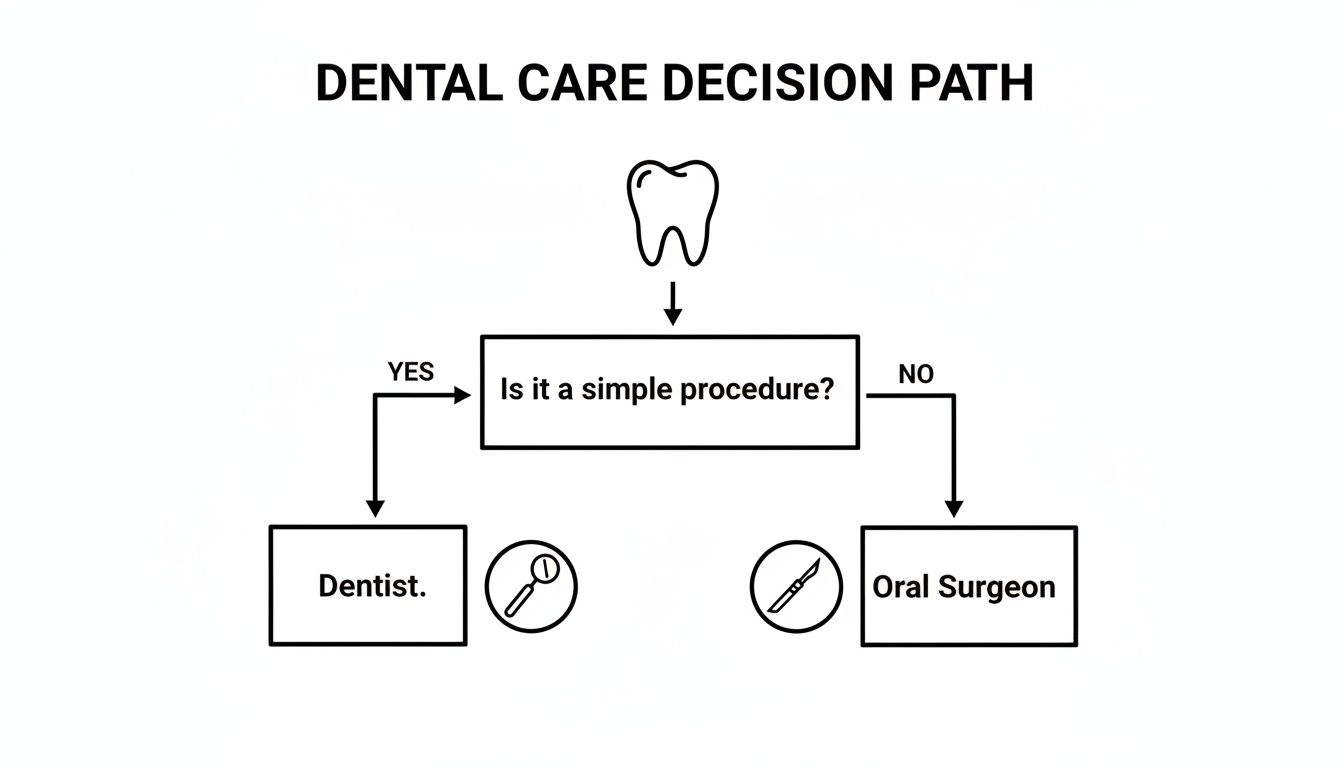
As the flowchart shows, your general dentist is your starting point. They'll only direct you to a specialist when complex surgical intervention is truly necessary.
The Referral Process: A Bridge To Specialized Care
So, when exactly does an oral surgeon get involved? Almost always, the need for a surgical specialist is flagged by your general dentist during an exam. This is where the collaborative side of dental care really comes into play.
If your dentist finds a condition that requires surgical skills beyond the scope of general dentistry, they will give you a referral to an oral surgeon they trust. This ensures you get a smooth transition of care and that you're seeing the most qualified professional for your specific problem.
Your general dentist is essentially your oral health quarterback. They diagnose the issue, map out the best treatment plan, and when needed, pass the ball to a surgical specialist to ensure you get consistent, high-quality care every step of the way.
The training commitment alone highlights the difference. A general dentist typically invests 8 years after high school (4 in undergrad, 4 in dental school). An oral surgeon, on the other hand, puts in 12 to 14 years, adding a grueling 4-6 year hospital-based surgical residency after dental school. This specialized path is incredibly competitive—top programs often have acceptance rates below 10%—and involves extensive training in complex procedures and anesthesia.
Scenarios Requiring An Oral Surgeon
Your dentist will refer you to an oral surgeon for more complex issues, such as:
- Impacted Wisdom Teeth: When wisdom teeth are stuck under the gum line or growing in at a bad angle, an oral surgeon is the expert you need for a safe removal.
- Complex Dental Implant Surgery: If a case involves major bone loss that requires a bone graft or sinus lift before an implant can be placed, it's a job for a surgeon.
- Corrective Jaw Surgery (Orthognathic Surgery): This procedure corrects skeletal jaw misalignments that impact your bite, function, and facial appearance.
- Facial Trauma: Injuries like a fractured jaw or broken cheekbones demand the reconstructive skills of an oral and maxillofacial surgeon.
- Oral Pathology: Diagnosing and surgically removing cysts, tumors, or other suspicious growths in the mouth or jaw.
Understanding this referral process is crucial, especially for common procedures like extractions. You can learn more about the specifics of wisdom teeth removal in our detailed guide. By starting with your dentist, you can be confident you're on the right path to the right treatment, right from the start.
Your Partner In Comprehensive Oral Health In San Diego
Navigating your dental care journey is so much easier when you have a trusted guide. At Serena San Diego Dentist, we see ourselves as your central hub for oral health, serving our neighbors in San Diego, Clairemont Mesa, and La Jolla. Think of us as your first call for almost any dental concern you might have.
For the vast majority of your care—from the essential preventive check-ups that keep you healthy to smile-defining cosmetic treatments—our skilled team has you covered. We've built our practice around providing a complete suite of high-quality services right here under one roof.
Your First Choice for Dental Excellence
Our entire practice is set up to manage every detail of your smile's health and beauty. You can always count on our team for:
- General and Restorative Dentistry: We handle everything from routine fillings and cleanings to more complex work like custom-fit dental crowns and bridges.
- Cosmetic Services: We really shine when it comes to cosmetic dentistry, helping our patients achieve their ideal look with professional teeth whitening and beautifully crafted porcelain veneers.
- Initial Diagnostics: Every great treatment plan starts with a solid diagnosis. We're your starting point for any oral health issue, conducting thorough exams to get to the root of the problem.
We believe in building real, lasting relationships with our patients and guiding them every step of the way. You can find more advice on this in our guide on how to choose the right dentist for your needs.
Think of our clinic as your home base for dental care. We manage your long-term health and aesthetics, ensuring you only see a specialist when it's absolutely necessary.
Seamless Referrals When Specialized Care Is Needed
Our commitment to your well-being means knowing when a specialist’s touch is required. While we manage a very wide range of dental procedures in-house, we also recognize the critical role of surgical expertise.
If a situation calls for it—like a deeply impacted wisdom tooth or a complex bone graft—we make sure your transition to a specialist is completely seamless. We have a trusted network of local oral surgeons we work with, and we'll facilitate a smooth referral to one of them. This collaborative approach guarantees you receive the highest standard of care without any gaps, and our team will coordinate the entire process for you. For any practice, being visible to new patients is crucial. To ensure new patients can easily find your practice online and understand the specialized services you offer, exploring strategies like this guide to Local SEO for Medical Practices can be highly beneficial.
Payment and Accessibility
We believe that everyone deserves access to top-tier dental care. Serena San Diego Dentist accepts most major insurance plans for covered services and offers flexible out-of-pocket payment options, including financing plans. Our team is happy to work with you to maximize your benefits and find a payment solution that fits your budget. We are committed to providing affordable, high-quality care without quoting specific prices online, so please contact us for a personalized estimate.
What is the difference between a dentist and an oral surgeon?
Let's clear up some of the most common questions people have when navigating dental care. These answers should give you the clarity you need to feel confident about your next steps.
Can A General Dentist Pull A Tooth?
Yes, absolutely. Simple tooth extractions are a routine part of general dentistry. If a tooth is fully erupted (meaning, you can see the whole thing) and doesn't present any unusual complications, your family dentist is typically the right person for the job.
The game changes, however, when things get complicated. Think impacted wisdom teeth buried in the jawbone, a tooth that has broken off at the gum line, or one that's sitting dangerously close to major nerves. For those situations, a referral to an oral surgeon is the standard of care. Their specialized surgical training and anesthesia certifications are crucial for handling these complex cases safely, minimizing risk, and setting you up for a smoother recovery.
Do I Need A Referral To See An Oral Surgeon?
In almost all cases, yes, and it's for your own benefit. Most dental insurance plans, especially PPOs and HMOs, won't cover a specialist's services without an official referral from your general dentist.
Think of your general dentist as your primary care provider for your mouth. It's always best to start there. They'll properly diagnose the problem, confirm if you actually need a specialist, and forward all your relevant history and X-rays to the surgeon. At Serena San Diego Dentist, we manage this referral process from start to finish for our patients. This creates a seamless transition to a trusted surgical specialist we know and work with, ensuring everyone is on the same page about your care.
Who Is Better For Dental Implants: A Dentist Or An Oral Surgeon?
This is a great question, and the answer truly depends on your specific situation. Both highly trained general dentists and oral surgeons can place dental implants successfully. The key is matching the practitioner's skill set to the complexity of the case.
If you have a healthy, robust jawbone and the implant placement is straightforward, a qualified general dentist can achieve fantastic results. They are well-equipped to manage cases without any major hurdles.
But when challenges pop up, an oral surgeon is the expert you want. If you've experienced significant bone loss and need a bone graft, require a sinus lift in your upper jaw, or if the implant needs to be placed near sensitive nerves, an oral surgeon's deep surgical expertise becomes essential. Their years of residency training are focused entirely on mastering these intricate procedures to ensure the long-term success of your implant.
Ultimately, your general dentist will be the one to assess your jawbone and anatomy and recommend the right professional for your implant surgery.
What Kind Of Anesthesia Can An Oral Surgeon Use?
This is one of the biggest differentiators between the two. The ability to manage patient comfort and anxiety is critical, and oral surgeons are certified to provide a full spectrum of sedation and anesthesia in their offices. Worried about pain during a procedure? Here's what to expect.
Their toolkit includes:
- Local Anesthetic: To numb the immediate area.
- Nitrous Oxide: Also known as "laughing gas," for light relaxation.
- IV Sedation: Often called "twilight sleep," this puts you in a deeply relaxed state where you're still technically conscious but won't remember much, if anything, about the procedure.
- General Anesthesia: This renders you completely unconscious, just like in a hospital setting.
This wide range of options allows them to perform long, complex, or potentially stressful surgeries while keeping patients completely comfortable. General dentists are typically limited to local anesthetic and sometimes nitrous oxide, depending on their individual training and state regulations.
Is An Oral Surgeon More Expensive Than A Dentist?
The price of a procedure is tied to its complexity, not the provider's title. That said, because oral surgeons exclusively handle complex surgical cases, their services naturally tend to cost more than the routine care you get from a general dentist.
A simple extraction by your dentist, for instance, will cost significantly less than a surgical extraction of an impacted wisdom tooth by an oral surgeon. The surgical procedure simply requires more time, specialized equipment, a higher level of skill, and often deeper sedation—all factors that contribute to the final cost.
The good news is that many procedures performed by oral surgeons are considered medically necessary, so your dental insurance will often cover a portion of the cost. The best advice is to always get a detailed cost estimate from the surgeon's office and check with your insurance provider before moving forward.
Can I See An Oral Surgeon For A Second Opinion?
You certainly can, and you should! Getting a second opinion is a smart move, especially if you're facing a complex diagnosis or an expensive treatment plan. You deserve to feel 100% confident in the path you choose for your health.
While you'll likely need to get a referral to ensure your insurance covers the consultation, you are well within your rights to have a specialist review your case. An oral surgeon can either confirm the initial diagnosis or maybe even offer a different perspective or alternative treatment you hadn't considered. It's all about empowering you to make the best possible decision.
At Serena San Diego Dentist, your long-term oral health is our top priority. Whether you need dedicated routine care, a complete cosmetic smile makeover, or a trusted referral for specialized surgical treatment, our team is here to guide you with genuine expertise and compassion. Ready to enhance your smile? Schedule your consultation today to experience premium dental care in San Diego.