Have you ever had a cavity that seemed too big for a regular filling, but getting a full crown felt like a bit much? That's the exact situation where dental inlays and onlays shine. They're the perfect "in-between" solution.
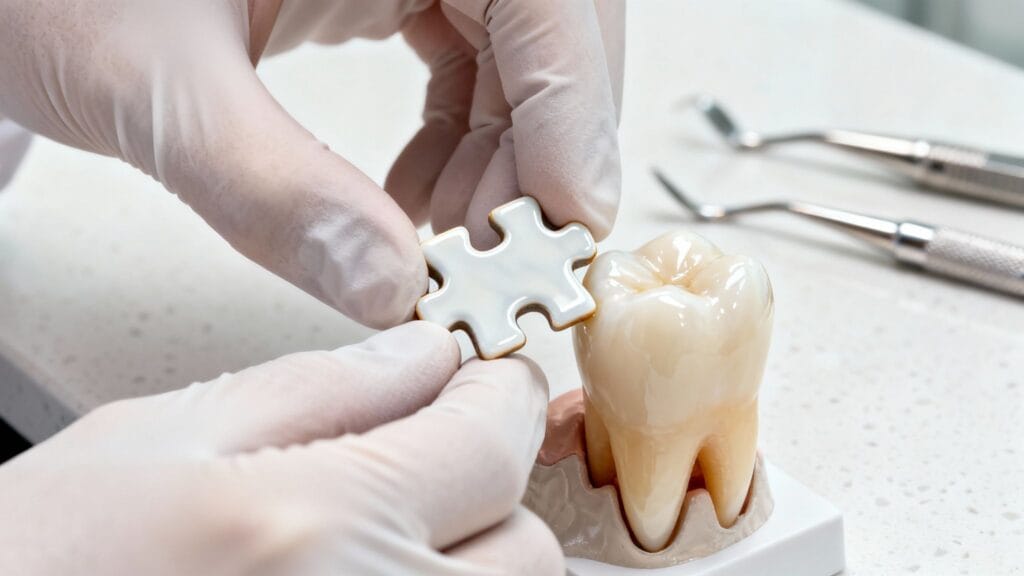
Think of them less like a simple patch and more like a custom-crafted puzzle piece, milled to fit your tooth with absolute precision. This approach restores your tooth's strength and natural look in a way that other restorations can't quite match. In sunny San Diego, where smiles are always on display, understanding these modern options is key to maintaining your confidence.
When Is the Damage "Just Right" for Inlays and Onlays?
Choosing the right way to fix a damaged or decayed tooth is a big deal for its long-term health. Small cavities? A standard filling often does the trick. But for larger areas of damage, fillings can sometimes fall short on strength.
On the flip side, a dental crown is a fantastic restoration, but it requires removing a significant amount of healthy tooth structure to make it fit. This is where inlays and onlays come in—they bridge that gap perfectly.
We often call them "indirect fillings" for a simple reason. Unlike a normal filling that's shaped directly in your mouth during your appointment, inlays and onlays are created outside of the mouth, usually in a high-tech dental lab or with our in-office CEREC technology. This two-step process allows us to use much stronger, more durable materials and results in a flawless fit that does a better job of sealing out future decay.
Keeping Your Natural Tooth Intact
One of the best things about this treatment is how conservative it is. Our goal is always, always to save as much of your healthy, natural tooth as possible.
- An inlay is crafted to fit neatly within the cusps (the little pointed bumps on top of your molar).
- An onlay, sometimes called a partial crown, is a bit larger and is designed to cover one or more of those cusps. It adds more structural support without having to shave down the entire tooth for a full crown.
Believe it or not, this method can increase a tooth's strength by up to 75%, bringing back its integrity while removing only the damaged or decayed portions.
To give you a clearer picture, let's break down the key differences in a simple table.
Inlays vs Onlays At a Glance
| Feature | Dental Inlay | Dental Onlay |
|---|---|---|
| Placement | Fits within the cusps on the tooth's chewing surface. | Covers one or more of the tooth's cusps. |
| Size | Smaller, used for more contained areas of decay. | Larger, used for more extensive damage. |
| Common Analogy | A custom puzzle piece for the center of the tooth. | A partial crown or a "cap" for the top of the tooth. |
| Purpose | To restore the central chewing surface. | To restore the chewing surface and protect weakened cusps. |
As you can see, the choice really comes down to the size and location of the damage. Both options, however, share the same incredible benefits of strength and conservation.
Think of it this way: an inlay or onlay doesn't just sit on your tooth; it becomes part of your tooth. It’s bonded seamlessly into place, reinforcing the tooth's structure from the inside out, making it a far superior choice for both function and a beautiful, natural look.
These custom restorations are a cornerstone of modern dental care, offering a durable and visually appealing alternative to older methods. They are a key part of what we do in restorative dentistry to keep your smile healthy and strong.
You can learn more about the five procedures you can get with restorative dentistry right here on our blog. Here in San Diego, where a healthy, confident smile is part of the lifestyle, understanding your options is the first step toward making the best decision for your oral health.
Comparing Your Dental Restoration Options
When a tooth is damaged, your dentist might start throwing around terms like fillings, crowns, inlays, and onlays. It can feel like you need a translator just to understand what's happening. The good news is, it's not as complicated as it sounds once you understand the role each one plays in getting your smile back to health.
Think of it like repairing a damaged road. A standard filling is like a quick patch for a small pothole—it gets the job done for minor issues. On the other end of the scale, a full dental crown is like completely repaving a large, crumbling section of the road. It’s a heavy-duty solution for major damage, but it's also a more involved process.
So, what about inlays and onlays?
Inlays And Onlays: The Custom-Fit Solution
Inlays and onlays are the middle ground—the sweet spot between a simple filling and a full crown. They act like precision-milled puzzle pieces designed to fit perfectly into the damaged area of your tooth, restoring its strength without altering the healthy parts.
They're stronger and more durable than a filling but far less invasive than a crown. It’s a modern approach that prioritizes preserving as much of your natural tooth as possible.
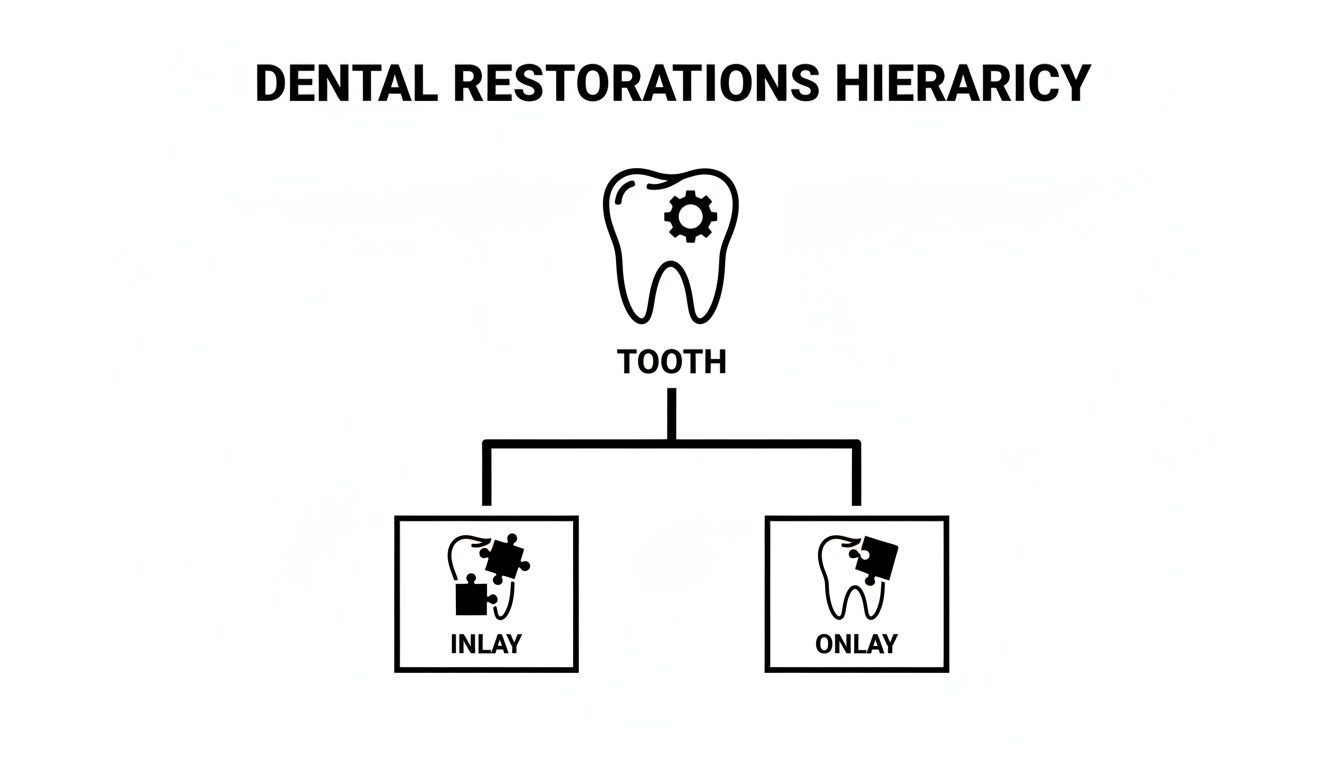
This diagram helps visualize how inlays and onlays are crafted to integrate with your tooth, not just cover it up. They are a conservative, custom-fit option.
How Do They Actually Compare?
The real difference between these treatments comes down to how much healthy tooth structure we can save.
- Fillings: These are perfect for smaller cavities. We simply clean out the decay and pack the filling material directly into the tooth.
- Inlays and Onlays: They are the go-to for moderate to large decay or cracks that have weakened the tooth but don't yet need a full crown. In fact, they can increase a tooth's strength by up to 75%.
- Crowns: A crown becomes necessary when a tooth is severely damaged. It covers the entire visible part of the tooth, which you can learn more about by reading the dental crown procedure steps.
To make it even clearer, this table breaks down how each restoration stacks up against the others.
How Dental Restorations Compare
| Restoration Type | Best For | Tooth Preservation | Typical Lifespan | Materials |
|---|---|---|---|---|
| Filling | Small to moderate cavities. | Good. Only the decayed area is removed. | 5-15 years | Composite resin, amalgam, gold. |
| Inlay | Moderate decay that doesn't involve the tooth's cusps. | Excellent. Maximally preserves healthy tooth structure. | 15-30 years | Porcelain, ceramic, gold, composite. |
| Onlay | Larger decay that extends over one or more tooth cusps. | Excellent. A conservative alternative to a crown. | 15-30 years | Porcelain, ceramic, gold, composite. |
| Crown | Extensive decay, cracks, or after a root canal. | Least. Requires reshaping the entire tooth. | 10-20 years | Porcelain, ceramic, metal alloys, gold. |
Each option has its place, but the goal is always to choose the most conservative treatment that will provide a durable, long-lasting result.
The biggest win with inlays and onlays is their ability to preserve your natural tooth. By bonding a custom-milled piece to the damaged area, we maintain the tooth's long-term integrity.
Here at Serena San Diego Dentist, we guide patients from Clairemont Mesa, La Jolla, and all over San Diego to find the right fit for their unique situation. An inlay or onlay often delivers the best of both worlds: the strength of a crown and the conservative nature of a filling.
The Inlay and Onlay Procedure From Start to Finish
Knowing what to expect can take all the stress out of a dental visit. Here at Serena San Diego Dentist, we make a point of walking you through every step, so you feel comfortable and in control. The entire process for getting an inlay or onlay is incredibly precise, efficient, and designed around you.
It all starts with a simple consultation. We'll take a close look at the tooth, get some clear digital X-rays, and make sure that an inlay or onlay is truly the best way to get your tooth back to full strength and health.
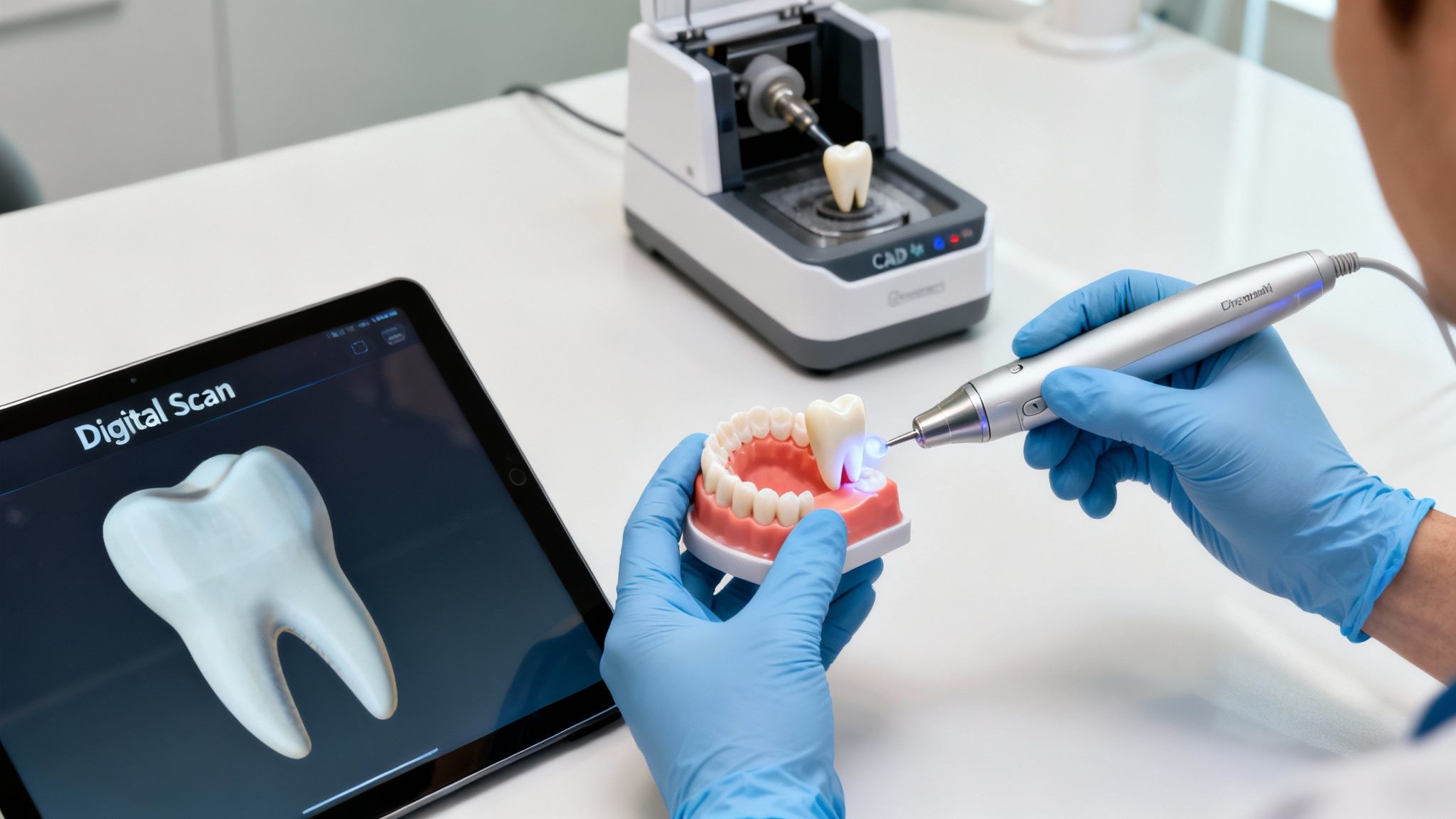
Step 1: Prepping the Tooth and Taking a Digital Scan
First things first, we completely numb the area so you won't feel a thing. Then, we gently clear out any decay or old filling material, carefully shaping the tooth so it's perfectly prepared to hold the new restoration.
Once the tooth is ready, we bring out our intraoral scanner. This amazing little wand takes a highly accurate 3D digital impression of your tooth. Say goodbye to the goopy, uncomfortable putty molds of the past! This modern tech is not only more pleasant, but it also gives us a far more precise model to work from.
Step 2: Designing and Milling Your Custom Restoration
This is where the magic really happens. We use advanced CAD/CAM (Computer-Aided Design/Computer-Aided Manufacturing) software to design your inlay or onlay right on a computer screen. We can meticulously fine-tune the shape and contours to guarantee a perfect fit that feels completely natural when you bite down.
For most of our patients, we can do all of this in a single visit. Our in-office milling machine takes the digital design and carves your permanent porcelain inlay or onlay from a solid ceramic block while you relax. It's the same incredible technology we use for our same-day CEREC crowns, making high-quality dental work fit easily into your busy schedule.
If you've chosen a different material like gold, or if your case is particularly complex, we'll send the digital scan to our trusted local lab. In that situation, we'll place a temporary restoration to keep your tooth protected while your permanent one is being made.
Step 3: Bonding the Final Restoration
Whether it's the same day or a second visit, the final step is placing your beautiful new restoration. We'll set the inlay or onlay onto your tooth and double-check the fit, feel, and color, making tiny adjustments until it's absolutely perfect.
Finally, we bond the restoration to your tooth with a powerful dental adhesive. Once it’s securely in place, we give it a final polish until it blends so seamlessly you won't be able to tell where your tooth ends and the restoration begins. You'll walk out of our San Diego clinic with a tooth that’s not just strong and functional, but looks fantastic, too.
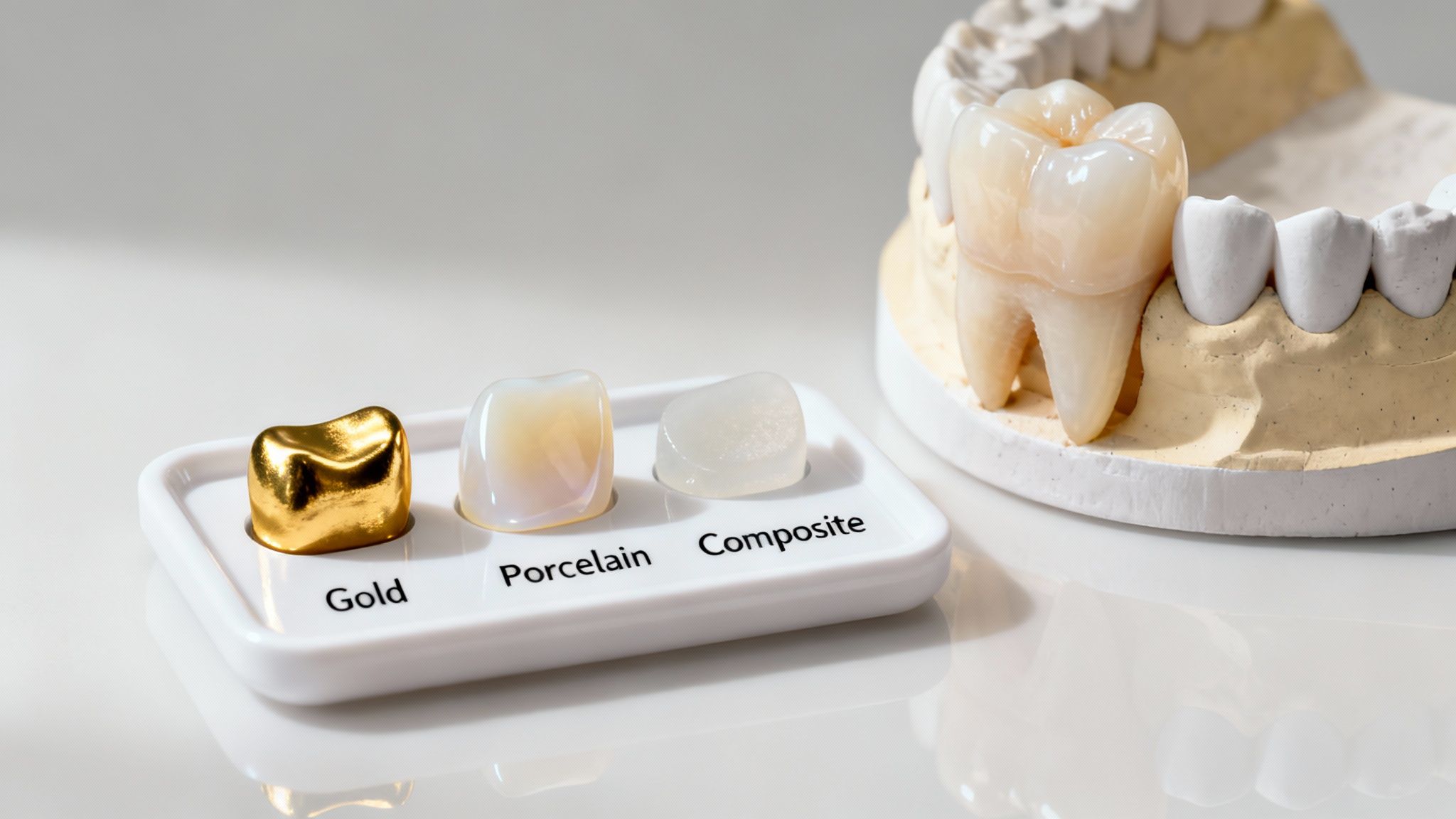
Understanding Your Material Choices: From Gold to Ceramic
The material used for your inlay or onlay plays a huge role in how it looks, feels, and how long it lasts. Think of it like choosing countertops for your kitchen—you need something that's not only beautiful but also tough enough to handle daily wear and tear. Here at our San Diego clinic, we'll walk you through the options to find the perfect fit based on the tooth's location, your bite, and what you want your smile to look like.
Each material brings something different to the table, and knowing the pros and cons is the key to making a choice you'll be happy with for years to come.
Porcelain or Ceramic: The Aesthetic Champion
For our patients in San Diego who want a restoration that blends in perfectly, porcelain (or ceramic) is the clear winner. This material is a master of disguise, mimicking the look and feel of natural tooth enamel so well that it's nearly impossible to spot.
- Flawless Appearance: We can color-match porcelain to your exact tooth shade, making the restoration virtually invisible. It just looks like your tooth.
- Stain Resistance: Unlike natural teeth, porcelain is highly resistant to staining from coffee, tea, and red wine, which helps keep your smile consistently bright.
- Excellent Strength: Don't let its delicate appearance fool you. Modern ceramics are incredibly strong and bond directly to the tooth, which actually helps reinforce its structure.
Because of these amazing qualities, porcelain is almost always the go-to choice for teeth that show when you smile.
Gold: The Durability Powerhouse
You don't see it as much these days for cosmetic reasons, but gold is still the undisputed champion of durability. Its strength is legendary in dentistry, making it a fantastic choice for molars way in the back of the mouth that take a pounding from chewing.
Gold is also exceptionally kind to the teeth it bites against, wearing down at a rate very similar to natural enamel. This means it won't grind down the opposing tooth over time. It’s a true workhorse material that can easily last for decades.
Composite Resin: The Versatile Alternative
Composite resin is the same tooth-colored material often used for fillings. It offers a more budget-friendly alternative to porcelain while still looking great. It bonds directly to the tooth, allowing us to be more conservative and preserve more of your natural tooth structure.
While it's not quite as durable or stain-resistant as porcelain, composite is an excellent choice for smaller restorations or when cost is a major factor.
The evolution in materials has been a game-changer, transforming inlays and onlays from simple gold fillings into modern ceramic works of art that are strong, beautiful, and biocompatible. At Serena San Diego Dentist, our specialists in Clairemont Mesa use top-tier materials like zirconia to create restorations that are indistinguishable from natural teeth, delivering the world-class results our La Jolla patients expect. You can explore the latest industry insights on dental materials to see just how far the technology has advanced.
The Real Benefits of Inlays and Onlays
So, why would you choose an inlay or onlay when you could get a regular filling or even a full crown? It really comes down to a powerful combination of strength, preserving your natural tooth, and getting a great look. These aren't just simple patches; they are custom-made solutions that offer some serious long-term benefits for your smile.
For our patients here in San Diego, this is about investing in a fix that supports your active, confident lifestyle. Inlays and onlays are a fantastic, health-first way to get your tooth back in action and looking its best.
Unpacking the Key Advantages
When you go with an inlay or onlay, you're choosing a treatment that really shines in a few critical areas. These benefits all work together to give you a better, more lasting result.
- Superior Longevity and Durability: Inlays and onlays are crafted from tough materials like porcelain or gold, so they’re built to last. They can handle chewing forces much better than a large filling and often hold up for 15 years or more with good care.
- Preservation of Healthy Tooth Structure: This might be the biggest win. A crown requires shaving down a significant amount of your natural tooth, but an inlay or onlay only replaces the part that's damaged. This conservative approach means we can preserve up to 70% more of your healthy tooth.
- Strengthens the Tooth: Because it's bonded directly to the tooth, an inlay or onlay can actually increase its structural integrity by up to 75%. This is huge for preventing fractures down the road, which is a common problem with big, old fillings.
- A Tighter, More Protective Seal: Since they're custom-milled in a lab to fit your tooth perfectly, the seal you get is incredibly precise. This creates a much better barrier against bacteria, helping to stop future decay from sneaking in around the edges of the restoration.
The numbers speak for themselves. Long-term studies show that ceramic onlays have a 98% survival rate at 5 years and an impressive 90% at 10 years, easily outperforming fillings. For our local patients, this means you're getting a reliable, beautiful solution right here at our clinic. You can learn more about the rise of these advanced restorations from industry reports.
Is This Right for You? Cost, Candidacy, and Insurance Explained
Let's get down to what really matters. Is an inlay or onlay the right choice for your tooth, and what does the investment look like?
Think of it this way: an inlay or onlay is the perfect "middle ground" restoration. It’s for a tooth that has too much damage for a simple filling to handle but isn't so far gone that it needs the full-scale commitment of a dental crown.
Who Is an Ideal Candidate?
You might be a perfect candidate for an inlay or onlay if any of these situations sound familiar:
- You have a large, old filling that's giving up. Metal amalgam fillings don't last forever. When they start to fail, a custom-milled inlay can replace them and add serious strength back to the tooth.
- Your tooth is cracked or fractured. If a cusp has fractured but the rest of the tooth is still in good shape, an onlay is a brilliant way to protect it from more damage without having to grind the whole tooth down.
- You have a really big cavity. Sometimes, a cavity is just too large for a standard filling to provide the support your tooth needs for the long haul. An inlay offers a much more durable, long-lasting fix.
Your Payment Options and Insurance Accessibility
It's true that the initial cost for an inlay or onlay is higher than a typical filling, but it’s crucial to look at the long-term value. This is a durable, precision-crafted restoration designed to last for years, often decades. At Serena San Diego Dentist, we believe world-class care should be accessible. We accept most major PPO insurance plans for covered services and provide flexible out-of-pocket payment options to fit your budget. For more details on financing, just ask our friendly team.
This focus on preserving as much of your natural tooth as possible with strong, long-lasting materials is a huge part of modern dentistry. Patients and dentists alike are choosing these restorations because they often prevent the need for more extensive—and expensive—work down the road. You can learn more about the global shift toward inlays and onlays to see why this trend is picking up so much steam.
Here’s the great news: Since inlays and onlays are restorative procedures (not just cosmetic), many dental insurance plans—especially PPO plans—cover a good portion of the cost.
At Serena San Diego Dentist, we're pros at this. We help our patients from all over, from Clairemont Mesa to La Jolla, figure out their insurance so there are no surprises. Our team will verify your coverage and walk you through everything.
For a deeper dive, check out our guide on navigating dental insurance in San Diego. We also have flexible payment options available to make sure this top-tier care works for your budget.
Got Questions? We've Got Answers
Even with all this information, you probably still have a few questions floating around. That’s completely normal. We’ve put together a list of the most common questions we hear from our patients right here in our San Diego office to give you some clear, no-nonsense answers.
We want you to feel 100% confident in your dental health decisions. So, let's get into the details.
How Long Do Inlays and Onlays Last?
Here’s the great news: with good care, these restorations are built to last. You can realistically expect an inlay or onlay to serve you well for 10 to 15 years, and often much longer. That's a huge step up in durability compared to a standard filling.
Of course, a few things factor into their lifespan. The material we choose plays a big role (gold and porcelain are the champions of longevity), as does your own commitment to oral hygiene. The amount of bite force on that tooth and keeping up with regular check-ups at our San Diego clinic are also key to making them last.
Is Getting an Inlay or Onlay Painful?
Your comfort is everything to us. The entire process of preparing the tooth is done under local anesthesia, which means you won't feel any pain during the appointment. We make sure the area is completely numb before we begin. Worried about discomfort? We’ll explain every step so you feel relaxed and informed.
Once the anesthetic wears off, it’s common to feel some minor sensitivity for a day or two as the tooth settles down. This is perfectly normal and easily managed with over-the-counter pain relievers. We'll send you home with simple aftercare instructions to make sure your recovery is as quick and comfortable as possible.
How Do I Take Care of My New Restoration?
This is the easy part—you care for an inlay or onlay the same way you care for your natural teeth. There are no special tricks, just solid daily habits.
- Brush twice a day using a soft-bristled toothbrush.
- Floss every day, making sure to gently clean around the edges of the restoration.
- Keep your regular cleaning and check-up appointments so we can keep an eye on things.
Also, try to avoid chewing on super-hard things like ice or pen caps. That’s good advice for all your teeth, and it will definitely help your new restoration go the distance.
Can I Whiten My Inlay or Onlay?
This is a fantastic question. The materials we use for inlays and onlays, like porcelain or composite resin, won't change color with teeth whitening gels. They're crafted to match your tooth shade at the time they are made and are very resistant to staining.
If you're thinking about brightening your smile, the best time to do it is before we place your final inlay or onlay. That way, we can create a restoration that perfectly matches your new, whiter shade for a seamless look.
For dental professionals offering advanced restorations like inlays and onlays, effectively communicating treatment information to prospective patients is crucial. Learn more about effective dental practice website design to enhance patient engagement.
Ready to enhance your smile with a custom-fit inlay or onlay? At Serena San Diego Dentist, we combine advanced technology with personalized, expert care to deliver exceptional results. Schedule a free consultation with our team today! You can call us or visit https://serenasandiegodentist.com to book your appointment and learn how we make advanced dental care affordable.