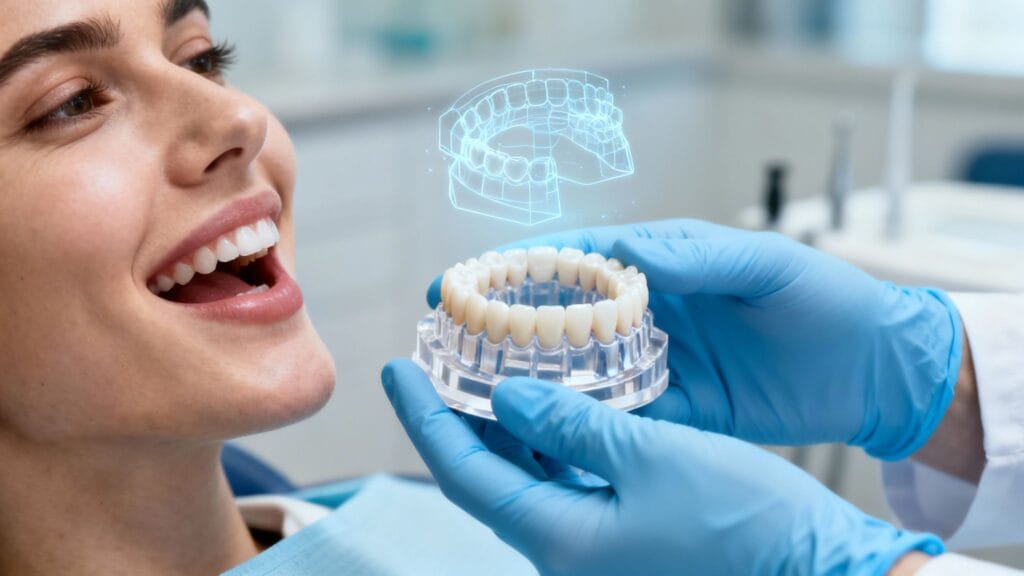
When you hear the term "full mouth reconstruction," it's easy to picture a purely cosmetic procedure. But it's so much more than that. This is a comprehensive, medically necessary process designed to rebuild or simultaneously restore all the teeth in both your upper and lower jaws.
Unlike cosmetic treatments that focus solely on aesthetics, a full mouth reconstruction tackles severe functional problems—think widespread decay, significant tooth wear, damage from trauma, or chronic jaw pain.
A Blueprint for Restoring Your Oral Health
Think of it like renovating a house with serious structural issues. If the foundation is cracked and the wiring is shot, a fresh coat of paint won’t fix the deep-seated problems. It’s the same with your mouth. When multiple issues compromise your oral health, a series of isolated fixes just won't cut it.
A full mouth reconstruction strategically combines various restorative and cosmetic dentistry procedures to get to the root of the problem. The main goal is to build a strong, healthy, and stable foundation for your bite. This not only resolves pain but dramatically improves your ability to eat and speak with total confidence.
Of course, a beautiful smile is a fantastic result of the process, but the core focus is always on restoring your mouth to optimal health and function. To get a better idea of the building blocks, you can explore our guide on the five key procedures in restorative dentistry.
It's common to confuse a full mouth reconstruction with a cosmetic smile makeover, but they are fundamentally different. The table below breaks down the key distinctions.
Full Mouth Reconstruction vs Cosmetic Smile Makeover
This table clarifies the crucial differences between a full mouth reconstruction and a cosmetic smile makeover, helping you understand the distinct goals of each approach.
| Aspect | Full Mouth Reconstruction | Cosmetic Smile Makeover |
|---|---|---|
| Primary Goal | Restore oral health, function, and structure. | Enhance the aesthetic appearance of the smile. |
| Medical Necessity | Medically necessary to address pain, decay, or trauma. | Elective; chosen by the patient for cosmetic reasons. |
| Focus | Function, bite alignment, and structural integrity. | Color, shape, size, and alignment of visible teeth. |
| Procedures | Implants, crowns, bridges, gum therapy, orthodontics. | Veneers, teeth whitening, bonding, gum contouring. |
| Driver | Health-driven. | Aesthetics-driven. |
While there can be some overlap in the procedures used, the "why" behind the treatment is what truly sets them apart. Reconstruction is about need; a makeover is about want.
What Does Reconstruction Involve?
Because every mouth is unique, a full mouth reconstruction is a highly personalized treatment plan. It’s a carefully sequenced journey, not a one-day fix, that combines multiple procedures to achieve a final, stable, and healthy result.
A typical plan might include:
- Restoring Damaged Teeth: Rebuilding worn or broken teeth with durable dental crowns, bridges, or veneers.
- Replacing Missing Teeth: Using dental implants to provide permanent, sturdy new teeth that function like natural ones.
- Addressing Gum Health: Treating gum disease with periodontal therapy to ensure the foundation is healthy and strong.
- Correcting Bite Alignment: Carefully adjusting how the upper and lower teeth meet to prevent future wear and relieve jaw strain.
The ultimate objective is to bring harmony back to your entire oral system—your teeth, gums, and jaw. This is why it’s considered a medical necessity for patients whose smiles have been compromised by severe decay, physical trauma, or chronic health conditions.
Could You Be a Candidate for This Procedure?
Ever wonder if a full mouth reconstruction is what you really need? This isn't for a single chipped tooth or a little bit of staining. We're talking about a comprehensive solution for people whose oral health has been seriously impacted by several problems all happening at once.
This is the path we take when the entire system—your teeth, gums, and bite—needs a complete reset to get back to a healthy, functional state. Let’s look at some real-life situations where a full mouth reconstruction isn't just cosmetic, but a true medical necessity.
When Patchwork Fixes Are No Longer Enough
Sometimes, dental problems create a domino effect. One issue triggers another, and before you know it, your whole mouth is unstable. For people in this situation, fixing one tooth at a time is like trying to patch a leaky roof in the middle of a hurricane—it just won’t hold up.
Here are some common scenarios that point toward a full mouth reconstruction:
- Extensive Tooth Wear from Grinding (Bruxism): Years of clenching and grinding can wear teeth right down to the nubs. This can cause your bite to collapse, leading to jaw pain and major sensitivity. The reconstruction rebuilds that lost tooth structure, creating a comfortable and functional bite again.
- Severe Dental Trauma: A serious accident can leave you with multiple broken, cracked, or even knocked-out teeth. Rebuilding requires a coordinated plan that might use a combination of crowns, bridges, and implants to restore both your smile and your ability to chew.
- Widespread Tooth Decay or Failing Restorations: If decay is running rampant or you have a mouth full of old fillings and crowns that are starting to break down, we need a plan to get rid of all the decay and replace the old work with strong, modern materials.
- Advanced Periodontal (Gum) Disease: When gum disease gets severe, it can destroy the bone that holds your teeth in place. Teeth become loose and can eventually be lost. After getting the gum disease under control, a reconstruction is often needed to replace missing teeth and bring stability back to your mouth.
Key Insight: A full mouth reconstruction becomes necessary when the damage is so widespread that individual repairs are bound to fail. The goal is to build a completely new, stable foundation where every part of your mouth works together correctly.
Recognizing the Need for a Comprehensive Plan
Think about a patient who has lost several back teeth from gum disease. Because they can't chew in the back, they're forced to use their front teeth for everything. But front teeth aren't built for that kind of heavy lifting. Over time, they start to wear down, chip, and even move out of place.
In a case like this, just popping in some implants in the back isn't enough. The dentist has to fix the damage to the front teeth and correct the collapsed bite. This calls for a multi-step plan involving gum therapy, dental implants for the missing teeth, and crowns to restore the worn-down front teeth. If you're weighing your own tooth replacement options, our guide on dental implants versus dentures provides a great breakdown of the pros and cons.
This kind of big-picture thinking is what a full mouth reconstruction is all about. It’s not just about fixing teeth; it’s about rebuilding your entire oral system for health that lasts.
Your Reconstruction Journey Step by Step
Taking on a full mouth reconstruction is a big decision, there's no doubt about it. But when you break it down into clear, manageable steps, the whole process feels much less intimidating. Think of it as a custom-planned project to rebuild your smile from the ground up, where every phase is designed to get you closer to a healthy, comfortable, and beautiful result.
This is a true partnership between you and your dental team. We'll map out every step with precision, from the initial blueprint to the final polish, so you’ll always know exactly what’s happening and what comes next.
Phase 1: The Comprehensive Examination
Your journey starts with a deep dive—a diagnostic phase that goes way beyond a standard check-up. We need to get a complete picture of your oral health to understand not just the problems we can see, but the underlying causes.
During this first appointment, our entire focus is on gathering information to build your personalized plan. This usually includes:
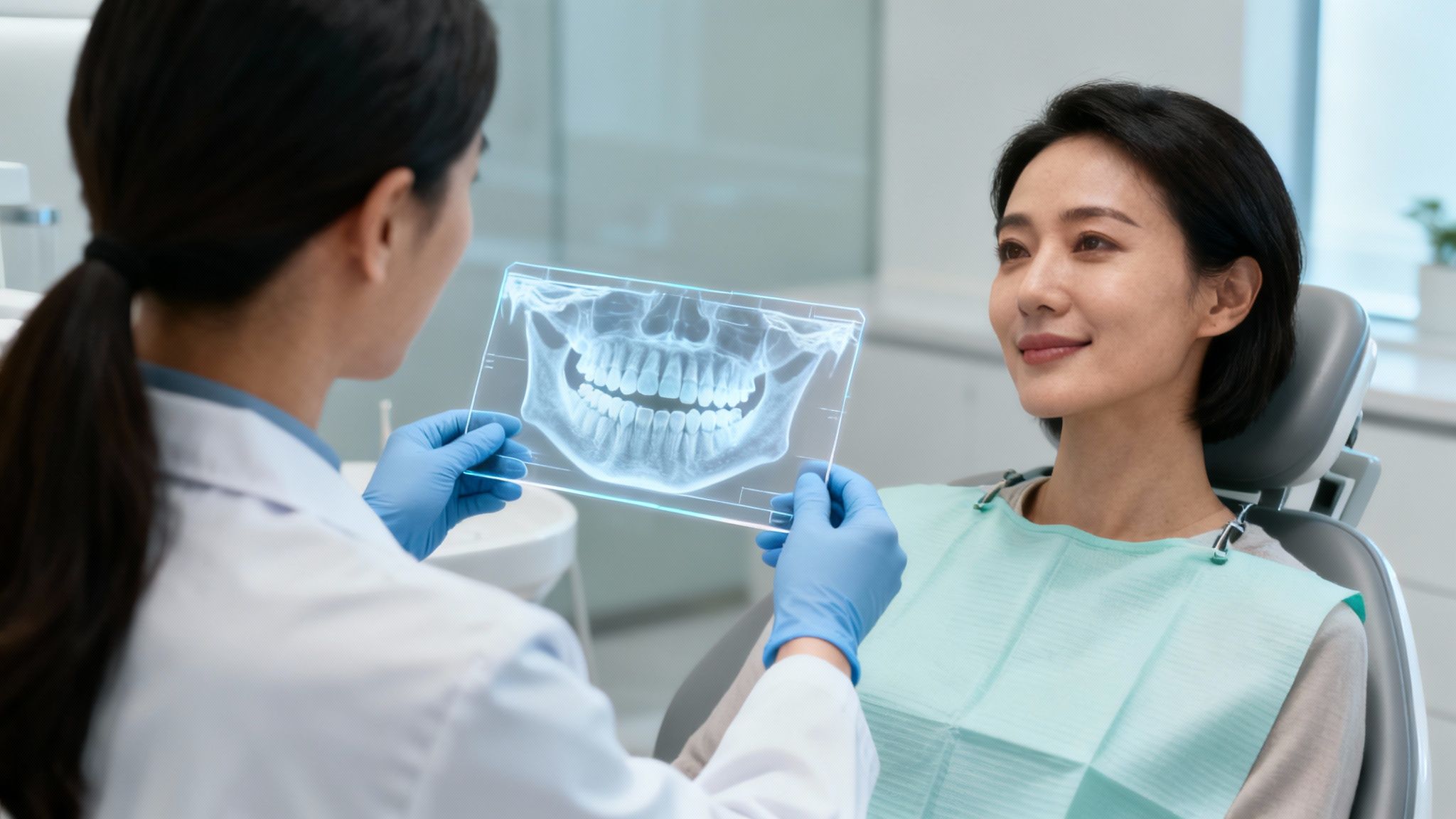
- Advanced 3D Imaging: We use a cone-beam computed tomography (CBCT) scanner to get a detailed, three-dimensional look at everything—your teeth, their roots, your jawbone, and all the surrounding structures.
- Digital Scans and Impressions: Forget goopy impression trays. We create an incredibly precise digital model of your mouth that becomes the blueprint for designing your new smile.
- Functional Analysis: It's not just about how your teeth look, but how they work. We carefully evaluate your bite, your jaw joint function, and how your facial muscles coordinate to spot any hidden issues.
This phase is all about data. By being this thorough, we ensure your treatment plan is built on a solid foundation of accuracy and tackles the root of the problem, not just the symptoms.
Phase 2: Preparatory and Foundational Work
Once we have a detailed plan, the next step is to get your mouth ready for the restorative work. You can't build a beautiful house on a shaky foundation, and the same is true for your smile. We need to create a healthy, stable base before we can start rebuilding.
That means addressing any active disease or infection first.
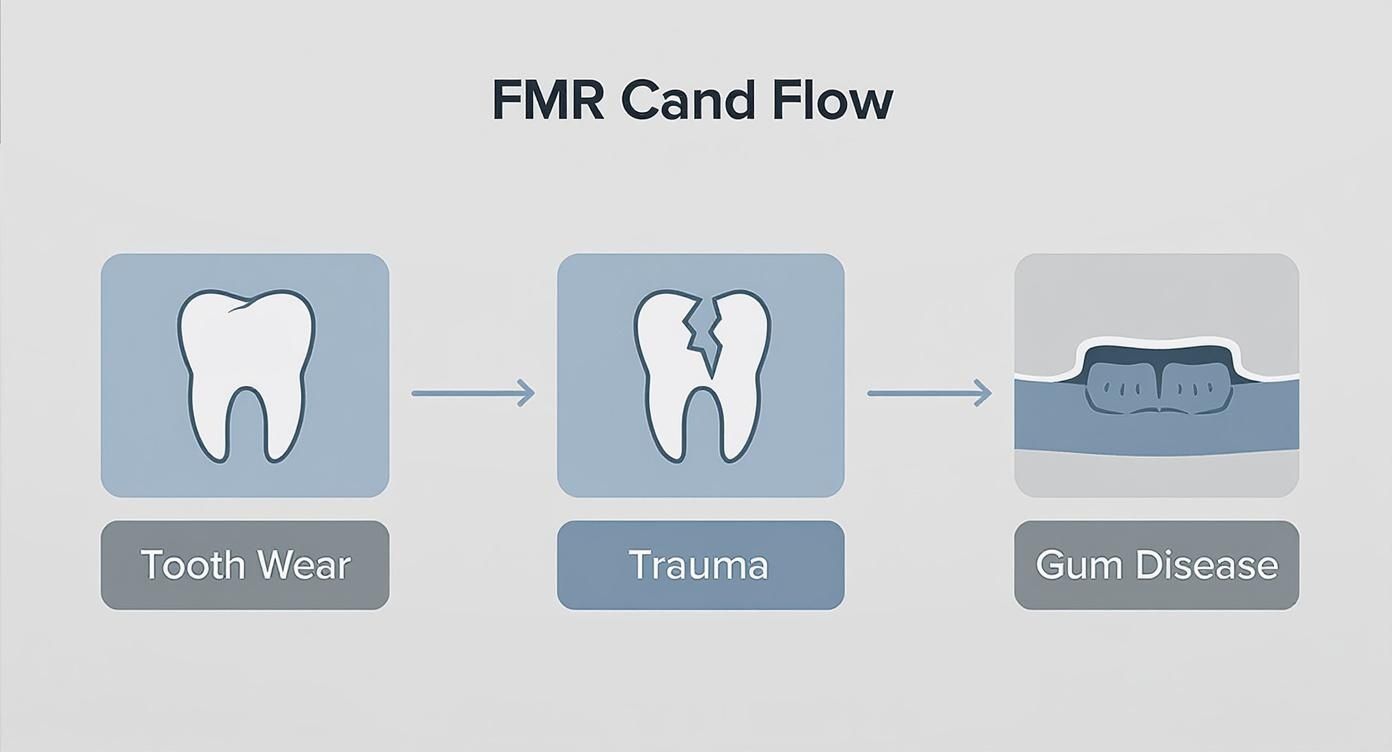
As you can see, major issues like severe wear, physical trauma, or gum disease are often the very reason a full reconstruction is needed in the first place.
Depending on your unique situation, this preparatory stage could involve a few different things:
- Treating advanced gum disease to get rid of infection and inflammation.
- Extracting any teeth that are unfortunately too damaged to be saved.
- Bone grafting to rebuild parts of the jawbone that have become weak, making sure it’s strong enough to support future dental implants.
Phase 3: Core Restorative Procedures
Now we get to the heart of the transformation—the part where we actively rebuild and restore your smile. These procedures are carefully sequenced, not just for efficiency, but to allow for proper healing along the way.
For many people, this phase involves placing dental crowns to protect and strengthen teeth that have been damaged. If you're curious about what that entails, you can get all the details in our guide on dental crown procedure steps.
A full mouth reconstruction isn't a single marathon appointment. It's a series of well-coordinated visits, with healing time built in between, to ensure each procedure has the best possible chance of long-term success.
During this phase, we might place dental implants, fit you with high-quality temporary restorations, and start the process of handcrafting your final, permanent crowns, bridges, or veneers.
Phase 4: Final Adjustments and Aftercare
This is the home stretch. Once your mouth has fully healed and your permanent restorations are ready, we move into the final stage. We’ll permanently place your beautiful new teeth and then make meticulous, fine-tuned adjustments to your bite until everything feels perfectly comfortable and functions in harmony.
Finally, we'll give you clear, simple instructions on how to care for your new smile to keep it healthy for a lifetime. Your commitment to aftercare is the final, crucial piece of the puzzle that protects your investment in your health.
The Technology That Rebuilds Your Smile
A full mouth reconstruction today is less about just filling gaps and more about a perfect blend of artistry and engineering. Think of it like an architect designing a building—it has to be beautiful, but it also has to be incredibly strong and functional. We use some seriously impressive technology to make sure every part of your new smile is built to last.
But before we build anything, we have to make sure the foundation is solid. That means tackling any underlying health issues first.
The Building Blocks of a New Smile
Several key treatments are the go-to solutions for a full mouth reconstruction. Each one has a specific job in bringing back your smile's health, function, and natural look.
- Dental Implants: These are the gold standard for replacing missing teeth. A small titanium post acts as a new tooth root, creating a permanent and super-stable base for a crown or bridge. This not only restores your bite but also helps prevent jawbone loss.
- Porcelain Crowns and Bridges: A crown is essentially a custom-made, tooth-shaped cap that fits over a damaged tooth, giving it back its original shape and strength. A bridge does what its name suggests—it "bridges" the gap left by missing teeth, using crowns on either side to hold a new tooth in place.
- Periodontal Therapy: You can't have a healthy smile without healthy gums. This therapy focuses on treating gum disease, getting rid of infection and inflammation to ensure your smile's foundation is rock-solid. Sometimes, this also means rebuilding jawbone density, which you can learn more about in our article on the truths about bone grafting for a strong smile.
Precision Technology Makes All the Difference
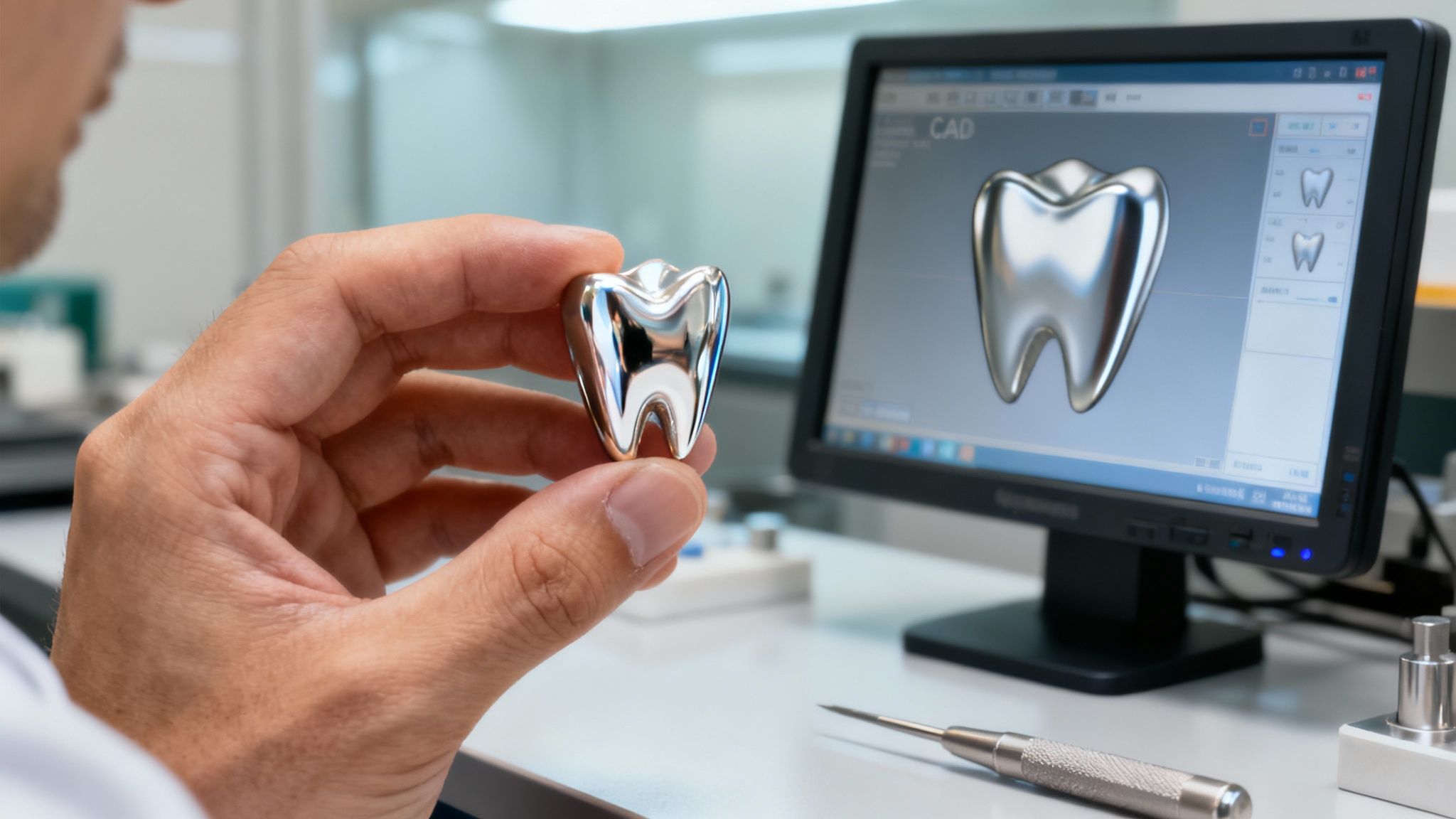
What really sets modern dentistry apart is how we use digital tools to map out and craft your new smile. This is where computer-aided design/computer-aided manufacturing (CAD/CAM) technology truly shines.
With CAD/CAM, we can design and create custom crowns, bridges, and other restorations from high-strength materials like zirconia with pinpoint accuracy. This digital workflow means a better fit, more comfort, and a look that’s indistinguishable from natural teeth.
This isn't just theory; it's proven in practice. A detailed case study on a patient with severe chronic periodontitis highlighted how CAD/CAM was essential for designing prosthetics for a full-mouth rehabilitation. The result? An ideal fit and fantastic aesthetic outcome. You can dive into the full case study about achieving successful full-mouth reconstructions to see the technical details.
By pairing these trusted procedures with digital precision, we can build a smile that not only looks great but feels completely natural and is designed to last for many years. It’s this combination that delivers those truly life-changing results.
The Life-Changing Benefits of a Healthy Mouth
Deciding to go forward with a full mouth reconstruction is a huge step. It’s a real investment in yourself—not just in your teeth, but in your entire quality of life. The changes you’ll see go so much deeper than just a better-looking smile in the mirror. They touch everything from your physical health to your confidence in daily interactions.
When your mouth is finally healthy and every tooth is doing its job, the simple pleasures come rushing back. Think about it: biting into a crisp apple, enjoying a steak, or just laughing out loud without a second thought about pain or how your teeth look. That’s the reality a properly planned reconstruction can give you.
Restored Function for Everyday Life
One of the first things patients notice is just how much easier life gets. When teeth are missing, broken, or misaligned, the whole system is out of whack, and that can cause a surprising number of problems.
A full mouth reconstruction tackles these issues directly, bringing back the balance your mouth needs. This leads to some incredible improvements:
- Effortless Chewing: You can finally eat the foods you love without pain or struggling. This doesn't just make meals more enjoyable; it can also make a big difference in your overall nutrition.
- Clearer Speech: It's amazing how much missing or loose teeth can muddle your words. Restoring your smile helps you speak clearly and with confidence again.
- Elimination of Chronic Pain: So many people live with jaw pain, muscle strain, or constant headaches that they don't realize are tied to a bad bite. Correcting the alignment can bring lasting relief.
A Boost to Your Overall Health
We've known for years that oral health is directly connected to your body's overall health. Your mouth is a gateway, and getting rid of chronic problems there can have a powerful ripple effect.
By treating widespread decay and gum disease, a full mouth reconstruction removes major sources of chronic inflammation and infection from your body. This is a huge deal. Harmful oral bacteria can get into your bloodstream and have been linked to serious health issues, including heart disease and diabetes.
A clinical study focusing on full mouth reconstruction patients showed that personalized treatment plans resulted in a 2.9-fold reduction in tissue inflammation. That’s a clear, measurable impact on reducing harmful inflammation throughout the body.
What's more, that same study found a dramatic drop in neurological symptoms. Patients reported that intense facial pain (neuralgia) and temporo-mandibular joint (TMJ) pain fell by 5.2 and 8.4 times, respectively. You can dive into the full research on how treatment protocols enhance patient comfort and safety to learn more.
Renewed Confidence and Well-Being
Maybe the most profound benefit, and the one that brings patients the most joy, is the incredible boost to self-esteem. Constantly hiding your smile takes a heavy emotional toll. It can impact your social life, your career, and just your general happiness.
A healthy, beautiful smile gives you the freedom to express yourself without hesitation. It’s about so much more than just looking good—it’s about reclaiming your confidence and feeling completely comfortable in your own skin. That renewed sense of self is truly priceless.
Your Questions, Answered
Deciding on a major dental procedure like this naturally comes with a lot of questions. We get it. Below, we've laid out clear, straightforward answers to the things most of our patients ask about. Our goal is to make sure you have all the information you need to feel comfortable and confident about moving forward.
How Much Does a Full Mouth Reconstruction Cost?
This is usually the first question people ask, and the honest answer is: it varies—a lot. Because every single treatment plan is built from the ground up for an individual's specific needs, the final cost can range anywhere from $30,000 to over $100,000.
What drives that number? A few key things:
- The scope of the work: The biggest factor is simply how much needs to be done. Are we talking about a few crowns and an implant, or a more complex case involving gum surgery, bone grafts, and a full set of new teeth?
- Materials matter: The type of materials used, like high-end zirconia for crowns or top-tier dental implant systems, will influence the final investment.
- Where you live: Just like with other services, dental fees can change depending on your city. Costs in San Diego might be different from those in a smaller town.
Since every plan is unique, the only way to get a firm number is to come in for a complete examination. We, like many other practices, offer financing plans to help make this life-changing care more accessible.
Is Full Mouth Reconstruction Covered by Dental Insurance?
This is another big one, and the answer really hinges on your insurance plan and why a procedure is being done. Insurance companies draw a line between what’s medically necessary and what's purely cosmetic.
Here’s how it usually breaks down:
- Necessary Treatments: Procedures that restore function or health—like a crown on a broken tooth, treatment for gum disease, or a bridge to help you chew properly—are often partially covered by PPO and other major insurance plans.
- Cosmetic Treatments: Things that are done just for looks, like teeth whitening, typically aren't covered.
Your dental office is your best ally here. We’ll submit a pre-treatment estimate to your insurance company before we start. This document details the entire plan and gives us a clear picture of what they'll cover, so you know your out-of-pocket costs upfront. No surprises.
How Long Does the Entire Process Take?
Think of a full mouth reconstruction as a multi-stage project, not a one-and-done appointment. The entire timeline can span from a few months to more than a year.
The biggest variable is your body's own healing clock. After dental implants are placed, for instance, they need a few months to securely fuse with your jawbone. We can't rush that process.
Things like preliminary work (bone grafting or getting gum disease under control) also add to the timeline. We’ll map out a detailed schedule for you during your consultation so you'll know exactly what to expect and when.
Is a Full Mouth Reconstruction Painful?
Keeping you comfortable is our absolute top priority. Thanks to modern dental techniques, we can perform these procedures with little to no pain.
We use effective local anesthesia to completely numb the area we're working on. And if you're feeling nervous, we have sedation dentistry options that can help you feel completely relaxed and at ease throughout your appointment.
You can expect some mild soreness and tenderness after certain procedures, especially implant surgery, but this is temporary. It’s usually nothing that can't be managed with standard over-the-counter pain relievers and the aftercare instructions we'll send you home with.
At Serena San Diego Dentist, we don't just fix teeth—we rebuild smiles with care, skill, and a genuine understanding of what you're going through. If you feel that a full mouth reconstruction might be the answer for you, we encourage you to take that first step. Schedule your comprehensive consultation with our team today and let's explore how we can restore your health, your bite, and your confidence.