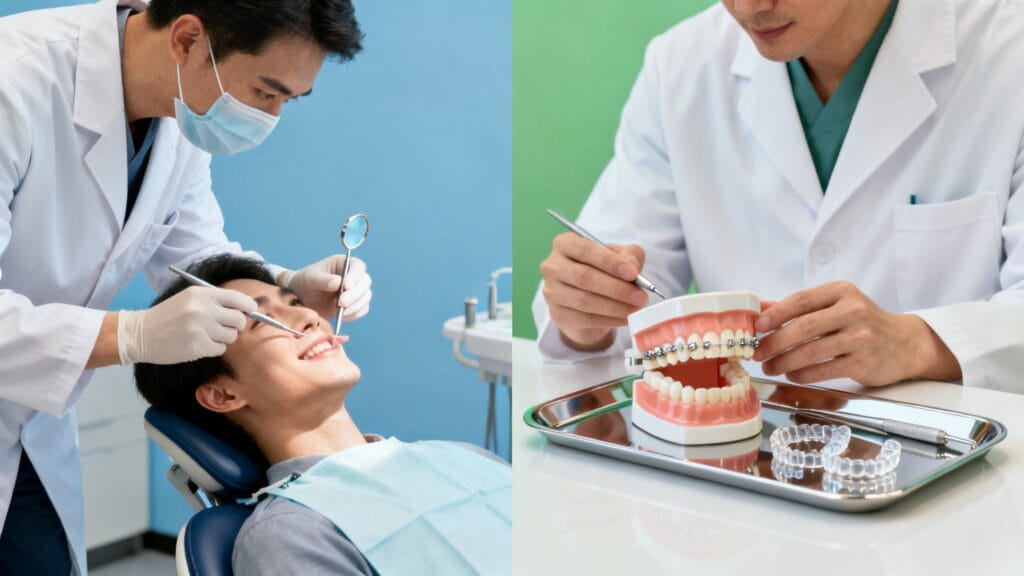
Think of your general dentist as the primary care provider for your oral health. They handle everything from routine cleanings and fillings to more complex procedures like crowns. An orthodontist, however, is a specialist who dedicates an additional 2-3 years of focused training to mastering the art and science of correcting teeth and jaw alignment.
Your Quick Guide to Dentist vs. Orthodontist Roles
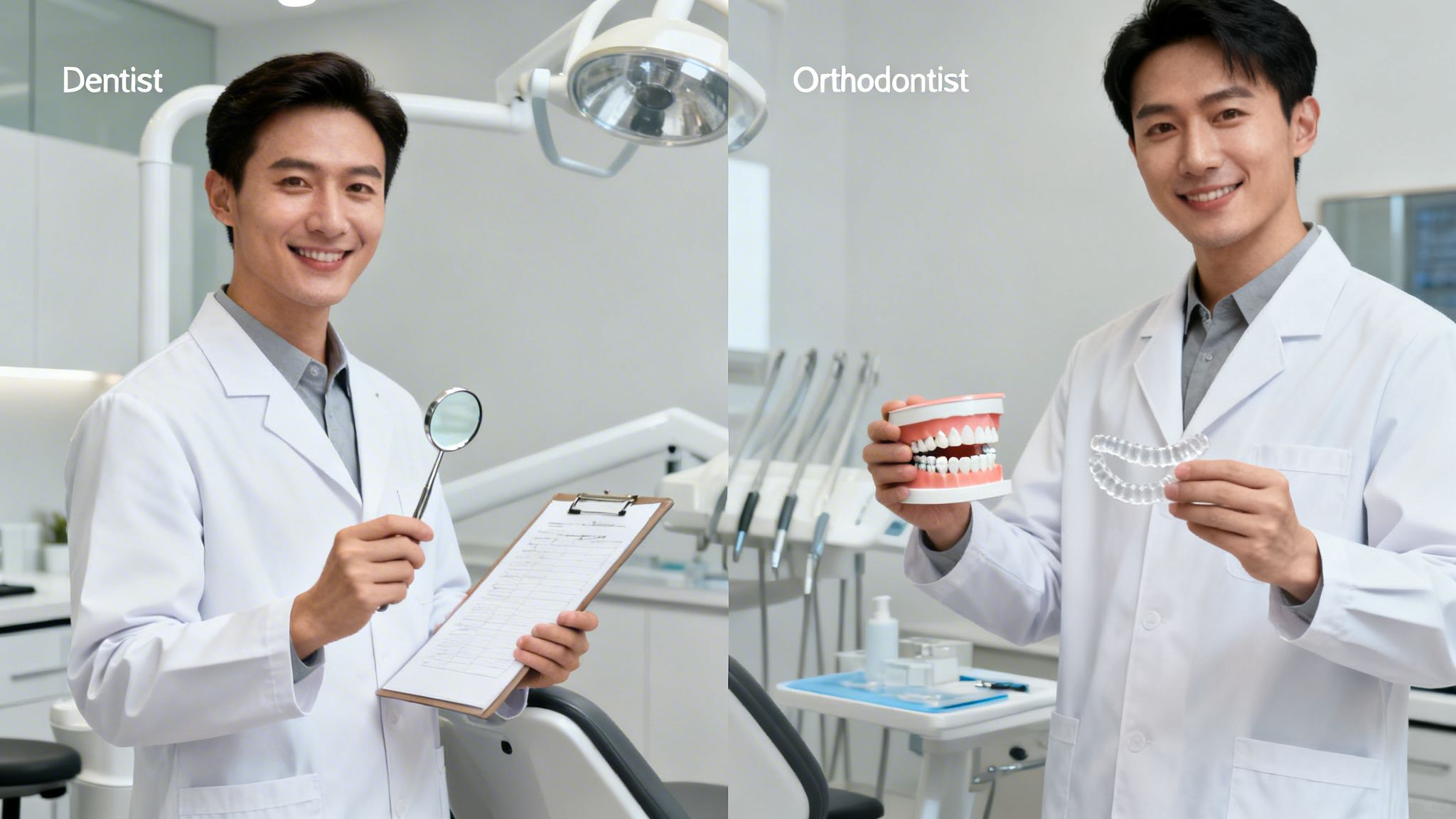
Navigating dental care can feel confusing. If a tooth starts to ache, you instinctively know to call your dentist. But what about crooked teeth or a misaligned bite? That’s where the distinction between a dentist and an orthodontist really matters.
The simplest way to look at it is this: your general dentist is like a family doctor for your mouth. They're your first stop for regular check-ups, cleanings, and common issues like cavities or gum disease. Their main job is to keep your teeth and gums healthy, setting the stage for a lasting, beautiful smile.
An orthodontist, on the other hand, is a dentist who has become a specialist. After finishing dental school, they dive into several more years of intensive, full-time training that focuses only on moving teeth and aligning jaws. They are the true experts in correcting bite issues and straightening teeth.
At a Glance Comparison
To put it all into perspective, let's break down the distinct roles and responsibilities of each professional. This table offers a quick snapshot of what truly sets them apart.
Quick Comparison: Dentist vs. Orthodontist
| Attribute | General Dentist | Orthodontist |
|---|---|---|
| Primary Focus | Overall oral health, covering teeth, gums, and nerves. | Diagnosing and correcting teeth and jaw misalignment (malocclusion). |
| Education | Doctor of Dental Surgery (DDS) or Doctor of Dental Medicine (DMD). | DDS/DMD degree plus an additional 2-3 years of specialized orthodontic residency. |
| Common Services | Cleanings, fillings, crowns, veneers, root canals, and teeth whitening. | Braces, Invisalign, retainers, and other appliances designed to straighten teeth. |
| When to See Them | For routine check-ups, tooth pain, cavities, or cosmetic improvements. | For concerns about crooked teeth, gaps, overbites, or underbites. |
Understanding these specialties helps clarify who to see for specific needs. Just as orthodontists focus on alignment, other specialists tackle different areas. For instance, exploring the difference between an endodontist and a general dentist shows how endodontists are the experts for issues inside the tooth, like root canals.
How Dentists and Orthodontists Train for Their Roles
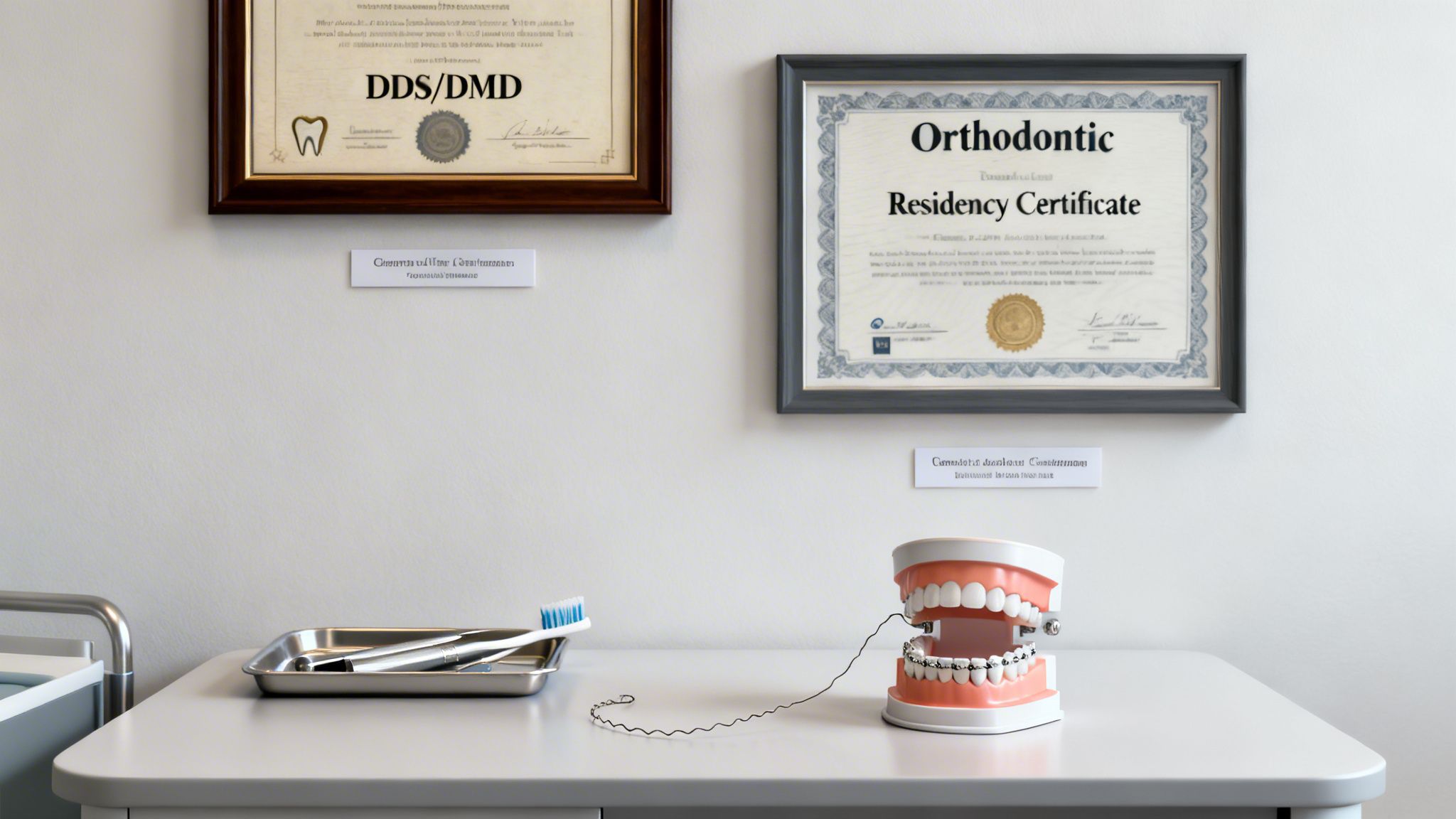
To really grasp what separates a dentist from an orthodontist, you have to look at their education. Both start out on the exact same footing, but their professional journeys eventually split, leading them down very different paths of expertise.
Every dentist and orthodontist first completes a demanding four-year dental school program. After graduation, they earn either a Doctor of Dental Surgery (DDS) or a Doctor of Dental Medicine (DMD) degree—which are essentially the same qualification. This foundational training prepares them for the full spectrum of oral health care, from cleanings and fillings to more involved work like crowns and bridges.
The Extra Mile: Specializing as an Orthodontist
This is where the road forks. Once a general dentist graduates, they're licensed and ready to practice. But for someone aiming to become an orthodontist, the training has only just begun. They must get into a highly competitive, full-time residency program specifically for orthodontics, accredited by the American Dental Association.
This isn't a part-time certificate; it’s an immersive, post-graduate education that takes another two to three years to complete. During this time, they accumulate thousands of hours of advanced, hands-on clinical training focused solely on orthodontics and dentofacial orthopedics—the art and science of moving teeth and aligning jaws.
Key Takeaway: Every orthodontist is a fully qualified dentist first, but only about 6% of dentists take on the rigorous residency needed to become a certified orthodontic specialist. This deep dive gives them an unparalleled grasp of bite mechanics, jaw alignment, and tooth movement.
A Laser-Focused Curriculum on Alignment
The coursework in an orthodontic residency is intense and highly specialized, going far beyond what’s covered in general dental school. The entire curriculum is designed to master the physics of tooth movement and the biology of facial growth.
Some of the core subjects they master include:
- Biomechanics: This is the precise science of applying gentle, consistent force to guide teeth into their correct positions safely and predictably.
- Malocclusion Diagnosis: Advanced diagnostics to identify all types of bite issues, from minor crowding to complex jaw discrepancies that might require surgical intervention.
- Facial Growth and Development: A deep understanding of how a child's jaw and face mature, which is critical for timing treatments for the best possible results.
This specialized education is what makes an orthodontist the go-to expert for straightening teeth and correcting misaligned bites. They've dedicated their entire career to this one specific craft. While your general dentist is your partner in overall oral health, the orthodontist is the specialist you trust to create a perfectly aligned smile.
What They Actually Do: A Look at Their Day-to-Day Services
The best way to really grasp the difference between a dentist and an orthodontist is to see what they do every day. Both are dedicated to your oral health, but their tools, techniques, and ultimate goals are worlds apart—think of it like the difference between your family doctor and a cardiologist.
A general dentist provides a massive range of services to keep your mouth healthy and fix problems as they pop up. They are your first line of defense, the primary care provider for your smile, handling everything from basic check-ups to complex cosmetic work.
An orthodontist, on the other hand, has a laser-focused job. Their entire world revolves around one thing: correcting the alignment of your teeth and jaw. This specialty is known as malocclusion, and it's all they do.
The General Dentist’s Toolbox
General dentists are the jacks-of-all-trades in the dental world. At a practice like Serena San Diego Dentist, the goal is to provide a complete menu of care to manage your oral health from top to bottom.
Their services usually fall into three main categories:
- Preventive Care: This is the bedrock of dentistry. It includes routine cleanings, comprehensive exams, X-rays, and fluoride treatments—all designed to stop trouble before it can begin.
- Restorative Treatments: When decay or an accident damages a tooth, your dentist steps in to fix it. This includes common procedures like fillings, root canals, crowns, and bridges.
- Cosmetic Dentistry: Want a brighter, more confident smile? Dentists handle that, too. Services like professional teeth whitening, dental bonding, and porcelain veneers are all in their wheelhouse.
The Orthodontist’s Niche: Perfecting Your Bite
You won't go to an orthodontist for a cleaning, a filling, or a crown. Their expertise lies in using specialized appliances to gently guide your teeth into perfect alignment, which improves how your teeth work and how your smile looks. They're focused on the bigger picture—the mechanics of your entire bite, not just individual teeth.
An orthodontist's primary treatments include:
- Braces: This covers everything from traditional metal brackets and subtle ceramic braces to lingual braces that hide behind your teeth.
- Clear Aligners: Removable, nearly invisible trays from brands like Invisalign have become an incredibly popular way to straighten teeth without the look of metal braces.
- Retainers and Other Appliances: After your teeth are straight, retainers hold them in place. Orthodontists also use special appliances to guide jaw growth in children and adolescents.
If you're weighing your alignment options, understanding the differences between Invisalign vs. traditional braces is a great starting point for a conversation with a specialist. This level of specialization also commands a higher salary; U.S. dentists earn an average of $221,245 a year, while orthodontists earn up to 23% more, with an average annual salary of $271,770.
The simplest way to put it is this: A dentist takes care of the health of your individual teeth. An orthodontist perfects the alignment of all your teeth as a complete system.
So, who should you see? It all comes down to your needs. If you have a cavity or are curious about veneers, you start with your general dentist. If crooked teeth or a bite issue is your main concern, an orthodontist is the expert you need. To learn more about alignment solutions, you can explore what's available for orthodontics in San Diego.
Treatment Focus: Dentist vs. Orthodontist
To make it even clearer, this table breaks down common dental goals and shows you which professional is typically the one to see.
| Dental Issue or Goal | Primary Provider (Dentist/Orthodontist) | Description of Treatment |
|---|---|---|
| Routine Check-up & Cleaning | Dentist | Regular exam, X-rays, and professional cleaning to prevent decay and gum disease. |
| Cavity / Toothache | Dentist | Removal of decay and placing a filling to restore the tooth's structure and function. |
| Chipped or Broken Tooth | Dentist | Repairing the tooth with bonding, a veneer, or a dental crown depending on the severity. |
| Crooked or Crowded Teeth | Orthodontist | Applying braces or clear aligners (like Invisalign) to gradually move teeth into proper alignment. |
| Overbite or Underbite | Orthodontist | Using orthodontic appliances to correct the relationship between the upper and lower jaws. |
| Teeth Whitening | Dentist | Professional-grade whitening treatments to remove stains and brighten the smile's appearance. |
| Gum Disease Treatment | Dentist | Deep cleaning procedures (scaling and root planing) to manage periodontal disease. |
| Missing Tooth Replacement | Dentist | Creating and placing a dental bridge, denture, or dental implant to fill the gap. |
This side-by-side view helps illustrate how each professional plays a distinct, yet complementary, role in your lifelong oral health journey.
Navigating Your Dental Care Journey
Trying to figure out whether you need a dentist or an orthodontist? It usually boils down to a single, simple question: Is your problem about the health of your teeth, or their alignment? Knowing the answer gets you to the right professional, right away.
Think of your general dentist as your primary care provider for your mouth. They're your first call for almost anything. From a nagging toothache that won't quit to that "uh-oh" moment when you chip a tooth on something hard, your dentist is the one you need to see. They handle the urgent stuff like pain and damage, but also all the routine care that keeps your smile in top shape.
But if you look in the mirror and your concerns are more about how your teeth fit together—maybe they look a little crowded, you see some awkward gaps, or your bite just feels off—that's squarely in an orthodontist's territory. Their entire focus is on diagnosing and fixing these kinds of structural and alignment issues.
This simple flowchart can help guide you to the right specialist based on what you're experiencing.
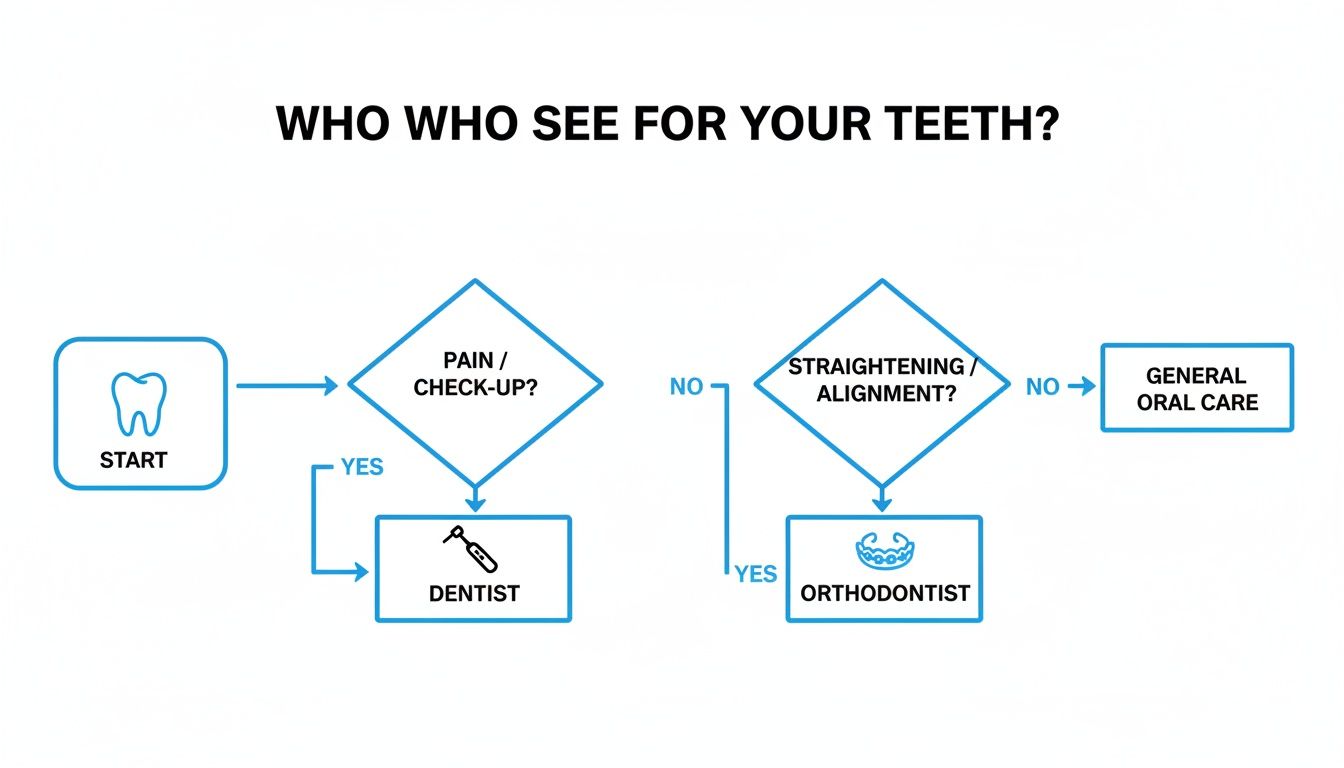
As you can see, the path usually starts with a general dentist for your immediate health or cosmetic concerns. An orthodontist comes in for the specialized work of straightening teeth and correcting your bite.
When Roles Overlap and Referrals Happen
The connection between your dentist and an orthodontist isn't a one-or-the-other situation; it's a partnership. Your general dentist is essentially the quarterback of your oral health team, managing your overall care and keeping an eye out for issues during your regular check-ups.
It’s actually quite common for a general dentist to be the first one to notice the early signs of a bad bite (malocclusion), especially in kids and teenagers. If they see alignment problems starting to develop, they’ll refer you to a trusted orthodontic specialist. This ensures you’re getting advice from someone who has dedicated years of extra training specifically to moving teeth and jaws safely and effectively.
Orthodontic care is more in-demand than ever. The average orthodontist is now managing a record 696 active patients at a time—a huge increase from 574 just two years ago. With 6.66 million patients in active treatment nationwide, it's clear this is a distinct, high-volume specialty. You can dig into these numbers in the American Association of Orthodontists' latest study.
Why Your Dentist Is Crucial During Orthodontic Treatment
Even when you’re in the middle of treatment with an orthodontist for braces or clear aligners, you absolutely still need your general dentist. In fact, their job becomes even more critical. All those brackets, wires, and even aligner attachments can create tricky new places for plaque and food to hide, which increases your risk for cavities and gum problems.
That’s why sticking to your regular six-month dental check-ups and cleanings is completely non-negotiable. Your dentist and orthodontist work together as a team. While the orthodontist straightens your teeth, your dentist makes sure they stay healthy and strong underneath. This collaborative approach is the key to finishing your treatment with a smile that’s not just perfectly straight, but brilliantly healthy, too.
If you're exploring discreet options, you can learn more about Invisalign options in San Diego and see how they can be part of a complete oral health plan.
How to Choose the Right Dental Professional in San Diego
Finding the right dental care in San Diego can feel overwhelming, but it doesn't have to be. The best place to start is with a great general dentist who can act as your home base for all things oral health. Once you have that relationship, getting specialized care like orthodontics becomes a much simpler process.
Think of your general dentist as your primary partner for your smile. They’re who you see for regular check-ups, cleanings, and any immediate issues that pop up, like a nagging toothache or a chipped tooth. When you're looking for one, you'll want a practice that covers all the bases—preventive, restorative, and even cosmetic work.
Selecting Your General Dentist
A top-notch general dentist really is the quarterback for your oral health team. They’re not just there to keep your teeth and gums in good shape; they’re also the first to spot when you might need to see a specialist.
Here are a few things to look for:
- Comprehensive Services: Does the practice handle everything from cleanings and fillings to more involved cosmetic procedures like crowns and veneers? Keeping your care under one roof makes life so much easier.
- Modern Technology: A clinic that invests in up-to-date equipment usually means you're getting more accurate diagnoses and more comfortable treatments.
- A Patient-First Approach: A great dental team makes you feel comfortable, takes the time to answer your questions, and genuinely puts you at ease.
Practices like Serena San Diego Dentist are set up to be that central hub for families in San Diego. We provide a full spectrum of general and cosmetic care and have a network of trusted local specialists we can refer you to when needed. If you want to dig deeper, check out our guide on how to choose the right dentist for your needs.
Finding a Qualified Orthodontist
While your general dentist is your starting point, finding an orthodontist is a different ballgame. They are specialists, so you absolutely want to make sure they have the right credentials. A 2023 European study highlighted just how specialized they are, noting that orthodontists make up 5.0% of all dentists. It's a small, focused group for a reason. You can discover more about this dental specialization data if you're curious.
This specialization is exactly why a referral from a general dentist you trust is so valuable.
Our Expert Advice: Your best move is to find a quality general dentist first. They’ll get your teeth and gums in excellent health and can then give you a solid referral to a local orthodontist they know and trust.
If you decide to search on your own, the American Association of Orthodontists (AAO) is your best resource. Their website has a search tool that helps you find board-certified orthodontists right here in the San Diego area. This guarantees they've completed the extra 2-3 years of full-time, specialized training after dental school.
At the end of the day, starting with your general dentist just makes sense. By choosing a practice that can handle the majority of your needs, you're not just getting a dentist—you're getting a trusted advisor who can guide you to the right specialists whenever the time comes.
Common Questions About Dentists and Orthodontists
Let's clear up some of the most common questions people have when figuring out the difference between a dentist and an orthodontist. Getting these answers straight will help you make the best decisions for your family's oral health.
Can My General Dentist Provide Braces or Invisalign?
This is a common point of confusion. While some general dentists do offer limited orthodontic treatments like Invisalign after completing continuing education courses, they just don't have the same depth of training as an orthodontist. An orthodontist goes through an extra 2-3 year residency that is entirely dedicated to diagnosing and correcting complex bite and alignment problems.
For anything beyond very minor tooth movements, an orthodontist is always the right specialist for the job. Their specialized expertise is what ensures you get the most stable, predictable, and lasting results. Your general dentist is the perfect person to assess your initial situation and then refer you to a trusted orthodontist for that advanced care.
Do I Still Need to See My Dentist While I Have Braces?
Yes, absolutely! In fact, it's even more critical to keep up with your regular dental check-ups and cleanings every six months while you're in orthodontic treatment.
Why? Because brackets, wires, and aligners create a lot of new nooks and crannies where plaque can build up, making it much harder to keep your teeth clean. This puts you at a higher risk for cavities and gum disease. Your dentist is a key partner in maintaining your overall oral health, making sure your teeth and gums are in great shape while they're being straightened. For instance, learning how to properly floss with braces is a skill your dental team can help you master.
Key Insight: Think of your dentist and orthodontist as a team. The orthodontist is focused on alignment, while your dentist is focused on health. If you neglect one, you could seriously compromise the beautiful results you're working so hard to achieve.
Is an Orthodontist More Expensive Than a Dentist?
The cost really comes down to the specific treatment, not the professional's title. A routine dental cleaning, for example, will always be less expensive than getting a full set of braces.
Generally speaking, orthodontic treatments are a significant investment. This is due to their complexity, the cost of materials, and the length of time you're in treatment—often 18-24 months or even longer. But it's also true that major restorative or cosmetic procedures from a dentist, like getting dental implants or a full set of porcelain veneers, can carry a similar or even higher price tag. The good news is that most dental and orthodontic offices in San Diego accept major insurance plans and offer flexible payment options to make treatment affordable.
Who Should I See First for a Smile Makeover?
Your general and cosmetic dentist is your ideal first stop for any smile makeover journey. Think of them as the "quarterback" of your oral health—they see the whole field and coordinate the entire plan.
A great cosmetic dentist will start by evaluating the health of your teeth and gums to address any underlying issues first. From there, they'll talk with you about your goals, which might involve treatments like teeth whitening, bonding, or veneers. If crooked teeth are a foundational problem that stands in the way of achieving the best cosmetic result, they will refer you to an orthodontist to handle the alignment before any aesthetic work begins.
Ready to take the first step toward your ideal smile? At Serena San Diego Dentist, we provide comprehensive general and cosmetic care to ensure your smile is both healthy and beautiful. Schedule your consultation today!