Prosthodontics is one of the dental specialties recognized by the American Dental Association, and it's all about the intricate work of restoring and replacing teeth. Think of a prosthodontist as an architect for your mouth—they’re the experts who design and build solutions to bring your smile back to full strength and beauty.
An Architect for Your Smile
Ever hide your smile because of a missing tooth? Or maybe you avoid certain foods because chewing has become a chore due to damaged or worn-down teeth. These aren't just minor inconveniences; they're the exact problems that prosthodontics was created to solve. This isn't your everyday dental check-up. It's a highly specialized field dedicated to tackling complex dental issues with a blend of scientific precision and artistic vision.
To earn their title, a prosthodontist completes an additional three years of rigorous, full-time training after graduating from dental school. This deep dive gives them the advanced skills needed to handle everything from a single implant to a full-mouth reconstruction, making them the go-to specialist for significant dental challenges.
Is Prosthodontic Care Right for You?
This advanced specialty is the answer for people facing a wide array of dental issues. You might be a great candidate for a prosthodontist if you're dealing with:
- Multiple missing or failing teeth that demand a comprehensive, well-coordinated plan.
- Teeth that are severely worn down, chipped, or broken, affecting both your bite and your confidence.
- Old dentures or bridges that just don't fit right anymore, causing soreness, slipping, or trouble with speech.
- The goal of a total smile makeover, involving complex procedures like a full set of veneers or dental implants.
- Complex bite problems or jaw joint pain (TMJ/TMD) that impact your overall oral health.
At its core, a prosthodontist’s job is to craft a solution that doesn't just look incredible, but also restores the delicate balance of your bite for lasting health and comfort. It's where science meets art to create a smile that truly works for you.
Why This Specialty Is More Important Than Ever
The demand for top-tier tooth replacement is on the rise. Prosthodontics, sometimes called dental prosthetics, is the field responsible for creating these custom solutions. The global market for these treatments was valued at around USD 8.28 billion in 2024 and is expected to climb to USD 13.27 billion by 2032.
This boom really underscores how many people are looking for durable, high-quality answers for their dental problems. You can explore more about dental prosthetic market trends on fortunebusinessinsights.com.
Choosing a prosthodontist means putting your smile in the hands of a true specialist—someone equipped to handle even the most complex dental situations and help you regain your confidence and oral health.
A Closer Look at Core Prosthodontic Treatments
When it comes to rebuilding your smile, a prosthodontist has a whole toolkit of proven, reliable solutions. These treatments are the cornerstones of smile reconstruction, designed to bring back strength, proper function, and a natural look to your teeth. Let's dive into the three mainstays a prosthodontist turns to for solving common dental problems.
These options are a key part of what makes up modern dental repair. You can learn more about the 5 procedures you can get with restorative dentistry in our more comprehensive guide on the topic.
Dental Crowns: A Custom Shield for Your Teeth
The easiest way to think about a dental crown is as a custom-made helmet for a tooth. It’s a cap that fits snugly over a damaged or weakened tooth, restoring its original shape, size, and strength. A crown is the go-to solution when a simple filling just won't cut it.
A prosthodontist might suggest a crown for a few common reasons:
- To protect a weak tooth (maybe after a root canal or a large filling) from breaking.
- To restore a tooth that's already broken or severely worn down.
- To serve as a strong anchor for a dental bridge.
- To cover up a discolored or poorly shaped tooth for a better aesthetic.
Today’s crowns, typically crafted from materials like porcelain or zirconia, are true works of art. They are meticulously designed to match the color and feel of your natural teeth, so they blend in perfectly.
This infographic really highlights how much the materials and success rates in this field have improved, making today's treatments better and more efficient than ever.
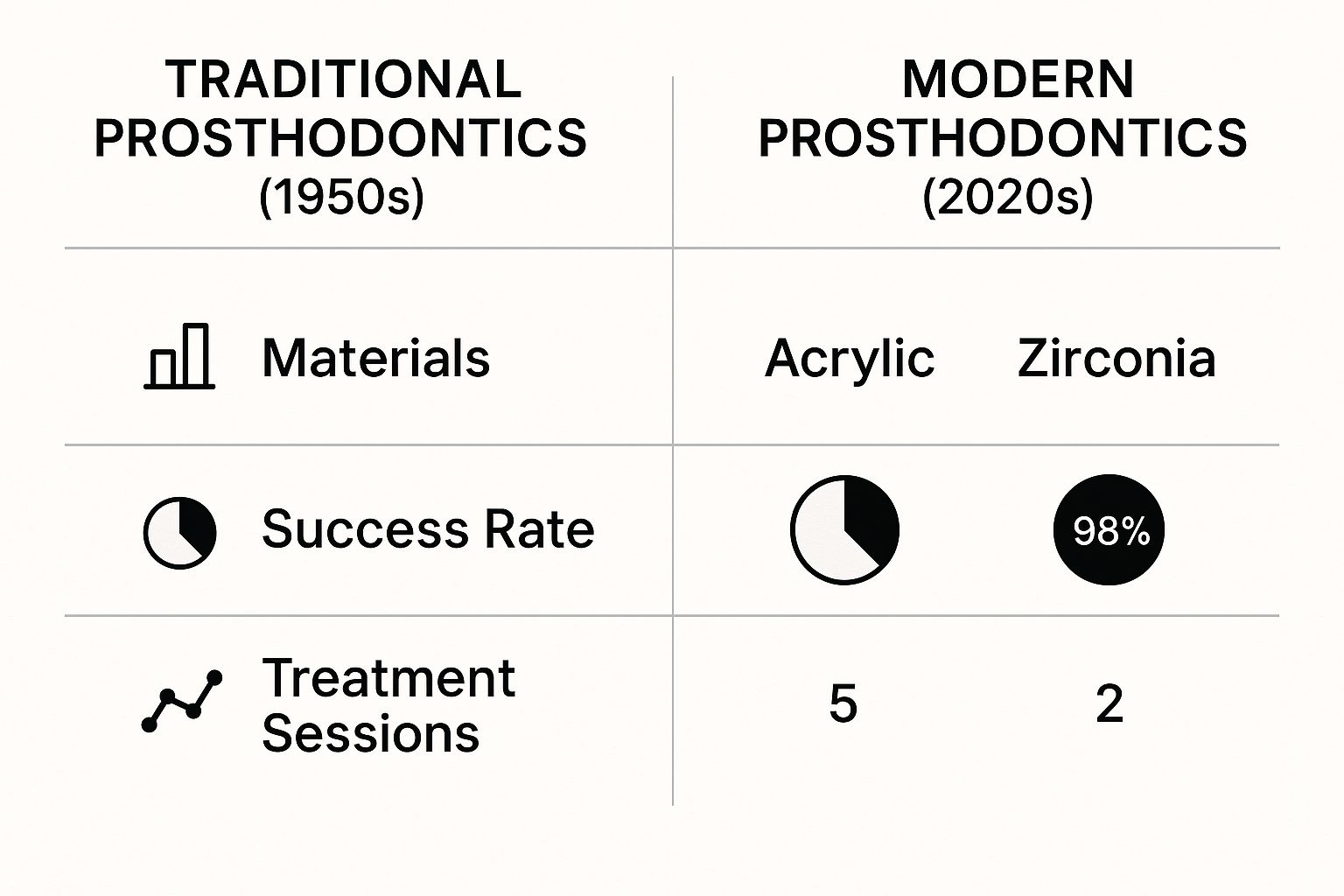
The numbers speak for themselves. With better materials and techniques, we're seeing much higher success rates and fewer appointments, which is a huge win for patients.
Dental Bridges: Closing the Gaps in Your Smile
A dental bridge does exactly what its name implies—it bridges the gap left by one or more missing teeth. It’s essentially a single unit made up of two crowns that go on the teeth flanking the gap (the abutment teeth) and a false tooth (a pontic) that sits in the middle.
Bridges are a fantastic option if you have strong, healthy teeth on either side of the empty space. By filling that gap, a bridge not only gives you your smile back but also stops the neighboring teeth from shifting out of place, which can cause bite issues down the road.
Dentures: A Complete Fix for Significant Tooth Loss
For those missing several or all of their teeth, dentures are a time-tested and effective solution. These are removable appliances that can replace just a few teeth (partial dentures) or an entire arch (complete dentures). This is where a prosthodontist’s advanced training truly shines, as creating a comfortable, functional denture requires an expert understanding of jaw mechanics and facial structure.
The goal of a modern denture isn't just to replace teeth—it's to restore confidence. A well-made denture improves your ability to eat and speak clearly while providing essential support for your facial muscles.
Prosthodontists custom-design dentures to look natural and fit securely, helping patients avoid the discomfort and slipping often associated with older or poorly crafted appliances.
To help you understand these non-implant options at a glance, here’s a quick comparison of how they work and when they’re used.
Common Prosthodontic Treatments at a Glance
| Treatment | Primary Purpose | Best For | Permanence |
|---|---|---|---|
| Dental Crown | To cover and protect a single damaged or weak tooth. | Teeth with large fillings, cracks, or after root canals. | Permanent (cemented in place) |
| Dental Bridge | To replace one or more missing teeth in a row. | Gaps with healthy, strong teeth on either side. | Permanent (cemented in place) |
| Partial Denture | To replace multiple missing teeth when some natural teeth remain. | Patients missing several teeth in different locations. | Removable |
| Complete Denture | To replace all teeth in the upper or lower jaw. | Patients who are missing all of their natural teeth. | Removable |
While crowns and bridges are fixed in place, dentures offer a flexible, removable solution. A prosthodontist will help you determine which path is the best fit for your specific situation, your health, and your long-term goals.
Why Dental Implants Are the Gold Standard
When it comes to replacing a missing tooth, we have a few good options, like bridges and dentures. But if you're looking for the absolute best solution modern dentistry has to offer, dental implants are in a class of their own. They're considered the gold standard because they come closer to replicating a natural tooth than anything else we can do—in feel, function, and appearance.
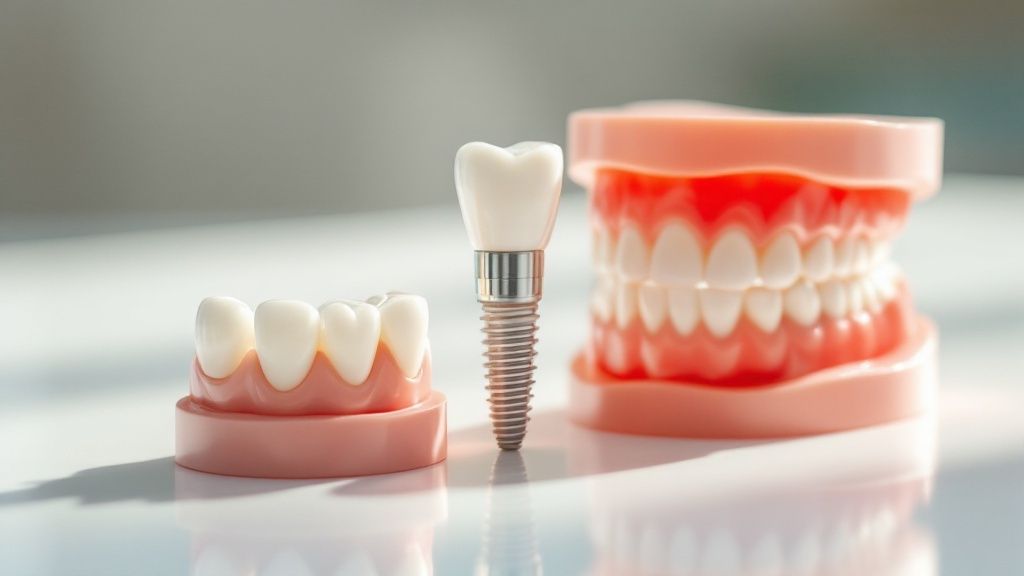
Unlike other restorations that just rest on your gums or use neighboring teeth as anchors, a dental implant actually becomes a part of your body. It's a truly integrated solution.
The Science of a Lifelong Solution
The secret to an implant's incredible stability is a natural process called osseointegration. It might sound a bit technical, but the idea is actually quite straightforward. Imagine a tree setting down deep, strong roots into the earth—that's exactly what an implant does in your jaw.
It all starts with a small post, usually made from biocompatible titanium, that acts as a new tooth root. This post is gently placed into your jawbone where the tooth used to be. Over the next few months, your body does something amazing: the bone grows directly onto the implant's surface, fusing with it until it's completely locked in place. This fusion creates a foundation that's as solid as a rock.
This biological bond is what makes implants so permanent and reliable. The choice of titanium is no accident; its unique ability to integrate with bone without being rejected is what allows for a worldwide implant survival rate of nearly 96.9%.
The Three Key Components of an Implant
A complete dental implant isn't just one piece. It's a system of three parts working together seamlessly to give you a brand-new tooth.
- The Implant Post: This is the titanium screw that serves as the artificial root, placed securely within the jawbone to provide that unshakeable base.
- The Abutment: Think of this as a small connector. It attaches to the top of the implant post and sits just at the gumline, creating a secure attachment point for your new tooth.
- The Crown: This is the part everyone sees. It's a custom-designed prosthetic tooth, meticulously crafted to perfectly match the color and shape of your surrounding teeth.
When all three pieces are in place, you get a replacement tooth that doesn't just look real—it feels and functions like one, too.
Why Implants Outperform Other Options
The advantages of choosing dental implants go well beyond just closing a gap in your smile. They provide critical long-term health benefits that other options simply can't offer.
The most crucial benefit of a dental implant is its ability to preserve jawbone health. When a tooth is lost, the underlying bone begins to shrink away due to lack of stimulation—a process called resorption. An implant mimics a natural tooth root, stimulating the bone and preventing this loss.
This is huge. It helps maintain the natural shape of your face and prevents that sunken-in look that can happen over time with missing teeth. For anyone weighing their options, understanding these fundamental differences is key. You can read our comparison of dental implants vs. dentures to learn more.
On top of that, implants are just incredibly comfortable and convenient. There's no slipping, no messy adhesives, and you can eat whatever you want. With good care, the titanium post itself can easily last a lifetime, making it one of the smartest investments you can make in your long-term health and self-confidence.
When Should You See a Prosthodontist?
Your general dentist is your go-to for routine care, but some dental problems are just too complex for a generalist. Recognizing when you need a specialist's touch—specifically, that of a prosthodontist—is the key to a successful, lasting result.
Think of it this way: you see your family doctor for a check-up, but you’d see a cardiologist for a serious heart condition. Prosthodontics is that level of specialized care for your smile. A prosthodontist completes years of advanced training after dental school, focusing entirely on complex tooth restoration and replacement.
Recognizing the Signs You Need a Specialist
So, how do you know if your situation calls for this level of expertise? If you find yourself nodding along with any of the scenarios below, it’s a good sign that a consultation with a prosthodontist is the right move. These aren't simple, one-tooth fixes; they require an architect's vision for your entire mouth.
For example, imagine a patient in San Diego who had a bicycle accident that left them with several cracked and broken front teeth. A simple filling wouldn't be enough. This patient would need a specialist who could rebuild their smile from both a functional and aesthetic standpoint. This is precisely where a prosthodontist shines.
Here’s a quick checklist to help you decide:
- You have multiple missing teeth. Simply filling the gaps isn't enough. You need a strategic plan to restore a stable, balanced bite.
- Your teeth are severely worn down or damaged. Years of grinding, acid erosion, or trauma can wear teeth down so much that a full-mouth reconstruction is the only real solution.
- You're unhappy with your current dental work. Do your dentures slip? Is your old bridge failing? Do you have crowns that just never feel right? A prosthodontist can diagnose the root cause and provide a much better fix.
- You are considering dental implants. As the leading experts in tooth replacement, prosthodontists are the best-qualified specialists to plan and restore dental implants for optimal results.
- You want a complete smile makeover. When your dream smile involves a mix of veneers, crowns, and implants, their artistic eye and technical skill are essential.
The Prosthodontist Advantage in San Diego
But why does seeing a specialist matter so much? Sure, a general dentist can place a crown. The difference lies in the depth of understanding. A prosthodontist's training gives them a comprehensive grasp of the entire oral system—how your jaw, muscles, and teeth all work together in harmony.
They don’t just fix a tooth; they see the bigger picture. They are master problem-solvers, designing restorations that not only look fantastic but function perfectly for years.
If you’re in San Diego and dealing with a major dental issue, going to a prosthodontist means you're getting the highest standard of care available. They are the specialists equipped to handle the most demanding restorative cases, giving you peace of mind and a final result you can truly be confident in.
How To Choose The Right Prosthodontist
When you need serious dental work, finding the right expert isn't just a step—it's the step. Choosing a highly qualified prosthodontist is the single most important decision you'll make, setting the foundation for a result that not only looks great but lasts for years to come.
Check Credentials And Specialization
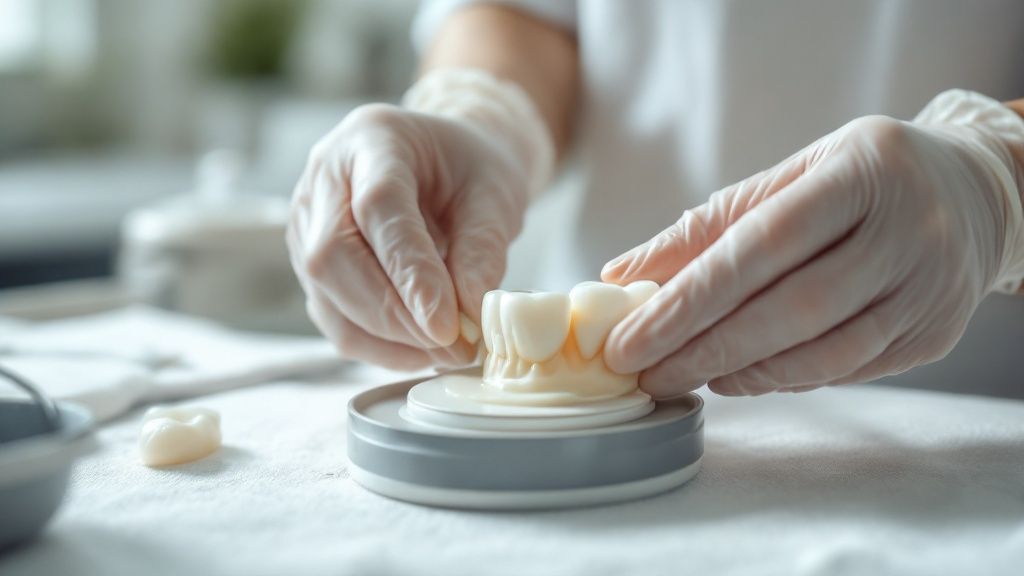
First things first, you need to verify their qualifications. Look for a specialist who is board-certified. This isn’t just another piece of paper; it means they’ve passed demanding exams that go far beyond their required three years of specialty training. It's a true mark of dedication and expertise.
Don’t be shy about asking about their specific experience, either. If you need a full-mouth reconstruction or a tricky implant case, you want someone whose portfolio is filled with similar success stories.
Evaluate Their Technology And Results
Today’s best dental work relies on great technology. A top-tier prosthodontic practice will have tools like 3D imaging (CBCT scans) and digital intraoral scanners. This tech allows for incredibly precise planning and, thankfully, gets rid of those goopy, uncomfortable impression molds from the old days.
But technology is only half the story. You need to see the proof in their work. Ask to look through a portfolio of before-and-after photos from actual patients—it’s the best way to gauge their skill and artistry. Reading online reviews is also smart. Understanding how online reputation management for dental practices works can help you read between the lines and get a clearer picture.
For a deeper dive, our guide on how to choose the right dentist offers even more tips.
Make The Most Of Your Consultation
Think of the consultation as your interview. This is your chance to see if you click with the prosthodontist and their team. A great specialist will take the time to listen, explain things without jargon, and make you feel completely at ease.
A consultation should feel like a collaborative partnership. The prosthodontist should present all viable options—not just the most expensive one—and help you understand the pros and cons of each path.
Walk in with a list of questions so you can make an empowered choice. Here are a few to get you started:
- What are all the treatment options available to me?
- Could you show me examples of cases similar to mine?
- What kind of technology do you use for diagnosis and treatment?
- What does the long-term maintenance look like for my new smile?
- Can you give me an estimated timeline and breakdown of the costs?
By focusing on credentials, seeing their results, and having a great consultation, you can find the best prosthodontist in San Diego to confidently rebuild your smile.
The Future of Prosthodontic Dentistry
Prosthodontics has always been a field where precision meets artistry, but today's technology is launching that blend into a whole new stratosphere. The future of restoring smiles isn't some far-off concept; it's happening right now, thanks to digital tools that make treatments faster, more comfortable, and unbelievably accurate.
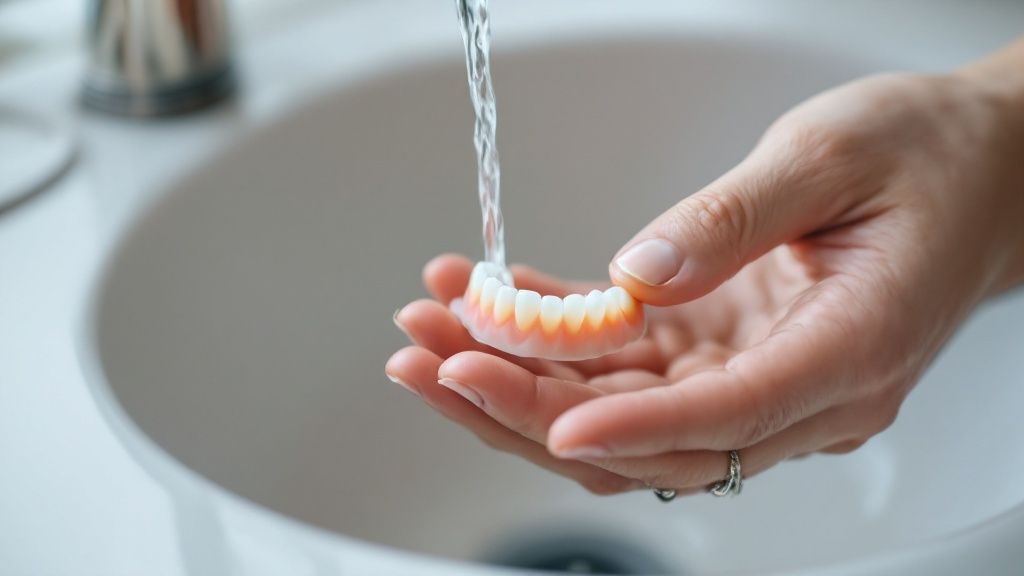
This shift is fundamentally changing how specialists design and craft everything from a single crown to a full set of implants, which translates directly into better, longer-lasting results for patients.
The Rise of Digital Workflows
Remember the days of biting down on a tray full of goopy, unpleasant impression material? For the most part, those are gone. Modern prosthodontics has moved on, embracing a seamless digital process from the first scan to the final restoration.
CAD/CAM Technology: This is a big one. Computer-Aided Design and Computer-Aided Manufacturing lets a prosthodontist design your perfect restoration on a screen. Then, an in-office milling machine carves it from a solid block of high-strength ceramic. This is the magic behind same-day crowns.
3D Printing: This technology is pushing the boundaries of precision. We can now 3D print incredibly accurate surgical guides for placing dental implants, guaranteeing the perfect angle and depth for a successful outcome. We also use it for creating detailed models of your teeth or even temporary restorations while your permanent ones are being made.
What does this all mean for you? It means a more comfortable and precise fit, dramatically shorter treatment times, and results that are consistent and predictable.
Stronger and More Beautiful Materials
It's not just the process that's getting better—the materials themselves are a huge part of the story. We're now working with advanced ceramics like zirconia that offer the best of both worlds: exceptional strength and surprisingly natural aesthetics.
These materials are tough enough to handle the immense biting forces on your back molars, yet they can be crafted to look indistinguishable from natural tooth enamel.
This combination of digital techniques and next-generation materials is revolutionizing how dental prosthetics are made. You can read more about the trends in the dental prosthetics market on persistencemarketresearch.com.
Ultimately, the goal is simple: providing state-of-the-art solutions that are as efficient and comfortable as they are beautiful and built to last.
Common Questions About Prosthodontic Care
Stepping into the world of specialized dental care naturally brings up a lot of questions. If you're wondering what a prosthodontist can do for you, getting clear, straightforward answers is the first step. Let's walk through some of the most common questions we hear from patients right here in our San Diego clinic.
Is Prosthodontic Treatment Covered By Insurance?
This is probably the most frequent question we get, and the honest answer is: it depends. Coverage for prosthodontic work varies quite a bit based on your insurance plan and the specific treatment you need.
Generally speaking, treatments that are considered medically necessary for restoring function—like a crown on a badly broken tooth or a bridge to fill a gap—often receive partial coverage from PPO plans. Procedures that are seen as purely cosmetic, however, might not be included. Your best bet is always to check directly with your insurance provider. We can also walk you through flexible out-of-pocket and financing options to help make the smile you want a reality.
How Is A Prosthodontist Different From A General Dentist?
I like to use a medical analogy here. Think of your general dentist as your primary care physician for your teeth—they are your go-to for checkups, cleanings, and common fillings. A prosthodontist, on the other hand, is the specialist you see for complex issues, much like you'd see a cardiologist for a heart condition.
After finishing four years of dental school, a prosthodontist completes an additional three years of intensive, focused training. This rigorous program is all about mastering the art and science of restoring and replacing teeth, making them the true experts in handling full-mouth reconstructions, intricate cosmetic work, and the most challenging dental cases.
How Long Do Prosthodontic Restorations Last?
The durability of your new smile really comes down to two things: the type of restoration and how well you take care of it.
- Crowns and Bridges: With good daily oral hygiene and regular dental visits, you can expect these to last 10 to 15 years, and often much longer.
- Dental Implants: These are a game-changer because they're designed to be a permanent solution. The titanium post itself can last a lifetime once it integrates with your jawbone. The crown on top might need to be replaced after 15 to 20 years due to normal wear and tear, but the foundation remains solid.
Ultimately, maintenance is everything. For a deeper dive, check out our guide on how to look after dental implants and maintain your oral health.
Ready to explore how prosthodontic dentistry can restore your confidence and oral health? The expert team at Serena San Diego Dentist is here to guide you. Schedule your consultation today to create a personalized plan for your perfect smile at https://serenasandiegodentist.com.