
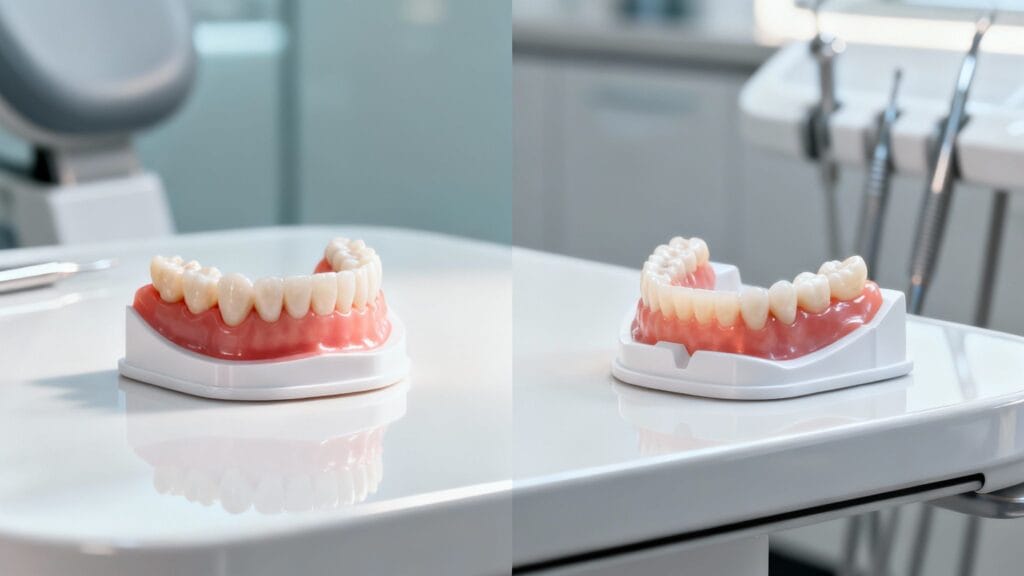
If you're missing teeth, your dentist will likely talk to you about two popular options: a dental bridge or a partial denture. Think of it this way: a dental bridge is a permanent, fixed solution that literally bridges the gap left by one or two missing teeth in a row. A partial denture, on the other hand, is a removable appliance that can replace several missing teeth, even if they aren't right next to each other.
Choosing the right one isn't a one-size-fits-all decision; it depends on your unique situation—how many teeth are missing, where they are, the health of your jawbone, your budget, and whether you prefer something fixed in place or something you can take out.
Choosing Your Best Tooth Replacement Option
Deciding how to replace missing teeth is a significant step. It’s not just about restoring your smile; it's about regaining your confidence and your ability to eat and speak with ease. When you weigh a fixed bridge against a removable partial denture, you’re considering factors that will shape your daily routine, cleaning habits, and oral health for years. We understand that this choice can feel overwhelming, but we're here to make it clear and comfortable.
Getting the right diagnosis from the start is absolutely key. This is where modern imaging comes into play. You can learn more about how CBCT scans are revolutionizing dental diagnostics for tooth replacements to understand how this technology gives your dentist a crystal-clear picture of your jawbone and helps them plan a restoration that fits you perfectly.
Key Factors in Your Decision
To make a truly informed decision, it helps to put these two excellent options side-by-side. While we'll get into the details, here's a quick look at the main points of comparison.
| Feature | Dental Bridge | Partial Denture |
|---|---|---|
| Permanence | Cemented in place; you don't take it out. | Removable for daily cleaning and at night. |
| Appearance | Usually offers a very natural, seamless look. | Can look great, though metal clasps might be visible. |
| Oral Hygiene | Needs special cleaning tools like floss threaders. | Must be removed and cleaned separately every day. |
| Impact on Teeth | Requires preparing adjacent teeth to support crowns. | Rests on existing teeth, typically without altering them. |
| Candidacy | Perfect for replacing 1-3 consecutive missing teeth. | Great for multiple missing teeth, even in different spots. |
Getting a handle on these differences is your first step. Both solutions have their own clear benefits, and the best one for you really depends on your individual needs and what you hope to achieve for your oral health. For a wider view of all the possibilities, our guide on oral care and tooth replacement alternatives can give you more background before you sit down with your dentist.
How Dental Bridges Restore Your Smile
A dental bridge is a fixed, non-removable solution for filling the gap left by one or more missing teeth. Think of it as a literal "bridge" spanning that empty space. It's a popular choice because it delivers a stable, life-like result that brings back both your bite and your confidence.
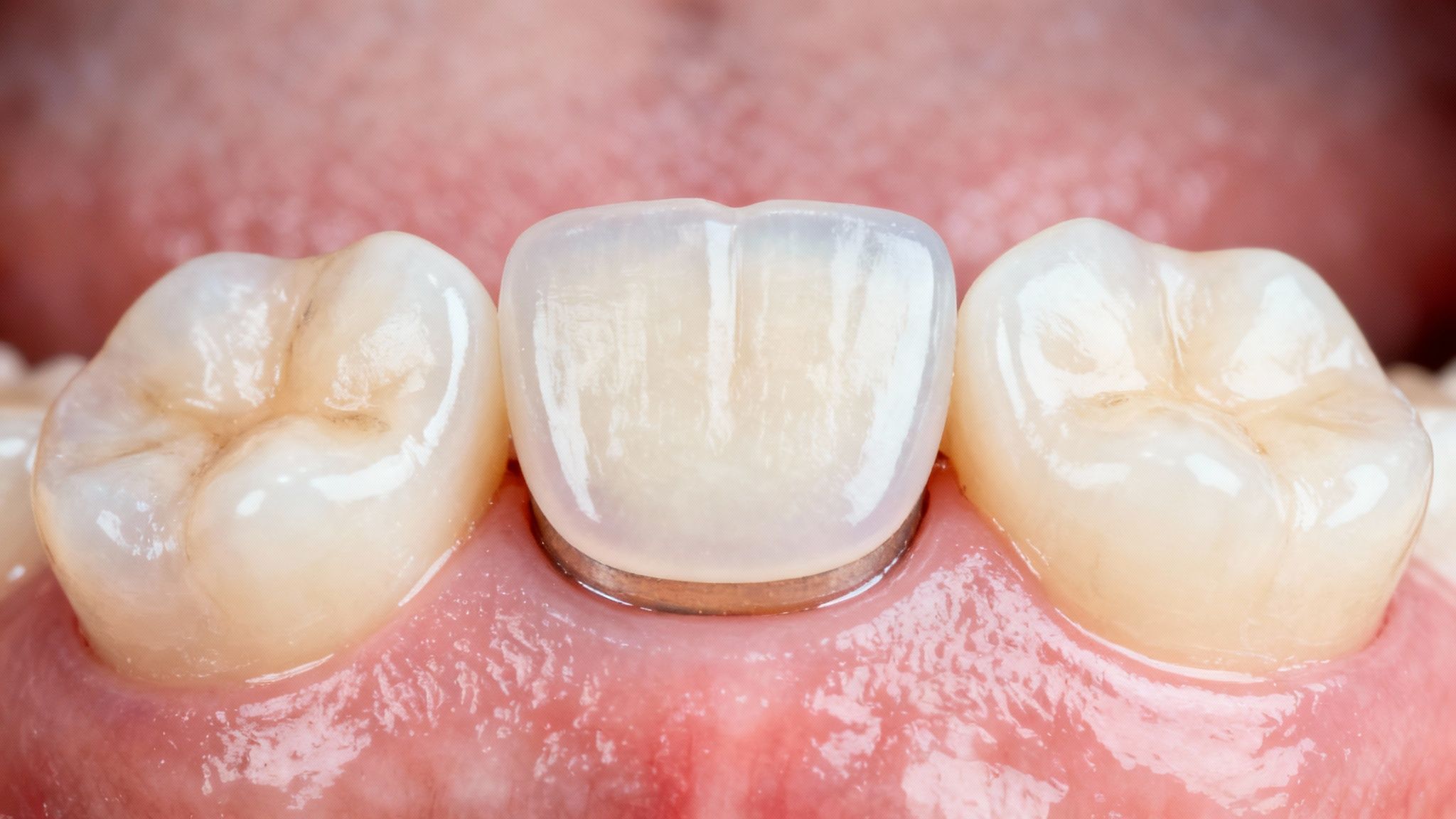
The most common design is the traditional bridge. It’s made of two crowns, called abutments, and a prosthetic tooth, known as a pontic. The crowns fit snugly over the healthy teeth on either side of the gap, securely anchoring the pontic in the middle. This setup feels incredibly secure, letting you chew and speak naturally.
The Procedure From Start to Finish
Getting a dental bridge is a straightforward process that usually wraps up in just two visits. Knowing what's involved can make the whole experience feel much more comfortable.
- Consult & Prep: First, we'll make sure the neighboring teeth are strong enough to act as anchors. If they are, we'll carefully reshape them to create the perfect foundation for the crowns. We ensure you are completely comfortable and numb during this step.
- Impressions & Temp Bridge: Next, we take precise impressions of your teeth. These are sent to a dental lab where skilled technicians craft a custom bridge that perfectly matches the color and shape of your existing teeth. You'll go home with a temporary bridge to keep everything protected.
- Placing the Final Bridge: At your second appointment, we'll remove the temporary and test the fit of your permanent bridge. After making sure it's perfect, we'll bond it securely in place with a strong dental cement.
The crowns on the abutment teeth are the foundation of a successful bridge. To see what that part of the process involves, you can dive deeper into the dental crown procedure steps in our guide.
Materials Used in Dental Bridges
The material we choose for your bridge has a big impact on its look, durability, and cost. Each one has its own strengths.
- Porcelain-fused-to-metal (PFM): A classic choice that combines a strong metal core with a natural-looking porcelain overlay.
- All-Ceramic or All-Porcelain: These are the top pick for aesthetics. They mimic the slight translucency of natural tooth enamel, which makes them a fantastic option for highly visible front teeth.
- Zirconia: This is a powerhouse ceramic. It's incredibly strong, resists chipping, and looks great, making it a reliable choice for anywhere in the mouth.
One of the best things about a fixed dental bridge is that it truly feels and functions like your own teeth. Since it’s cemented in place, you don't have to remove it for cleaning, which offers a level of convenience and stability many people love.
Other Types of Dental Bridges
While traditional bridges are the go-to, a couple of other designs exist for specific situations.
A cantilever bridge is an option when there's only one healthy tooth next to the gap to serve as an anchor. It's not as common and is usually reserved for areas of the mouth that don't take on heavy chewing forces.
A Maryland bridge is a more conservative design. Instead of full crowns, it uses little metal or porcelain "wings" bonded to the back of the neighboring teeth. This preserves more of the natural tooth structure and is often used for replacing missing front teeth.
Knowing how a dental bridge works and the different options available makes it clear why it remains a trusted and celebrated solution for rebuilding a full, vibrant smile.
Understanding How Partial Dentures Work
While a dental bridge is cemented in place, a partial denture offers a versatile, removable alternative. Think of it as a great choice for people missing several teeth, especially if those gaps aren't right next to each other in a neat row.
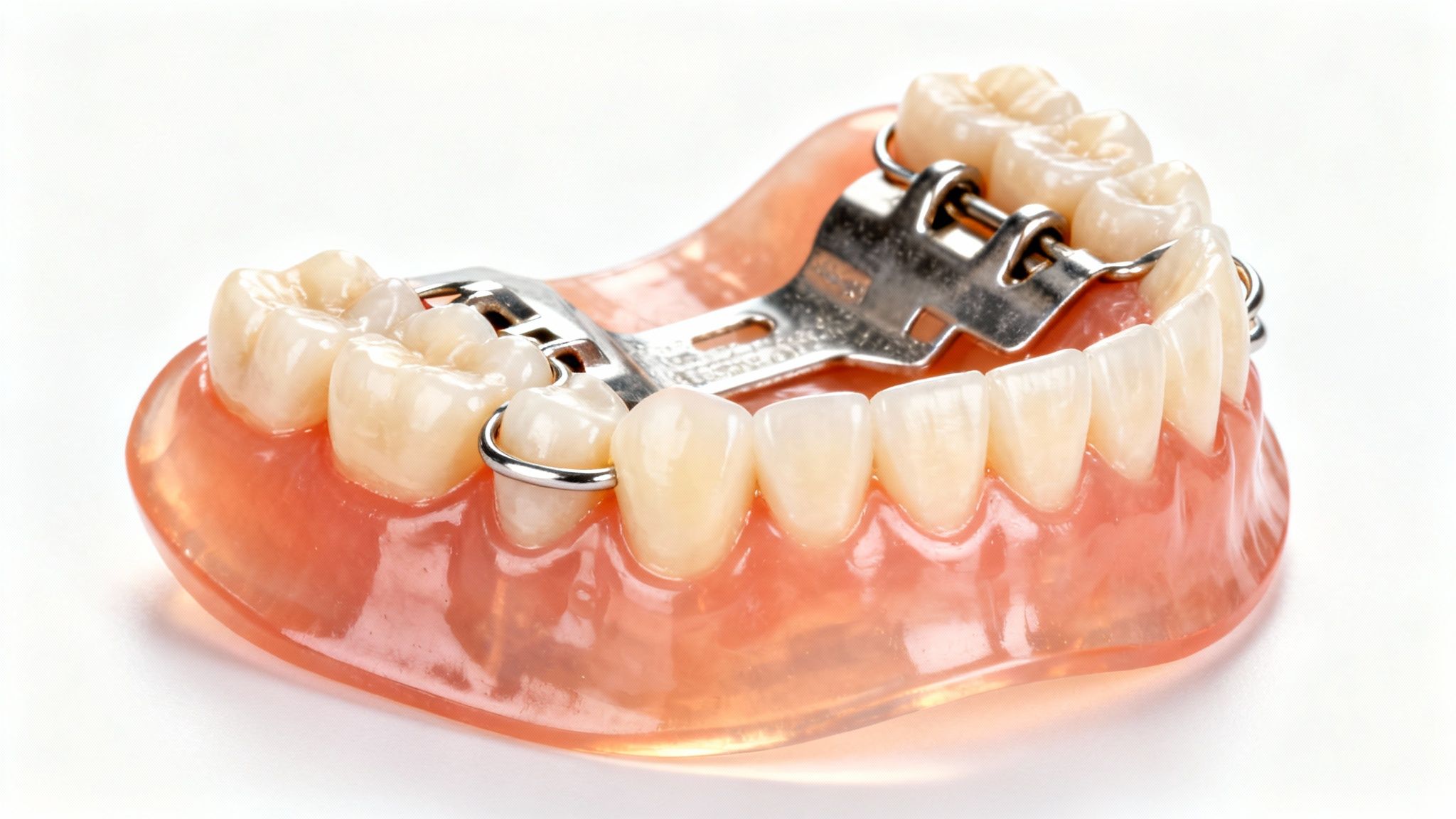
Unlike a bridge, you take a partial denture out every day for cleaning. This simple fact is a game-changer for many people weighing the dental bridge vs partial denture decision, as it makes the appliance uniquely adaptable.
The Anatomy of a Partial Denture
A partial denture isn't just one piece; it's a few key components working in concert to bring back your smile and chewing function. Each part is custom-made to fit your mouth precisely.
- The Acrylic Base: This is the foundation, a gum-colored base that rests on the soft tissues of your mouth. It's carefully crafted to look natural and feel comfortable.
- Artificial Teeth: The replacement teeth are set right into that acrylic base. Modern dental materials ensure they look and work just like the real thing.
- Clasps or Connectors: These are the small but mighty elements that hold the denture in place. They gently wrap around some of your remaining healthy teeth, giving you the stability to eat and speak with confidence.
These clasps are often made from strong, traditional metal, but you can also get them in a more flexible, gum-colored plastic for a subtler look.
The Patient Journey to Getting a Partial
Getting a partial denture is all about precision and patience. It's a multi-step process that unfolds over several appointments to ensure every last detail is perfect.
It all starts with your dentist taking highly accurate impressions of your mouth. These molds are like a blueprint, capturing the exact shape of your gums and teeth, which a dental lab then uses to build your custom appliance.
You’ll likely have a "try-in" appointment where a wax version of the denture is fitted. This is our chance to check the bite, comfort, and look before the final version is created. Once it's ready, your final fitting involves making tiny adjustments until it feels just right.
One of the biggest advantages of a partial denture is how adaptable it is. If you happen to lose another tooth down the road, we can often just add a new tooth to your existing partial. This makes it a really flexible long-term solution.
Daily Care and the Adjustment Period
Living with a partial denture means adopting a new daily routine. You’ll need to take it out every night to clean it thoroughly. This not only keeps the appliance fresh but also gives your gums a much-needed break.
It’s completely normal to go through an adjustment period at first. Your mouth needs some time to get used to the new appliance, and you might notice some temporary changes to your speech or how you eat. This initial phase usually passes within a few weeks as your muscles get the hang of it.
Proper care is everything. Removing and cleaning your partial daily prevents plaque from building up on both the denture and your natural teeth, protecting your overall oral health. Your dentist will walk you through exactly how to clean and store it to keep it in great shape for years to come.
Comparing a Bridge and a Partial Denture
Choosing between a dental bridge and a partial denture is a big decision. It’s about more than just filling a gap in your smile—it’s about finding a solution that fits your lifestyle, your budget, and your long-term oral health goals. Let's break down how they stack up against each other in the areas that really count.
This infographic gives a great at-a-glance look at the core difference: a fixed bridge versus a removable partial.
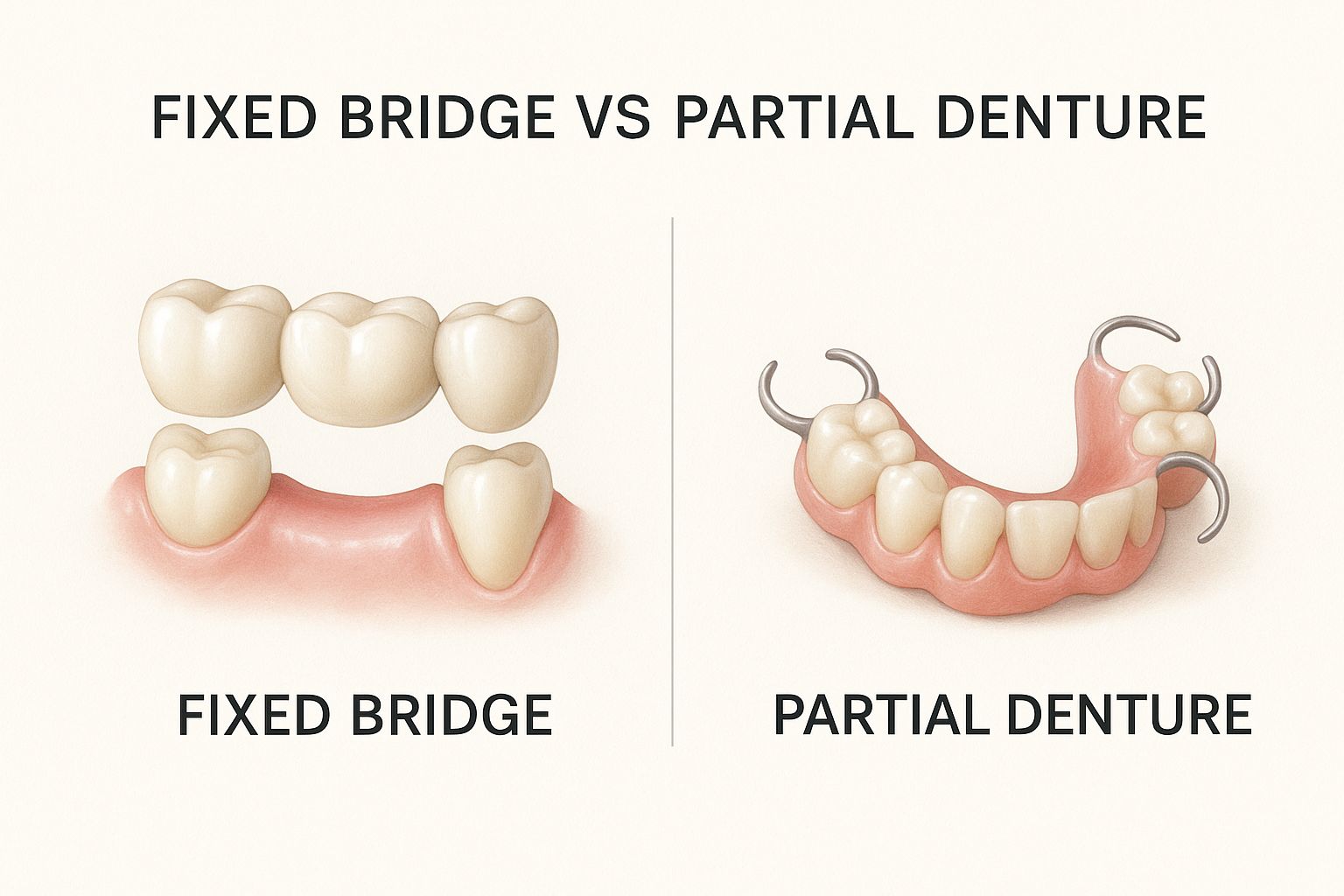
As you can see, a bridge becomes a permanent part of your mouth by attaching to neighboring teeth, while a partial denture is designed to be taken in and out.
Durability and Lifespan
When you're investing in your smile, you want something that's built to last. Both options are reliable, but they have different lifespans and vulnerabilities.
A well-cared-for dental bridge can last anywhere from 5 to 15 years, sometimes even longer. Its success is directly tied to the health of the teeth it's anchored to, known as abutment teeth. If you keep those teeth strong and cavity-free, your bridge will have a long and stable life.
Partial dentures are also quite durable, typically lasting 5 to 10 years. They often need replacement because of natural wear on the materials or because changes in your jawbone affect how they fit over time.
Comfort and Daily Function
This is where the "fixed vs. removable" debate really comes to life. How your new teeth feel on a daily basis is a major consideration.
Since a dental bridge is cemented in place, it feels and functions almost exactly like your natural teeth. There’s no adjustment period; you can eat and speak confidently from day one. It just becomes another part of your smile.
A partial denture, on the other hand, takes some getting used to. It might feel a bit bulky at first, and learning to eat and talk with it can take a little practice. While today's partials are made for a snug and comfortable fit, they don't have that "set it and forget it" security of a fixed bridge.
For many patients, the decision comes down to this feeling of permanence. A bridge feels like your tooth, while a partial denture feels like an appliance you wear.
To help you see the differences more clearly, here is a quick side-by-side comparison of their key features.
Feature Comparison: Dental Bridge vs. Partial Denture
| Feature | Dental Bridge | Partial Denture |
|---|---|---|
| Type | Fixed, permanently cemented | Removable, taken out for cleaning |
| Stability | Excellent, feels like natural teeth | Good, but can shift slightly |
| Procedure | Requires preparing adjacent teeth | Minimal impact on other teeth |
| Lifespan | 5-15 years | 5-10 years |
| Daily Care | Flossing under the bridge | Removed and cleaned nightly |
| Cost | Higher upfront cost | More affordable upfront |
| Best For | One or two missing teeth in a row | Multiple, non-adjacent missing teeth |
This table highlights the fundamental trade-offs you'll be considering. The choice often depends on balancing stability and cost with convenience and the number of teeth being replaced.
Aesthetics and Natural Appearance
Both options do a fantastic job of restoring a full, beautiful smile, but they get there in slightly different ways.
A dental bridge, particularly one crafted from all-ceramic or zirconia, can be virtually indistinguishable from your natural teeth. Because it’s a single, fixed unit, there are no visible clasps or clips—just a seamless, natural-looking smile.
Partial dentures also offer a very natural appearance, with artificial teeth set into a pink, gum-colored base. Many modern designs even use flexible, tooth-colored clasps to avoid the look of metal. However, if traditional metal clasps are used, they might be visible in certain situations, which is a factor for some people.
Oral Hygiene and Maintenance
Your daily cleaning routine is going to look a little different depending on which path you take. Good hygiene is non-negotiable for making either option last.
- Dental Bridge Care: Cleaning a bridge takes a little finesse. You'll need to use special tools like a floss threader or a water flosser to get underneath the artificial tooth (the pontic). This is crucial for preventing plaque buildup and keeping the supporting teeth healthy.
- Partial Denture Care: A partial is simpler to clean, but it requires a consistent routine. You have to take it out every night to brush it thoroughly with a denture cleaner. This keeps the appliance clean and gives your gums and underlying tissues a chance to breathe.
If you're weighing all your options, it can be helpful to see how these two compare to a third popular choice: dental implants. Our comprehensive breakdown of dental implants vs dentures can provide even more context to help you make a confident decision.
Long-Term Success and Clinical Performance
When you're choosing between a dental bridge and a partial denture, it's easy to focus on the immediate fit and feel. But the real test is how they hold up over time. We need to look at their clinical performance—how well do they actually work after five, ten, or even fifteen years of chewing, talking, and daily life?
Understanding the evidence-backed success rates and what can go wrong down the line is key to making a choice you'll be happy with for years to come.
Dental bridges are built for the long haul. When cared for properly, they have impressive durability and become a fixed, stable part of your mouth. They're not something you have to think about day-to-day.
Clinical studies consistently back up the reliability of dental bridges. The data gives us a clear picture of what patients can expect from their investment, showing it’s a dependable, long-term solution.
Extensive research confirms this, showing that dental bridges have an estimated 10-year survival rate between 79% and 82%. That means the vast majority of bridges are still going strong after a full decade. For a deeper dive, you can explore the research on fixed dental prosthesis outcomes and see the full data for yourself.
Longevity Factors for Dental Bridges
So, what makes a bridge last? It almost always comes down to the health of the abutment teeth—those are the natural teeth on either side that anchor the bridge.
The number one reason a bridge fails is decay getting in underneath the crowns on those supporting teeth. This is why meticulous oral hygiene isn't just a suggestion; it's essential. You have to be diligent about cleaning around and under the bridge every single day to keep plaque away and protect those foundational teeth.
Performance Outlook for Partial Dentures
Partial dentures, on the other hand, typically have a lifespan of 5 to 10 years. The appliance itself is often quite durable, but the limiting factor isn't the denture breaking—it's the changes happening in your mouth.
Over time, your gum tissues and the underlying jawbone naturally shift and recede. This can cause a once-snug denture to become loose and ill-fitting, which means it will need to be adjusted, relined, or replaced entirely.
Regular check-ups are crucial for monitoring these changes to keep the partial stable and comfortable. For anyone exploring their options, our guide on maintaining dental implants and oral health has great tips on the importance of ongoing care, which applies to any dental restoration you choose.
Ultimately, whether you get a bridge or a partial, consistent home care and professional oversight are what will truly maximize its lifespan and performance.
So, Which One Should You Choose?
Deciding between a dental bridge and a partial denture isn't about picking the "best" option—it's about finding the right fit for your mouth, your budget, and your lifestyle. Let's move past the technical jargon and look at some real-life situations to see which solution makes the most sense.
Think of it this way: your oral health, the number and location of missing teeth, and even your daily routine are the biggest factors. What works perfectly for a friend might not be the ideal choice for you.
Practical Scenarios: Bridge vs. Partial
To put this into perspective, let's walk through a few common patient scenarios.
Scenario 1: You’re missing one tooth, but the teeth on either side are healthy and strong.
A dental bridge is almost always the go-to recommendation here. It’s a fixed solution, so you never have to take it out. It feels completely natural, looks seamless, and gives you that sturdy, reliable function you're used to.Scenario 2: You have several missing teeth, and they aren't all next to each other.
This is where a partial denture really shines. It's designed to replace multiple teeth across your arch with just one appliance. Plus, it’s a far more conservative approach since it doesn't require altering the neighboring healthy teeth for crowns.Scenario 3: Your top priority is finding the most budget-friendly way to replace multiple teeth.
Hands down, a partial denture is the winner for initial cost. It’s a practical and effective way to get your smile and chewing ability back without the higher upfront investment required for bridges or implants.
At the end of the day, the goal is to choose a restoration that doesn't just fill a space, but also protects the long-term health of your entire mouth. It’s a trade-off: the rock-solid stability of a bridge versus the flexibility and wider coverage of a partial denture.
The Final Step: A Conversation with Your Dentist
This is a decision you should make with your dentist, not for them. Prosthetic solutions like bridges and dentures are a cornerstone of modern dentistry, helping people keep their natural teeth for a lifetime. And they are incredibly reliable—research shows that the 10-year survival probability for a well-maintained fixed bridge is around 89%. You can read more about these clinical trends and success rates.
Now that you understand the key differences from a practical standpoint, you're ready for a meaningful conversation with your dentist. They can give you a professional evaluation and help you land on the perfect solution to restore your smile, your confidence, and your ability to enjoy your favorite foods again.
Frequently Asked Questions
Even after weighing the pros and cons, you probably still have a few questions. That's completely normal. Let's tackle some of the most common ones we hear from patients trying to decide between a dental bridge and a partial denture.
Can a dental bridge replace several missing teeth?
A dental bridge is a fantastic option, but it's really designed to replace one to three teeth in a single, continuous row. Its success depends entirely on having strong, healthy teeth on either side of the gap to serve as anchors.
If you're missing several teeth that aren't next to each other, or if the gap is just too wide, a partial denture is almost always the more practical solution. It's designed to replace multiple teeth anywhere in the upper or lower arch with one single appliance.
Will it be hard to adjust to a partial denture?
There’s definitely an adjustment period. When you first start wearing a partial denture, it might feel a little bulky or foreign in your mouth. It can take a bit for your tongue and cheeks to get used to it while you eat and speak.
But don't worry—this phase is usually short-lived. Today's partials are custom-made for a precise, comfortable fit. Most people find that after a few weeks of wearing it regularly, the denture starts to feel completely natural, just another part of their day.
Which is better if I might lose more teeth in the future?
This is a critical question to consider for your long-term oral health. In this case, a partial denture gives you much more flexibility. If you lose another tooth down the line, a dentist can often add a new tooth to your existing partial. It’s a fairly simple and affordable fix.
A dental bridge, on the other hand, is a fixed unit. It can’t be modified. If an anchor tooth fails or you lose another tooth nearby, the entire bridge has to be removed, and you’ll have to start over with a new treatment plan.
Choosing between a dental bridge vs partial denture often comes down to future-proofing your smile. A partial offers adaptability, while a bridge provides unmatched stability for the current gap.
Are bridges and partials covered by dental insurance?
Yes, most dental insurance plans do offer coverage for both options. They are typically classified as major restorative procedures, which are essential for your oral health, not just cosmetic.
How much is covered can vary quite a bit, but it's common for plans to pay for up to 50% of the cost after you've met your deductible. At Serena San Diego Dentist, we work with a wide range of PPO insurance plans and also offer flexible out-of-pocket payment options to ensure care is accessible. The best move is to review your policy or have our office verify your benefits so you know exactly what to expect.
Ready to explore the best tooth replacement option for your smile? The team at Serena San Diego Dentist is here to provide a personalized consultation and guide you toward the perfect solution. Schedule your appointment with us today by visiting https://serenasandiegodentist.com.