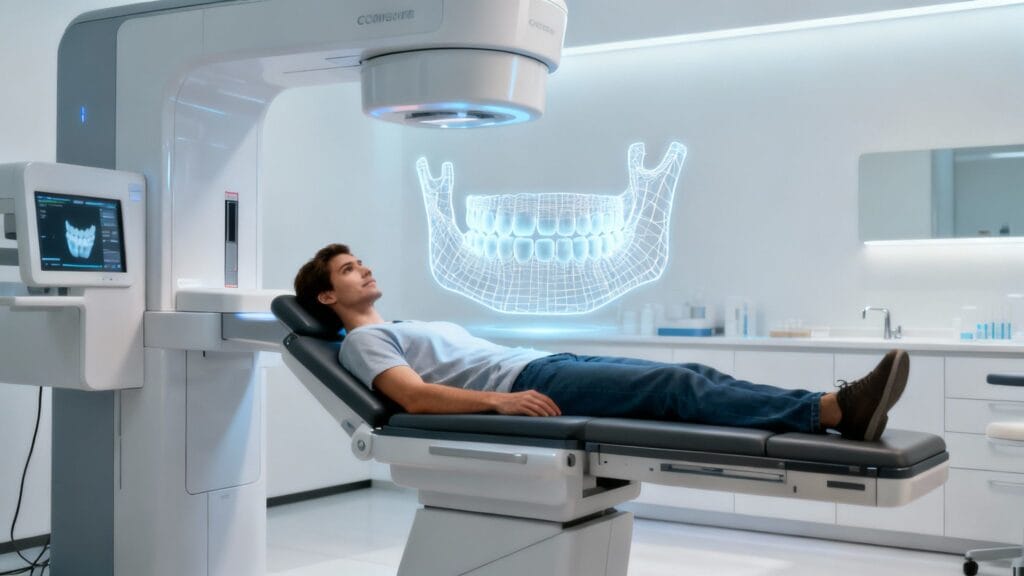
Think of a standard dental X-ray as a flat map of your teeth and jaw. It's useful, for sure, but it can't show you the full picture. A teeth CT scan, on the other hand, is like having a complete 3D GPS model of your entire oral anatomy. It gives us an incredibly detailed view of everything—your teeth, jawbone, nerves, and even the soft tissues.
This comprehensive perspective, created by a technology called Cone Beam Computed Tomography (CBCT), is absolutely crucial for planning complex dental procedures with pinpoint accuracy.
What Is a Dental CT Scan and How Does It Work?
For years, dentists relied on traditional 2D X-rays. They’re great for spotting cavities or checking on the general health of your teeth, but they have their limits. A flat image can't truly show the depth, width, or density of your jawbone. It also can’t precisely trace the path of a nerve or show the exact contours of your sinuses. That’s where a teeth CT scan completely changes the game.
It’s like trying to navigate a city with just a postcard. You see the main landmark, but you miss all the side streets and the layout of the buildings. A CBCT scan gives us the full, interactive map.
“Standard X-rays are like snapshots of a single street; CBCT scans let you explore the whole city in 3D.”
The Cone Beam Technology
The "cone beam" name comes from the actual shape of the X-ray beam used. During the scan, a machine makes a single, swift rotation around your head, capturing hundreds of individual images from every possible angle. The entire process is incredibly fast, often finishing in less than a minute.
From there, powerful software takes these hundreds of "slices" and digitally stitches them together into a perfect, high-resolution 3D model. With this model, your dentist can virtually step inside your jaw to:
- Measure bone density and volume to confirm if you're a good candidate for dental implants.
- Pinpoint the exact location of major nerves and sinuses to avoid them during surgery.
- Clearly visualize impacted teeth or complex root canal systems.
- Get to the bottom of TMJ disorders and other complex jaw problems.
Precision and Predictability
This level of detail takes all the guesswork out of complex treatments. When we have a complete picture before a procedure even starts, we can plan every single step with surgical precision. This means better, more predictable outcomes and a much higher level of safety for you. If you're interested in the technical side of how these imaging centers operate, this complete guide for imaging centers and teleradiology services offers a deep dive.
At Serena San Diego Dentist, we've integrated this technology directly into our practice because we believe every patient deserves the most accurate diagnosis and treatment plan. You can learn more about our commitment to using the latest dental technology for superior care. It's this approach that allows us to deliver predictable, lasting results, whether we're placing a single implant or planning a full mouth reconstruction.
When Would I Need a Dental CT Scan?
While a regular X-ray gives us a great starting point, some situations demand a much deeper look. A dental CT scan isn't something every patient needs, but for more complex cases, it’s the difference between guessing and knowing. It provides the essential blueprint we need for predictable, safe, and successful treatment.
Think of it like this: you wouldn't build a house with just a single photo of the land. You'd want a complete survey showing every hill, valley, and rock. A CBCT scan gives us that same level of detailed surveying for your mouth.
So, when does this technology really shine? Let's break down the most common scenarios.
Common Reasons for a Teeth CT Scan
Here’s a quick overview of the key procedures where a 3D scan is often the best choice and why it's so helpful for our team.
| Dental Procedure | Reason for CT Scan | Information Gained |
|---|---|---|
| Dental Implants | To assess bone structure for placement. | Exact bone width, height, and density. Precise location of nerves and sinuses to avoid. |
| Root Canals | To map complex or hidden root anatomy. | Reveals extra canals, sharp curves, and micro-fractures missed by 2D X-rays. |
| Impacted Teeth | To pinpoint the exact position of a trapped tooth. | Shows the tooth's relationship to other roots, nerves, and bone for safe extraction. |
| Jaw Issues (TMJ) | To evaluate the temporomandibular joint. | Provides a clear view of the joint's condition, helping diagnose disorders. |
| Oral Surgery | To plan for complex extractions or bone grafts. | Gives a complete anatomical map for precise surgical planning and risk avoidance. |
Each of these situations requires an incredible amount of precision, and that's exactly what a CT scan delivers.
Planning for Dental Implants
One of the most frequent uses for a dental CT scan is planning for dental implants. For an implant to last a lifetime, it needs a solid foundation in the jawbone. A standard 2D X-ray just doesn't give us the full picture.
Here’s what the 3D scan shows us for implant planning:
- Bone Density and Volume: We can see the exact width, height, and quality of your jawbone, confirming if there’s enough healthy bone to secure an implant.
- Nerve and Sinus Location: The 3D model precisely maps out critical structures, like the main nerve in your lower jaw or your sinus cavities up top. This lets us place the implant with surgical precision, keeping you safe from potential complications.
- Optimal Placement Angle: We can even perform a virtual surgery on the computer first, figuring out the perfect angle and position for the implant to ensure it looks natural and remains stable for years to come.
Navigating Complex Root Canals
Root canal therapy is necessary when the soft tissue, or pulp, inside a tooth gets infected. Most are fairly straightforward, but some teeth are tricky. They might have extra canals or unusual curves that are completely invisible on a normal X-ray.
A CBCT scan gives an endodontist (a root canal specialist) a 3D view of the tooth’s entire root system. This helps them find hidden canals, spot tiny fractures, and see the full extent of an infection, making sure every last bit is cleaned out and sealed.
Orthodontics and Oral Surgery
Beyond implants and root canals, a dental CT scan is invaluable for other advanced treatments. Orthodontists rely on it to see the exact position of impacted teeth—especially wisdom teeth and canines—so they can plan a safe way to bring them into alignment.
It's also a critical tool for diagnosing TMJ disorders, identifying cysts or tumors in the jaw, and planning for complex extractions. The detailed anatomical map is crucial for any procedure that falls under oral surgery. To learn more about what that involves, you can check out our guide to oral surgery.
A CBCT scan is the gold standard for any procedure where anatomical precision is non-negotiable. It removes uncertainty and empowers your dental team to plan for success.
The use of CBCT has exploded in modern dentistry because of its incredible diagnostic power. In fact, research shows that over 70% of dental implant procedures now use CBCT imaging for planning. This isn't just a trend; it's a testament to its value in boosting patient safety and making treatment outcomes far more reliable. This shift shows how better technology directly leads to better, safer care for patients.
A Step-by-Step Walkthrough of the Dental CT Scan Procedure
If you're feeling a little nervous about an upcoming dental CT scan, knowing exactly what to expect can make all the difference. The good news is the whole thing is quick, completely painless, and surprisingly simple. Let’s walk through it together, step by step.
Preparing for Your Scan
You can relax—there’s almost nothing you need to do to prepare. Unlike other medical scans, you won't have to fast or follow a special diet. It's that easy.
Your only real job is to remove any metal objects from your head and neck. Metal can create fuzzy spots or streaks on the final 3D image, so taking these off ensures your dentist gets the clearest picture possible.
Be sure to remove:
- Jewelry like earrings and necklaces
- Eyeglasses
- Hairpins, clips, or barrettes
- Hearing aids
- Any removable dental work, such as dentures or retainers
We also suggest wearing comfy, loose-fitting clothes to your appointment for maximum comfort.
Getting Positioned in the Scanner
When you enter the imaging room, a technician will lead you to the CT machine. These are very open-feeling machines, and you'll either sit or stand, depending on the model. The technician will gently guide you to get your head perfectly positioned for the scan.
You'll rest your chin on a small support, and there might be soft stabilizers by your forehead to help you stay perfectly still. It's not uncomfortable at all—it just prevents tiny wiggles that could blur the image. You'll also be asked to bite down on a small plastic piece, which helps separate your upper and lower teeth for a clearer view.
The infographic below shows just how this detailed 3D data is used to plan everything from dental implants and root canals to orthodontics.
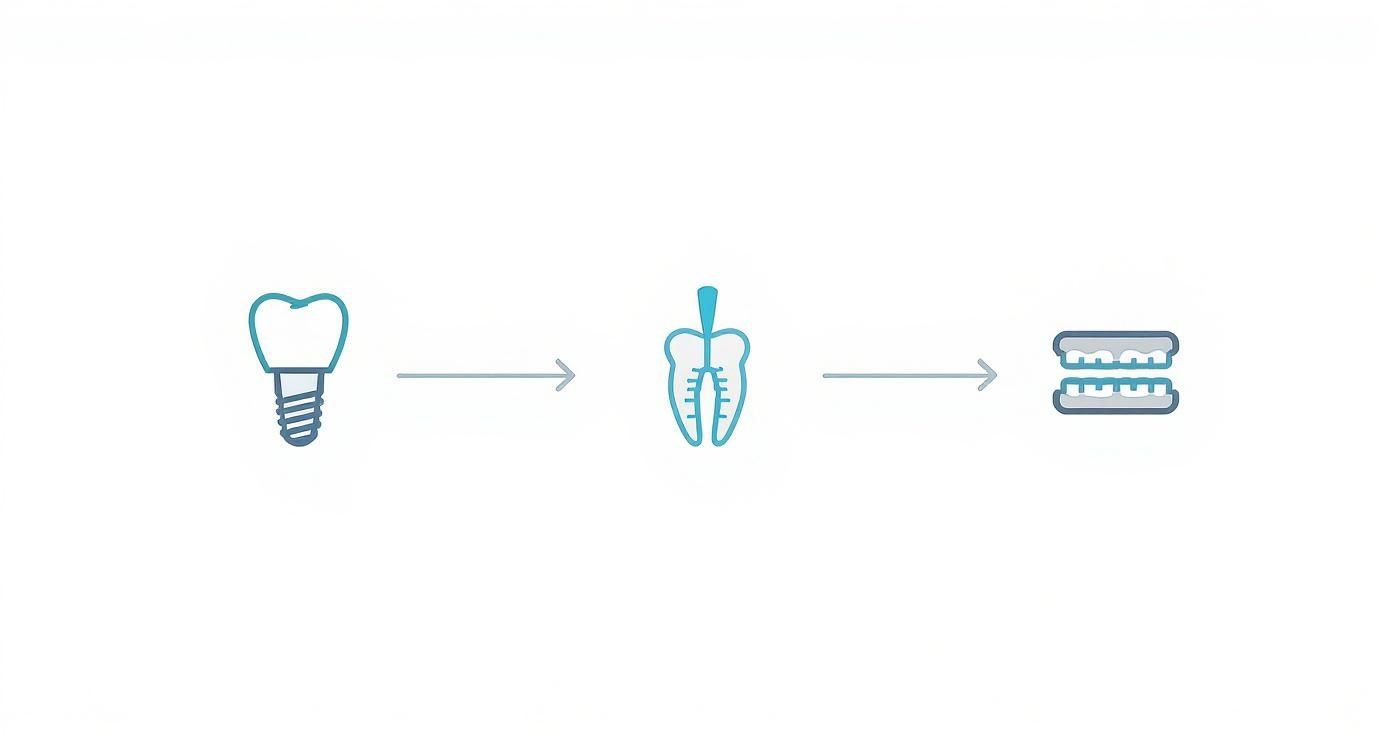
You can see how the scan data becomes a direct roadmap for your dentist, leading to much more precise and effective treatment.
During the Scan Itself
Once you’re all set, the technician will pop into a nearby room to start the scan. You'll be in plain sight the whole time through a window, so you're not alone.
When it starts, a C-shaped arm on the machine will make one quiet, smooth rotation around your head. You won't feel anything at all.
Your only task is to stay as still as you can. It’s a breeze, though, because the entire scan is over in a flash—usually taking just 10 to 40 seconds. It's often finished before you even realize it started.
What Happens After the Scan
And that's it! As soon as the machine stops moving, you're done. The technician will help you out, and you can immediately put your glasses, jewelry, or dentures back in.
There are zero side effects or downtime. You can walk right out and get back to your day, whether that’s heading back to work or running errands.
In the background, the scanner's advanced software is already stitching together hundreds of individual image "slices" into a comprehensive 3D model of your mouth. Your dentist can view these results almost instantly, exploring your anatomy from every conceivable angle to map out the perfect treatment plan.
The Perks of Seeing Your Smile in 3D
Think of it this way: a standard, flat X-ray is like looking at a map of a city. It’s useful, but it doesn’t show you the height of the buildings or what’s underground. A teeth ct scan, on the other hand, is like having a complete 3D model of that city you can explore from any angle.
This leap in technology gives us a level of clarity that completely changes how we plan and perform dental work. The advantages go way beyond just getting a "better picture"—they lead to safer procedures, more predictable outcomes, and a much better experience for you.
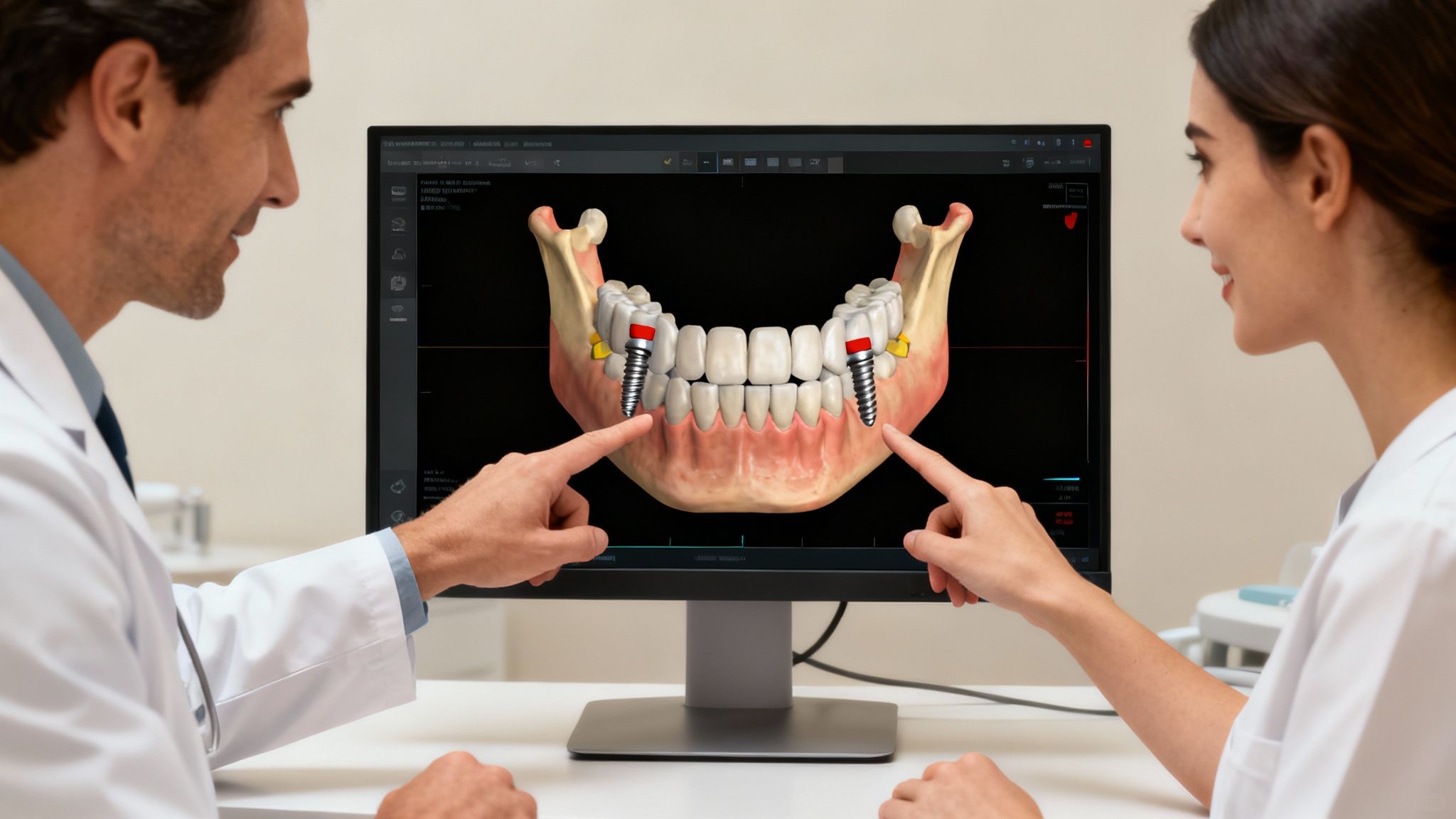
With this kind of detailed imaging, we can see your unique anatomy with incredible precision. It ensures every decision we make is based on a full and complete understanding of your oral health.
Unmatched Accuracy and Detail
The single biggest win with a 3D scan is its incredible accuracy. A traditional 2D X-ray can sometimes make things look distorted or hide problems by overlapping structures. A CBCT scan, however, creates a perfect 1:1 digital model of your jaw, teeth, and facial bones.
This means we can measure bone density down to the millimeter, trace the exact path of a nerve, and spot tiny issues that might otherwise go completely unnoticed. There are no surprises during surgery because we've already explored the entire area from every angle on a computer screen.
For instance, we had a patient named Mark who was interested in a dental implant. His 2D X-ray made it seem like he had plenty of bone. But when we took a 3D scan, it revealed a very thin ridge of bone that would have made placing an implant risky. That key insight allowed us to plan for a bone graft first, setting his new implant up for long-term success.
Next-Level Treatment Planning
When you have a detailed 3D model to work with, planning a procedure becomes incredibly precise. We can essentially perform "virtual surgery" on a computer long before we begin the actual treatment. This is an absolute game-changer, especially for placing dental implants.
Using the scan, your dentist can:
- Pick the Perfect Implant: We can choose the exact length and width of the implant that fits your specific bone structure perfectly.
- Find the Optimal Angle: The scan allows us to determine the ideal angle for placement, which maximizes stability and ensures your new crown looks completely natural.
- Create Custom Surgical Guides: We can use the 3D data to print a surgical guide that fits over your teeth and directs the implant into the pre-planned position with pinpoint accuracy.
This careful planning doesn't just improve the final result; it often means you spend less time in the dental chair. To see how this applies to the implant process, our guide on San Diego dental implants has all you need to know. This 3D data is also what gets sent to 3D printers to create physical models for practice and planning. If you're curious about the technology itself, you can look into general guides on 3D printing.
A New Standard of Patient Safety
One of the most crucial benefits is how much safer it makes complex procedures. Your jaw is a busy place, with a whole network of sensitive structures like major nerves and your sinus cavities. Accidentally disturbing one of them can lead to serious complications.
A CBCT scan acts like a GPS for your dentist, clearly mapping out these critical "no-go zones" so they can be carefully avoided.
Take Maria, who needed her lower wisdom teeth removed. The 2D X-ray showed the tooth roots were uncomfortably close to the inferior alveolar nerve—the one that controls feeling in your lower lip and chin. A teeth ct scan confirmed the nerve was running right alongside the root. Armed with that 3D view, her oral surgeon was able to gently section the tooth and remove it in pieces without ever touching the nerve, preventing what could have been permanent numbness.
Better Communication and Understanding
Finally, 3D imaging is a fantastic tool for patient education. It’s one thing for me to tell you that you need a procedure, but it's something else entirely when you can see exactly why.
I can pull up your personal 3D scan on a screen, rotate it, zoom in, and point out the specific problem we need to address. This visual approach helps you truly understand your treatment plan, empowering you to make confident, informed decisions about your own health. When you can see what your dentist sees, it builds trust and makes the entire process feel a lot less mysterious.
Understanding Safety and Radiation Exposure
It's natural to have questions about radiation whenever X-rays are part of the conversation. The term "CT scan" often brings to mind massive hospital machines, but a teeth CT scan is a whole different ballgame, built around a much lower dose of radiation. Knowing a bit about the technology helps put everything into perspective.
https://www.youtube.com/embed/ub1AcfVHn7w
The technology we use today, called Cone Beam Computed Tomography (CBCT), was specifically designed for dentistry back in the late 1990s. Unlike the big medical scanners, a CBCT uses a cone-shaped beam to capture your entire jaw in one quick, single rotation. This focused approach is the key to its dramatically lower radiation output. If you're curious about the backstory, you can discover more about the journey of CBCT technology and how it evolved.
Putting Radiation Doses into Perspective
Modern dental CBCT scanners are engineered with one primary goal in mind: getting the most information with the least possible exposure. To be specific, they use up to 90% less radiation than a traditional medical CT scan.
Still, what do those numbers actually mean? Let’s make it more relatable. The radiation from a single dental CT scan is comparable to:
- The cosmic radiation you’d get on a cross-country flight.
- The natural background radiation everyone is exposed to over two weeks just by living on planet Earth.
We’re all surrounded by a small amount of natural radiation every day from the sun and our environment. A CBCT scan is a very small, one-time addition to that, and it's only recommended when the diagnostic benefits are absolutely essential.
The ALARA Principle: Our Guiding Philosophy
In dentistry, we don’t take any chances with your health. Every decision about imaging is guided by a simple but powerful safety principle known as ALARA.
It’s an acronym for "As Low As Reasonably Achievable," and it's our professional pledge to use the bare minimum amount of radiation needed to get the job done right.
This means we won't suggest a teeth CT scan unless that detailed 3D picture is critical for planning your treatment with precision and safety. We also take extra steps, like carefully selecting the smallest possible field of view to scan only the exact teeth or area we need to see, which further reduces your exposure.
The ALARA principle ensures that the incredible benefit of getting a precise diagnosis always far outweighs the tiny risk from the scan. Your safety is always our number one priority.
We want you to be an active participant in your own care. If you ever have questions about why a scan is needed or want to talk about how we minimize the dose, please ask. Open communication helps ensure you feel comfortable and confident with every part of your treatment plan. Your peace of mind is just as important as the clinical information we gather.
The Cost of a Dental CT Scan and Making It Affordable
Let's talk about the financial side of getting a dental CT scan. It's a question we get all the time, and for good reason. For most people, the cost lands somewhere between $250 and $700.
Serena San Diego Dentist accepts most major PPO insurance plans or offers flexible out-of-pocket payment options and financing plans like CareCredit to fit your budget. Getting the clear, detailed imaging from a CT scan is a critical step in your treatment, and we’re here to make it manageable.
Will My Insurance Cover It?
This is the big question, isn't it? The short answer is: maybe. Most dental insurance plans will chip in if the scan is considered medically necessary. Think of it this way—if the scan is essential for planning a complex procedure like placing implants, assessing impacted wisdom teeth, or diagnosing a potential jaw issue, your insurance is far more likely to see its value.
Scans for purely elective or routine reasons usually aren't covered. The best way to know for sure is to do a little homework before your appointment.
- Check with Your Insurance: A quick call to your insurance provider is the best first step. Ask them specifically about your plan's coverage for dental CT scans.
- Get the Codes: Ask our office for the specific billing codes (often called CDT codes) for the scan you need.
- Confirm Coverage: Give those codes to your insurance company. They can tell you exactly what your plan will cover for your specific situation.
For a deeper dive into making sense of your policy, our guide to dental insurance in San Diego is a great resource.
We'll Help You Make It Work
We never want financial worries to stand between you and the best possible diagnosis. If your insurance doesn't cover the full amount or if you don't have insurance, we have options to make it manageable.
Many of our patients use financing options like CareCredit, which breaks the cost down into affordable monthly payments. We also offer our own in-house payment plans designed to fit your budget. The best place to start is by talking with our team. We can give you a clear, personalized cost estimate and help you figure out your insurance benefits before you commit to anything.
Ready for precise imaging? Contact us to learn how your PPO plan can cover a teeth CT scan – call or visit serenasandiegodentist.com.
Frequently Asked Questions About Dental CT Scans
Let's walk through some of the most common questions people have about dental CT scans. Getting clear, straightforward answers can help you feel much more comfortable and prepared for your appointment.
How Is a CT Scan Different from a Regular Dental X-ray?
Think of it like this: a standard dental X-ray is a flat, 2D photograph. It's useful, but it's just one angle. A dental CT scan, on the other hand, is like creating a fully interactive 3D model of your jaw.
It uses a special cone-shaped beam to take hundreds of pictures from every possible angle, which a computer then stitches together. This gives us a complete, layer-by-layer view of your teeth, bone, nerves, and sinuses—something a flat X-ray could never do.
Does the Procedure Hurt?
Not at all. The scan is completely painless and non-invasive. There are no needles or discomfort involved. You'll simply sit or stand still for a few seconds while the machine makes a quick, quiet rotation around your head. The whole thing is usually over in less than a minute.
Expected Timeline For Results
How Long Until I See My Scan Results?
This is one of the best parts—the results are practically instant. The 3D model of your mouth is generated in real-time as the scan is happening. In most cases, you and your dentist will be able to sit down and look at the images together during the very same appointment, discussing what they see and what comes next.
The demand for this kind of precise, immediate diagnostic tool is growing fast. The global dental CBCT market is expanding at a CAGR of about 10%, and by 2020, there were already over 10,000 CBCT units installed worldwide (Learn more about CBCT growth findings).
Key Advantages At A Glance
- Immediate Diagnoses: The high-resolution 3D models allow dentists to find the root of a problem right away.
- Improved Safety: We can map out the exact location of critical nerves and sinuses to avoid them during surgical procedures like implant placements.
- Personalized Planning: The scan data allows us to create virtual surgical guides for incredibly precise, customized treatment.
- Better Communication: When you can see the issue on a 3D model, it's much easier to understand your diagnosis and feel confident in your treatment plan.
Common Image Quality Concerns
Can Metal Fillings Or Braces Affect My Images?
Metal objects can sometimes create small streaks or "artifacts" on the images. However, today's scanning software is incredibly advanced and has built-in filters to minimize these distortions. Your technician is also skilled at positioning your head to get the clearest view possible, so it's rarely an issue.
Are There Safety Or Radiation Risks?
This is a top concern for many patients, and it's a great question to ask. A dental CT scan uses a fraction of the radiation of a medical-grade CT scan—often up to 90% less.
To put it in perspective, the dose is roughly equivalent to what you'd get from a couple of weeks of normal background radiation, or about the same as taking a two-hour cross-country flight.
| Scan Type | Radiation Dose Equivalent |
|---|---|
| Dental CBCT | ~70 microsieverts (≈ two weeks of background radiation) |
| Medical CT | ~700 microsieverts (≈ two years of background radiation) |
In dentistry, we live by the ALARA principle: As Low As Reasonably Achievable. This means we only use imaging when necessary and always use the lowest possible dose to get the diagnostic information we need.
Additional Patient Questions
Who Interprets My Scan?
Your dentist, who is trained in reading these complex images, will be the primary person to review your scan. For particularly complex cases, they might collaborate with a specialist known as an oral radiologist to get a second expert opinion.
Can I Get A Copy Of My 3D Images?
Absolutely. You have the right to your medical records. Just ask, and we can provide you with the digital files or printed images. Having a copy is great for your own understanding and makes it easy to share with other specialists if you ever need to.
How Should I Prepare For My Scan?
It couldn't be simpler. There's no fasting or special prep needed. The only thing you'll need to do is remove any metal items like jewelry, glasses, or removable dental appliances. Just wear comfortable clothing and plan to arrive a few minutes early.
When Can I Return To Normal Activities?
Immediately. There's no downtime or recovery period whatsoever. You can walk out of the office and go right back to your day as soon as the scan is complete.
Is A CT Scan Right For Me?
A CT scan isn't needed for every situation, but it becomes essential for more complex procedures. If you're considering dental implants, need a tricky root canal, or have a challenging orthodontic case, a 3D scan is often the key to ensuring your treatment is safe, predictable, and successful. Your dentist will let you know if it’s the right choice for your specific needs.
Conclusion
Teeth CT scanning with CBCT is a revolution in dental imaging, providing a complete 3D view of your oral anatomy and ensuring precision in complex procedures. At Serena San Diego Dentist, we combine this technology with experienced care for safe, effective outcomes. Ready to experience the difference? Schedule your teeth CT scan today and take the first step toward a healthier smile.
About Dr. Serena Patel
Dr. Serena Patel, DMD, leads our team at Serena San Diego Dentist with over 15 years of expertise in advanced dental imaging and restorative care. Her commitment to patient-centered treatment and cutting-edge technology ensures you receive the highest-quality care in a comfortable, friendly environment.