When a dental problem strikes and you don't have insurance, it can feel overwhelming. But you have more options than you might think. The key is to understand your immediate needs and then explore the various paths available, from community clinics and dental schools to flexible payment plans at private practices like ours. Tackling the issue proactively, especially for non-urgent care, can save you significant money and discomfort down the road.
Your First Steps for Dental Care Without Insurance
A sudden toothache or a chipped tooth without an insurance card can be stressful, but there's no need to panic. Practical, immediate options are available right here in San Diego. It all comes down to knowing where to look and how to approach the situation based on its urgency. You're not alone in this—an estimated 76.5 million adults in the United States lack dental insurance, forcing many to delay care due to cost concerns.
First, take a moment to assess the situation. Are you in severe pain? Is there swelling or uncontrolled bleeding? That could be a dental emergency requiring immediate attention. On the other hand, if it's a more manageable issue—like a minor chip or some sensitivity—you have more time to find a planned, affordable solution.
This initial decision is what guides all your next steps.
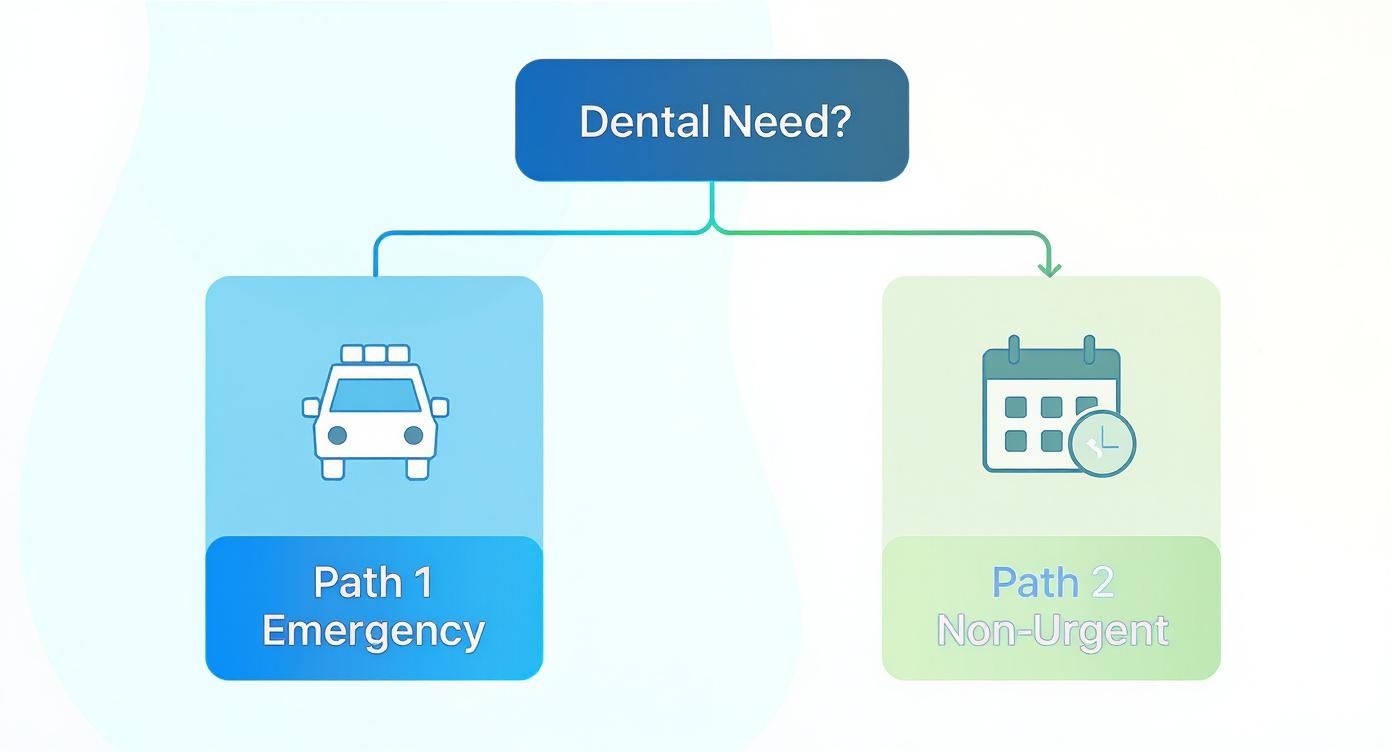
As you can see, your first move depends on whether you're dealing with a true emergency or something that can wait. Both paths lead to accessible care, just through different avenues.
Creating a Financial Safety Net
One of the best things you can do, especially without insurance, is to build a financial cushion for these kinds of surprises. A little preparation goes a long way.
Learning how to build an emergency fund can ensure you're ready for unexpected dental bills without derailing your entire budget. Having some savings set aside can transform a potential crisis into a manageable problem.
Exploring Your Local San Diego Options
Once you know what you need and have a handle on your finances, it's time to explore who can help. Even without insurance, you have resources. Many private practices, including our San Diego dental office, understand this challenge and offer flexible ways to make your treatment affordable.
To get started, consider these immediate avenues for care:
- Community Health Centers: These clinics are a fantastic local resource. They often provide dental care on a sliding-scale fee, meaning what you pay is based on your income.
- Dental Schools: Here in San Diego, you can get high-quality treatment from dental students under the close supervision of experienced dentists. Services from cleanings to more complex procedures are available at a significant discount.
- In-House Payment Plans: Don't rule out private dentists. Many, including Serena San Diego Dentist, offer in-house financing or membership plans that provide discounts and allow you to spread the cost over time, putting top-tier care within your reach.
By taking these first steps, you can confidently find the dental treatment you need and keep your oral health on track.
Navigating dental care without insurance is about knowing your options. This quick guide breaks down the most common paths so you can choose the one that best fits your situation.
Quick Guide to Uninsured Dental Care Options in San Diego
| Option Type | Best For | Average Cost | How to Access |
|---|---|---|---|
| Community Clinics | Routine care & urgent needs for low-income individuals | $$ (Sliding scale) | Search local San Diego health department listings |
| Dental Schools | Complex procedures at a lower cost; non-emergencies | $ – $$ | Contact universities with dental programs in the area |
| In-House Plans | Consistent, high-quality care with predictable costs | $$ | Ask your local dentist about their membership plans |
| Government Programs | Basic care for eligible children, seniors, or disabled adults | $ (Free to low-cost) | Check state Medicaid (Denti-Cal) or CHIP sites |
Each of these avenues provides a viable way to get the care you need. It's just a matter of matching the right resource to your specific dental and financial circumstances.
Tapping Into Community Clinics and Dental Schools
When you don’t have insurance, your first thought might be to just put off dental work. But two of the best resources for affordable care are right in your community: local health clinics and dental schools. They're the backbone of accessible care for so many people, offering high-quality services that don't come with a shocking price tag.
Knowing how to navigate these options can make all the difference.
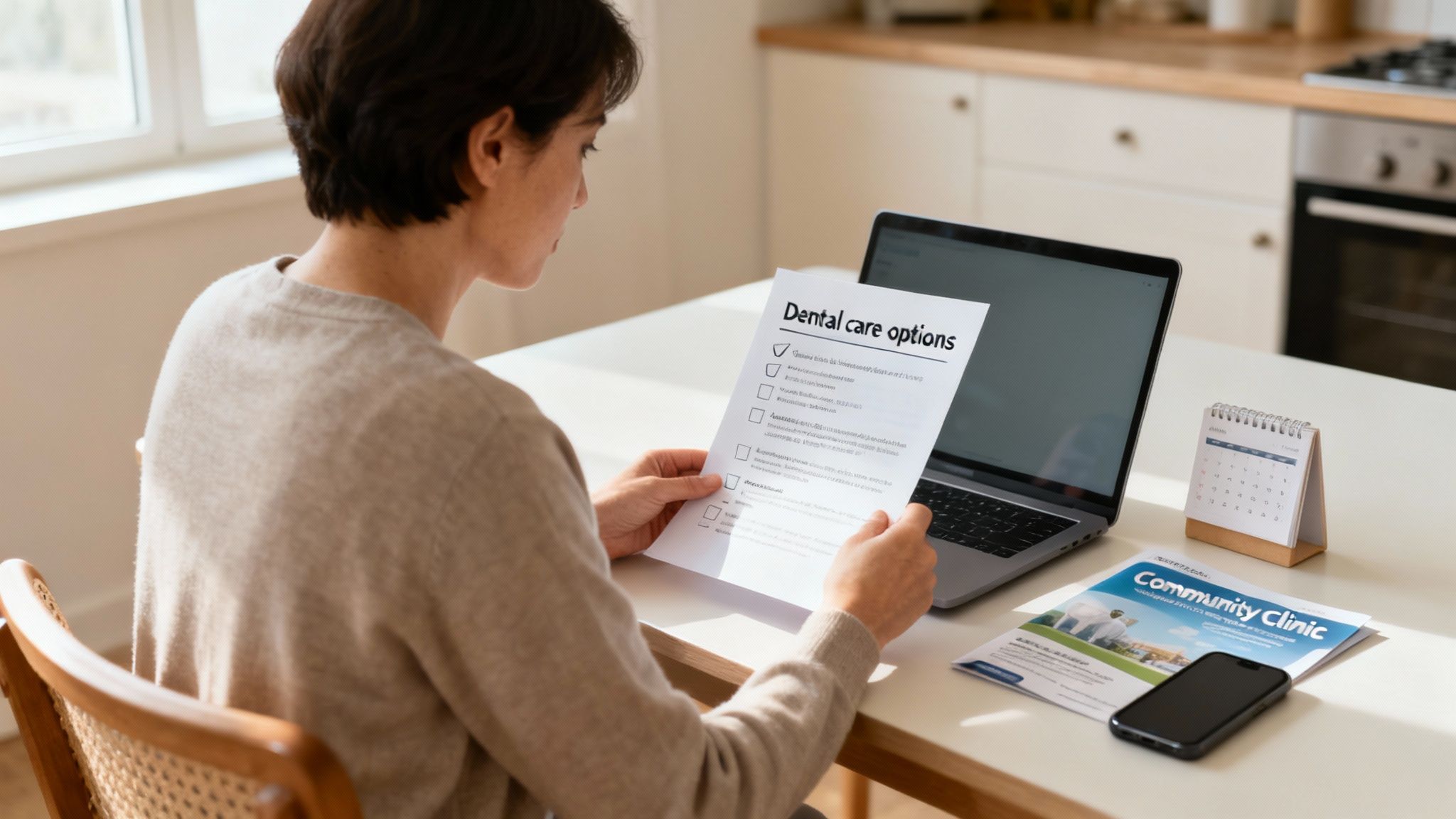
And we're not just talking about basic cleanings. These places often handle everything from fillings and root canals to crowns and extractions. The main difference from a private practice is the cost and the setting, both of which are designed to serve the community first.
The Dental School Advantage
Dental schools are a fantastic, and honestly, an often-overlooked source for top-notch, low-cost care. Here’s the deal: you’ll be treated by dental students in their final years of training, but they are under the constant, watchful eye of experienced, licensed faculty. It's like having a whole team of experts focused on your treatment.
People sometimes worry about the quality, but I’ve found the care can be even more thorough. Since every single step is checked and approved by a seasoned professor, nothing gets missed. The one trade-off is time. Appointments will almost certainly take longer than they would at a private office because of this built-in teaching and review process.
A Pro Tip for Dental School Visits: Plan for a longer appointment. The meticulous, supervised process means your treatment is exceptionally thorough, but it won't be fast. I always suggest bringing a book, a podcast, or some work to pass the time during the check-in and review stages.
Getting started usually involves a screening appointment. They'll assess your dental needs to make sure you're a good candidate for their teaching program. This first visit is typically very inexpensive.
Your Guide to Community Health Centers
Federally Qualified Health Centers (FQHCs), along with other community clinics, are another pillar of accessible healthcare. These centers get federal funding specifically to provide comprehensive care to people in the community, regardless of their ability to pay.
Most of these clinics operate on a sliding-scale fee model. This is a game-changer. It means what you pay is directly linked to your income and household size. So, if your income is lower, your bill will be too. It’s a system that makes everything from a routine check-up to an urgent procedure financially manageable.
To take advantage of the sliding scale, you will need to provide some documentation.
How to Prepare for Your First Clinic Visit
To make sure your first visit is as smooth as possible and to lock in the lowest fees you qualify for, it pays to be prepared. A little prep work goes a long way.
Here’s a quick checklist of what you'll probably need:
- Proof of Income: Recent pay stubs, a W-2, or a letter from your employer usually work. If you're not currently employed, an unemployment benefits statement is a good alternative.
- Identification: A standard driver's license or another government-issued photo ID.
- Proof of Address: A utility bill or lease agreement with your name and address on it will do the trick.
- Household Details: You'll need to know the number of people living in your household, as this is crucial for the sliding-scale calculation.
My best advice? Call the clinic before you go. A quick phone call to confirm exactly what documents they require can save you a ton of hassle and a potential second trip. By using these community-focused resources, you can get the care you need without the financial stress.
Finding Help Through Government Programs and Non-Profits
If you've looked into low-cost clinics and dental schools, the next layer of support comes from government programs and non-profit organizations. Think of this as the community's safety net, designed to catch those who might otherwise fall through the cracks. It can feel like a maze at first, but knowing what's out there is the first big step to getting the care you need.
The gap these programs fill is massive. A recent analysis found that around 72 million adults—that's 27% of the population—don't have dental insurance. That's a staggering number, nearly three times the rate of people without general health insurance, and it really highlights why this kind of aid is so essential.
Denti-Cal: California's Medicaid Dental Program
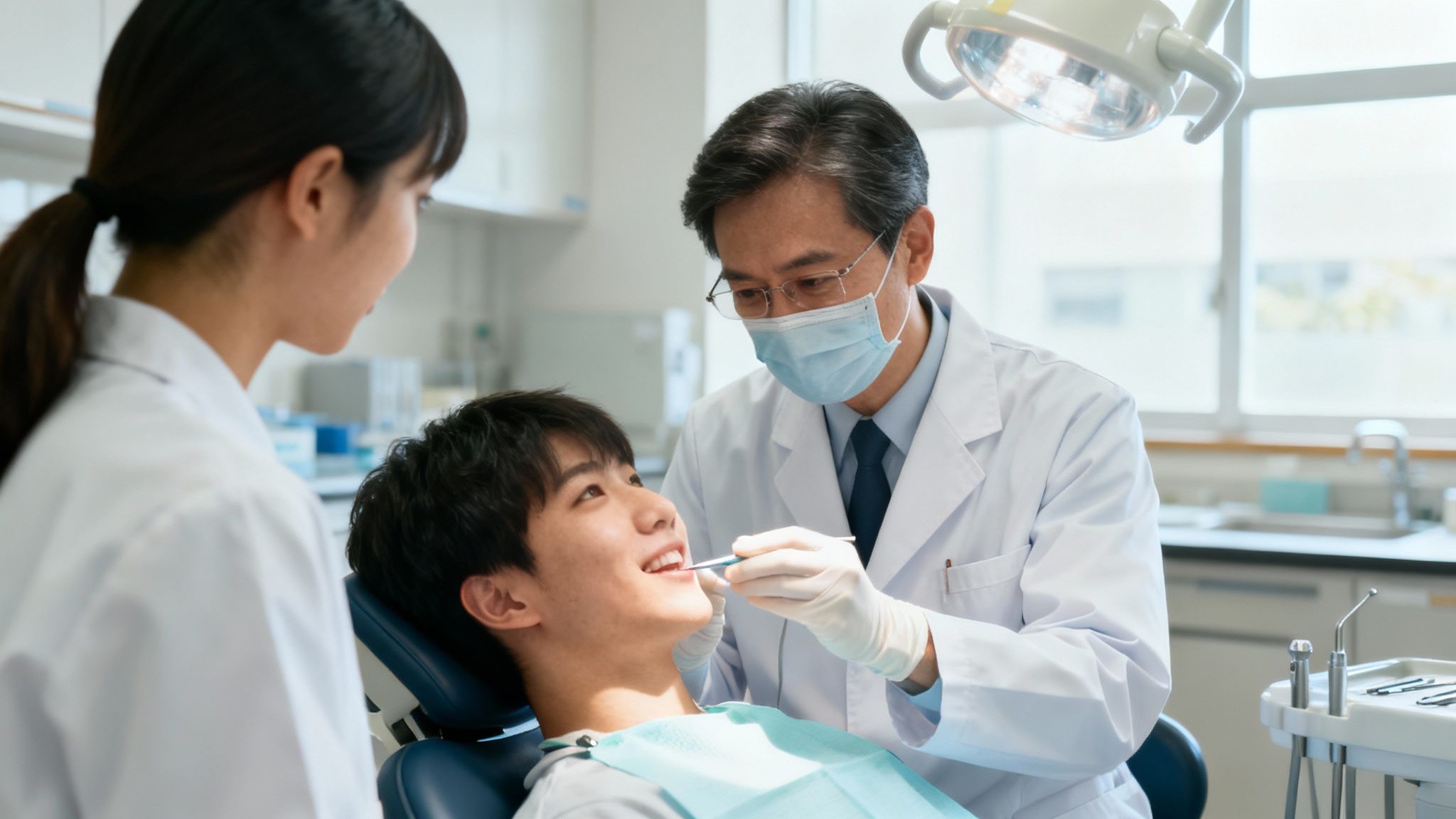
Here in California, the main government resource you'll want to look into is Denti-Cal. It's the dental branch of the Medi-Cal program and serves as a vital lifeline for millions of low-income individuals and families across the state.
Eligibility for Denti-Cal is tied to your income and the number of people in your household. If you qualify, it provides a solid range of benefits at no cost, which can be a game-changer. The program is designed to cover the fundamentals of oral health.
Here’s a snapshot of what Denti-Cal typically covers:
- Diagnostic and Preventive Care: This includes the basics like exams, X-rays, and routine cleanings to stop problems before they get serious.
- Restorative Services: Think necessary treatments like fillings, root canals on certain teeth, and some types of crowns.
- Emergency Services: If you're dealing with pain, an infection, or an injury, this is a core part of the program.
- Dentures: For those who need them, both full and partial dentures are often covered to help restore function.
Getting started with Denti-Cal means applying for Medi-Cal. The easiest way is to apply online through the Covered California website, or you can get in touch with your local county social services office.
Other Government-Funded Options
While Denti-Cal is the big one in our state, there are a few other federal and state programs that offer dental support for specific groups of people. It's definitely worth checking if you fall into one of these categories.
- Children’s Health Insurance Program (CHIP): If your family's income is too high for Medi-Cal but private insurance is out of reach, CHIP provides comprehensive dental benefits for your kids.
- Medicare: This is a common point of confusion. Original Medicare doesn't cover most routine dental care like cleanings or fillings. However, some private Medicare Advantage (Part C) plans might bundle in dental benefits.
- Veterans Affairs (VA): The VA does provide dental care for eligible veterans, but the rules for eligibility can be quite specific, often linked to service-connected disabilities or certain income thresholds.
Figuring out these differences is important. For a deeper dive into how different plans stack up, our guide on dental insurance in San Diego can be a helpful resource if you ever decide to look into traditional coverage.
Tapping into Non-Profits and Charities
Beyond government aid, the charitable sector is a huge player in providing free or low-cost dental care. These organizations are driven by a mission to serve the community, and they often show up where other systems can't. To figure out where help is most needed, these groups often start with a community needs assessment.
These charitable events are powered by volunteer dentists and hygienists who are passionate about giving back. The atmosphere is often incredibly supportive and focused on helping as many people as possible in a single day.
Keep an eye out for these types of non-profit initiatives:
- Free Dental Days: Many local dental practices set aside a day each year to offer free cleanings, fillings, or extractions. It’s their way of giving back to the community.
- Missions of Mercy: These are large-scale events, often held over a weekend in a big venue like a convention center. They treat hundreds of patients on a first-come, first-served basis.
- Donated Dental Services (DDS): This amazing program links volunteer dentists with people who are elderly, disabled, or have serious medical conditions and can't afford treatment.
To find these opportunities, you'll want to check local news outlets, call your local United Way chapter, or do some online searches for dental charities in the San Diego area. They represent a powerful, community-first approach to getting essential care.
Making Private Dental Care More Affordable
Many people automatically dismiss private dental practices when they don't have insurance, assuming the cost will be too high. This common misconception prevents many from receiving the consistent, high-quality care they deserve. The reality is, most dentists understand that cost is a significant barrier and have implemented systems to make treatment accessible.
Don't let the fear of a large bill deter you. The key is to be proactive and inquire about the flexible financial options that are often available. At Serena San Diego Dentist, we believe in transparent conversations about cost and are committed to helping you find a solution.
Explore In-House Membership Plans
A growing number of private practices, including ours, now offer their own in-house membership plans. This isn't insurance; it's a direct agreement between you and our office. For a flat annual fee, you typically receive all your essential preventive care, plus a significant discount on any other treatments you might need.
These plans are specifically designed for patients without insurance, eliminating common frustrations:
- No Waiting Periods: You can sign up and use your benefits on the very same day.
- No Annual Maximums: Unlike insurance, there's no yearly cap on how much you can save.
- No Deductibles: Your benefits kick in immediately without having to pay a certain amount first.
- Transparent Pricing: The discount is clear and simple, so you know your costs upfront.
A typical plan often covers two cleanings, two exams, and all necessary X-rays for the year, along with a 15-20% discount on everything else, from fillings to cosmetic procedures.
Look into Third-Party Financing
What if you need more extensive work, like a full smile makeover in San Diego? The upfront cost can still feel daunting. That's where third-party financing comes in handy. Companies like CareCredit operate like a credit card but are specifically for healthcare expenses.
They are known for offering promotional financing where you can pay for your treatment over 6, 12, or even 24 months with no interest. As long as you clear the balance before the promotional period ends, you won't pay a dime in interest.
A Word of Caution: Always read the fine print before you sign up. Make sure you understand the interest rate that kicks in if you don't pay off the balance in time—it can be steep.
Most dental offices that work with these companies can walk you through the application right there, and you’ll often get an approval decision in minutes.
The Power of Open Communication
Honestly, one of the most effective tools you have is a simple conversation. The office manager or financial coordinator at a dental practice talks about money with patients all day, every day. They're the experts at finding ways to make treatment possible.
Before committing to a treatment plan, just ask to speak with them for a few minutes. Be open about your situation and what you can realistically afford.
You could try starting the conversation like this:
- "Since I don't have insurance, do you offer any payment plans for this procedure?"
- "If I can pay for the full treatment upfront in cash, is there any kind of discount?"
- "Is it possible to stage my treatment over a few months to help spread out the cost?"
You'd be surprised how often a practice will offer a 5-10% discount for paying in full with cash or check. It saves them on credit card fees and administrative hassle. All it takes is asking the question. You'll not only save money but also build a much stronger, more trusting relationship with your dental team.
How Smart Habits Can Slash Your Dental Bills
Let's be honest, the best way to keep dental costs down is to avoid problems in the first place. Shifting your mindset from treating problems to preventing them is the single most powerful thing you can do, especially when you don't have insurance. It’s a proactive approach that can save you thousands of dollars and a ton of time in the dental chair down the road.
It might feel backward to spend money on a cleaning when you're trying to save, but trust me, these visits are one of the best investments you can make. Think of a professional cleaning and exam as an early warning system. Catching a tiny cavity today is infinitely cheaper than dealing with a full-blown root canal and crown a year from now.
Don't Skip Your Professional Cleanings
Even when paying out-of-pocket, a routine check-up is one of the most affordable and impactful things you can do for your health. A hygienist can remove built-up plaque and tartar in ways you simply can't at home, and the dentist can spot the earliest signs of decay, gum disease, or even oral cancer before they become serious.
This is a huge deal. Statistics show that people with private dental insurance are 2.54 times more likely to have seen a dentist in the past year than those without coverage. Why? Because they know it helps them catch issues early. You can close that gap by prioritizing these visits yourself. For a deeper dive into the numbers, you can learn more about these dental care trends and see just how much consistent care matters.
Your At-Home Routine is Your First Line of Defense
What you do every single day between those professional cleanings is just as crucial. A solid at-home routine is your primary weapon against expensive dental work. It's about more than just a quick, sleepy swipe with a toothbrush in the morning.
To make sure your daily habits are actually working for you, focus on these fundamentals:
- Brush Like You Mean It: Grab a soft-bristled brush and fluoride toothpaste. You need to brush for a full two minutes, twice a day, making sure to gently clean along the gumline.
- Make Flossing a Non-Negotiable Habit: Flossing cleans the ~40% of your tooth surfaces that your toothbrush can't even reach. Skipping it is like only washing half your body in the shower—it leaves the door wide open for cavities and gum disease.
- Use Mouthwash as a Finisher, Not a Replacement: A good antimicrobial mouthwash can give you an extra boost by reducing bacteria, but it’s a supplement. It never takes the place of thorough brushing and flossing.
For a complete playbook, check out our guide on how to step up your oral hygiene for more actionable tips.
Learn to Spot Trouble Before It Starts
Knowing what to look for is half the battle. When you can recognize the early signs of a dental issue, you can get it checked out at a low-cost clinic before it snowballs into a painful, expensive emergency.
Key Insight: Never ignore the small stuff. A little tooth sensitivity or a bit of pink on your floss might seem like nothing, but these are often the first whispers that something is wrong. Listening to your body and acting quickly is always the cheapest option.
Keep an eye out for these common red flags:
- Sudden Sensitivity: A new zing of pain from hot, cold, or sweet things could mean a small cavity is forming or a filling is failing.
- Bleeding Gums: If your gums bleed when you brush or floss, that's the classic first sign of gingivitis. The good news? It's completely reversible with better hygiene and a professional cleaning.
- Bad Breath That Won't Go Away: Persistent bad breath can be a sign of hidden gum disease or decay.
- A Dull, Nagging Ache: Even a minor but constant ache can signal a brewing infection or a tiny crack in a tooth.
By adopting these habits, you put yourself in the driver's seat. You’ll be proactively managing your health instead of just reacting to expensive emergencies, which makes dental care far more predictable and affordable, even without an insurance plan.
Your Questions About Uninsured Dental Care, Answered
Trying to figure out dental care without an insurance plan can feel like navigating a maze. It’s completely normal to have questions, and getting solid answers is the first step toward feeling in control of your oral health. Let's walk through some of the most common concerns I hear from patients in this exact situation.
I'm in Pain. What's the First Thing I Should Do in a Dental Emergency?
When you’re hit with a sudden dental emergency—excruciating pain, a knocked-out tooth, or scary swelling—your first move is to stay calm and assess. If you have bleeding you can't stop or think your jaw might be broken, don't hesitate: go straight to a hospital ER. They're set up for that level of trauma.
For most urgent dental problems, though, your best bet is to get on the phone. Start calling local dental offices and community health clinics right away. Many dentists, our San Diego practice included, intentionally leave a little wiggle room in the schedule for exactly these kinds of emergencies.
Be direct about your situation. When you call, ask what they charge for an emergency exam and X-ray. Getting a clear idea of that initial cost upfront can ease a lot of anxiety. This first visit is all about diagnosis and is usually more affordable than people expect. Dental schools are another great option, but you'll likely need to call their urgent care clinic the second they open to have a shot at a same-day appointment.
Are Dental School Clinics Actually a Safe and Reliable Option?
Absolutely. In fact, they are one of the most dependable and safest places to get high-quality, affordable care. Yes, a dental student performs the treatment, but they are under the constant, direct supervision of experienced and licensed dental faculty every step of the way.
Think about it: your procedure is essentially being double-checked by a seasoned pro from start to finish. This highly meticulous environment often results in exceptional care that’s based on the very latest research and techniques.
The biggest trade-off is time. An appointment at a dental school will almost always take longer than one at a private practice because of that built-in teaching and verification process. But for non-urgent work like crowns, fillings, or root canals, the major cost savings make it a fantastic trade-off for many people.
How Is an In-House Dental Plan Different from Insurance?
This is a really important distinction that often causes confusion. An in-house dental savings plan is not insurance. It’s a membership you have directly with a specific dental office. You pay that practice an annual fee, and in return, you get a set package of benefits.
Here’s where they really differ from traditional insurance:
- No Waiting Periods: You can use your benefits the same day you sign up.
- No Annual Maximums: There’s no ceiling on how much you can save in a year.
- No Deductibles: You don't have to meet a spending threshold before your benefits kick in.
- No Claim Forms: It’s all handled in-office, so there’s zero paperwork hassle.
Typically, a membership will cover all your preventive care for the year—think two cleanings, two exams, and any necessary X-rays. For everything else, from a simple filling to more complex cosmetic work, you get a flat discount, usually somewhere between 15-25%. It's a straightforward and transparent way to budget for your dental health.
Can I Actually Negotiate the Price of Dental Work?
While you can’t exactly "negotiate" like you would for a car, you can definitely have a conversation about the cost and see if there’s any flexibility. This is especially true if you're in a position to pay for your treatment in full, upfront. Many private practices are happy to offer a discount for this because it eliminates their administrative headaches and the fees associated with processing claims or financing plans.
The key is to bring this up politely and professionally before you've committed to the treatment. The office manager or financial coordinator is your go-to person for this chat.
You can try a simple, direct approach like this:
"I don't have dental insurance and will be paying out-of-pocket. I was wondering if you offer a discount for patients who pay in full at the time of service?"
That one question opens the door. A pay-in-full discount can range from 5-15%, which can translate into hundreds of dollars saved on bigger procedures. It never hurts to ask.
Here at Serena San Diego Dentist, our core belief is that everyone deserves access to top-tier dental care, insurance or not. We provide flexible payment options and are always ready to sit down and figure out a plan that makes your treatment manageable for your budget. Ready to get back on track with a healthy smile? You can schedule a consultation by visiting us at https://serenasandiegodentist.com.