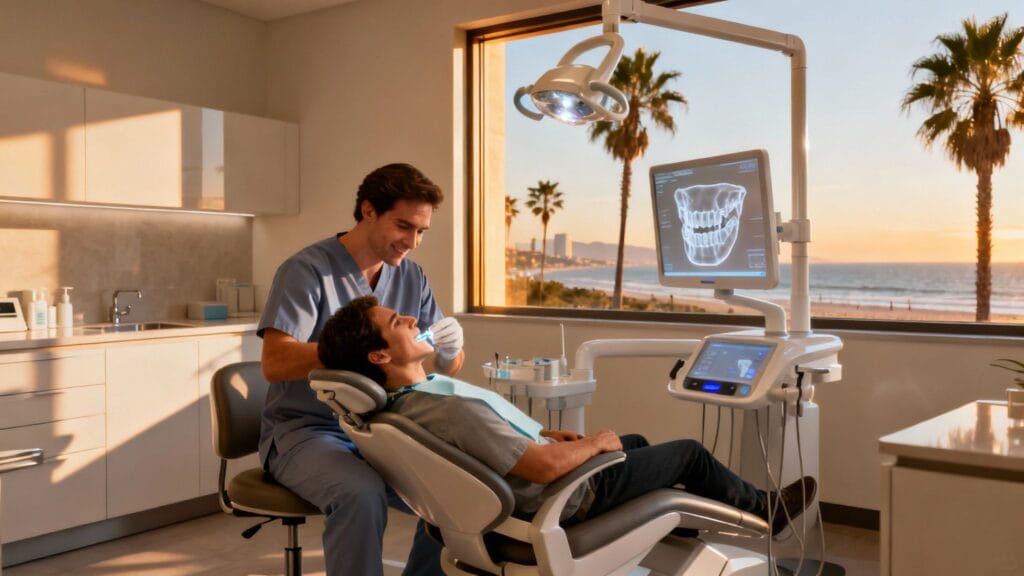
Having your wisdom teeth removed in San Diego is a common rite of passage—a proactive step to prevent significant dental issues later on. While the thought can be intimidating, it’s a routine procedure handled with expertise by our region's top dental professionals, ensuring your comfort and a smooth recovery.
Why San Diego is a Premier Destination for Wisdom Teeth Removal
Have you noticed how many of your friends and colleagues in San Diego have had their wisdom teeth taken out? It's not just your imagination. Living in California places you in a region where this procedure is exceptionally common.
In fact, residents in the Western U.S. are 82% more likely to undergo wisdom teeth extraction compared to those in the Northeast. This high frequency has made San Diego's oral surgeons and dentists incredibly proficient. You can explore regional dental trends in this comprehensive study.
Because it's a standard procedure here, the local dental community is expertly equipped to manage everything from a straightforward extraction to a complex impacted tooth, ensuring you receive the highest standard of care.
A Community of Dental Experts
San Diego is home to a high concentration of board-certified oral and maxillofacial surgeons and highly skilled general dentists. This fosters a collaborative environment where professionals are committed to continuous improvement and adopting the latest, most effective techniques.
What does this mean for you as a patient?
- Abundant Choices: You have access to a wide pool of qualified professionals, making it easy to find a surgeon whose approach and philosophy align with your needs.
- Specialized Care is the Norm: Whether your case is simple or involves a challenging impacted tooth near a nerve, you can trust that there is an expert in San Diego who has successfully handled similar cases.
- A Focus on Your Comfort: Local dentists prioritize a positive patient experience. We offer a range of sedation options to alleviate anxiety and ensure the entire process is painless and stress-free.
Achieving Better Outcomes with Advanced Technology
Leading dental practices in San Diego invest heavily in technology that makes wisdom teeth removal safer, more precise, and more predictable. We've moved beyond traditional 2D X-rays to gain a complete, multi-dimensional view of your oral anatomy.
A prime example is the Cone Beam Computed Tomography (CBCT) scanner. This incredible device generates a detailed 3D model of your teeth, jaw, and nerves. It allows your surgeon to meticulously plan the safest and most efficient removal strategy before the procedure even begins.
This level of detailed planning is a game-changer. It helps prevent potential complications and paves the way for a significantly smoother recovery. You can learn more about the state-of-the-art dental technology that top San Diego clinics use to achieve exceptional results. This dedication to modern tools transforms what could be a daunting procedure into a well-managed and successful part of your healthcare journey.
What to Expect During Your Wisdom Teeth Removal Procedure
The idea of tooth extraction can cause some anxiety, but a San Diego wisdom teeth extraction is a controlled, precise, and surprisingly comfortable experience. Let's walk through the process step-by-step, from your initial consultation to the final stitch, so you can feel confident and prepared.
Your journey begins with a thorough consultation. This isn't just a quick look in your mouth; it's a strategic planning session. We use advanced imaging, like 3D CBCT scans, to create a precise map of your jaw. This technology allows us to see the exact position of your wisdom teeth, trace their roots, and identify their proximity to critical nerves—all essential for a safe and successful surgery.
Choosing Your Comfort: Anesthesia and Sedation Options
One of the most important decisions you'll make concerns sedation. Your comfort is our highest priority, and modern dentistry provides several excellent options tailored to your anxiety level and the complexity of your procedure.
Here are the most common choices available:
- Local Anesthesia: Similar to a routine filling, this involves numbing the extraction site completely. You will be awake and aware, but you will only feel some pressure—no pain. This is ideal for simple, single-tooth extractions.
- IV Sedation (Twilight Sleep): A popular choice for wisdom teeth removal, this is administered through a vein and places you in a deeply relaxed, dream-like state. You are not fully unconscious but will be completely unaware of the procedure and will have no memory of it afterward.
- General Anesthesia: For more complex cases or for patients with significant dental anxiety, general anesthesia ensures you are completely asleep throughout the entire surgery.
We will discuss the pros and cons of each option with you to select the best one to ensure you feel calm and at ease.
This graphic breaks down the straightforward path from your initial San Diego consultation to the extraction and recovery phases.
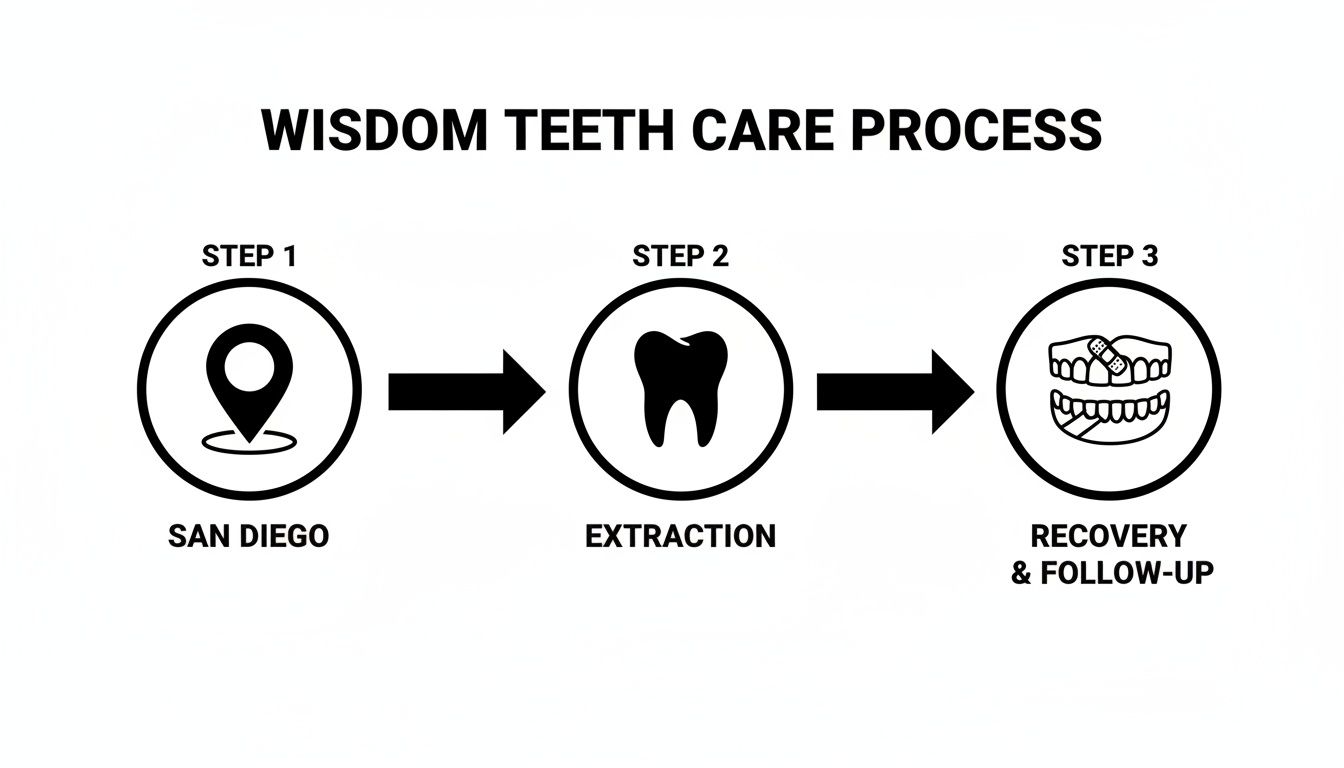
It simplifies the journey, demonstrating that this is a well-defined process managed from start to finish by local experts.
The Surgical Steps, Demystified
Once you are completely numb and comfortable, the surgery itself begins. Your oral surgeon will work with meticulous precision, much like a sculptor.
Here’s a step-by-step look at the procedure:
- Creating Access: A small, precise incision is made in the gum tissue over the wisdom tooth to expose both the tooth and the underlying bone.
- Removing Obstructions: If a tooth is impacted (stuck beneath the gums or bone), the surgeon will gently remove any bone that is blocking its removal path.
- Sectioning the Tooth: This is a crucial step. To make the removal easier and less traumatic for your jaw, the surgeon often divides the tooth into smaller, more manageable sections. This technique requires less force and significantly reduces trauma to the area.
- Extracting the Tooth: Each section is then carefully and gently lifted out of the tooth socket.
- Cleaning and Closing: After the tooth is removed, the surgeon cleans the site of any debris and closes the incision with a few dissolvable stitches.
The entire process is methodical and carefully planned. By sectioning the tooth, we can perform the extraction with finesse rather than force, which is the key to a much smoother and more comfortable recovery.
Before any surgery, obtaining a pre-operative clearance is an essential safety measure to confirm you are physically prepared for both the procedure and anesthesia. For a deeper understanding of various procedures, explore our guide on what to expect from oral surgery. Your surgeon will provide specific instructions to ensure you are fully prepared for a successful outcome.
A Patient's Guide to a Smooth and Speedy Recovery
The care you take after your wisdom teeth extraction is just as vital as the procedure itself. A little preparation and a solid recovery plan can make a world of difference in how quickly and comfortably you heal.
Think of this as your game plan for a successful recovery. Before your appointment, be sure to arrange for a ride home—you will not be able to drive after sedation. It is also wise to wear loose, comfortable clothing to make your trip home as relaxing as possible.

The First 24 Hours: Your Immediate Action Plan
The first day is critical. Your primary goals are to manage swelling, control any minor bleeding, and protect the crucial blood clot forming in the empty socket. This clot acts as a natural bandage and is essential for proper healing.
Here’s your post-procedure checklist:
- Bite Gently: Your surgeon will provide gauze pads—bite down on them with gentle but firm pressure. You should change them every 30-45 minutes. This consistent pressure is the most effective way to stop bleeding.
- Use Cold Compresses: For the first 24-48 hours, an ice pack will be your best friend. It is incredibly effective at minimizing swelling and soothing discomfort. For tips on proper use, see this guide on using a cold compress effectively. Wrap it in a towel and apply it to your cheek for 20 minutes on, then 20 minutes off.
- Rest and Elevate: Take it easy. Rest with your head propped up on a couple of pillows to help reduce swelling. Avoid strenuous activity or heavy lifting, which can increase your blood pressure and lead to more bleeding.
Your Post-Surgery Diet: The First Week and Beyond
Your diet will play a major role in your comfort and healing. For the first few days, you will be on a soft-food-only diet. It’s the perfect excuse to enjoy smoothies, milkshakes, and pudding (with one important rule: no straws!).
Recovery Tip: Avoid using straws, smoking, or spitting forcefully for at least the first week. The suction created by these actions can dislodge the vital blood clot, leading to a painful complication known as a dry socket.
Here is a general timeline for reintroducing foods:
- Days 1-2: Stick to liquids and puréed foods. Think yogurt, applesauce, smoothies, and lukewarm soups.
- Days 3-5: You can begin to incorporate semi-soft foods that require minimal chewing, such as scrambled eggs, mashed potatoes, and oatmeal.
- Day 6 and Onward: Gradually return to your regular diet as you feel comfortable. Continue to avoid hard, crunchy, or spicy foods for a little while longer to prevent irritating the healing gums.
After the first 24 hours, you can start gently rinsing your mouth with a warm salt water solution (a half-teaspoon of salt in a cup of warm water) after meals. This is an excellent way to keep the area clean and promote healing. For a more detailed guide, please see our complete post on what to do after a tooth removal.
Following these steps will empower you to take control of your recovery, helping you return to your daily life faster and with minimal discomfort.
Understanding the Costs and Insurance for Wisdom Teeth Removal in San Diego
Let's address the question on every patient's mind: what is the cost of wisdom teeth removal in San Diego? The answer varies, as the final price depends on a few key factors specific to your individual case.
The primary factor is the complexity of your extraction. A simple extraction, where the tooth has fully emerged from the gums, will be less costly. In contrast, a tooth that is deeply impacted—trapped within the jawbone—requires a more involved surgical procedure, which will influence the overall cost.
Your choice of anesthesia also plays a significant role. Local anesthetic is the most straightforward and cost-effective option. However, many patients opt for IV sedation or general anesthesia for enhanced comfort, especially if they are anxious or have a more complex case. While this adds to the total, it ensures a stress-free and pain-free experience.
Navigating Your Dental Insurance Coverage
The good news is that most dental insurance plans consider wisdom teeth removal a medically necessary procedure, not a cosmetic one. Consequently, many plans—particularly PPO plans—will cover a significant portion of the cost, often between 50% and 80% after your annual deductible has been met.
To ensure transparency and avoid surprises, our team will submit a pre-treatment authorization to your insurance provider. This request details your specific procedure and asks for a precise breakdown of what they will cover. This simple step provides you with a clear financial picture, allowing you to plan accordingly. If you would like to learn more, we can help you understand the nuances of dental insurance in San Diego to maximize your benefits.
What If I Don’t Have Insurance?
If you do not have dental insurance, please do not let that prevent you from seeking necessary care. Many of our San Diego patients pay for their wisdom teeth removal directly, and we offer several options to make it manageable.
We believe that financial considerations should never be a barrier to your health. Our commitment is to provide clear, upfront pricing and flexible payment solutions that fit your budget.
We will provide a transparent cost estimate at your initial consultation, so you know exactly what to expect.
Furthermore, we partner with third-party financing groups like CareCredit. These plans are designed for healthcare expenses and function like a credit card, allowing you to break down the total cost into smaller, manageable monthly payments, often with no interest. This is a popular option that allows you to receive the care you need now and pay for it over time. Please call our office, and we can guide you through the solutions that work best for your situation.
How to Choose the Right Oral Surgeon in San Diego
Selecting the right professional for your San Diego wisdom teeth extraction is the most crucial decision in this journey. The right surgeon not only ensures a successful procedure but also provides peace of mind. You are not just finding a doctor; you are choosing a trusted partner for your health.
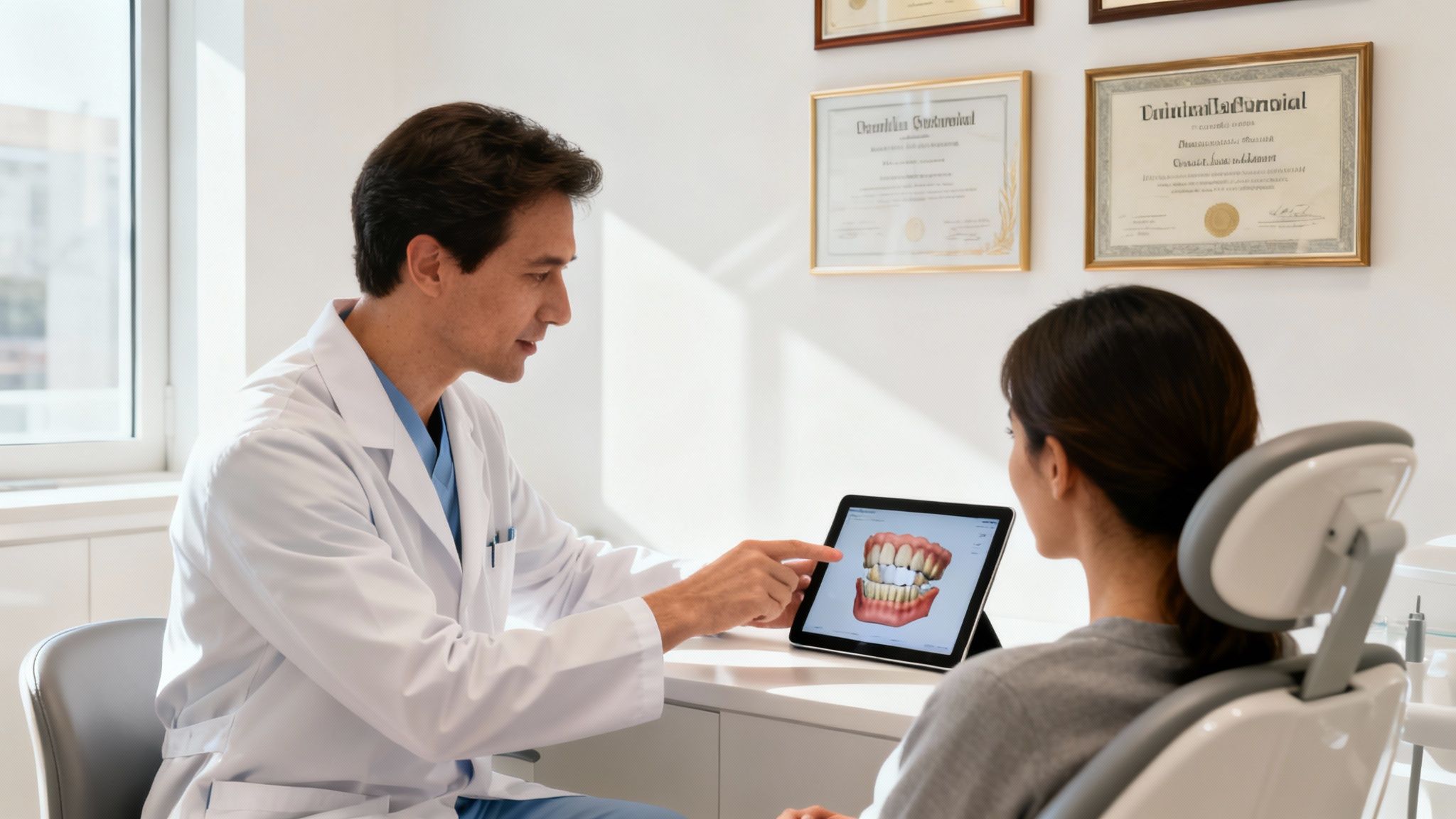
While many general dentists can handle simple extractions, a board-certified oral and maxillofacial surgeon has advanced, specialized training. They have completed years of hospital-based residency programs that go far beyond dental school. This represents the gold standard of care, especially for complex cases involving impacted wisdom teeth.
Why Board-Certified Expertise Matters
What does "board-certified" mean for you? It is an essential credential that signifies a surgeon has met the highest standards in their specialty.
- Advanced Surgical Training: They have completed years of intensive, hands-on training focused specifically on surgery of the mouth, jaw, and face.
- Anesthesia Mastery: Board-certified surgeons are licensed to administer all levels of sedation, from local anesthetic to IV sedation and general anesthesia, ensuring your safety and comfort.
- Peer-Reviewed Excellence: To achieve this certification, they must pass rigorous written and oral examinations, proving their expertise to their peers.
By choosing a board-certified oral surgeon, you are selecting a specialist who is prepared for any scenario. They can manage routine procedures with precision and are equipped to handle any unexpected challenges that may arise.
Your Consultation Checklist
Your consultation is an opportunity to interview the surgeon and their team. This is your health, so feel empowered to ask questions until you are completely comfortable with the proposed plan.
A great surgeon will welcome your questions and take the time to provide clear, understandable answers. Their goal is to make you an informed and confident partner in your own care.
Here are a few key questions to ask during your appointment:
- "How much experience do you have with cases similar to mine?" If your X-rays reveal impacted teeth or other complexities, you want a surgeon who has extensive experience with such cases.
- "What technology do you use for surgical planning?" The best practices utilize 3D CBCT scanners. This imaging provides a crystal-clear, 3D map of your teeth, jaw, and critical nerves, which is vital for planning a safe surgery and minimizing risks.
- "What are my sedation options at this clinic?" A quality practice will offer a full range of choices and collaborate with you to determine the best fit for your anxiety level and the procedure's complexity.
- "What is your approach to patient comfort and managing anxiety?" The answer reveals the clinic's patient care philosophy. You want a team that prioritizes a positive, stress-free experience.
The Value of Patient Reviews
Before making a final decision, take some time to read patient reviews and testimonials. While an individual experience is just one perspective, a pattern of feedback can be very insightful.
Look for consistent themes. Do patients consistently report feeling safe, heard, and well-cared-for? Comments like these are often the best indicator of a clinic's culture and genuine commitment to its patients, helping you make a choice you can feel confident about.
Your Wisdom Teeth Questions, Answered
Even after learning about the procedure and recovery, it's natural to have more questions. This is an important step in your healthcare, and feeling well-informed is key. Here are some of the most common questions we hear from our San Diego patients, with clear, straightforward answers.
Do I Really Need to Have My Wisdom Teeth Removed?
This is the most frequent question we receive, and the answer is: it depends on your individual situation. For many, removing wisdom teeth is a crucial preventive measure. Most modern jaws simply do not have enough space to accommodate these third molars. As a result, they often erupt at an angle, become trapped under the gums (impacted), or begin to crowd other teeth.
When this occurs, a variety of problems can arise:
- Pain and Infection: An impacted tooth can cause significant pain, swelling, and infections in the surrounding gum tissue.
- Damage to Adjacent Teeth: A wisdom tooth pushing against the next molar can cause decay, root damage, or other issues for an otherwise healthy tooth.
- Cyst Formation: In some cases, a fluid-filled sac (a cyst) can form around an impacted wisdom tooth. If left untreated, it can cause damage to the jawbone and nerves.
- Alignment Issues: Pressure from incoming wisdom teeth can sometimes undo years of orthodontic work, causing your straight teeth to become crowded again.
The final recommendation will be made after a comprehensive examination and review of your X-rays. We only recommend extraction when it is the best course of action to protect your long-term oral health.
How Much Pain Will I Be In?
Let’s clarify this important point: thanks to modern anesthesia, you will feel absolutely no pain during the procedure itself. Your comfort is our primary focus. You may feel a slight sense of pressure, but you will not experience any sharpness or pain.
Post-operative discomfort is a normal part of healing, but it is very manageable. You can expect some soreness and swelling, which typically peaks around the second or third day. We will provide a detailed pain management plan, which usually includes over-the-counter anti-inflammatories like ibuprofen and may include a prescription for stronger medication for the first few days. Following the aftercare instructions, especially using ice packs diligently, is the most effective way to minimize discomfort.
How Long Does the Surgery Actually Take?
The time you spend in the surgical chair is often much shorter than you might think. For a standard case involving all four wisdom teeth under IV sedation, the procedure itself typically takes about 45 to 60 minutes. For simpler cases involving one or two teeth, it can be even quicker.
However, you should plan to be at our San Diego office for a total of 90 minutes to two hours. This allows time for check-in, administering sedation, performing the surgery, and a brief recovery period before your designated driver takes you home.
When Can I Return to Work or School?
Healing times vary, but a good rule of thumb is to plan for at least 2 to 4 days of rest and relaxation. Returning to strenuous activity too soon can increase bleeding and swelling, so taking it easy is non-negotiable for the first few days.
Most individuals with desk jobs or school schedules feel ready to return within three to five days. If your job is physically demanding, you may want to schedule a full week off to allow your body adequate time to heal without risking complications.
What Is a Dry Socket and How Can I Avoid It?
A dry socket is the most common complication following an extraction, but it is almost entirely preventable. It occurs when the blood clot that forms in the empty socket is dislodged or dissolves prematurely, exposing the underlying bone and nerves to air and food. This can be quite painful.
Your main goal during the first week is to protect that blood clot.
Crucial Prevention Tip: The suction created by smoking or drinking through a straw is the number one enemy of the blood clot. You must avoid both for at least one week after your surgery.
Other preventive measures include:
- Eating only soft foods for the first few days.
- Avoiding vigorous rinsing or spitting.
- Pausing any intense physical activity.
- Being very gentle when brushing your teeth near the extraction site.
Are Impacted Wisdom Teeth Really That Common?
Yes, they are incredibly common. It's largely a matter of evolution—modern human jaws are smaller than our ancestors', leaving insufficient space for these third molars. Impacted wisdom teeth affect nearly 25% of the global population, which is why their removal has become such a standard dental procedure.
In the U.S., dental data indicates that extractions are most frequent in the late teens and early twenties, when these teeth attempt to emerge. By age 25, approximately 50% of people have had at least one wisdom tooth removed. You can explore more about why this procedure is so essential for oral health.
What If I Have Dental Anxiety?
If you feel anxious about this procedure, you are not alone. It is an extremely common feeling, and our entire team is trained to help you feel safe, comfortable, and in control throughout your visit.
For anxious patients undergoing a San Diego wisdom teeth extraction, IV sedation is often an excellent choice. It induces a state of deep relaxation, sometimes called "twilight sleep," where you remain completely unaware of the procedure and will not remember it afterward. We will thoroughly discuss all sedation options with you during your consultation to find the approach that best alleviates your concerns.
At Serena San Diego Dentist, our commitment is to make your wisdom teeth extraction a safe, comfortable, and positive experience from the first call to the final check-up. If you have more questions or you're ready to schedule a consultation, please visit us at https://serenasandiegodentist.com.