Say the words "root canal," and most people flinch. It’s a procedure with a seriously bad reputation. But here’s the thing that experienced dentists know: a San Diego root canal isn’t the source of the pain—it’s the solution. This is a rescue mission for your tooth, designed to get you out of pain, eliminate the infection, and save your natural smile for years to come.
What a Root Canal Really Means for Your Tooth
Let's clear the air and get past the outdated myths. A root canal is one of the most common and effective ways we have to stop a nasty tooth infection in its tracks.
Think of your tooth like a small, incredibly strong fortress. Deep inside, in its inner chamber, is the pulp—a bundle of soft tissue, nerves, and blood vessels that keeps the tooth alive. When decay or a crack in the tooth allows bacteria to breach the defenses and invade that inner chamber, the pulp gets infected. That's when the real trouble starts, and it’s what causes that deep, throbbing ache you can't ignore.
A root canal doesn’t destroy your tooth. It saves it. We simply go in, thoroughly clean out the infected pulp from the inner chamber, and seal it up to prevent any more bacteria from getting in. The fortress remains standing, strong and functional.
Recognizing the Signs You Might Need a Root Canal
Your body has a way of telling you when something is seriously wrong with a tooth. Ignoring these signals can lead to a much bigger problem, like a dangerous abscess.
How can you tell if that inner pulp is in trouble? It often starts with a few key symptoms that are hard to miss.
| Quick Guide to Root Canal Symptoms |
| :— | :— | :— |
| Symptom | What It Feels Like | Why It Happens |
| Persistent, Severe Tooth Pain | A throbbing, unrelenting ache that can keep you up at night. It feels deep inside the tooth. | The infection is causing inflammation and pressure on the nerves within the tooth's pulp. |
| Sensitivity to Hot and Cold | A sharp pain when you eat or drink something hot or cold that lingers long after you're done. | The nerve endings in the pulp are damaged and overreacting to temperature changes. |
| Swollen Gums | Tender, puffy gums near the painful tooth, sometimes with a small, pimple-like bump (abscess). | The infection is spreading from the tooth's root tip into the surrounding bone and gum tissue. |
| Tooth Discoloration | The tooth starts to look darker, almost grayish or bruised, compared to its neighbors. | This is a sign that the pulp inside the tooth has died, causing the tooth to lose its vitality. |
If any of these sound familiar, don't wait for it to get worse. It’s a clear sign that you need to see a dentist.
This is far from a rare procedure. In fact, dentists across the United States perform around 41,000 root canals every single day. It's a standard, reliable treatment for saving teeth from extraction. Understanding why an infection can become so serious is also key; you can learn more about why a tooth abscess is dangerous here. We find that when patients are well-informed, their anxiety drops significantly, which is why we believe in using innovative patient education strategies to explain every step of the process.
The Modern Root Canal Procedure Explained
Let's clear the air: a modern root canal is nothing like the horror stories you might have heard. Forget the scary myths. Today, the entire process is precise, focused, and designed for your comfort—all with the goal of saving your natural tooth and getting you out of pain for good.
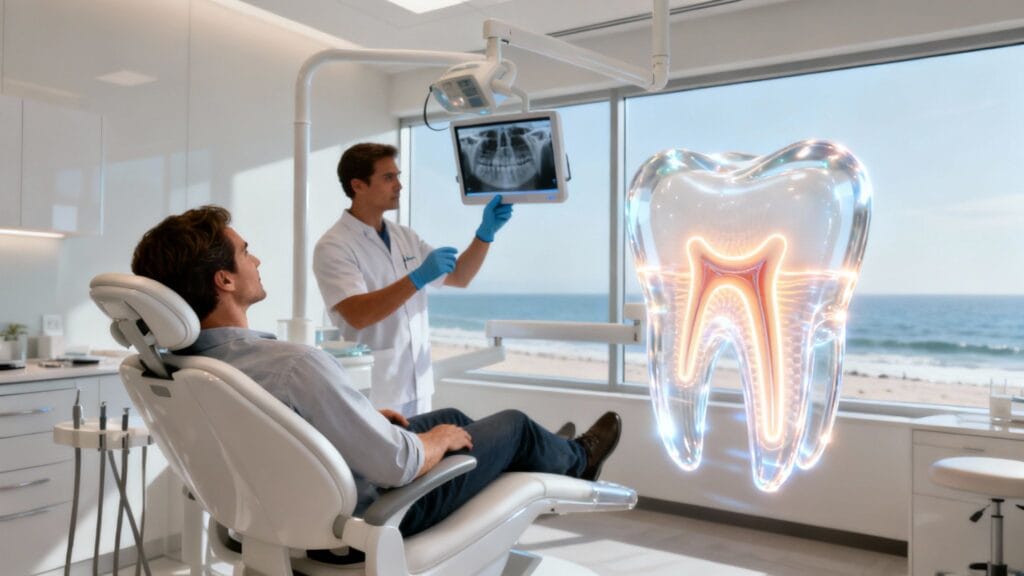
Think of it less as a major procedure and more like a highly specialized deep cleaning for the inside of your tooth. It all starts not with a drill, but with a simple, high-resolution digital X-ray. This quick scan gives us a crystal-clear map of your tooth’s interior, showing the exact shape of the root canals and pinpointing the extent of the infection. This digital blueprint is the key to a smooth and successful treatment.
Your Step-by-Step Guide to the Procedure
Once we’ve confirmed a San Diego root canal is the right move, the procedure itself is surprisingly straightforward. The main objective is to remove the source of the pain—the infected pulp—and protect the tooth from any future problems.
Here’s a simple breakdown of what to expect during your visit:
- Getting You Comfortable: Our first and most important step is making sure you feel absolutely nothing. We use a strong local anesthetic to completely numb the tooth and the surrounding gum tissue. You won’t feel any pain during the procedure, just a little bit of pressure. Seriously.
- Accessing the Tooth: To keep the area sterile, we place a small protective sheet called a “dental dam” around the tooth. This isolates it, keeping it clean and dry throughout the process. Then, a tiny opening is made in the top of the tooth, giving us access to the inner pulp chamber.
- Cleaning the Canals: Using very fine, flexible instruments, we gently remove the damaged and infected pulp from inside the tooth. We then meticulously clean, shape, and disinfect the inner canals to ensure every last trace of bacteria is gone.
- Filling and Sealing: After the canals are spotless, they’re filled with a biocompatible, rubber-like material called gutta-percha. This completely seals the canals to prevent any bacteria from getting back in. A temporary filling is then placed to close the opening on top of your tooth.
This visualization shows the journey from that first throb of pain to finding lasting relief.
It really is a rescue mission for your tooth, directly addressing the source of the problem to restore your comfort and health.
Honestly, the entire process feels a lot like getting a standard filling, it just takes a bit more time. Modern techniques have turned it into a routine and incredibly successful treatment. In fact, the 95% success rate of root canals is a powerful testament to just how effective this tooth-saving procedure is.
Once the root canal is finished, your tooth needs one final layer of protection. Because the living pulp has been removed, the tooth can become more brittle over time. That’s why a dental crown is almost always placed over the treated tooth to restore its original strength and function.
This final restoration is what allows you to bite and chew normally without a second thought. You can learn more about this part of the process in our guide on dental crown procedure steps. With the crown in place, your rescued tooth can easily last a lifetime with proper care.
Busting the Myth: The "Painful" Root Canal
Let's be honest. When you hear the words "root canal," the first thing that probably pops into your head is pain. It’s a reputation that precedes the procedure, built on decades of old stories and movie clichés. But it’s time to set the record straight.
The truth is, the agonizing pain people associate with a root canal doesn't come from the treatment—it comes from the infected tooth before the treatment. That deep, throbbing ache is your body's alarm bell, and a root canal is what finally turns it off. It’s a pain-relief procedure, not a pain-causing one.
How We Keep You Comfortable: Modern Anesthetics and a Gentle Touch
At Serena San Diego Dentist, we make your comfort our top priority. The first step is always ensuring the area is completely numb using a powerful local anesthetic. Modern numbing agents are incredibly effective, and we won’t start until you are completely comfortable and can’t feel a thing.
Our techniques are precise and focused on solving the problem efficiently. Most of our patients tell us the experience feels surprisingly similar to getting a routine filling; it just takes a bit more time. For anyone feeling extra anxious, we have options to help you relax. You can learn more about sedation dentistry and its safety here.
Think of it this way: The pain comes from the infection inside the tooth. A root canal removes that source of pain. The procedure is the solution, not the problem.
What to Expect After the Numbness Wears Off
It's completely normal to feel some mild tenderness or sensitivity around the tooth for a few days afterward. Your body has been busy fighting off an infection, and the surrounding tissues just need a little time to calm down and heal. This is nothing like the sharp, persistent pain of the original toothache.
Any post-procedure discomfort is easily managed with common over-the-counter pain relievers.
- Ibuprofen (Advil, Motrin): This is often our first recommendation because it tackles both pain and inflammation, helping to reduce any swelling.
- Acetaminophen (Tylenol): A great alternative for pain relief if you can't take ibuprofen.
Most people are back to their normal routine the very next day. We’ll send you home with clear, simple aftercare instructions to make sure your recovery is as smooth and fast as possible. The key is to shift your perspective: a root canal isn't something to dread—it's the relief you've been waiting for.
Understanding Root Canal Costs and Insurance in San Diego
Let's talk about one of the biggest questions on everyone's mind: "So, what is this going to cost?" It's a completely fair question. The financial side of dental work can feel like a maze, but breaking it down helps you feel in control of your health decisions.
A root canal isn’t a one-price-fits-all procedure. The final cost depends on a few key things.
The biggest factor is which tooth is causing the trouble. Your front teeth, the incisors, are the most straightforward. They usually have just one root canal, making them the simplest to treat. Bicuspids, the teeth between your canines and molars, typically have one or two canals. The real complexity comes with molars—those big grinders in the back can have three, sometimes four, canals that are often curved and tricky to navigate. More complexity means more time, which influences the cost.
On top of that, the severity of the infection plays a role. A simple, contained infection is very different from a situation where a large abscess has developed, which might require extra steps and care.
Navigating Dental Insurance for Your Procedure
Here’s the good news: most dental insurance plans cover root canals. Because the procedure is done to save a tooth and eliminate a serious infection, it’s considered a medically necessary treatment, not a cosmetic one.
Most PPO plans, which are quite common here in San Diego, will typically cover a good chunk of the cost—often somewhere between 50% and 80% after you’ve met your deductible. Of course, every plan is different. To make things easy and avoid any surprises, our team at Serena San Diego Dentist is more than happy to do a complimentary benefits check for you. You can also dive deeper by reading our guide to dental insurance in San Diego.
Cost and Timeline: Root Canal vs Tooth Extraction
When you're weighing the cost, it’s really important to think about the long game. At first glance, pulling the tooth might seem like the cheaper, quicker option. But that initial saving often disappears when you factor in the cost of replacing that missing tooth down the road.
This table gives a clearer picture of the two paths:
| Factor | Root Canal & Crown | Extraction & Dental Implant |
|---|---|---|
| Initial Cost | Moderate (Procedure + Crown) | Higher (Extraction + Implant + Crown) |
| Goal | Saves your natural tooth | Removes the tooth permanently |
| Timeline | 2-3 visits over a few weeks | 3-6+ months for healing and restoration |
| Long-Term Value | Preserves jawbone and alignment | Requires a prosthetic to prevent shifting |
As you can see, investing in saving your natural tooth is almost always the best choice for your long-term health and finances. At Serena San Diego Dentist, we believe quality care should be accessible. We offer flexible payment options and financing plans to make sure this essential treatment can fit comfortably within your budget.
How to Choose the Right San Diego Endodontist
When it comes to your San Diego root canal, picking the right professional is arguably the most critical decision you'll make. It’s the difference between a smooth, successful procedure and one that falls short. Not all dental offices are created equal; the technology they use and the expertise of the team can vary wildly.
Finding a dentist who marries advanced tools with a genuine, patient-first approach is what truly matters. When your tooth’s health hangs in the balance, you need to feel that confidence from the moment you step through the door. That means clear communication, no-surprises treatment planning, and a team that’s fully committed to saving your natural tooth.
Experience and Specialization Matter
It's true that many general dentists perform root canals. However, an endodontist is a specialist who has dedicated two or more years of advanced training solely to diagnosing tooth pain and mastering root canal therapy. This focused expertise often translates to higher success rates, particularly for more complicated cases like molars with tricky curved roots.
Also, ask about the technology they use. Modern tools like dental operating microscopes are game-changers. They allow the dentist to see the incredibly small and complex network of canals inside your tooth with high magnification, achieving a level of precision that's simply impossible with the naked eye. This ensures every last bit of infected tissue is thoroughly cleaned out.
A successful root canal isn't just about technical skill; it's about making the patient feel safe and informed. A great endodontist will take the time to answer all your questions, explain the procedure clearly, and ensure you are comfortable at every stage.
The Power of Patient Reviews and Modern Technology
In our connected world, you have a direct line into a practice’s quality of care through patient testimonials and online reviews. Before you commit, see what other people in San Diego are saying. Pay attention to comments about everything from the front desk team's helpfulness to the dentist's chairside manner. A useful tool for understanding how practices gather this feedback is a dental practice reviews widget.
At Serena San Diego Dentist, we bring together specialized endodontic skill with the best diagnostic tools available to deliver the highest standard of care. We know that over 15 million root canals are performed each year in the U.S., and we're dedicated to upholding the procedure's impressive 95% success rate. Our entire focus is on meticulous, patient-centered treatment that saves your natural teeth—a far better and more cost-effective outcome than extraction in the long run.
Still Have Questions About Your San Diego Root Canal?
It’s completely normal to have questions running through your mind, even after getting the rundown on the procedure. We get it. To help put you at ease, here are the answers to the questions we hear most often from our patients here in San Diego.
How Long Does a Root Canal Appointment Take?
Most of the time, we can get everything done in one visit that lasts about 60 to 90 minutes.
For more complicated situations—like a molar with several tricky, curved canals or a really stubborn infection—we might bring you back for a second appointment. This just gives us the extra time to be absolutely certain we've cleaned out every last bit of infection. Our goal is to do it right, not just do it fast.
Do I Really Need a Crown After a Root Canal?
For almost everyone, the answer is a definite yes. A root canal saves your tooth from being lost to infection, but the process does make it a bit more fragile over time. I like to compare it to a tree branch that's been hollowed out—it's still there, but it can't handle the same pressure it used to.
A dental crown is like a custom-fit helmet that slips over the tooth, giving it back its original strength and appearance. It protects the tooth so you can chew your favorite foods without a second thought. If you skip this final step, the tooth is left open to cracking, which could mean losing it for good down the road.
What’s the Recovery Time Like?
Honestly, the recovery is usually pretty smooth. Most of our patients are back to work, school, and their regular routine the very next day.
You might feel some slight tenderness around the area for a few days as things heal up, but that’s completely normal. It’s easily managed with over-the-counter pain relievers and is a world away from the throbbing pain that brought you in.
Isn't It Just Easier to Pull the Tooth?
That might seem like the simpler option on the surface, but keeping your natural tooth is almost always the best move for your long-term health.
When you pull a tooth, it sets off a chain reaction you might not expect:
- Drifting Teeth: The teeth next door can start to lean into the gap, messing up your bite and alignment.
- Bone Loss: Without a root to keep it strong, the jawbone in that spot starts to shrink.
- More Expensive Fixes: Replacing a pulled tooth with a dental implant or a bridge costs more and takes more time than saving the original tooth ever would have.
Think of a root canal as an investment in your smile's future. It keeps your natural bite intact and helps you avoid much bigger, more expensive dental problems later on.
Why Is It So Important to Get This Treated Early?
Putting off treatment for a toothache is a gamble that never pays off—the infection will only get worse. This is a particularly important message here in our community. Some startling local data shows that nearly one-third of children starting school in San Diego County already have untreated cavities, which is how these infections start in the first place. It’s a clear sign that catching these problems early is crucial to stop them from turning into painful emergencies. You can see more on this in the county's oral health report.
How Long Will My Tooth Last After a Root Canal?
As long as you get a proper crown on top and stick to good oral hygiene, your treated tooth can last a lifetime. Just keep brushing, flossing, and coming in for your regular check-ups. The tooth will look, feel, and work just like all your other natural teeth.
Here at Serena San Diego Dentist, our promise is to give you clear, honest answers and make sure you feel comfortable and cared for every step of the way. If you’re ready to finally get rid of that tooth pain and save your smile, let's talk. You can schedule your consultation with us today.