A straighter, brighter smile can feel simple in theory until the insurance question shows up. If you are comparing invisalign vs veneers 92117: which works best with your ppo plan, the real answer usually comes down to two things at once – what you want to change, and what your plan is actually willing to help pay for.
That matters because Invisalign and veneers solve very different problems. One moves teeth. The other changes how teeth look from the front. If you choose based on coverage alone, you may save money upfront but end up with a result that does not fully address your goals. If you choose based on appearance alone, you may miss a more conservative treatment path.
Invisalign vs veneers 92117: what is the real difference?
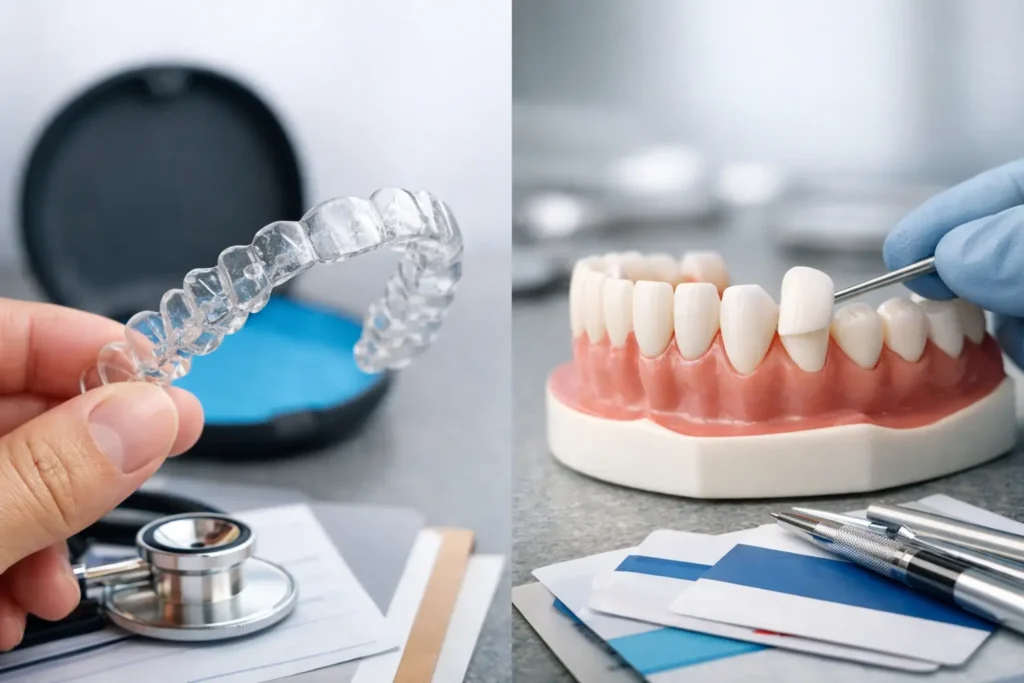
Invisalign is orthodontic treatment. It uses a series of clear aligners to gradually move teeth into better positions. This can improve crowding, spacing, bite alignment, and overall symmetry. For adults in Clairemont and the greater San Diego area, Invisalign is often appealing because it is discreet, removable, and easier to fit into a professional routine than traditional braces.
Veneers are thin porcelain shells bonded to the front of teeth. They do not move teeth. Instead, they change visible shape, color, proportion, and minor irregularities. Veneers are often chosen for teeth that look worn, chipped, stained, uneven, or slightly misaligned when the underlying bite does not need full orthodontic correction.
This is why the comparison can get confusing. If your concern is cosmetic, both options may seem like they could work. But they work in completely different ways, and PPO dental plans often treat them very differently.
Which treatment fits your smile goals?
If your main issue is crooked teeth, overlapping teeth, gaps, or a bite that feels off, Invisalign is usually the more appropriate clinical option. Moving teeth into healthier alignment can improve appearance, but it can also support easier cleaning and better long-term function.
If your teeth are fairly well positioned and you mostly want a whiter, more refined, more uniform smile, veneers may be the better match. They can deliver a dramatic cosmetic upgrade in a shorter time frame, especially when discoloration, chips, small cracks, or shape inconsistencies are the real concern.
Sometimes the best answer is not either-or. A patient may benefit from limited Invisalign first and veneers afterward on selected teeth. That approach can create a more conservative final result because the veneers may require less adjustment to natural tooth structure. It usually costs more overall, but for the right case, it delivers a level of balance and polish that one treatment alone may not achieve.
How PPO plans usually view Invisalign
PPO coverage for Invisalign varies widely. Some plans include adult orthodontic benefits, some only cover orthodontics for dependents under 18, and some exclude clear aligners completely. Even when Invisalign is covered, there is often a lifetime orthodontic maximum rather than a percentage-based benefit.
That means your PPO might contribute a fixed amount, then stop. In many cases, that contribution is helpful but partial. You should also expect plan rules around waiting periods, age limits, and whether treatment is considered medically necessary or purely elective.
The practical advantage of Invisalign from an insurance standpoint is that orthodontic treatment is at least recognized by many PPO structures as a legitimate category of care. The downside is that coverage is rarely generous for adults, and the out-of-pocket portion can still be significant.
How PPO plans usually view veneers
Veneers are typically classified as cosmetic. That is the key phrase patients need to hear early. Most PPO dental plans do not cover cosmetic dentistry when the purpose is appearance enhancement rather than restoring function after damage or disease.
So if you are asking invisalign vs veneers 92117 with insurance in mind, veneers often have less PPO support. There are exceptions in rare restorative situations, but for elective smile design, patients usually pay out of pocket.
That does not make veneers the wrong choice. It simply means the financial conversation needs to be transparent from the beginning. For many adults, veneers are still worth the investment because the result is immediate, highly customized, and focused on visible transformation.
Cost is not the same as value
Insurance can make one treatment look better on paper, but value is about fit. Invisalign may receive more PPO assistance, yet it may not solve deep stains, worn edges, or shape concerns. Veneers may receive little or no insurance contribution, yet they may be the treatment that actually gives you the smile you want.
This is where a thorough cosmetic consultation matters. Digital imaging, close evaluation of bite position, and a clear review of your priorities can prevent an expensive mismatch between treatment and expectations.
A patient who wants teeth to be straighter may be disappointed by veneers alone. A patient who wants brighter, perfectly proportioned front teeth may finish Invisalign and still feel underwhelmed. The right question is not just what costs less. It is what problem are you truly trying to solve.
Timeline, maintenance, and lifestyle trade-offs
Invisalign usually takes months, sometimes longer depending on complexity. Success depends on compliance. Aligners need to be worn as directed, and treatment works best when patients are consistent and engaged. There is also a retention phase after treatment to help preserve the result.
Veneers are faster. Once planned and approved, treatment is completed on a shorter timeline than orthodontics. For busy professionals or patients preparing for a wedding, public-facing role, or milestone event, that shorter path can be compelling.
But fast does not mean casual. Veneers require careful design, precise preparation, and long-term maintenance. They are durable, but they are still a commitment. Invisalign asks for patience and discipline. Veneers ask for a higher upfront investment and a cosmetic philosophy that is more transformational than corrective.
When Invisalign is usually the better choice
If your teeth are healthy but noticeably crowded, spaced, or uneven, Invisalign often makes more sense. The same is true if your bite contributes to wear patterns or cleaning challenges. In those cases, orthodontic movement addresses the root issue instead of masking it.
It may also be the smarter PPO decision if your plan includes meaningful adult orthodontic benefits. Even modest coverage can narrow the financial gap enough to make Invisalign a very attractive option.
When veneers are usually the better choice
If your teeth are close to straight and your main concern is beauty rather than movement, veneers often win. They are especially effective for intrinsic staining, chipped edges, short teeth, irregular contours, and smile design cases where color and proportion matter as much as alignment.
For patients seeking a polished, camera-ready result with a luxury cosmetic finish, veneers can provide a level of customization that orthodontics cannot. They do not correct the bite, but they can dramatically improve what you see in the mirror.
What to ask before using your PPO plan
Before choosing either treatment, ask for a benefits review and a clinical recommendation in the same appointment process. You want to know whether your PPO covers adult orthodontics, whether there is a lifetime maximum, whether waiting periods apply, and whether any related imaging or records are included.
For veneers, ask whether any portion could be considered restorative in your specific case, but go in knowing that most cosmetic veneer treatment is not insurance-funded. That clarity helps you plan realistically rather than hoping for reimbursement that may never come.
An experienced, technology-forward practice can often help you compare these paths with more precision. At Serena Family and Cosmetic Dentistry, treatment planning is centered on aesthetics, function, and long-term value, not just a basic insurance code.
The best choice is usually the one that fits your smile goals, your oral health, and your budget without compromise in the areas that matter most to you. If your PPO helps with Invisalign, that can be a strong advantage. If veneers are the treatment that truly matches your vision, their value may go well beyond what insurance recognizes. A confident smile should feel intentional, not accidental.