
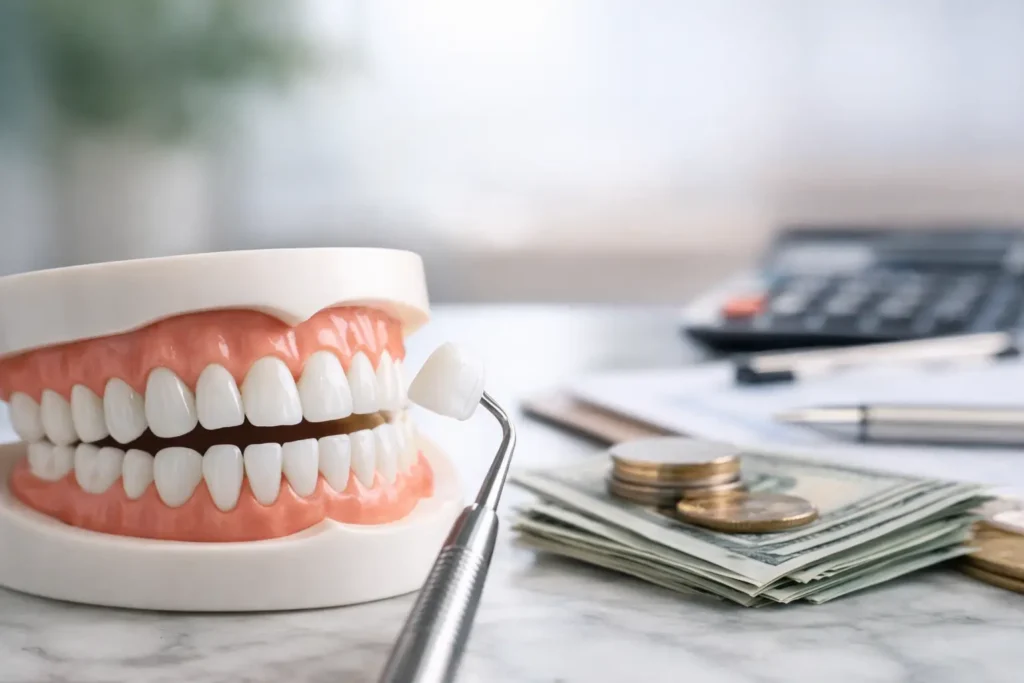
Sticker shock usually happens before the exam, not after the smile design. If you are searching for a dental veneers cost breakdown 2026: using Delta Dental or Cigna PPO in Clairemont Mesa, the real question is not just what veneers cost. It is what you are actually paying for, what your PPO may or may not help with, and how to compare quotes without missing the fine print.
Veneers sit in a category that feels simple from the outside and highly customized once you are in the chair. Two patients can both ask for porcelain veneers and receive estimates that differ by thousands of dollars. That does not automatically mean one office is overpriced. It often means the treatment plans are built differently, the materials are different, or the preparation work is not the same.
Dental veneers cost breakdown 2026 in Clairemont Mesa
In Clairemont Mesa and the broader San Diego market, porcelain veneers in 2026 commonly fall in the range of about $1,200 to $2,500 per tooth. Premium cosmetic cases can run higher when they include advanced smile design, complex bite adjustments, or highly customized ceramics from top-tier labs. Composite veneers are usually less expensive, often around $400 to $1,200 per tooth, but they are a different category of treatment with different longevity, stain resistance, and aesthetic limitations.
For most adults considering veneers, the total cost depends on how many teeth are being treated. A single veneer placed to repair one chipped front tooth is a very different investment than six to eight veneers designed to reshape the visible smile line. In a cosmetic practice, patients often choose six, eight, or ten veneers because matching one central front tooth perfectly can be more challenging than harmonizing several teeth together.
The fee itself usually includes more than the final ceramic shell. It may cover the cosmetic consultation, digital imaging, 3D intraoral scanning, shade analysis, temporary veneers, lab fabrication, and delivery appointment. In higher-end offices, you are also paying for planning precision, aesthetic judgment, and the kind of refinement that makes veneers look natural instead of obvious.
What makes one veneers quote higher than another
Material is one of the biggest variables. Porcelain veneers made from premium ceramics generally cost more than composite because they are more durable, more color-stable, and better at mimicking natural enamel. Lab quality matters too. A veneer crafted by a highly skilled cosmetic lab technician tends to command a higher fee because the detail work is significantly better.
Preparation can also change the price. Some patients need minor contouring, gum rebalancing, old bonding replacement, or bite adjustment before veneers are placed. If a tooth already has a large filling, fracture, or wear pattern, the dentist may need to rebuild the foundation before the veneer is even possible.
Then there is the planning stage. A technology-forward office using digital scans, high-resolution imaging, and detailed smile previews may price differently than a basic fee-for-service office. For patients who care about symmetry, phonetics, facial balance, and long-term fit, that planning stage is not fluff. It is part of the result.
A realistic example of total cost
If you are considering six porcelain veneers at $1,600 per tooth, the treatment fee would be about $9,600. At $2,200 per tooth, that same six-unit case becomes $13,200. If preliminary work such as replacing old fillings, whitening adjacent teeth, or adjusting the bite is needed, the final number can rise further.
This is why online average pricing is only mildly helpful. It gives you a rough range, but it does not tell you whether the quote includes temporaries, design revisions, or prep work. Patients comparing offices in Clairemont Mesa should ask exactly what is included, not just what the per-tooth number is.
Using Delta Dental or Cigna PPO for veneers in Clairemont Mesa
This is where expectations need to be realistic. Most PPO dental plans, including many Delta Dental and Cigna PPO plans, treat veneers as cosmetic. When a procedure is classified as cosmetic, benefits are often excluded entirely. That means the patient pays the full fee even if the office accepts the insurance plan.
That said, there are gray areas. If a tooth is damaged by trauma, has structural loss, or needs restoration for reasons beyond appearance, parts of treatment may be considered under different benefit categories. Some plans may cover a portion of the exam, imaging, or a more medically necessary restoration while still excluding the veneer itself. The details depend on the exact employer plan, annual maximum, frequency limitations, and whether the office is in-network or out-of-network.
With Delta Dental PPO, one patient may have zero veneer coverage while another may have partial benefits if the case is submitted under a restorative code supported by clinical findings. Cigna PPO plans can vary just as widely. The plan name alone is not enough. Group plan details matter.
What PPO patients should check before saying yes
Before moving forward, ask for a benefits estimate and also ask what happens if insurance pays less than expected. Pre-treatment estimates can help, but they are not always a guarantee of final payment. You should also confirm your annual maximum. Even when some portion of care is covered, many PPO plans cap yearly benefits at levels that barely dent a multi-veneer case.
For example, if your annual maximum is $1,500 and your treatment is $10,000, insurance may play only a small supporting role. In cosmetic dentistry, financing options often matter more than the PPO itself.
Delta Dental vs Cigna PPO for veneer-related costs
For Clairemont Mesa patients trying to compare Delta Dental and Cigna PPO, the practical difference usually comes down to fee schedules, network participation, and how each plan interprets necessity. Neither carrier is known for broad cosmetic veneer coverage across standard PPO plans. If veneers are being done primarily to improve color, shape, spacing, or smile aesthetics, assume limited to no benefit unless your plan documents clearly show otherwise.
Where the plans may help is around surrounding care. Your consultation, X-rays, periodontal evaluation, cleaning, or other foundational treatment may receive some coverage. If a tooth needs buildup, core material, or another restorative step before final cosmetic treatment, there may be partial reimbursement depending on the diagnosis.
The safest approach is to think of PPO coverage as a possible offset, not the reason to choose veneers. The more cosmetic the goal, the less likely insurance will carry meaningful weight.
How to compare veneer value, not just veneer price
A lower quote is attractive until it leads to bulky contours, flat color, short lifespan, or visible margins a year later. Veneers are one of the most technique-sensitive treatments in dentistry. The design has to suit your face, bite, speech, and surrounding teeth.
Patients in Clairemont Mesa should look at three factors together: clinical experience in cosmetic cases, the technology used for planning, and the quality of the lab work. If an office offers advanced digital scanning, detailed smile analysis, and a clearly explained treatment plan, you are more likely to understand what you are buying and why it costs what it costs.
This is also where a premium environment can be practical, not just aesthetic. Offices that focus on comfort, precision, and personalized planning often create a smoother veneer process from consultation through placement. At a modern practice such as Serena Family and Cosmetic Dentistry, that level of detail can be especially valuable for patients who want natural-looking cosmetic work and a polished experience from start to finish.
Questions worth asking at your consultation
Ask whether the quoted fee is for porcelain or composite. Ask how many veneers are recommended and why. Ask whether temporaries, scans, lab fees, and follow-up adjustments are included. If you have Delta Dental or Cigna PPO, ask the team to verify benefits and explain what is cosmetic versus potentially billable as restorative.
You should also ask what alternatives exist. In some cases, whitening, bonding, or a combination of orthodontics and conservative cosmetic treatment may achieve your goal for less. Veneers are excellent when they are the right answer, but they are not the only answer.
A good consultation should leave you with clarity, not pressure. You should understand the total fee, the likely insurance contribution, the expected lifespan of the work, and what maintenance will look like over time.
The best veneer decision is rarely the cheapest one. It is the one that fits your smile goals, your budget, and your standards well enough that you still feel good about it years from now.