
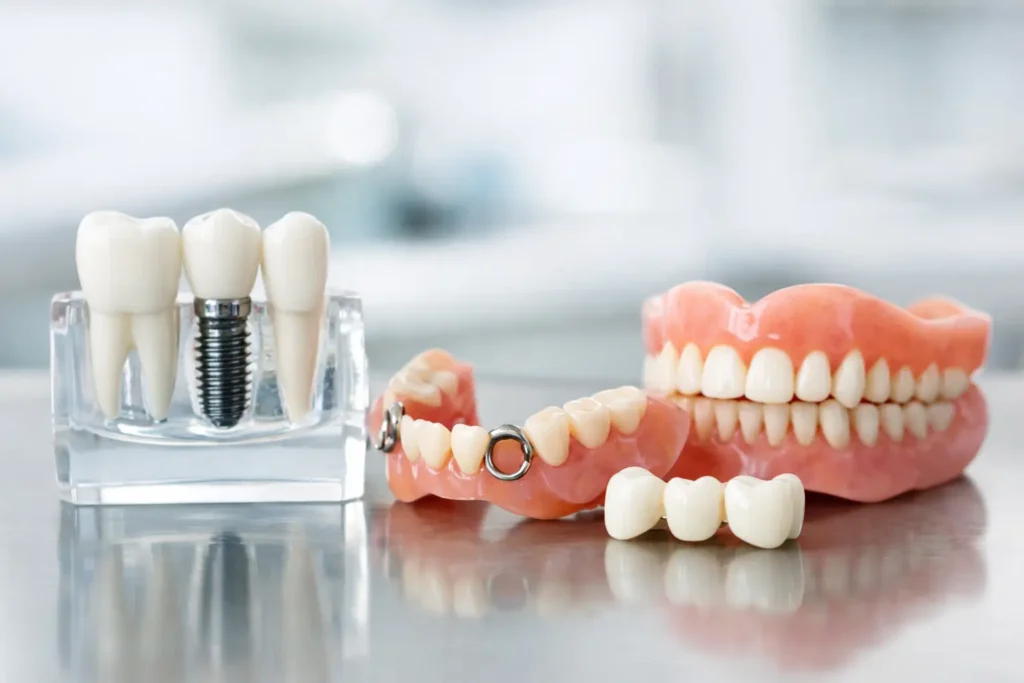
Losing a tooth changes more than your smile. It can affect the way you chew, the way you speak, and even how confident you feel in everyday moments. If you are weighing the best options for missing teeth, the right answer depends on where the tooth is missing, how many teeth are involved, your bone support, your goals for appearance, and how long you want the result to last.
For some patients, a straightforward bridge makes sense. For others, dental implants offer the most natural look and function. And in cases where several or all teeth are missing, modern dentures can provide a beautiful, practical solution. What matters most is choosing a treatment that fits your health, lifestyle, and long-term expectations.
What are the best options for missing teeth?
The best tooth replacement options usually fall into three categories: dental implants, dental bridges, and dentures. Each one solves the same problem in a different way.
Dental implants replace the root of a missing tooth with a titanium post placed in the jawbone. A custom crown, bridge, or denture is then attached on top. This is often considered the premium option because it is stable, long-lasting, and designed to feel very close to a natural tooth.
A dental bridge replaces one or more missing teeth by anchoring an artificial tooth to the natural teeth on either side. It can restore appearance and function without surgery, which makes it appealing for many patients.
Dentures replace several missing teeth or a full arch. They have come a long way in comfort and aesthetics, and they remain an effective option when affordability or the condition of the mouth makes other treatments less practical.
Dental implants: the closest match to natural teeth
If you want the most natural-looking and natural-feeling replacement, implants are often the first treatment worth considering. They are designed to stand independently, which means they do not rely on neighboring teeth for support. That can be a major advantage when the surrounding teeth are healthy.
Implants are especially appealing because they help preserve jawbone. When a tooth is lost, the bone in that area can begin to shrink over time. Since implants stimulate the bone much like a natural root, they can help limit that loss. This matters not just for oral health, but for facial structure and smile aesthetics as well.
The trade-off is that implants require planning, healing time, and a higher upfront investment. Not every patient is an immediate candidate. If there has already been bone loss, bone grafting may be recommended before implant placement. Smokers, patients with uncontrolled diabetes, or those with certain health conditions may need a more careful evaluation.
For adults in San Diego looking for a long-term solution that supports both function and appearance, implants are often the gold standard. They work well for a single missing tooth, several missing teeth, or even full-arch restoration.
When implants make the most sense
Implants are often the strongest choice when you want a fixed solution, when you do not want a removable appliance, or when protecting adjacent teeth is a priority. They are also ideal for patients who place a high value on cosmetics, because the final restoration can be crafted to blend beautifully with the rest of the smile.
That said, implants are not always the fastest route. If you need a tooth replaced immediately for an event or short-term function, another treatment may be used first while implant therapy is completed in stages.
Bridges: a reliable option for one or a few missing teeth
A bridge can be an excellent solution when one tooth is missing between two healthy teeth, or when a patient wants a fixed replacement without surgery. It is a proven restorative treatment and can deliver very attractive results.
One of the biggest benefits of a bridge is efficiency. In many cases, treatment can be completed faster than an implant process. For patients who want to restore chewing ability and close a visible gap without a surgical procedure, that can be very appealing.
The main limitation is that a traditional bridge usually requires reshaping the neighboring teeth so crowns can support the replacement tooth in between. If those adjacent teeth already need crowns or have large fillings, a bridge may be a smart use of treatment. If they are completely healthy, preserving them with an implant may be the more conservative option.
Bridges can last many years with excellent care, but they do not prevent bone loss in the empty area the way an implant can. That difference becomes more important over time, especially in visible parts of the smile.
Dentures: practical, modern, and more refined than many expect
Dentures remain one of the best options for missing teeth when multiple teeth are gone or when a full arch needs to be replaced. They can be removable or supported by implants, and the right design depends on budget, anatomy, and lifestyle.
Traditional removable dentures are often the most cost-effective way to replace many teeth at once. They can restore facial support, improve speech, and make eating easier compared with having no replacement at all. For some patients, especially those replacing a full arch, they offer a meaningful improvement in quality of life.
Still, conventional dentures have limitations. They may shift during eating or speaking, and some patients find them less secure than they would like. Lower dentures in particular can be challenging because they tend to have less natural suction.
This is where implant-supported dentures can make a dramatic difference. By anchoring the denture to implants, stability improves significantly. Patients often feel more confident eating, talking, and smiling. It is a strong middle ground for someone who wants more security than a traditional denture but may not need or want a separate implant for every missing tooth.
Best options for missing teeth if several teeth are gone
When several teeth are missing, the decision becomes more customized. A partial denture may be appropriate if you want a removable, lower-cost solution. A bridge may work if the missing teeth are grouped in one area and the supporting teeth are strong. Implant-supported options usually offer the best blend of comfort, function, and long-term stability, but they also require more investment and treatment planning.
How to choose the right treatment
The best choice is rarely about one feature alone. It is about balancing aesthetics, comfort, longevity, cost, and oral health.
If appearance is your top priority, implants and high-quality bridges tend to deliver the most natural result. If you want the longest-lasting fixed option, implants are often favored. If you need to replace many teeth while keeping costs more manageable, dentures may be the most practical path.
Your timeline matters too. Bridges and dentures can often be completed faster than implant treatment, especially if healing or grafting is involved. On the other hand, choosing the faster option is not always the best value if you are looking years ahead.
A comprehensive exam is essential because what looks like a simple missing tooth may involve bite issues, gum disease, bone loss, or wear on the surrounding teeth. Advanced imaging and digital planning help identify the option that will function well, look balanced, and hold up over time.
Why replacing a missing tooth sooner is usually better
It is easy to postpone treatment when a missing tooth is not visible. But the gap can create problems that spread beyond aesthetics. Neighboring teeth may begin to shift. Opposing teeth can drift. Biting forces can become uneven, which may lead to wear, jaw strain, or difficulty cleaning certain areas properly.
Bone loss is another reason not to wait too long. The longer the space remains empty, the more likely the jawbone is to shrink. That can complicate future treatment, particularly if you later decide you want an implant.
At Serena Family and Cosmetic Dentistry, treatment planning for missing teeth is approached with both precision and personalization, so patients can feel confident they are choosing a solution that fits their goals and their lives.
The best restoration should do more than fill a space. It should help you eat comfortably, smile naturally, and protect your long-term oral health. If you are deciding between implants, bridges, or dentures, the right answer is the one that feels right in function, appearance, and confidence for years to come.