A missing tooth can change more than a photograph. It can affect how comfortably you chew, how clearly you speak, and how confident you feel when you smile. The best ways to replace teeth depend on where the tooth is missing, the health of your gums and jawbone, your goals for appearance and function, and the level of long-term investment that feels right for you.
For many patients, waiting is not the neutral choice it may seem. Neighboring teeth can drift into the open space, the opposing tooth may over-erupt, and the jawbone in that area can gradually lose volume. A personalized examination, supported by digital imaging and 3D scanning when appropriate, provides a clear view of which option will protect your smile now and in the years ahead.
The Best Ways to Replace Teeth Compared
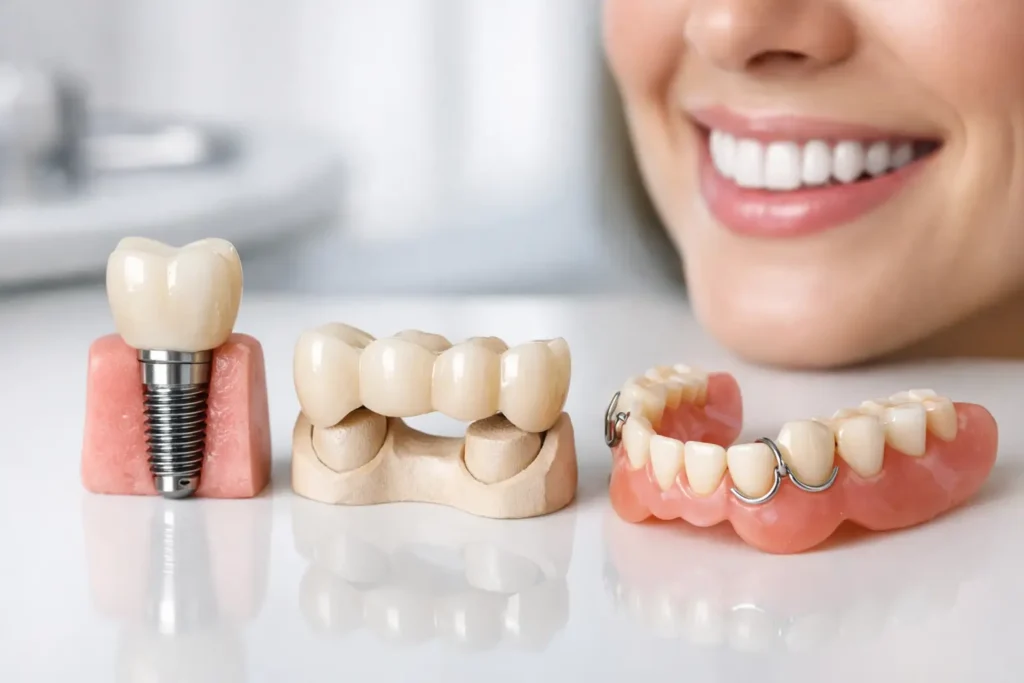
Modern dentistry offers several excellent solutions: dental implants, fixed dental bridges, removable partial dentures, complete dentures, and implant-supported dentures. Each can be the right treatment in the right clinical situation. The goal is not to choose the most advertised option. It is to choose a restoration that looks natural, feels comfortable, and supports your oral health.
Dental implants: the closest replacement to a natural tooth
A dental implant replaces a missing tooth from the root up. A small titanium implant post is placed in the jawbone, where it integrates with bone over time. Once healed, it supports a custom crown designed to match the shape, color, and character of your surrounding teeth.
For a single missing tooth, an implant is often considered the most complete solution because it does not require reshaping healthy neighboring teeth. It also stimulates the jawbone, helping preserve facial support in the area of the missing tooth. With thoughtful planning, precise placement, and consistent home care, an implant can provide exceptional long-term function and aesthetics.
The trade-off is time and upfront cost. Implant treatment generally involves a surgical procedure and a healing period before the final crown is placed. Patients with gum disease, uncontrolled medical conditions, significant bone loss, or certain smoking habits may need additional treatment or a different approach. When bone volume is limited, bone grafting can often create a stronger foundation for a future implant.
Dental bridges: a fixed solution without implant surgery
A traditional dental bridge fills a gap by attaching a replacement tooth to crowns placed on the teeth beside it. The bridge is fixed in place, so it does not come out for cleaning, and modern porcelain can create a highly natural-looking result.
A bridge can be an excellent choice when the teeth next to the missing space already need crowns because of large fillings, fractures, or extensive wear. It is also a practical option for patients who prefer to avoid implant surgery or want to complete treatment on a shorter timeline.
The main consideration is that the supporting teeth must be prepared for crowns, even if they are otherwise healthy. A bridge also does not stimulate bone beneath the missing tooth, so some bone loss may still occur over time. Careful brushing and flossing under the replacement tooth are essential to protect the supporting teeth and gums.
Removable partial dentures: flexible tooth replacement
A removable partial denture replaces one or several missing teeth and can be removed for cleaning. It may be made with a discreet acrylic base, a metal framework, or a more flexible material, depending on the design and the needs of your bite.
Partial dentures can be a cost-conscious way to restore several teeth, particularly when implants or a bridge are not ideal. They can also be used as an interim solution while a patient heals after extractions, grafting, or implant placement.
However, removable appliances do require an adjustment period. They may feel bulkier than a fixed bridge or implant, and they can shift slightly during eating or speaking. A well-designed partial denture should fit securely, but it still needs periodic adjustments as the gums and jawbone change.
Complete dentures: restoring a full arch of teeth
When all teeth in the upper or lower arch are missing, complete dentures can restore a fuller smile and the ability to eat a wider variety of foods. Today’s dentures are custom designed with attention to facial balance, tooth shape, shade, bite relationship, and lip support. A properly planned denture should look refined, not generic.
Conventional dentures rest on the gums and are removable. They remain an effective solution for many patients, especially when surgery is not appropriate or desired. Yet even a beautiful denture can become less stable over time as the jawbone naturally changes after tooth loss.
For patients seeking greater security, implant-supported dentures offer a meaningful upgrade. A few strategically placed implants can stabilize a removable denture, while a fixed full-arch restoration can provide a more permanent feel. The best design depends on bone availability, bite forces, health history, and whether you want a removable or fixed solution.
How to Choose the Right Tooth Replacement Option
The best treatment is rarely determined by one factor alone. Your dentist should consider the health of the remaining teeth, the condition of the gums, the amount and density of jawbone, the position of the missing teeth, and how your upper and lower teeth meet. A replacement tooth that looks attractive but does not fit your bite can lead to discomfort, chipping, or strain on nearby teeth.
Your priorities matter just as much. If preserving natural tooth structure is your highest priority, an implant may be especially appealing. If you need a fixed result without surgery, a bridge may be the better fit. If you are replacing multiple teeth with a more limited initial budget, a partial denture may provide valuable function while you consider longer-term care.
Appearance also deserves careful attention, particularly for front teeth. The right restoration should blend with your smile rather than stand apart from it. This is where detailed treatment planning, digital shade matching, and high-quality materials make a visible difference.
Timing Matters After Tooth Loss
Replacing a tooth promptly can simplify treatment. Soon after an extraction, the bone and gum tissue may be in a better position for a natural-looking restoration. In some cases, an implant can be placed at the time of extraction. In others, the healthiest approach is to allow the site to heal or to complete bone grafting first.
There is no benefit in rushing past essential healing steps, especially in the smile zone or when infection is present. At the same time, postponing a consultation for months or years can allow tooth movement and bone loss to make treatment more complex. An early evaluation gives you options, even if you decide to begin treatment later.
What to Expect From a Personalized Treatment Plan
At Serena Family and Cosmetic Dentistry, treatment planning begins with understanding your goals, concerns, and comfort level. A comprehensive exam can identify concerns that are not visible in the mirror, including bite issues, hidden decay, gum inflammation, or bone loss around a missing tooth.
Digital diagnostics allow the dentist to evaluate the area precisely and discuss your choices in clear terms. You should understand the expected timeline, the number of visits, the materials being recommended, maintenance needs, and the likely cost before moving forward. For patients with dental anxiety, a calm, supportive setting and clear communication can make a significant difference in the experience.
The restoration itself is only part of the result. Long-term success depends on healthy gums, routine professional cleanings, consistent brushing and flossing, and protection from clenching or grinding when needed. Implants, bridges, and dentures all benefit from regular care and periodic evaluation.
A missing tooth does not have to limit how you eat, speak, or smile. The most effective next step is a thoughtful consultation that looks beyond the gap and considers the health, comfort, and confidence you want to carry forward.