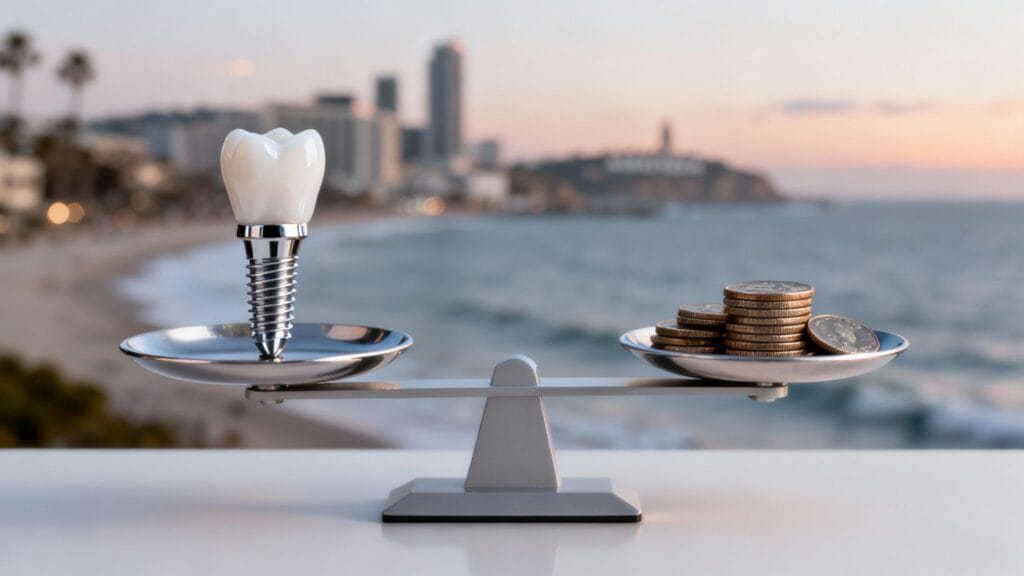
Let's cut right to the chase. When you're researching the dental implants San Diego cost, you're not looking at a single price tag. Instead, you're seeing the total for three key parts: the implant post, the abutment, and the crown.
For a clear starting point, a single implant procedure here in San Diego typically lands somewhere between $3,000 and $6,000. If you're considering a full arch of teeth to restore your entire smile, the investment will be significantly more.
Understanding the Investment in Your Smile
A dental implant is so much more than a simple replacement tooth. Think of it as a long-term investment in your oral health, your confidence, and your overall quality of life. In sunny San Diego, where smiles are always on display, feeling good about yours is priceless.
Unlike dentures or bridges that just sit on top of the gums, an implant actually fuses with your jawbone. This creates a permanent, rock-solid foundation that looks, feels, and chews just like a natural tooth. This process is crucial because it also prevents bone loss and helps maintain your facial structure over time, making it a far superior solution for missing teeth.
Getting a handle on the financial side is a critical first step for anyone thinking about this procedure. The dental implants cost in San Diego can shift based on several factors, but knowing the typical price range gives you the power to plan ahead. As you start your research, seeing a clear breakdown of potential expenses is incredibly helpful.
A Quick Look at San Diego Implant Costs
In the San Diego area, pricing is competitive, which is a good thing for patients. It reflects the high standard of care and quality of materials you should expect. A single tooth implant procedure isn't just one step—it involves several components, and each has its own associated cost.
A complete implant treatment includes three core parts: the implant post (the new root), the abutment (the connector piece), and the final crown (the visible tooth). The final price combines the costs for all three, plus any necessary preliminary work.
To give you a clearer picture, we've put together a table outlining the typical expenses you can anticipate.
Estimated Dental Implant Cost Breakdown in San Diego
This table breaks down the typical price ranges for the individual components of a dental implant and other common related procedures in the San Diego area.
| Component or Procedure | Average Cost Range |
|---|---|
| Initial Consultation & 3D Imaging | $150 – $500 |
| Single Dental Implant Post (Surgical Placement) | $1,500 – $3,000 |
| Abutment & Custom Crown | $1,500 – $3,000 |
| Total for Single Implant | $3,000 – $6,000 |
It's important to remember these are estimates, as every patient's situation is unique.
In San Diego, the all-in cost for a single tooth implant generally falls between $3,000 and $6,000, which covers the implant post, the connecting abutment, and the final crown. For more extensive work, like a full arch restoration, prices can range from $15,000 to $35,000 per jaw, based on recent local data.
You can learn more about all the moving parts that make up your final investment by reading our in-depth guide on what dental implants are and why they are such a worthwhile solution.
Decoding the Key Factors That Shape Your Final Cost
Ever wonder why one person’s implant treatment plan has a totally different price tag than another's? It’s not random. The final cost of dental implants in San Diego is a direct reflection of a highly personalized medical procedure, tailored to your unique clinical needs, material choices, and the dentist's expertise.
Getting a handle on these variables is the first step to understanding your final bill. It lets you see exactly what you’re investing in and why prices can vary so much from one San Diego dental practice to the next.
The Number of Implants You Need
This is the most straightforward factor. Replacing a single missing tooth will, of course, cost less than a full-mouth reconstruction that requires multiple implants to support a bridge or denture.
Think of it like building a fence—the final cost is directly tied to how many posts you need to make it secure. Every implant adds to the total, covering the implant itself, the surgeon's time, and all the parts needed to attach your new tooth.
Choice of Materials: Titanium vs. Zirconia
Not all implants are made the same, and the material used for both the implant post and the final crown makes a big difference in cost and performance.
- Titanium Implants: This is the industry gold standard. Titanium is incredibly strong, biocompatible (meaning your body accepts it readily), and has a proven track record stretching back decades. It offers fantastic, long-lasting results at a more accessible price point.
- Zirconia Implants: Think of this as the premium, aesthetic option. Zirconia is a ceramic material that’s white, just like a natural tooth root. This makes it a great choice if you have thin gums or are concerned about aesthetics. It’s also 100% metal-free, which is a major plus for anyone with metal sensitivities.
Just like a luxury car costs more for its premium engineering, zirconia implants come with a higher price tag. The best choice for you really comes down to your specific anatomy, budget, and what you want the final result to look like.
This diagram breaks down how the total cost is divided among the three main components: the implant post (the "root"), the abutment (the connector), and the crown (the visible "tooth").
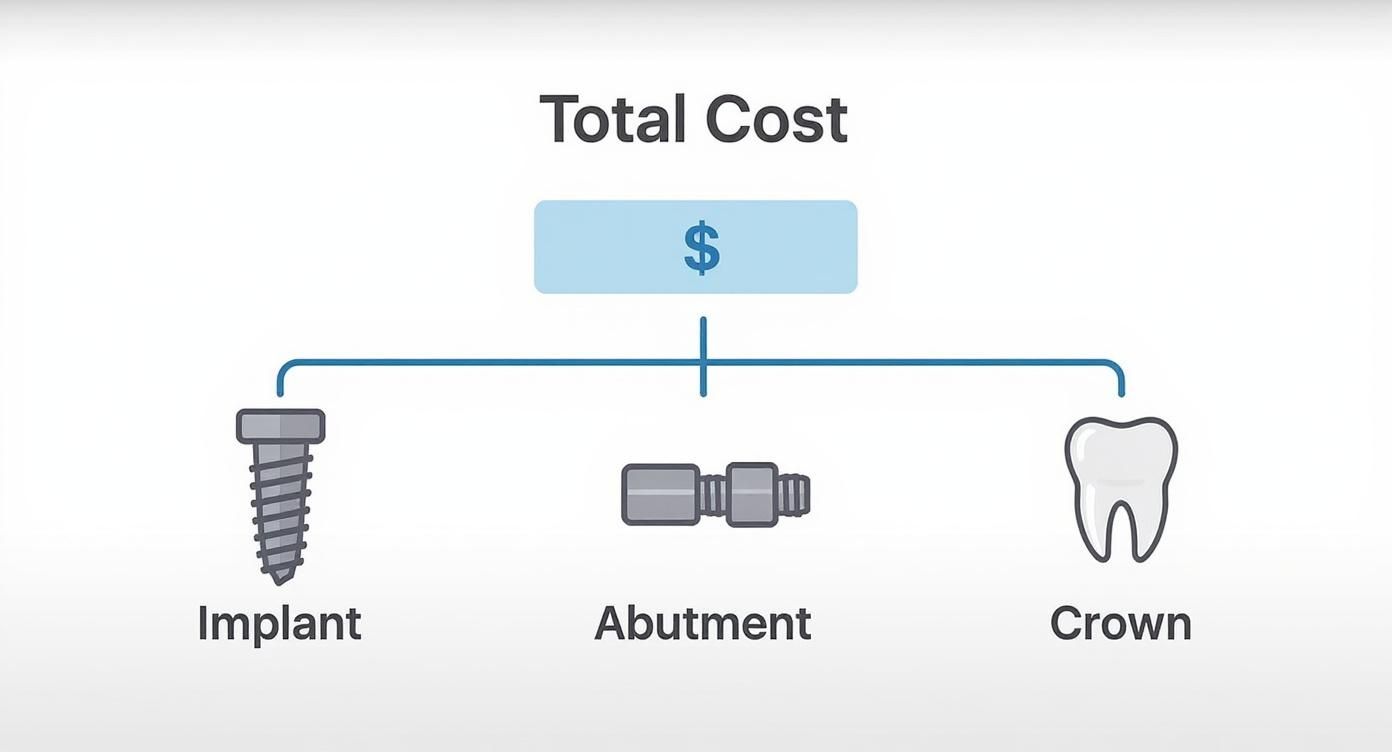
The materials chosen for each of these three pieces will directly influence your final investment.
To give you a clearer picture, let's break down how different choices and situations impact the overall price.
Key Factors Affecting Your Dental Implant Investment
| Influencing Factor | Impact on Cost | Example |
|---|---|---|
| Number of Implants | High | A full-arch restoration needing 4-6 implants costs significantly more than a single implant for one missing tooth. |
| Implant Material | Medium | Choosing a premium, metal-free Zirconia implant will be more expensive than a standard Titanium implant. |
| Additional Procedures | High | Needing a bone graft or sinus lift to prepare the jawbone can add $400 to $3,000+ to the total cost. |
| Dentist's Expertise | Medium | A board-certified periodontist with 20+ years of experience will have higher fees than a general dentist. |
| Technology Used | Medium | Clinics using advanced 3D CBCT scanners and surgical guides may have slightly higher prices, but this often leads to better outcomes. |
| Clinic Location | Low to Medium | A practice in a high-rent area like La Jolla may have higher overhead and pricing compared to a practice in a less central neighborhood. |
Ultimately, your treatment plan is a unique blueprint for restoring your smile, and each of these elements plays a part in the final cost.
Your Dentist’s Experience and Technology
The skill of your dental surgeon and the technology in the clinic are critical. An experienced implantologist who has successfully placed thousands of implants is going to command a higher fee than a general dentist who performs them less frequently.
This expertise isn't just an extra expense; it's an investment in a successful, long-lasting outcome. Top specialists use advanced tools like 3D cone-beam computed tomography (CBCT) for pinpoint-accurate planning, which dramatically reduces risks and improves results. Paying for a higher level of skill often means a smoother procedure and a much lower chance of expensive complications later on.
When you're weighing your options, it's smart to look at the whole picture. For a detailed comparison, check out our guide on choosing between a dental bridge vs. an implant to help you make a confident decision.
Clinic Location and Regional Economics
Where your dentist’s office is located in San Diego County matters, too. The cost of doing business—rent, staff salaries, local taxes—varies from one neighborhood to another. A clinic in an upscale area like La Jolla will have higher overhead than one in a community like Chula Vista, and their pricing often reflects that.
Here in San Diego, the cost for a single implant typically falls between $3,800 and $6,300. While that’s generally more moderate than what you might find in Los Angeles or San Francisco, it still reflects our area's cost of living and the high demand for quality dental care. These regional economic differences are a major reason why you'll see such a wide range of prices across California.
What About Other Procedures? Looking Beyond the Implant Itself
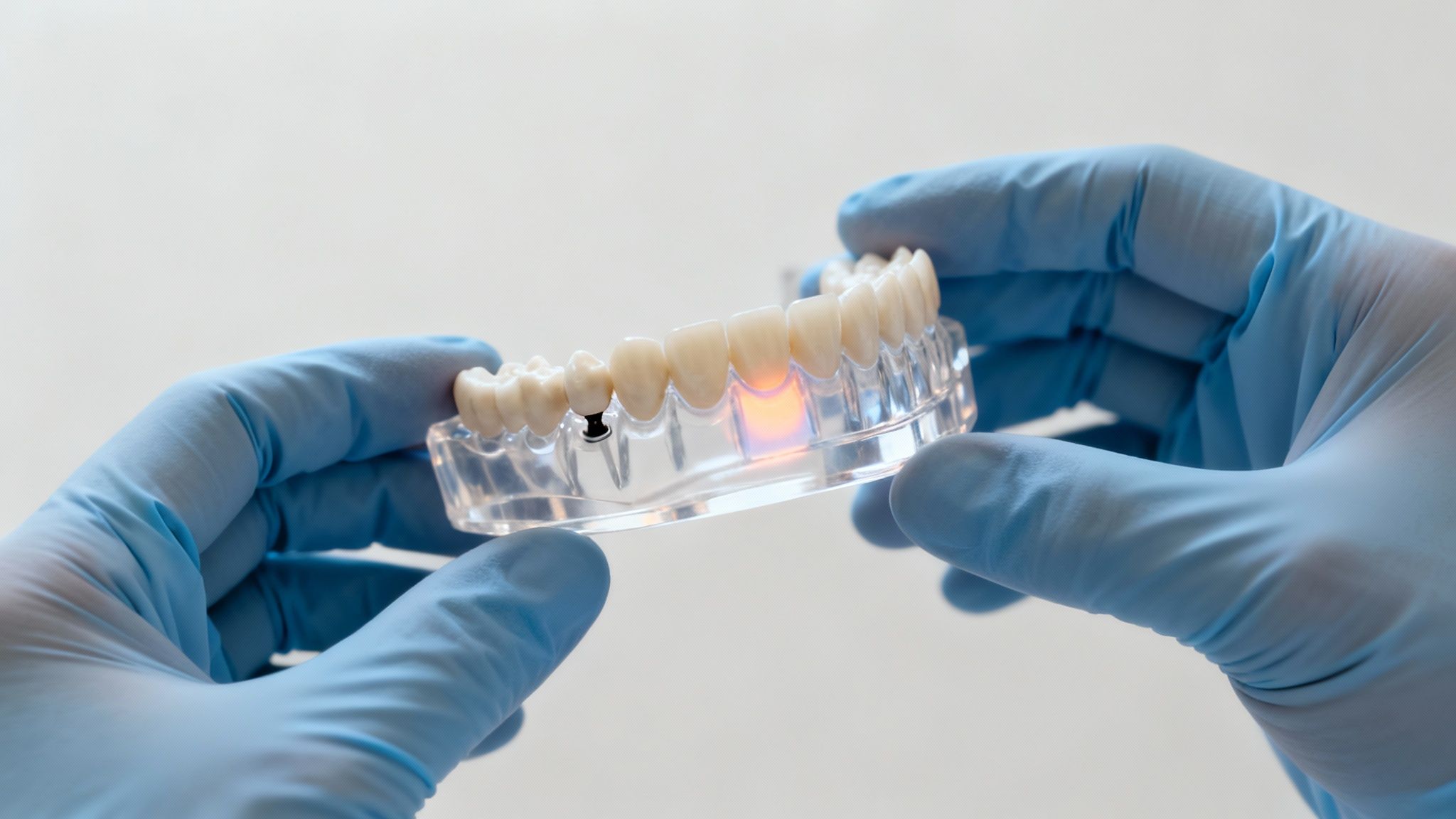
Sometimes, getting a dental implant isn't as simple as just placing the post. For an implant to last a lifetime, it needs a strong, solid foundation in your jawbone. If you've been missing a tooth for a while, it's very common for the bone in that spot to have weakened or shrunk.
This is a completely natural process, but it means your jaw might not be ready for an implant just yet. Understanding these potential prep steps is the key to getting a clear picture of the final dental implants San Diego cost and avoiding any surprises.
Think of it like building a house. You can't put up walls on soft, shifting ground; you have to pour a solid concrete foundation first. The same idea applies to your smile.
When Bone Grafting is Necessary
A bone graft is one of the most common procedures needed before an implant. It’s a straightforward treatment that rebuilds and strengthens your jawbone, creating the dense, sturdy base required to hold an implant securely for decades to come.
Your dentist might recommend a bone graft if your initial 3D scans show there isn't enough bone volume at the implant site. This is often the case for patients who:
- Have had a tooth missing for a year or more.
- Suffered from advanced gum disease that damaged the bone.
- Experienced an injury or trauma to the jaw.
The procedure itself is simpler than it sounds. Your dentist places special bone grafting material where the bone has receded. Over the next few months, your body works its magic and integrates this material, generating new, healthy bone. This gives the implant the best possible chance of fusing successfully.
A bone graft isn't just an "add-on"—it's a foundational step that directly contributes to the incredible 95-98% success rate of modern dental implants. By creating a solid anchor point, it prevents implant failure and protects your investment.
Here in San Diego, the cost for a minor bone graft can range from $400 to $800. More extensive grafts needed for multiple implants might be $1,200 or more. For a deeper dive, our guide on bone grafting essentials covers everything you need to know.
Understanding the Sinus Lift
Another common procedure, especially for implants in the upper back jaw, is the sinus lift. Your maxillary sinuses are just air-filled spaces right above your upper molars. When you lose one of those back teeth, the bone separating your mouth from the sinus can become very thin.
A sinus lift is a specialized type of bone graft that fixes this specific problem. The procedure gently "lifts" the sinus membrane and places bone grafting material underneath, which effectively creates more vertical bone height for the implant to anchor into.
This extra height is absolutely critical. It provides enough room to place an implant without it poking through into the sinus cavity. For many patients, a successful implant in this area would be impossible—or at least very risky—without it.
The cost for a sinus lift in the San Diego area typically falls between $1,500 and $3,000, depending on how complex your specific case is.
Why a Personalized Consultation is a Must
The only way to know for sure which of these preparatory steps you'll need (if any) is through a detailed consultation. We use advanced 3D imaging to get a precise map of your jawbone density and sinus anatomy.
This diagnostic step is the most important part of the entire process. It’s what allows your dental team to build a truly customized treatment plan that addresses all your unique needs right from the start.
This commitment to detailed planning means you get total transparency. You'll receive a personalized quote that includes every potential step, from initial grafts to the final crown. It's all about building confidence so you understand the complete journey to your new smile before it even begins.
Using Dental Insurance for Implants in San Diego
Let's be honest: figuring out dental insurance can feel like the most complicated part of getting implants. For a long time, insurance companies treated implants as a purely cosmetic choice, leaving patients to foot the entire bill.
The good news is that this is starting to change. More and more carriers are recognizing that implants are essential for long-term function and health, and they're beginning to offer some level of coverage. Knowing how to navigate your plan is the first step to lowering your final dental implants San Diego cost.
Key Insurance Concepts to Know
Before you even pick up the phone to call your provider, it helps to understand their language. A few key terms will make all the difference in understanding what your plan will actually pay for.
- Annual Maximum: This is the hard cap on what your insurance will pay out for all your dental care in a single year. Once you hit that limit, the rest is on you until the plan resets.
- Deductible: Think of this as the amount you have to pay first, out-of-pocket, before your insurance benefits kick in.
- Coverage Percentage: Insurance rarely pays 100% of the cost. Most plans cover a certain percentage for different types of care (like 80% for a filling, but maybe 50% for a "major" procedure). Implants almost always fall into that major category.
Grasping these three concepts will give you a realistic picture of your potential out-of-pocket costs.
How Plans Often Cover Implant Procedures
Here's a little secret about insurance and implants: even if your plan says it doesn't "cover implants," you might still get significant financial help. How? It's all about breaking the treatment down into its individual parts.
Many insurance plans take a "component-based" approach. They might deny coverage for the surgical placement of the implant itself, but they'll often help pay for the final crown that sits on top or the initial tooth extraction.
This is a really common way to make your benefits work for you. For example, your plan might cover 50% of major restorative services, and that 50% could be applied directly to the cost of the custom-made porcelain crown. This partial coverage can make a huge difference in your total investment.
If you want to dive deeper into this, you can learn more about how we work with various providers in our guide to dental insurance in San Diego.
Actionable Questions for Your Insurance Provider
When you call your insurance company, being prepared is your best strategy. Asking the right questions turns you from a confused patient into an informed advocate for your own health.
Here are the exact questions to ask to get the clarity you need:
- Does my plan offer any coverage for the dental implant itself? The procedure code is D6010.
- If the implant isn't covered, what about the abutment (D6057) or the crown (D6058)?
- What is my remaining annual maximum for this plan year?
- What is my deductible, and have I already met it?
- What is my coverage percentage for major restorative procedures?
Getting the answers to these questions will take the guesswork out of the equation. Of course, our team at Serena San Diego Dentist is here to help, too. We have years of experience verifying benefits and will gladly help you figure out your coverage before any treatment begins.
Making Your Dental Implants Affordable
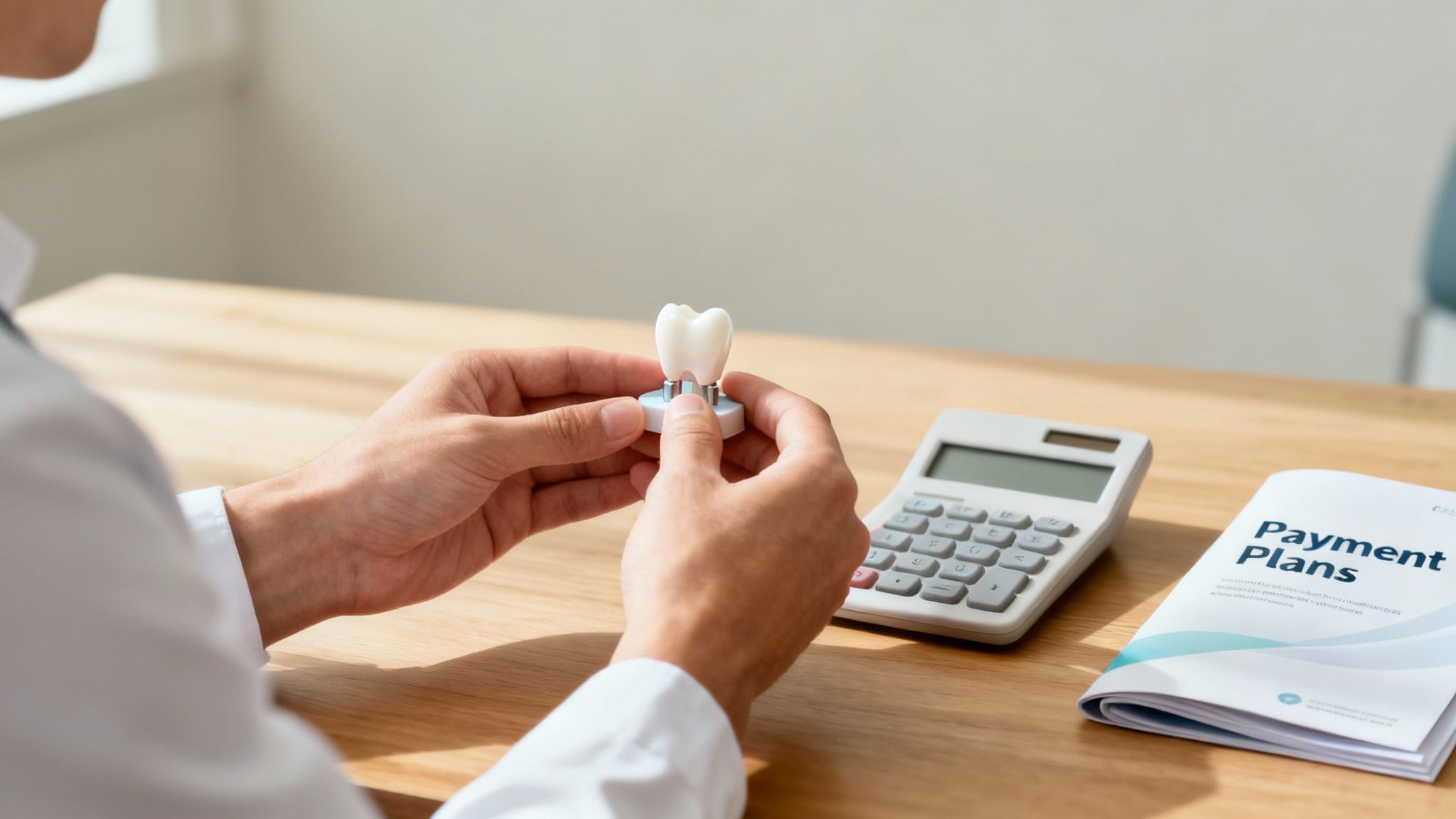
A healthy, confident smile should always be within reach. While the dental implants San Diego cost is a significant investment in your long-term health, don't let the numbers discourage you. There are several smart financial solutions that make this life-changing procedure attainable.
At Serena San Diego Dentist, we've seen it all, and we firmly believe financial concerns shouldn't stand between you and exceptional care. Our team is here to walk you through every option, from flexible financing to using pre-tax accounts you may already have. We'll help you find a path forward that feels comfortable and fits your budget.
Third-Party Financing Plans
One of the most common ways patients manage the cost of dental implants is through a third-party financing company. You've probably heard of CareCredit—it's essentially a credit card created specifically for health and wellness expenses. This lets you move forward with your treatment now and break the total cost into a series of manageable monthly payments.
The biggest advantage here is the promotional financing. Many plans offer 0% interest if you pay off the balance within a set period, like 6, 12, or even 24 months. This gives you the breathing room to spread out the cost without paying a penny in interest. It just makes budgeting for your new smile a whole lot simpler.
Using a financing plan like CareCredit can make the upfront cost of dental implants feel much less intimidating. By converting a large, one-time expense into smaller, predictable payments, you can proceed with your treatment confidently and without delay.
Our front office team can help you with the application, which is usually fast and gives you a decision in minutes.
In-House Payment Plans
For even more flexibility, some dental offices—including ours—offer in-house payment plans. This means you work directly with us to set up a payment schedule, no outside credit company involved. It's a straightforward arrangement between you and your dentist's office.
These plans are fantastic for bridging the gap between what your insurance covers and your final out-of-pocket costs. We can often adjust the down payment and the number of monthly installments to create a plan that fits your personal budget. The goal is to set up a schedule that feels sustainable, so you can focus on healing instead of stressing about bills.
Using Pre-Tax Funds for Your Implants
Here's a savvy strategy many patients overlook: using pre-tax funds from a Health Savings Account (HSA) or a Flexible Spending Account (FSA). These accounts are designed to help you pay for medical expenses while reducing your taxable income. It's a win-win.
- Health Savings Account (HSA): If you have a high-deductible health plan, you might have an HSA. The money you put in is tax-deductible, it grows tax-free, and you can use it for qualified medical expenses—including dental implants—without paying any tax on it.
- Flexible Spending Account (FSA): Many employers offer FSAs, which let you set aside pre-tax money from your paycheck for healthcare. Dental implants are absolutely a qualified expense for these funds.
Think of it like getting an automatic discount on your procedure, often equal to your income tax rate. By paying with money that hasn't been taxed, you can significantly lower the net dental implants San Diego cost. If you have access to one of these accounts, it's one of the smartest ways to pay.
Your Questions About Dental Implant Costs, Answered
To wrap things up, let's go over some of the most common questions we hear from patients right here in San Diego. Getting straight answers is the best way to feel confident about your decision, so we’ve laid out clear explanations for you.
Are Dental Implants Really Worth the Investment?
Absolutely. It’s true that the initial cost for a dental implant is higher than for something like a bridge or denture, but it's a far better investment in your long-term health. Think of it this way: implants are designed to last for decades—often an entire lifetime—with good care. That means you're not facing the cycle of replacements and adjustments that other options require every few years.
Even more importantly, implants are the only solution that truly protects your jawbone. They fuse with the bone, giving it the stimulation it needs to stay strong. This prevents that sunken-in look that can happen after tooth loss and helps maintain your natural face shape. When you add up the longevity, durability, and health benefits, implants often come out cheaper over a lifetime and offer a much higher quality of life.
Why Do I See Ads for Super-Cheap Implants in San Diego?
You have to be careful with those "too good to be true" ads. Often, an incredibly low price for a dental implant is a classic bait-and-switch. The advertised price usually only covers one small part of the entire process—typically just the surgical placement of the implant post itself.
This à la carte pricing means you'll be hit with separate, often significant, charges for the abutment (the piece that connects the implant to the crown) and the final crown (the part that looks like a tooth). On top of that, rock-bottom prices can sometimes be a red flag for lower-quality materials or a practitioner who lacks extensive experience.
Always insist on a comprehensive, all-inclusive quote that breaks down every single fee and component before you agree to anything. A reputable San Diego dentist will be transparent about the full cost from the start, leaving no room for financial surprises down the road.
A trustworthy clinic will always choose clear communication over a misleading price tag.
Will My PPO Dental Insurance Help Cover Implants?
This is a big one, and the answer is: it depends. Dental implant coverage under PPO plans varies quite a bit from one company to another. The good news is that we're seeing more and more insurance plans offer at least partial coverage, even if 100% is still rare.
Your specific plan might cover a certain percentage of the implant cost until you hit your annual maximum. In other cases, it might not cover the implant surgery itself but will help with related procedures, like the initial tooth extraction or the final crown.
The best thing you can do is have your dentist's office submit a pre-treatment authorization to your insurance company. This is an official request that comes back with a clear breakdown of exactly what your plan will and won't cover, so you know your out-of-pocket costs to the penny.
How Does the Cost of an Implant Compare to a Bridge?
At first glance, a traditional dental bridge often looks like the cheaper option. However, that initial savings comes with a trade-off. To place a bridge, the dentist has to grind down the healthy, perfectly good teeth on either side of the gap to use them as anchors. This permanently alters them and can make them more vulnerable down the line.
Plus, dental bridges don't last forever—they typically need to be replaced every 5 to 15 years. Over a lifetime, the cost of replacing a bridge two or three times can easily add up to more than the one-time cost of a dental implant. An implant stands on its own without damaging other teeth and is built to last for decades. When you look at the total lifetime cost and the goal of preserving your healthy teeth, the implant is almost always the smarter, healthier choice.
What’s Actually Included in the Price I’m Quoted?
A proper, comprehensive quote for the dental implants San Diego cost should be all-inclusive, leaving no room for doubt. It should clearly list every single step of your treatment.
A transparent quote should include:
- The initial consultation and any 3D imaging, like a CBCT scan.
- The surgical placement of the titanium or zirconia implant post.
- The healing abutment and the final, custom-made abutment.
- The creation and placement of your final restoration (the crown).
- All follow-up appointments to make sure you're healing perfectly.
Don't hesitate to ask for a detailed treatment plan that breaks down every cost. This ensures you know exactly what you’re paying for and avoids any hidden fees. Transparency is the hallmark of a dental practice that truly puts its patients first.
Ready to take the next step toward a permanent, confident smile? The team at Serena San Diego Dentist is here to provide a transparent, personalized consultation to discuss your options and create a plan that fits your needs and budget. We accept most major insurance plans and offer flexible payment options to make your dream smile a reality.
Schedule your consultation with us today!