A lot of adults reach the same point. They notice one front tooth turning in photos, a little overlap that was not there years ago, or crowding that returned after earlier orthodontic treatment. They want a straighter smile, but they do not want brackets, wires, and the look or routine that comes with traditional braces.
That instinct is reasonable. Modern dentistry gives you more than one way to improve a crooked smile without braces. The important part is choosing the option that fits the problem. Some treatments move teeth. Others reshape or disguise them. Some work well for a small relapse. Others make sense only when the bite is already stable and the goal is cosmetic.
If you are searching for how to fix crooked teeth without braces, this guide is built to help you decide based on three things that matter in real life: your goal, your timeline, and what you are comfortable maintaining.
Beyond Braces Your Modern Path to a Straighter Smile
Patients typically do not walk into a dental office asking for a specific appliance. They come in saying something simpler. “I hate how this tooth looks.” “My smile shifted.” “I want it fixed, but I do not want braces.”
Those are different problems hiding under the same request.
A person with mild crowding after years without a retainer may be a candidate for tooth movement with clear aligners or, in some cases, an active retainer. A person with one slightly rotated front tooth and perfect bite function may be happier with a cosmetic solution that improves the appearance without moving the tooth at all. Someone with a crooked tooth that is also heavily filled, cracked, or structurally weak may need a restorative fix, not a straightening one.
The first question to ask
Before choosing a treatment, ask this:
Do you want to change the position of the tooth, or do you want to change how it looks?
That one distinction clears up most confusion.
- If you want real alignment changes, clear aligners and selected retainer-based movement are the main non-braces options.
- If you want a faster cosmetic change, veneers, bonding, and contouring can improve shape, symmetry, and visual straightness.
- If the tooth is damaged as well as crooked, a crown may enter the conversation.
A straight-looking smile and a corrected bite are not always the same thing. The right answer depends on what is bothering you.
What matters in San Diego life
Lifestyle matters more than people expect.
If you spend your day in meetings, on camera, or out with clients, removable and discreet options often feel easier to live with. If you surf, travel often, or have an unpredictable schedule, convenience matters. If you want the fastest visible change for an event, cosmetic dentistry may fit better than months of orthodontic movement.
The good news is that not wanting braces does not leave you with one backup plan. It leaves you with a decision. That is a better place to start.
Clear Aligners The Invisible Straightening Solution
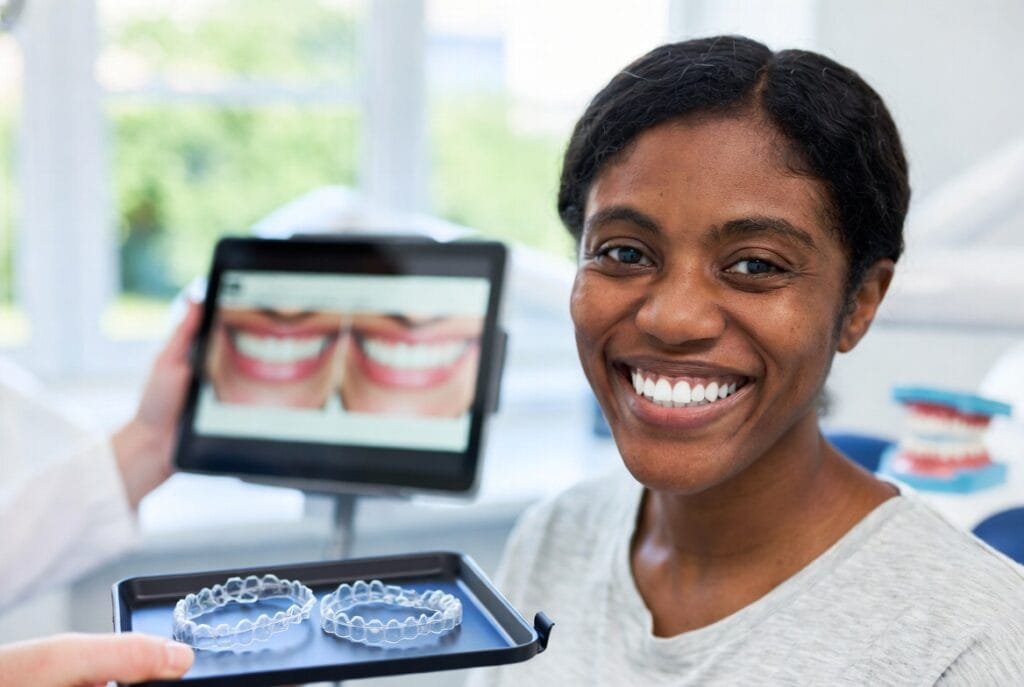
Clear aligners are the closest thing most adults have to a braces alternative that still moves teeth. They use a series of custom transparent trays that fit over your teeth and apply gradual pressure over time.

They are popular for a reason. They are subtle, removable, and easier to manage around meals and social events than fixed braces. But they are not magic. They work best when the case is appropriate and the patient wears them.
What the process feels like
From a patient standpoint, treatment usually starts with an exam and digital records. Your dentist reviews crowding, spacing, tooth angulation, and bite contacts to see whether aligners are a good fit.
If they are, the usual rhythm looks like this:
Records and planning
Digital scans or impressions are used to map tooth movement.Tray delivery
You receive a sequence of aligners designed to move teeth in stages.Daily wear
For best results, aligners need consistent wear and only come out for eating, drinking anything that could stain, and brushing.Progress checks
Your dentist confirms that teeth are tracking the plan and adjusts if needed.
That last step matters. Teeth do not always move exactly as software predicts. Good treatment planning includes real clinical review, not just a box arriving at your door.
Why remote monitoring is becoming common
Many patients want fewer office visits, not no supervision. That is where AI-supported remote monitoring has become useful.
Emerging trends show the integration of AI-driven remote monitoring with clear aligners, cutting in-person visits by up to 70%. FDA-cleared AI tools now report high compliance via gamified apps, and recent surveys show California leads the nation with a significant growth rate in consumer interest for these tech-enhanced treatments according to NewSmile’s overview of non-braces teeth straightening options.
For busy San Diego professionals, that can be a practical middle ground. You still get oversight, but you are not tied to constant chair time.
A short visual helps show how aligner treatment is typically presented to patients:
Who is a strong candidate
Clear aligners tend to make the most sense when your goal is to improve tooth position, not just mask the appearance.
They are often a good fit for:
- Mild to moderate crowding where teeth need real movement
- Small gaps that affect smile symmetry
- Minor relapse after previous orthodontic treatment
- Adults who want removability for work, meals, and hygiene
They are less ideal when the problem is mostly cosmetic and could be solved faster with bonding or veneers, or when the bite is complex enough that traditional orthodontics is the safer choice.
If you want your teeth to be straighter, not just look straighter, aligners are usually the first non-braces option to consider.
Cosmetic Solutions Veneers and Bonding for Instant Results
You may look in the mirror before work in San Diego, notice one front tooth that turns slightly inward, and wonder whether months of treatment make sense for a problem that shows up mainly in photos. In cases like that, the right answer is often a cosmetic fix, not tooth movement.
A straighter-looking smile and a straighter bite are not the same goal. Veneers and bonding improve what people see from the front. They do not correct the underlying position of the teeth or solve a bite issue. That distinction matters when you are choosing based on appearance, timeline, and budget.

Veneers change what the eye sees
Porcelain veneers are thin custom shells placed on the front of the teeth. They can make teeth look straighter by changing visible width, shape, edge position, and symmetry.
They make the most sense when the concern is limited to the visible smile zone and the bite is already stable. They are also a strong option when alignment is only part of the problem, and the patient also wants to improve color, worn edges, small gaps, or tooth proportions.
At Serena San Diego Dentist, porcelain veneers are used for cases where the goal is visual improvement rather than orthodontic correction.
The trade-off is simple. Veneers can create a polished result quickly, but they require planning and they do not move teeth. If a tooth is too far forward, too far back, or the bite is under strain, covering it cosmetically may not be the conservative choice.
Bonding is lighter treatment for smaller changes
Composite bonding uses tooth-colored resin shaped directly on the tooth. It works well for a chipped corner, a slight visible rotation, a narrow tooth, or a small space that throws off smile symmetry.
Bonding usually appeals to patients who want a conservative option and a lower upfront cost. It can often be completed quickly, which fits well for someone who wants improvement without committing to a larger cosmetic plan.
There are limits. Bonding is best for modest corrections, and the material can stain, chip, or lose polish over time faster than porcelain. For one or two small areas, it can be a very practical choice. For a full smile makeover, it may not hold up as well or deliver the same finish.
Side-by-side trade-offs
| Option | Best fit | Main advantage | Main limitation |
|---|---|---|---|
| Porcelain veneers | Minor visible crookedness with shape or color concerns | Strong cosmetic change in a short timeline | Irreversible in many cases, does not move teeth |
| Composite bonding | Small chips, tiny gaps, slight visual imbalance | Conservative and usually lower cost | Less durable and more maintenance over time |
How to choose based on your goal
Veneers usually fit patients who want a broader cosmetic upgrade and are comfortable investing more for durability and refinement.
Bonding usually fits patients who have one specific area that bothers them and want the most conservative cosmetic correction that still makes a visible difference.
I tell patients to start with one question. Do you want teeth that are moved into better position, or do you want teeth that look straighter from the front? If the answer is appearance only, veneers or bonding may be appropriate. If the tooth position or bite is the underlying problem, cosmetic masking can create frustration later.
Cosmetic treatment works best when the bite is healthy, the correction is visible and localized, and the patient is clear about the trade-offs.
Choosing Your Path A Comparison of Non-Braces Options
The smartest way to choose a treatment is to stop asking which option is “best” and start asking which one solves your specific problem.
If your front teeth have shifted and you want real correction, that points toward aligners or, in carefully selected relapse cases, active retainer therapy. If your complaint is visual and localized, veneers or bonding may be more efficient. If the tooth is damaged, a restorative approach may make more sense than either.

Non-Braces Straightening Options at a Glance
| Treatment | Best For | Timeline | Durability | Cost Guide |
|---|---|---|---|---|
| Clear aligners | Mild to moderate alignment changes, relapse, small gaps | Usually months | Good with retention | Moderate to higher |
| Veneers | Minor visible crookedness plus shape or color concerns | Short cosmetic timeline | Durable with good care | Higher |
| Dental bonding | Small chips, slight rotations, tiny gaps | Often quick | Moderate | Lower to moderate |
| Active retainers | Very mild relapse or limited movement | Months | Depends on wear and follow-up | Lower than full orthodontic treatment |
| Contouring | Tiny edge irregularities | Very quick | Stable when conservatively done | Lower |
| Crowns | Crooked teeth with major structural damage | Varies by case | Durable restorative option | Moderate to higher |
A simple patient-first framework
Use these questions to narrow your path:
Do you need teeth moved, or do you need the smile to look straighter?
Movement points toward aligners or retainers. Visual change points toward veneers, bonding, or contouring.How fast do you want a visible result?
Cosmetic treatments can change appearance quickly. Orthodontic approaches take longer but correct position.Is the tooth healthy?
A healthy but crooked tooth is handled differently from a cracked, heavily restored, or worn tooth.Will you maintain the result?
Removable systems only work if you wear them. Cosmetic work still needs protection, hygiene, and follow-up.
What usually works and what usually disappoints
Patients tend to be happiest when the treatment matches the diagnosis.
They tend to be frustrated when they choose a shortcut for a problem that was never a shortcut case. Veneers do not solve a functional bite issue. Bonding does not replace proper movement when crowding is real. Aligners are not a good match for someone who knows they will not wear them as directed.
The best plan is rarely the flashiest one. It is the one that fits your mouth and your habits.
Minor Corrections With Retainers Contouring and Crowns
Some of the most useful non-braces solutions are the ones people hear about the least. They are not broad smile makeover tools. They are targeted answers for narrow situations.
Active retainers for very small movement
A retainer is not only for holding teeth after treatment. In selected mild relapse cases, it can also be used to create limited movement.
For very mild cases with minor crowding, custom retainers worn consistently can achieve modest monthly tooth movement, with significant success rates over several months, according to Crystal Clear Dental’s discussion of non-braces teeth straightening methods.
That matters for adults who had previous orthodontic treatment and later noticed a small shift. It does not mean retainers replace aligners for broader corrections. It means they can be effective when the movement needed is limited.
When retainers work best
Retainer-based movement is most realistic when:
- The crowding is minor and localized
- The shift is a relapse, not a longstanding complex alignment problem
- The patient will wear the appliance consistently
- Monitoring is built in, so tracking stays accurate
Patients often like this option because it feels conservative. The downside is simple. It only works when the case is small and the wear schedule is followed closely.
Contouring can fix visual roughness
Enamel contouring, sometimes called enamelplasty, does not move teeth at all. It reshapes small irregular edges so a tooth looks smoother, more even, or less visually crooked.
This is helpful for:
- Slightly uneven incisal edges
- Tiny chips
- One tooth that catches the eye because of shape, not position
It is subtle, but subtle is often exactly what a smile needs.
If the problem lives at the edge of the tooth, contouring may do more than you expect. If the problem starts at the root position, contouring will not solve it.
Crowns can be part cosmetic, part restorative
Crowns are not a standard straightening treatment. They become relevant when a crooked tooth is also weakened by a large filling, fracture, wear, or heavy breakdown.
In that setting, the goal is twofold:
- Restore strength and function
- Improve the visible alignment and shape of the tooth
This is why diagnosis matters so much. A tooth may look like a cosmetic concern from the outside and still need a restorative plan underneath.
Your Next Steps for a Straighter Smile in San Diego
The main takeaway is simple. You can often improve crooked teeth without braces, but the right solution depends on whether you need movement, camouflage, or restoration.
A consultation matters because teeth that look similar in a mirror can require very different treatment. One patient needs aligners. Another needs bonding. Another needs a crown because the tooth is not structurally sound enough for a purely cosmetic fix.

What to bring to your decision
Come into the conversation knowing these three priorities:
Your real goal
Straighter tooth position, a better-looking smile, or repair of a damaged toothYour timeline
A gradual change, or a cosmetic result you want soonerYour maintenance style
Whether you can stay consistent with removable treatment and long-term retention
Payment and access
Practical details matter too. Serena San Diego Dentist accepts major PPO insurance plans for covered services and offers flexible payment options for patients who prefer to pay out of pocket. The best way to get a clear estimate is to schedule an exam, because coverage and treatment choices vary by diagnosis.
If you have been putting this off because you assumed braces were the only path, it is worth getting a real answer. Many adults are better candidates for non-braces solutions than they think.
Common Questions About Fixing Teeth Without Braces
Can crooked teeth really be fixed without braces
Often, yes. The right option depends on what is causing the tooth to look crooked. A small spacing issue or mild crowding may respond well to clear aligners or, in limited cases, an active retainer. If the concern is visual rather than positional, bonding, veneers, or careful contouring may give the result you want without orthodontic movement. If the bite is significantly off or the crowding is more advanced, traditional orthodontic treatment may still be the better choice.
What is the fastest option
For a faster cosmetic change, veneers or bonding usually win because they reshape what you see instead of shifting the tooth through bone.
That speed comes with a trade-off. You can improve appearance quickly, but you are not correcting the underlying position the way aligners do. If your goal is true tooth movement, expect more time and more follow-through.
Do clear aligners hurt
Clear aligners usually create pressure, not sharp pain. Teeth often feel tender for a day or two when you start a new tray, especially early in treatment. That soreness is expected because the teeth are being guided into a new position.
Do veneers or bonding damage healthy teeth
They should never be treated as a casual shortcut. Veneers usually require some enamel adjustment. Bonding is often more conservative, but it still has to be planned carefully so the result looks natural and holds up in daily function. Good case selection matters as much as the materials.
Will teeth move back after treatment
Yes, they can. Teeth have a memory, and retention is part of treatment, not an optional extra. Patients who travel often, play sports, or have inconsistent routines around San Diego tend to do better when they choose a plan they can realistically maintain long term.
How do I know if I need an orthodontist instead
Get an orthodontic opinion if your crowding is significant, your bite feels uneven, your teeth do not come together properly, or you have jaw discomfort along with the cosmetic concern. In practice, the right referral usually becomes clear once we look at photos, X-rays, bite function, and the condition of the teeth themselves.
If you want a practical answer based on your smile, your timeline, and what you are comfortable maintaining, schedule a consultation with Serena San Diego Dentist. The goal is to figure out whether you need movement, camouflage, or repair, then choose the option that fits your budget and daily life.