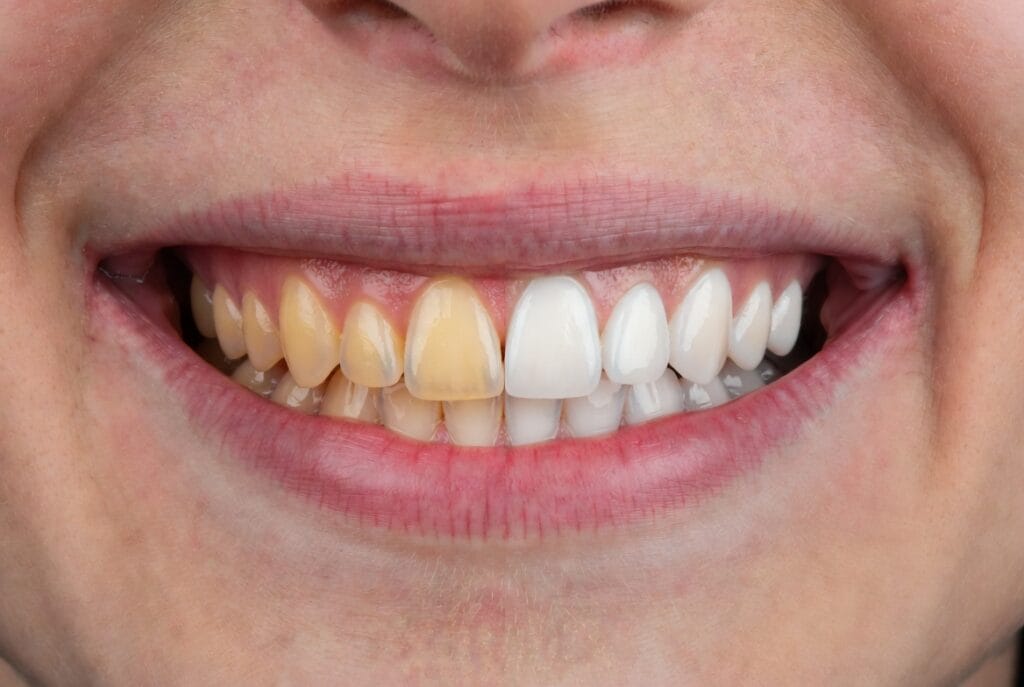
A lot of people start searching for how to get rid of yellow teeth at the same moment. You catch your reflection before work in downtown San Diego, or you see yourself smiling in a beach photo from La Jolla, and your teeth look darker than you expected. You brush every day, maybe you’ve already tried a whitening toothpaste, and you still feel like your smile looks dull.
That frustration is real. In San Diego, people spend a lot of time outdoors, in meetings, at weddings, on video calls, and in photos. When your smile doesn’t match how healthy or polished you want to look, it can affect confidence fast.
Yellow teeth don’t always mean you’re doing something wrong. Sometimes the cause is coffee, tea, red wine, tobacco, or inconsistent stain removal. Sometimes it’s age, genetics, past medication exposure, or enamel thinning. That difference matters, because the right fix depends on the kind of discoloration you have.
Some people do well with simple home care and a safer over-the-counter routine. Others need a dentist-supervised whitening plan. And some patients won’t get the result they want from whitening alone, no matter how many strips they buy.
Your Guide to a Brighter Smile in San Diego
A common San Diego pattern goes like this. Someone tries whitening toothpaste for a while, adds strips before an event, cuts back on coffee for a week, then wonders why their smile still looks yellow in bright sunlight.
Usually, the issue isn’t effort. It’s that the treatment didn’t match the stain.
If the color change is mostly on the surface, home whitening may be enough. If the yellow tone comes from deeper inside the tooth, you can spend a lot of time and money on products that barely move the needle. That’s why a realistic plan matters more than chasing trends.
What usually works best
Many individuals achieve better results when they think about whitening in layers instead of looking for one miracle product.
- Daily stain control: Good brushing technique, a whitening toothpaste with evidence behind it, and fewer staining habits between cleanings.
- Short-term improvement: Whitening strips or dentist-prescribed take-home trays when you want a visible boost.
- Fastest change: In-office whitening when you want a noticeable result on a tight timeline.
- Smile redesign: Veneers or crowns when discoloration is too deep for whitening to handle.
Practical rule: If a product only scrubs the tooth surface, it won’t fix every kind of yellowing.
San Diego patients often want one of two things. They either want a modest brightening they can maintain at home, or they want a faster cosmetic result for work, travel, engagement photos, or a special event. Both are reasonable goals. The key is choosing a method that’s safe for enamel and honest about what it can do.
You don’t need to guess your way through shelves of whitening products. A smarter approach is to understand the stain first, then choose the least aggressive option that can realistically get you where you want to go.
Why Teeth Turn Yellow The Science Behind Stains
Yellow teeth can come from extrinsic stains or intrinsic discoloration. That distinction explains why one person responds well to whitening toothpaste and another doesn’t.

Extrinsic stains sit on the outside
These are surface stains. They collect on enamel from the things many adults already know by heart.
Coffee, tea, red wine, dark sodas, tobacco, and strongly pigmented foods can all leave a visible film over time. Plaque and tartar can make that look worse. This is the kind of yellowing that often responds to better hygiene, professional cleanings, whitening toothpaste, and whitening gels.
Surface stains are frustrating, but they’re also the most treatable.
Intrinsic discoloration starts deeper
Intrinsic yellowing is different. The darker tone comes from inside the tooth or from enamel becoming thinner, which lets the naturally yellower dentin show through more clearly.
That’s why age-related yellowing often feels stubborn. According to Medical News Today’s summary of intrinsic yellowing research, enamel thinning after age 30 may occur at 1 to 2 microns per year, and 60% of adults are affected by dentin yellowing linked to enamel thinning. The same source notes that peroxide has less than 20% efficacy for these deeper cases compared with 70% for veneers, and over-the-counter strips usually improve color by only 1 to 2 shades temporarily.
How to tell which kind you may have
You don’t need a perfect diagnosis at home, but these clues help:
- Surface stain is more likely if your teeth have darkened gradually with coffee, tea, wine, or smoking and the color looks uneven around grooves or near plaque buildup.
- Intrinsic stain is more likely if your teeth have looked yellow for years, the color seems built into the tooth, or whitening products have given you little change.
- Mixed staining is common if you have both everyday surface buildup and age-related yellowing underneath.
If your teeth look yellow no matter how clean they are, the issue may be deeper than the enamel surface.
Why this matters before you whiten
A lot of disappointment comes from using a surface-level solution on a deeper problem. If you know your discoloration is mostly extrinsic, home care can be a good place to start. If it’s intrinsic, whitening may still help somewhat, but your expectations need to stay grounded.
That’s the science behind almost every whitening success story and almost every whitening letdown.
Safe and Effective At-Home Whitening Methods
If you want to start at home, stick with methods that have evidence behind them and avoid the internet’s harsher DIY trends. At-home whitening can help, but it works best when you choose products based on safety first and speed second.

Whitening toothpaste can help with mild surface stains
This is the easiest entry point for many individuals. Whitening toothpastes work by using mild abrasives to lift surface stains, and some formulas also include peroxide or stain-targeting enzymes.
According to Healthline’s review of whitening toothpaste evidence, a 2012 study found that toothpaste containing baking soda and peroxide led to significant stain removal and whitening after 6 weeks. The same source notes that papain and bromelain formulas also showed significant stain removal, with whitening toothpastes typically lightening teeth by about one shade over several weeks.
That means whitening toothpaste is useful, but modest. It’s maintenance, not a dramatic makeover.
Professional take-home trays are the stronger home option
If you want more than a slight surface improvement, custom trays from a dentist are usually a better at-home path than guessing with random retail products.
Here’s why they tend to work better:
- Better fit: Custom trays hold gel more evenly against the teeth.
- More predictable wear: You’re less likely to miss spots or irritate your gums.
- Professional oversight: A dentist can tell you whether whitening makes sense before you start.
Professional take-home trays can produce noticeable improvement within one week, with optimal whitening in two to four weeks, according to Estrella Mountain Dentistry’s overview of yellow teeth treatments. That same source notes that at-home products cost about $500 less on average than in-office whitening.
For patients who want flexibility, this is often the sweet spot.
Whitening strips have limits
Strips are popular because they’re easy to buy and easy to use. They can help some people with mild discoloration, but they don’t always contact every tooth evenly. If your teeth are crowded, rotated, or shaped irregularly, the whitening can look patchy.
They’re also not the ideal choice if your stains are deeper than the enamel surface. In those cases, strips often become a cycle of repeat use without a satisfying result.
A helpful visual on common whitening habits and misconceptions is below.
What not to do
A lot of DIY whitening advice sounds natural and harmless. Some of it isn’t.
The biggest mistakes usually involve people trying to scrub or acid-wash stains away. That can leave teeth looking worse over time because enamel damage makes the yellow dentin underneath more visible.
Avoid these habits:
- Straight abrasive scrubs: Dry or repeated baking soda scrubs can be rough on enamel when overused.
- Acidic hacks: Lemon, citrus peels, and apple cider vinegar can soften tooth structure instead of safely whitening it.
- Charcoal trends: These products often focus more on abrasion than controlled whitening.
- Undirected peroxide use: More isn’t better if it irritates tissue or triggers sensitivity.
A whitening method isn’t good just because it’s cheap, viral, or “natural.” Teeth need stain removal that preserves enamel.
A sensible home routine
If you’re trying to figure out how to get rid of yellow teeth without overdoing it, keep the routine simple:
- Brush twice daily for 2 minutes with gentle circular motion.
- Choose a whitening toothpaste with ingredients backed by evidence.
- Use whitening trays or strips only as directed.
- Rinse with water after coffee, tea, or wine.
- Stop if your teeth become noticeably sensitive and get advice before continuing.
For many people, that’s enough to brighten the smile gradually and safely. For others, it’s the step that shows them they need something stronger.
Professional Whitening in San Diego for Dramatic Results
A common San Diego scenario is a patient with a work presentation in Del Mar, engagement photos in La Jolla, or a wedding that weekend who wants a real change, not a small improvement that may or may not show up in pictures. In that situation, professional whitening is usually the fastest safe option.

Why in-office whitening works faster
As described in City of Oaks Dental’s clinical overview of professional whitening, professional whitening uses high-concentration hydrogen peroxide gels in the 35% to 40% range and can produce 3 to 8 shade improvements in a single 60 to 90 minute session.
The concentration matters, but supervision matters just as much. In-office whitening gives the dentist control over gum protection, tooth isolation, timing, and whether treatment should be adjusted for sensitive areas, thin enamel, or existing dental work. That is the difference between a stronger product and a stronger process.
A proper whitening visit usually includes:
- A pre-treatment exam to check for decay, gum irritation, enamel wear, and sensitivity risk.
- A barrier that protects the gums and other soft tissue.
- Careful isolation so the whitening gel stays where it should.
- Gel application in 3 to 4 cycles.
- Light activation in many systems to speed pigment breakdown.
Why many San Diego patients choose it
For busy schedules, one appointment is often more realistic than trying to stay consistent with strips or trays for days or weeks. I see this often with patients balancing long work hours, travel, outdoor events, and coffee habits that keep adding fresh stain.
Serena San Diego Dentist offers Philips Zoom Teeth Whitening, a professional system that uses whitening gel with light activation over three 15-minute cycles, with custom take-home trays recommended in appropriate cases.
At-Home vs. Professional Whitening at a Glance
| Method | Effectiveness | Timeline | Best For |
|---|---|---|---|
| Whitening toothpaste | Mild improvement for surface stains | Several weeks of daily use | Small touch-ups and maintenance |
| Whitening strips | Modest improvement, less predictable on uneven teeth | Gradual use over days to weeks | Mild surface stain and convenience |
| Custom take-home trays | Stronger and more even than retail products | Noticeable change within one week, optimal whitening in two to four weeks | Patients who want flexibility with professional guidance |
| In-office whitening | Strongest visible change in the shortest time | One 60 to 90 minute visit | Event-ready results and deeper extrinsic stains |
Professional whitening gives better control over strength, tissue protection, and case selection. That usually leads to a more predictable result.
The trade-offs are real
This option is not right for every yellow smile. Professional whitening can trigger temporary sensitivity, and crowns, veneers, fillings, and deep intrinsic discoloration do not respond the same way natural enamel does. The cost is also higher up front than store-bought products.
Still, for patients with healthy teeth and stain that responds to peroxide, in-office whitening is usually the most efficient way to get a noticeable result fast. That matters in San Diego, where people often want something that looks good in bright outdoor light, on camera, and in person, not just a slight change in the bathroom mirror.
When Whitening Isnt Enough Advanced Cosmetic Solutions
Some yellow teeth won’t become the shade you want with peroxide, no matter how carefully you use it. For these situations, cosmetic dentistry becomes the right tool for the job.

When the stain is built into the tooth
Deep intrinsic discoloration often comes from aging, genetics, medication exposure, trauma, or developmental changes in the tooth. In those cases, whitening may brighten the smile a bit but still leave the overall color warmer or darker than the patient wants.
According to Creekview Dental’s summary of treatment limits for intrinsic yellowing, peroxide-based whitening shows less than 20% efficacy for these deeper stains, while porcelain veneers offer over 70% efficacy in masking them.
That’s a major difference in outcome.
Veneers and crowns solve a different problem
Whitening changes tooth color. Veneers and crowns change what you see.
- Porcelain veneers cover the front surface of visible teeth and can correct deep discoloration, shape issues, and uneven tone at the same time.
- Dental crowns cover the full tooth and are often the better choice when a tooth is both discolored and structurally compromised.
This matters for patients who don’t just want brighter teeth. They want a smile that looks balanced, uniform, and natural.
How to know you may need something beyond whitening
A few signs point in that direction:
- Repeated whitening hasn’t delivered the level of brightness you expected.
- One or two teeth look darker than the others after trauma or prior dental changes.
- The color problem comes with shape issues, wear, chips, or old restorations.
- You want a long-term cosmetic redesign, not another round of bleaching.
Some smiles don’t need more whitening. They need a different strategy.
For the right patient, veneers or crowns can be the shortest path to the result they want. That’s especially true when the goal is not just “less yellow” but a consistently bright, camera-ready smile.
Maintaining Your Bright Smile and When to See a Dentist
You finish whitening, catch your reflection in the car mirror on the way to work, and your teeth finally look the way you wanted. The part that surprises many patients is what happens next. Keeping that result usually depends less on one big decision and more on the small habits that fit your routine in San Diego, especially if coffee, iced drinks, wine, or frequent dining out are part of the week.
Whitening fades in a predictable way. Pigments collect again, plaque holds surface stain, and enamel can start to look dull if home products are overused. Good maintenance keeps the color cleaner for longer and helps you avoid the cycle of whitening too often, then dealing with sensitivity.
Keep the result longer
A few habits make a clear difference:
- Brush gently twice a day: Use a soft-bristled brush and light pressure. Scrubbing harder does not make teeth whiter, but it can irritate gums and wear the tooth surface over time.
- Rinse with water after staining drinks: This is a simple habit that helps after coffee, tea, red wine, and dark sodas.
- Stay on schedule with dental cleanings: Even a good whitening result can look dull when stain and tartar build up along the gumline.
- Use whitening toothpaste sparingly: It can help maintain surface brightness, but daily use is not right for everyone, especially if teeth already feel sensitive.
- Watch for soreness or sharp sensitivity: If whitening products start to sting, stop using them and get an exam before trying another round.
A straw can help with iced coffee or tea, but it will not prevent all staining. That trade-off matters. Small reductions in exposure help, yet they do not replace brushing, rinsing, and professional cleanings.
A few common questions
How long do whitening results last?
That depends on the whitening method, the kind of discoloration you started with, and your daily habits. Patients who drink coffee throughout the day or smoke usually see relapse sooner than patients with lighter exposure to stains.
If my teeth are yellow from age, should I still whiten them?
Sometimes. Age-related darkening often responds, but not always as much as people hope. If the color change is deeper inside the tooth, whitening may brighten things somewhat without creating a dramatic change.
When should I book an exam instead of trying more products?
Book a visit if home whitening has stopped helping, if one tooth looks darker than the others, if you have fillings or crowns that no longer match, or if sensitivity is getting worse. Those cases need a diagnosis, not another box of strips.
Serena San Diego Dentist accepts many major insurance plans for covered dental services and also offers out-of-pocket payment flexibility, including financing options for patients who want cosmetic care or prefer a payment plan. For exact coverage and treatment costs, it’s always best to confirm details directly with the office.
If you’re tired of guessing how to get rid of yellow teeth, schedule a consultation with Serena San Diego Dentist. Patients across San Diego, Clairemont Mesa, and La Jolla can get a personalized plan based on the type of discoloration they have, whether that means safer home whitening, in-office treatment, veneers, crowns, or a combination approach.