If you have been putting off orthodontic treatment because metal braces feel too visible, too inconvenient, or simply not right for your professional life, Invisalign for adults in Clairemont Mesa 92117 may be the option that finally fits. One of the first questions most patients ask is whether clear aligners are covered by Cigna or Aetna PPO plans, and the honest answer is that it depends on your specific benefits, age limits, and orthodontic coverage details.
For many adults, the decision is not really about whether straighter teeth would help. It is about whether treatment can work with meetings, family schedules, photos, dating, travel, and a realistic monthly budget. Clear aligners appeal to adults because they are discreet, removable, and easier to fit into daily life than traditional braces. But the financial side matters just as much, especially when insurance is part of the conversation.
Invisalign for adults in Clairemont Mesa 92117: what makes it appealing
Adult orthodontic treatment tends to be more practical than teenage treatment. Most adults are not chasing perfection. They want to fix crowding that has worsened over time, close minor gaps, improve bite alignment, or feel more confident smiling at work and in social settings.
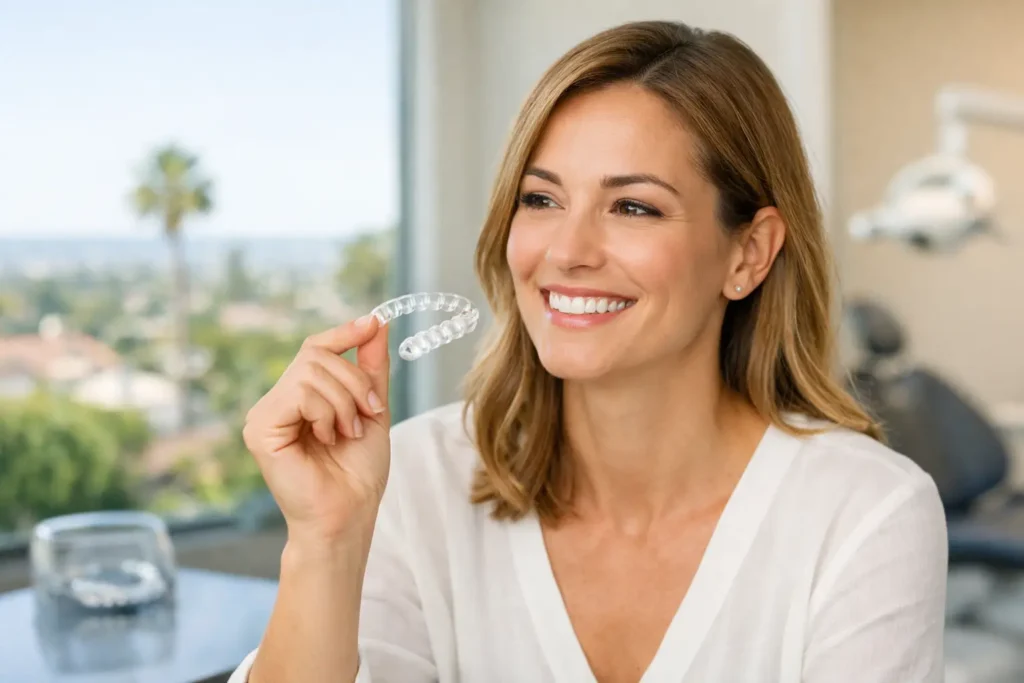
Invisalign is often a strong fit because the aligners are custom-made and clear enough to be subtle in most settings. They can also be removed for meals, coffee, brushing, and flossing. That flexibility matters to adults who want cosmetic improvement without the look or maintenance demands of brackets and wires.
There are trade-offs, though. Invisalign works best when patients wear the aligners consistently, usually around 20 to 22 hours per day. If trays are left out too often, treatment can slow down and results can suffer. For adults with disciplined routines, that is manageable. For adults with unpredictable schedules or low tolerance for compliance-based treatment, it may require more commitment than expected.
Are clear aligners covered by Cigna or Aetna PPO?
This is where details matter. Some Cigna PPO and Aetna PPO dental plans include orthodontic benefits, and some do not. Even when orthodontic coverage exists, adult Invisalign benefits are not automatic. One plan may cover a percentage of treatment up to a lifetime maximum, while another may limit orthodontic coverage to dependent children only.
In practical terms, clear aligners covered by Cigna or Aetna PPO usually come down to four questions. Does your plan include orthodontics at all? Does it cover adult orthodontics? Does it treat Invisalign the same way it treats braces? And what is the lifetime maximum or out-of-pocket responsibility?
Many PPO plans do not pay the full cost of Invisalign. Instead, they may contribute a portion of the fee, often up to a set lifetime maximum. For example, a plan might cover 50 percent of orthodontic treatment up to a maximum benefit. That still leaves a remaining balance, but it can make treatment more approachable.
Another detail patients often miss is network status. A PPO plan generally offers more flexibility than an HMO, but benefit levels can still vary depending on whether your provider is in-network or out-of-network. A benefits review before treatment starts is the clearest way to avoid surprises.
What adults should check before starting treatment
Insurance language can be frustratingly vague, especially when it refers broadly to orthodontics without naming Invisalign directly. In many cases, if a plan covers comprehensive orthodontic treatment, it may also apply to clear aligners. Still, there can be exclusions, waiting periods, or separate criteria.
Adults should look closely at age restrictions. This is one of the biggest sticking points with employer-sponsored dental plans. A plan can advertise orthodontic benefits and still exclude patients over a certain age. Another common issue is a waiting period, which means coverage may not begin immediately after enrollment.
It is also smart to ask how the benefit is paid. Some insurers pay their share upfront, while others distribute payments over the course of treatment. That difference can affect monthly planning.
Why a consultation matters more than an online estimate
Online pricing tools can offer a rough range, but they cannot tell you whether Invisalign is appropriate for your bite, how long treatment may take, or how your insurance benefits apply to your case. Adults often come in expecting a simple cosmetic adjustment and learn that bite correction, spacing, or crowding patterns make the treatment plan more involved.
A professional consultation gives you a clearer picture. Digital imaging and 3D intraoral scanning can show how your teeth are positioned now and what movement may be needed. That level of planning matters because Invisalign is not one-size-fits-all. A minor alignment case is different from a more comprehensive correction involving bite changes or significant crowding.
For adults investing in their smile, precision matters. A modern, technology-forward office can assess candidacy, estimate treatment length, and review insurance benefits in a more concrete way than a generic quote generator ever could.
Cost expectations for Invisalign in Clairemont Mesa
Without insurance, Invisalign costs vary depending on complexity, treatment length, and whether refinement trays are needed. Mild cases tend to cost less than moderate or complex cases. That said, patients should be careful about choosing based on price alone.
A lower advertised fee does not always reflect the full scope of care. It may exclude retainers, follow-up visits, or refinements after the first set of trays. A premium practice environment is not only about aesthetics. It often reflects more advanced diagnostics, more personalized treatment planning, and closer oversight from a dentist experienced in cosmetic and restorative outcomes.
For adults, that can be worth it. Straightening teeth is not just a cosmetic exercise. Alignment affects wear patterns, hygiene access, bite comfort, and the long-term appearance of your smile. If you are investing in clear aligners, it makes sense to want treatment that is both precise and well supervised.
When Invisalign is a good fit and when it may not be
Invisalign works very well for many adult patients, especially those with mild to moderate crowding, spacing, or relapse after previous braces. It is also appealing for professionals who want a discreet option and value the ability to remove aligners when needed.
It may be less ideal for patients who know they will struggle to wear trays consistently. If aligners stay in a case more often than in the mouth, treatment becomes inefficient. Some complex orthodontic issues may also require alternatives or a more specialized approach, depending on the case.
That is why adult treatment should never be sold as purely cosmetic. The best plans balance appearance, bite function, lifestyle, and budget. In some cases, Invisalign is clearly the best option. In others, the right recommendation may be different, and a trustworthy dentist will say so.
Clear aligners covered by Cigna or Aetna PPO: the smartest next step
If you are specifically searching for clear aligners covered by Cigna or Aetna PPO, the most efficient next move is not guessing from your benefits booklet. It is scheduling a consultation where your orthodontic needs and insurance details can be reviewed together.
At a practice like Serena Family and Cosmetic Dentistry, that conversation can be both clinical and practical. You want to know whether you are a candidate, what your treatment may involve, how long it may take, and what your insurance is likely to contribute. You also want clarity on financing if insurance covers only part of the fee.
For adults in Clairemont Mesa, convenience matters too. Choosing a local dental office with advanced technology, a polished environment, and personalized care makes the process feel less like a disruption and more like a smart step forward. Orthodontic treatment is a commitment, but it should feel organized, comfortable, and worth the investment.
A straighter smile tends to pay off in small daily moments long before treatment ends – on video calls, in photos, at dinner, and every time you stop thinking about how your teeth look and simply smile.