
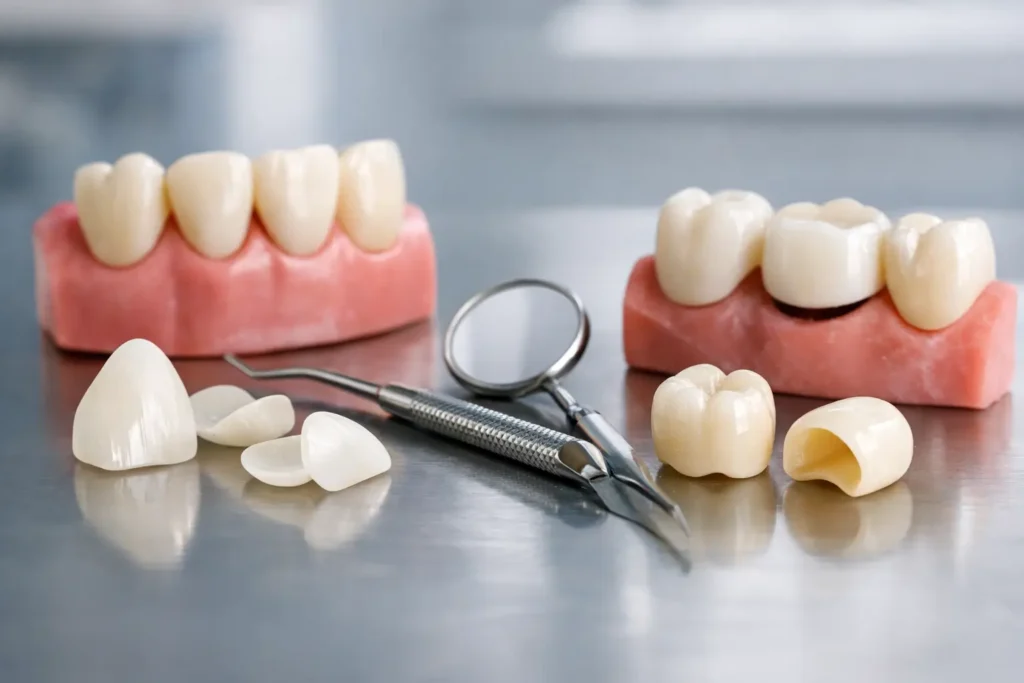
A lot of patients ask the same question after looking in the mirror at a chipped, worn, or discolored tooth: veneers vs crowns – what is actually the better choice? The answer is not about which treatment is more popular. It is about how much healthy tooth remains, what result you want, and whether the tooth needs cosmetic enhancement, structural protection, or both.
Both treatments can dramatically improve a smile. Both can look beautiful when planned well. But they are designed to solve different problems, and choosing the right one matters for comfort, longevity, and the overall health of your bite.
Veneers vs Crowns: The Core Difference
The simplest way to understand veneers vs crowns is this: veneers mostly improve the front surface of a tooth, while crowns cover the entire visible portion of the tooth.
A veneer is a thin porcelain shell bonded to the front of the tooth. It is typically used when the tooth is healthy enough to keep most of its natural structure, but the appearance needs improvement. Veneers are often chosen for teeth that are stained, slightly chipped, uneven, worn down, or mildly misshapen.
A crown, by contrast, fits over the whole tooth like a protective cap. It is usually recommended when a tooth has more extensive damage, a large filling, significant wear, cracking, or weakness after treatment such as a root canal. Crowns improve appearance, but they also restore strength and function in a way veneers cannot.
That distinction is why the best option is rarely based on cosmetics alone. A tooth that looks imperfect may still be structurally sound enough for a veneer. Another tooth may look similar from the outside but need the support of a full crown.
When Veneers Make More Sense
Veneers are often the right fit when the tooth is fundamentally healthy and the main goal is aesthetic refinement. If you have a tooth that is permanently stained, slightly chipped, small in proportion, or shaped differently than the teeth around it, a veneer can create a dramatic improvement with a very natural look.
Porcelain veneers are especially popular for smile design because they reflect light beautifully and can be customized with precision. For patients who want a brighter, more balanced smile without changing the underlying health of the tooth, veneers can be a very elegant solution.
They also tend to be more conservative than crowns in the right case. Less of the natural tooth is typically reduced, which is an advantage when preserving healthy enamel is possible. That said, veneers are not a shortcut for weak or heavily damaged teeth. If a tooth is structurally compromised, choosing a veneer for cosmetic reasons alone can lead to future failure.
Veneers are often best for front teeth, where appearance matters most and biting forces may be lower than on back teeth. Even then, habits such as nail biting, chewing ice, or clenching can affect whether veneers are a smart long-term choice.
When a Crown Is the Better Choice
Crowns are usually recommended when a tooth needs protection as much as it needs cosmetic improvement. If a large portion of the tooth is missing, if there is a crack, or if old dental work has weakened the structure, a crown can restore the tooth in a more complete way.
This is common with teeth that have had large fillings for years. From the outside, the tooth may not look especially damaged. Underneath, it may be fragile and prone to breaking. In those cases, a crown helps distribute biting force more evenly and protects what remains.
Crowns are also commonly used after root canal treatment because the tooth can become more brittle over time. For back teeth that handle heavy chewing pressure, a crown is often the most predictable option.
Cosmetically, modern porcelain crowns can be extremely lifelike. Patients sometimes assume crowns look bulky or artificial, but well-designed crowns can blend beautifully with surrounding teeth. The key is proper planning, shade matching, and precise fit.
Appearance, Strength, and Longevity
Patients comparing veneers vs crowns are usually weighing two things at once: which one will look better, and which one will last longer.
In purely cosmetic cases, veneers often win on minimalism and finesse. Because they are thinner and more conservative, they can create a refined result with less alteration to the natural tooth. For smile makeovers involving the front teeth, they are often the preferred option.
In structurally compromised cases, crowns usually offer better long-term security. A crown surrounds the tooth, giving it reinforcement that a veneer cannot provide. If the tooth is at risk of fracturing, strength has to come before aesthetics.
As for longevity, both veneers and crowns can last many years with excellent care. Their lifespan depends on material quality, bite forces, oral hygiene, and habits like grinding or using teeth as tools. Neither option should be viewed as permanent without maintenance. Dentistry is durable, not indestructible.
The Role of Tooth Preparation
One of the biggest differences between veneers and crowns is how much tooth reshaping is required.
Veneers generally require less reduction because they cover only the front surface. That makes them appealing when the tooth is healthy and conservative treatment is a priority. Still, they are not always “no-prep,” and any claim that veneers work for everyone with little to no preparation should be viewed carefully.
Crowns usually require more reshaping because the restoration must fit over the entire tooth. That does mean more of the outer tooth structure is removed. On the other hand, if the tooth is already heavily filled, broken down, or worn, there may be less healthy structure to preserve in the first place. In those cases, the additional coverage of a crown is not excessive. It is appropriate.
This is where clinical judgment matters. The right treatment is the one that respects both form and function, not the one that sounds more conservative on paper.
Cost Is Part of the Decision, But Not the Only Part
Patients naturally ask about cost when comparing veneers vs crowns, and the pricing can vary based on materials, the complexity of the case, and how many teeth are being treated.
A veneer may cost less or more than a crown depending on the situation, so it is not always helpful to think of one as the budget option and the other as the premium one. More importantly, the less expensive treatment is not truly less expensive if it fails because it was the wrong indication.
The better question is value. Which treatment gives you the right balance of aesthetics, durability, and long-term health for that specific tooth? When treatment planning is done carefully, it protects your investment as much as your smile.
Why the Bite Matters More Than Most People Realize
Two patients can have nearly identical-looking teeth and need completely different treatment because their bites are different.
If you grind your teeth, clench under stress, or have uneven pressure in certain areas, veneers may chip or debond more easily. A crown may hold up better in one case, while another patient may need bite adjustment or a night guard to protect any restoration. This is why a quick visual opinion is rarely enough.
Advanced diagnostics, digital imaging, and detailed bite analysis help identify what is happening beyond the surface. For patients investing in cosmetic or restorative dentistry, that level of planning can make the difference between a result that simply looks good at delivery and one that still performs beautifully years later.
How to Know Which One You Need
If your tooth is healthy but you want to improve color, shape, symmetry, or minor chips, veneers may be the right answer. If your tooth is cracked, heavily filled, weakened, or has had more extensive damage, a crown is often the safer and more durable choice.
There are also cases where the answer is mixed. A patient may need veneers on several front teeth for cosmetic balance and a crown on one tooth that has more structural damage. The best treatment plan is often customized tooth by tooth rather than chosen as a one-size-fits-all solution.
At a modern cosmetic and restorative practice such as Serena Family and Cosmetic Dentistry, this decision is guided by more than appearance alone. It is based on diagnostics, smile goals, tooth condition, bite function, and the kind of result that will look polished while staying dependable in daily life.
The right restoration should do more than improve a photo. It should feel natural, fit your lifestyle, and support the long-term health of your smile.