
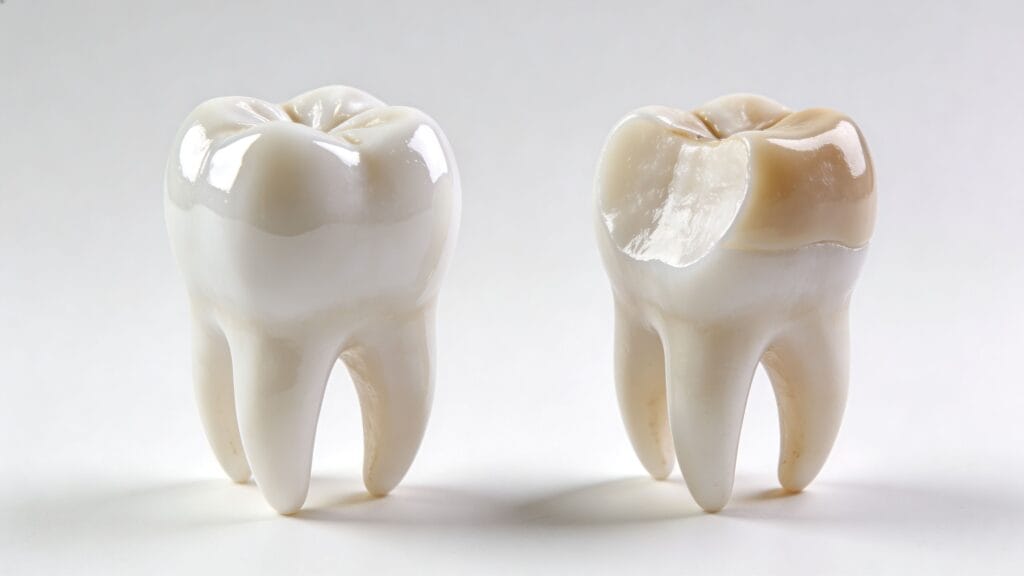
A crown is the professional term and cap is the common everyday term for the same full-coverage tooth restoration. The part that trips people up is that some people also use cap to mean a more conservative partial restoration, such as an inlay or onlay, which doesn’t cover the whole tooth.
If you’re reading this, there’s a good chance you’ve heard both words in the same week. Maybe your dentist said you need a crown, but a friend told you they got a cap. That can make it sound like two different treatments, and when you’re already dealing with a cracked tooth, an old filling, or sensitivity, unclear language is the last thing you need.
I explain this often in our San Diego office because the wording matters. In many conversations, the answer is simple: crown and cap mean the same thing. But in some conversations, that shorthand can hide an important difference between a full-coverage restoration and a partial-coverage restoration.
That difference affects how much tooth structure gets removed, how many visits you may need, and whether a more conservative option is possible. If you’ve been searching for what is the difference between a crown and a cap, the clearest answer is this: sometimes there’s no difference at all, and sometimes the word cap is being used loosely for a smaller restoration.
Your Guide to Dental Crowns and Caps in San Diego
You’re in the dental chair, your tooth has a large crack or a failing filling, and you hear two phrases in one appointment: “You may need a crown” and “We can place a cap on that tooth.” Most patients stop right there and wonder if they just got told two different plans.
Usually, they didn’t.
In everyday dentistry, crown is the clinical word, and cap is the patient-friendly word for the same kind of restoration. Both describe a custom piece that fits over the visible part of a damaged tooth after the tooth is shaped. If you want a broad overview of restorative care, our San Diego dentistry services page shows where crowns fit within a larger treatment plan.
The confusion starts because some dentists, websites, and patients use cap more loosely. They may use it to describe something that “caps” only part of a tooth, such as an onlay. That’s where people can get mixed messages. One person is talking about a full crown. Another is talking about a partial restoration. Both are using the same casual word.
The short version
| Term | How it’s commonly used | What it usually means |
|---|---|---|
| Crown | Professional dental term | Full-coverage restoration |
| Cap | Common patient term | Usually the same as a crown |
| Cap | Secondary, less precise use | Sometimes a partial restoration like an onlay |
That’s why I encourage patients to ask one simple follow-up question: “Do you mean full coverage or partial coverage?”
Practical rule: If the restoration covers the whole visible tooth, most dentists will call it a crown, even if a patient calls it a cap.
In San Diego, where many patients want strong results that still look natural, this distinction matters. Some teeth need the wraparound support of a full crown. Others may be good candidates for a more conservative restoration that saves more natural enamel. Clear language helps you make the right choice.
Defining the Terms A Crown and a Cap
You hear two different words for what sounds like the same fix, and it is easy to wonder whether you are being offered two different treatments. In many dental conversations, you are not. Crown is the clinical term dentists use. Cap is the everyday word many patients use for that same full-coverage restoration. As explained in Mint Dental KC’s overview of cap versus crown terminology, there is often no difference in the actual procedure when those words are used that way.

A simple way to picture it is clothing. A coat is the general everyday word someone might use. A trench coat is the more exact label. In dentistry, crown is the more exact label. Cap is familiar and informal.
That said, the word cap causes confusion for one reason. Some patients and some websites use it more loosely to mean something that covers only part of the tooth, not the whole tooth.
What dentists usually mean by a crown
A crown covers the entire visible part of a tooth above the gumline. It works like a fitted helmet over a weakened structure. Before placing it, the dentist reshapes the tooth so the final restoration can fit securely and look natural. If you want to see how that treatment is described in everyday practice, our page on dental crowns in San Diego walks through the basics.
Dentists commonly recommend a full crown when a tooth has lost enough strength that it needs support from all sides, such as when it is:
- Worn down by a large cavity or an old filling
- Cracked or more likely to split under pressure
- Misshapen or heavily discolored
- Weakened after major treatment
Why the word cap can mean two different things
Here is the part that trips people up. In casual speech, cap may still mean a full crown. But some people also use cap for a more conservative restoration that covers only the damaged portion of the tooth, such as an onlay.
An onlay is more like repairing the broken corner of a tabletop instead of putting a new shell over the entire table. It restores the area that needs help while leaving more of the original structure in place. That is why a patient may say, “I want a cap instead of a crown,” while really asking for a partial restoration.
This difference in language matters because the treatments are not interchangeable. A tooth with a deep crack may need full coverage for strength. A tooth with damage limited to one area may be a candidate for a partial restoration.
For a general clinical example of how full-coverage restorations are described, this overview of dental crowns and bridges shows the standard use of the word crown in treatment planning.
A practical way to clear up the confusion
If your dentist says crown, ask whether the restoration will cover the whole visible tooth.
If your dentist or a family member says cap, ask one follow-up question: “Do you mean full coverage or partial coverage?”
That one question usually clears up the misunderstanding.
The takeaway
- Crown usually means a full-coverage restoration.
- Cap often means the same thing in everyday conversation.
- Cap can also be used loosely for a partial restoration, such as an onlay.
At Serena San Diego Dentist, this is one of the terms we slow down and explain because the right decision starts with clear language. If you know whether your tooth needs full coverage or partial coverage, the treatment choices make much more sense.
Detailed Comparison of Dental Restoration Types
A clearer way to compare these treatments is to look at how much of the tooth they cover and how much healthy tooth they preserve. In everyday conversation, a patient may call both options a cap. In actual treatment planning, those are often two different repairs.

A full crown covers the entire visible part of the tooth, like a protective shell. A partial restoration, such as an inlay or onlay, repairs the damaged area while leaving more of the natural tooth uncovered. That is often the underlying question behind “crown vs cap.”
Side-by-side comparison
| Feature | Full-coverage crown | Partial restoration such as inlay or onlay |
|---|---|---|
| Coverage | Covers the whole visible tooth | Covers only part of the tooth |
| Main goal | Protect and reinforce a weakened tooth | Repair damage while preserving more natural structure |
| Best for | Larger cracks, heavy wear, root canal-treated teeth, or major loss of structure | Damage limited to one area with strong remaining tooth walls |
| Tooth preparation | More shaping of the tooth | Less shaping of the tooth |
| Materials | Often zirconia, ceramic, or porcelain-fused-to-metal | Often ceramic, zirconia, gold, or similar lab-made materials |
| Appearance | Strong cosmetic improvement, especially with modern ceramics | Very natural when the damaged area is smaller |
When a full crown makes more sense
A full crown usually fits the situation better when the tooth has lost enough strength that the remaining walls could flex or fracture under biting pressure. Molars with large old fillings are a common example. So are teeth with long cracks, heavy grinding wear, or extensive breakdown after decay is removed.
If you want a broader patient explanation of how crowns fit into restorative care, this overview of dental crowns and bridges is a useful reference.
When a partial restoration may be the better choice
A partial restoration can be a smart option when the damage is contained and the rest of the tooth is still strong. An onlay works a bit like replacing a damaged corner of a countertop instead of tearing out the whole surface. You still repair the weak area, but you keep more of what is healthy.
That matters because natural tooth structure has value. The more sound enamel and dentin we can preserve without sacrificing durability, the better the long-term foundation for that tooth.
Materials matter, but design matters too
Patients often focus on whether a restoration is zirconia, ceramic, or metal-based. Material does matter, especially for strength, appearance, and wear. Fit, bite design, and how much healthy tooth remains matter just as much. A well-planned restoration on the right tooth usually performs better than choosing a material based on a label alone.
At Serena San Diego Dentist, this is the part we slow down and explain carefully. A strong material cannot make up for a tooth that needs more coverage than a partial restoration can provide. In the same way, full coverage is not automatically better if the tooth can be repaired predictably with less removal of healthy structure.
A simple way to picture the trade-off
A full crown works like a helmet for the whole tooth. A partial cap, in the looser everyday sense of the word, works more like a custom patch that also reinforces the area under pressure. The right choice depends on whether the tooth needs full protection or targeted repair.
For patients deciding whether to save a damaged tooth with a restoration or consider replacing it, our guide to implants versus crowns explains how dentists weigh those options.
The most conservative treatment is the one that preserves tooth structure and still gives that tooth enough protection to function well for years.
The Step-by-Step Procedure What to Expect
A lot of patients sit down in the chair with one practical question. “What is this appointment going to be like?” That is a fair question, especially because “cap” can mean two different things in everyday conversation. Sometimes people mean a full crown, covering the whole visible tooth. Other times they mean a smaller restoration, such as an onlay, covering only the damaged part. The steps overlap, but the amount of tooth being treated can change the time, numbness, and number of visits.
For a visual of the general process, this image helps.

What happens with a full crown
A full crown works like a fitted shell around the entire visible portion of the tooth, so the appointment usually involves more reshaping. In many cases, the process goes like this:
Exam and planning
Your dentist checks the tooth, reviews X-rays if needed, and studies your bite. The goal is to confirm that full coverage is the right level of protection.Numbing and tooth shaping
The tooth is trimmed on all sides so the crown has room to fit properly. Patients often describe this as the longest part of the visit, but you should be numb and comfortable during the work.Impression or digital scan
A scan or impression records the new shape of the tooth so the final restoration can be made to match your bite.Temporary crown
If the final crown is being made by a lab, a temporary is placed to protect the tooth between visits.Final placement
At the return visit, the dentist checks the fit, contact with neighboring teeth, and bite, then bonds or cements the crown into place.
If you want a patient-friendly walkthrough focused just on the sequence, our page on dental crown procedure steps lays that out clearly.
What changes with a partial cap or onlay
A partial cap treats a smaller area. Instead of covering the whole tooth like a helmet, it repairs and reinforces the part that is damaged, more like a custom-made patch for a cracked section of a wall. Because more healthy tooth stays in place, the preparation is often more conservative.
That can mean a shorter appointment, less drilling, and in some cases an easier recovery. The exact plan still depends on where the damage is, how deep it goes, and whether the tooth has had a root canal or large filling before.
For patients who like learning from multiple sources before treatment, this guide to the benefits of a dental crown gives useful background on why a dentist may recommend coverage in the first place.
Here’s a short video that can make the process feel more familiar before your appointment:
What comfort looks like today
Comfort has improved because the process is more precise than it used to be. Digital scans can replace traditional impression trays in many cases, which many patients find easier. Better planning also helps your dentist shape only what needs to be shaped and check the fit more accurately before the restoration is placed.
At Serena San Diego Dentist, patients considering restorative options can ask whether their case is a better match for full coverage or a more limited restoration. That conversation matters because the term “cap” can sound simple, while the treatment choices behind it are not.
Cost Longevity and Your Insurance Options in San Diego
A common conversation in our office goes like this. A patient hears “crown” from one person and “cap” from another, then asks the practical question. “What will this cost me, and how long will it last?”
That is the right question to ask, especially because “cap” can mean two different things. Sometimes people use it as another word for a full crown. Other times they mean a partial restoration, such as an onlay, that covers only part of the tooth. The price, the amount of tooth preserved, and the long-term fit all depend on which of those treatments your tooth needs.
A useful way to compare them is to look at both durability and tooth preservation. In Osseo Family Dental’s review of a 2023 meta-analysis, full crowns are described as having a 94 to 97 percent 5-year survival rate, while partial restorations such as inlays and onlays show 91 to 95 percent over the same period. That same review says partial restorations may require 30 to 50 percent less enamel removal, which matters because keeping healthy tooth structure often gives us more options later if the tooth ever needs future treatment.
What affects the price
Fees vary because two restorations with the same nickname are not always the same treatment.
How much of the tooth needs coverage
A full crown usually involves more shaping and full coverage of the tooth. A partial cap, such as an onlay, covers a smaller area when the remaining tooth is still strong enough.The material selected
Zirconia, porcelain, and other ceramic options differ in lab steps, appearance, and wear characteristics.How much repair work is needed first
Some teeth need a buildup before the final restoration is placed. Others are ready for the restoration itself.The technology involved
Digital scanning, in-office milling, and outside lab fabrication can all affect the total fee.
Insurance and payment options
Dental insurance usually helps more with treatment that restores function than with changes made mainly for appearance. Coverage often depends on your deductible, annual maximum, waiting periods, and whether the plan classifies the procedure as major restorative care.
If you want to check the basics before your visit, our guide to dental insurance coverage in San Diego explains common plan terms in plain language. At Serena San Diego Dentist, we also review benefits with patients so they have a clearer sense of expected out-of-pocket cost before treatment begins.
One more point matters here. The lowest fee is not always the lowest long-term cost.
A partial restoration can be a smart choice when the tooth is strong enough to support it, because it preserves more natural structure. A full crown can be the better value when the tooth is heavily filled, cracked, or weakened and needs broader protection. The goal is not to pick the term that sounds simpler. The goal is to match the restoration to the condition of the tooth so the treatment has the best chance to last.
Which Is Right for You A Full Crown or a Partial Cap
The right treatment depends on what the tooth looks like after the old filling, decay, or fracture is evaluated. That’s why two people can both say, “I need a cap,” and end up with different restorations.

A full crown is often the better fit when
Most of the tooth has been lost
If little strong tooth structure remains, a full wraparound restoration provides broader protection.The tooth has a deep crack or major weakness
Full coverage can help hold the tooth together better than a smaller bonded piece.You need a major shape or color correction
A crown can change the overall form of the tooth more extensively.The bite load is high
Some back teeth take too much force for a partial restoration to be the safest long-term option.
A partial restoration may be the better fit when
Sometimes the smarter treatment is the one that does less.
If the tooth still has healthy walls, and the damage is more contained to the chewing surface or one side, a partial restoration may preserve more natural enamel while still restoring strength and appearance. This is often attractive to patients who want a conservative option and want to avoid removing healthy structure unnecessarily.
Questions worth asking at your consult
Bring these with you:
- How much healthy tooth is left?
- Do I need full coverage, or is partial coverage realistic?
- Which material do you recommend for this location in my mouth?
- What are the appearance trade-offs?
- If this were your tooth, which option would you choose and why?
The best restoration is the one that fits the tooth you actually have, not the word you heard online.
In San Diego, many patients care about both durability and appearance. That’s reasonable. You want your tooth to feel strong when you chew and look natural when you smile. If you’re unsure which category your situation falls into, schedule a consultation and ask your dentist to show you the tooth on a scan or photo. Seeing the remaining structure often makes the decision much easier.
Frequently Asked Questions About Dental Restorations
Does getting a crown or cap hurt
Most patients do well with local anesthesia and feel pressure more than pain during the procedure. Afterward, some soreness or bite sensitivity can happen for a short period, especially if the tooth was already inflamed before treatment.
Can a tooth with a crown still get a cavity
Yes. The restoration itself doesn’t decay, but the natural tooth at the margin near the gumline still can. Good brushing, flossing, and regular exams matter because plaque often collects where the crown meets the tooth.
How do I care for a new restoration
Keep it simple and consistent:
- Brush thoroughly around the gumline twice a day
- Floss daily and slide the floss gently along the side of the restoration
- Avoid chewing very hard objects like ice or hard candy
- Wear a nightguard if you clench or grind
- Keep follow-up visits so your dentist can check the bite and margins
Are there alternatives to a crown
Sometimes, yes. Depending on the tooth, options may include a large filling, an inlay, an onlay, or in some situations replacement of the tooth instead of restoration. The best alternative depends on how much healthy structure remains and whether the tooth can still be predictably saved.
If you still have questions about what is the difference between a crown and a cap, the most useful next step is a one-on-one exam. The terminology gets much easier once you know whether your tooth needs full coverage or only partial coverage.
If you’d like clear answers about your own tooth, schedule a consultation with Serena San Diego Dentist. We can evaluate the tooth, explain whether you need a full crown or a more conservative partial restoration, and help you review insurance and payment options without pressure.