
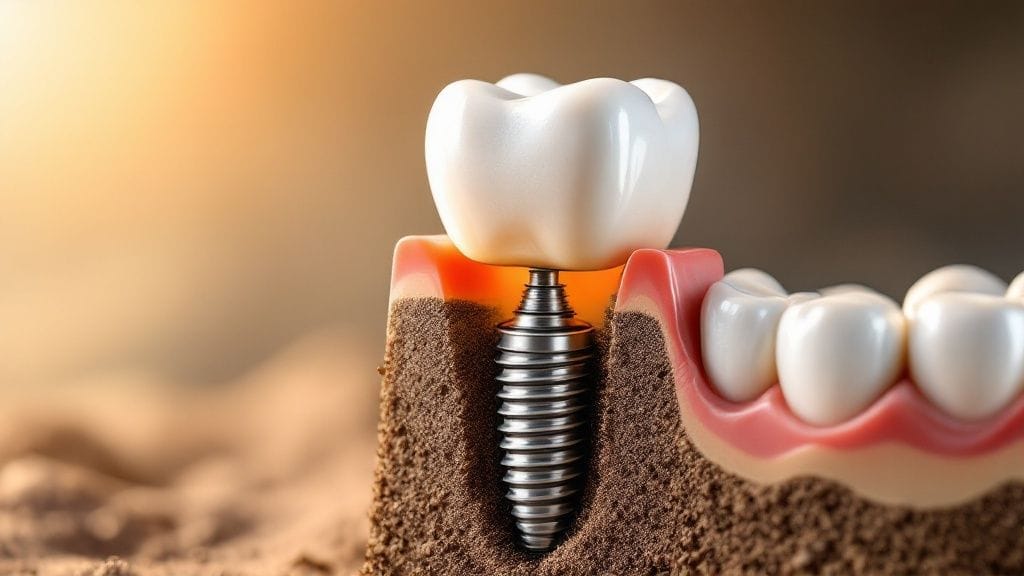
When cared for properly, the titanium post of a dental implant can last a lifetime, making it a permanent solution for missing teeth. However, the dental crown that sits on top—the part you see and chew with—typically needs replacement every 10-15 years due to normal wear and tear. This remarkable two-part system is why implants are considered the gold standard for durability and reliability in San Diego.
The True Lifespan of a Dental Implant
One of the first questions San Diego patients ask about dental implants is, "How long will they actually last?" It's a critical question. You're making a significant investment in your oral health and your smile, so you want a clear picture of what to expect for the future.
The best way to understand an implant's lifespan is to stop thinking of it as a single piece. Instead, it's a sophisticated system with two main components, each with its own role and its own expected longevity.
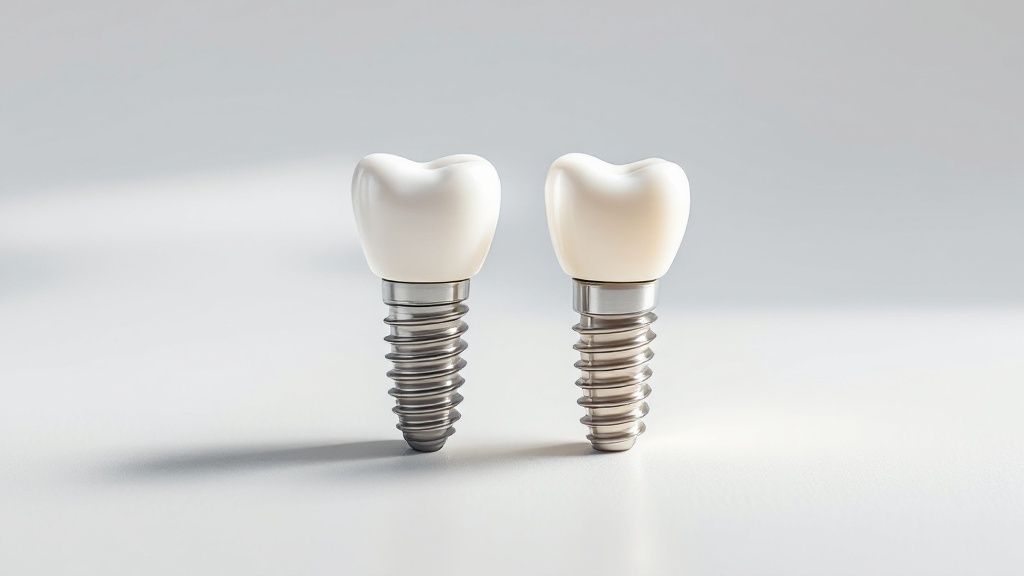
The implant itself is a small titanium post that's surgically placed into your jawbone. This post acts as a new tooth root. Through a natural biological process called osseointegration, your bone fuses directly to the titanium, making it a permanent, incredibly stable part of your jaw. This foundational piece is engineered to last a lifetime.
But the part you actually see and use for chewing—the dental crown—is a different story. It’s exposed to all the same forces as your natural teeth, which means it can chip, stain, or simply wear down after many years of daily use.
Lifespan of Implant Components
To get a clear picture of longevity, you have to look at each piece of the puzzle separately.
- The Implant Post: This is the titanium root replacement. It’s designed to be a permanent fixture in your jaw.
- The Abutment: This is a tiny connector that links the post to the crown. It's extremely durable and rarely ever needs to be replaced.
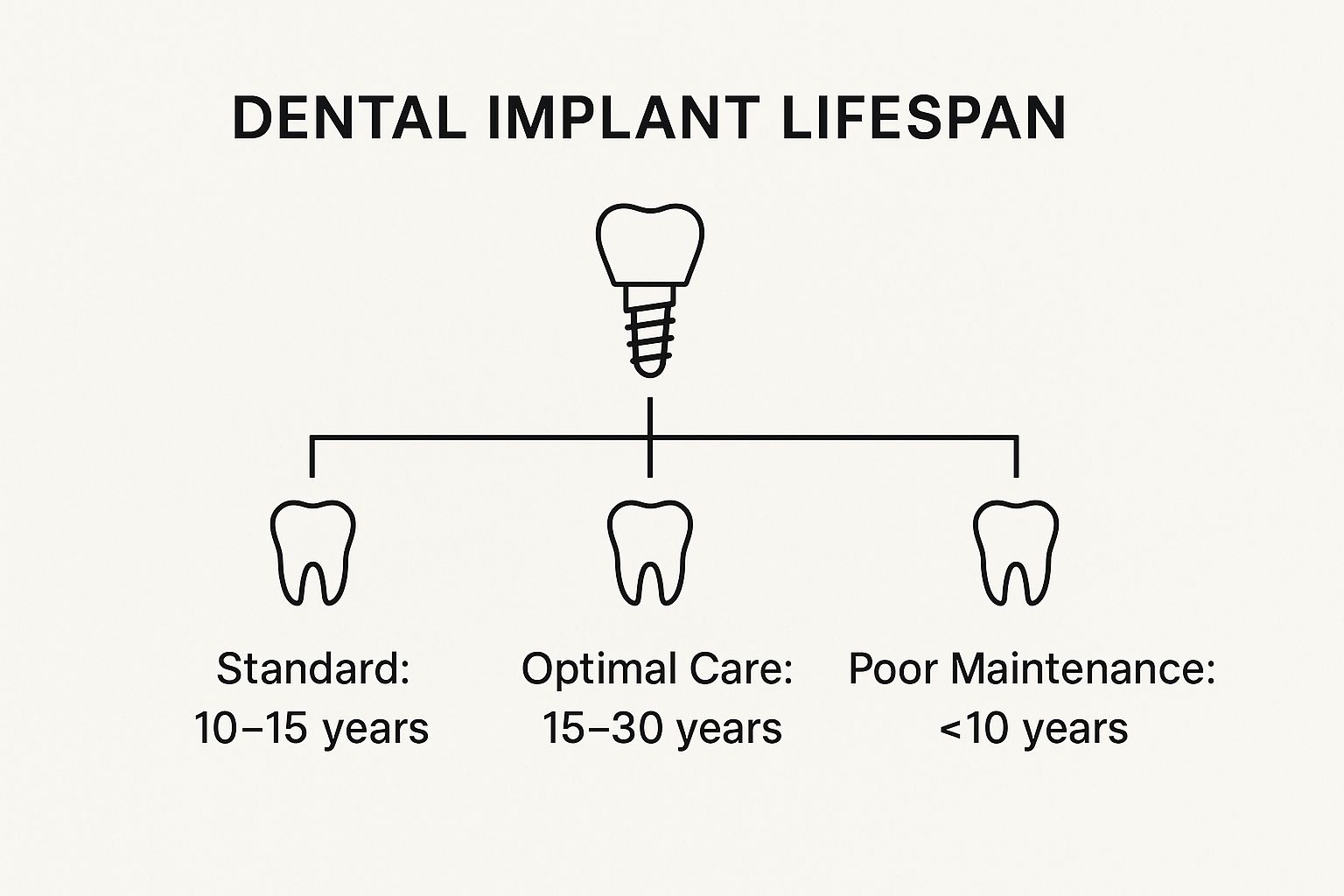
- The Crown: This is the prosthetic tooth. On average, you can expect it to last 10-15 years before it might need replacement.
This isn't just theory; long-term studies back it up. One piece of research that followed implants for almost four decades found an amazing 95.6% survival rate for the titanium posts. That’s incredible. The crowns attached to them, however, had a survival rate closer to 60.9% over that same period, which makes perfect sense given the daily work they do.
Here's a helpful visual that shows how the lifespan of an implant system changes based on the level of care it receives.
Understanding Your Implant's Components
This table breaks down the expected lifespan of each part of a dental implant system. It helps clarify which components are permanent and which may need attention in the future.
| Implant Component | Average Lifespan | Why It's Different |
|---|---|---|
| Implant Post | Lifetime | Fuses directly with your jawbone (osseointegration), becoming a permanent root. |
| Abutment | Lifetime | A protected connector piece that experiences very little stress or wear. |
| Crown | 10-15 Years | Endures daily chewing forces and wear, just like a natural tooth. |
This breakdown shows why your daily habits are so important. The implant post is incredibly resilient, but the long-term success of the entire restoration hinges on keeping the surrounding gums and bone healthy.
The data makes it clear: taking great care of your implant can dramatically extend its life. Consistent brushing, flossing, and regular dental check-ups are non-negotiable. When weighing your options, it's worth taking a moment to compare the long-term realities of dental implants vs. dentures, as their maintenance needs and durability are worlds apart.
What the Science Says About Implant Survival
While personal stories are reassuring, when we talk about how long dental implants last, the clinical data is where the real proof lies. Decades of research have tracked dental implant performance, giving us a clear, data-driven picture of their incredible durability and long-term success.
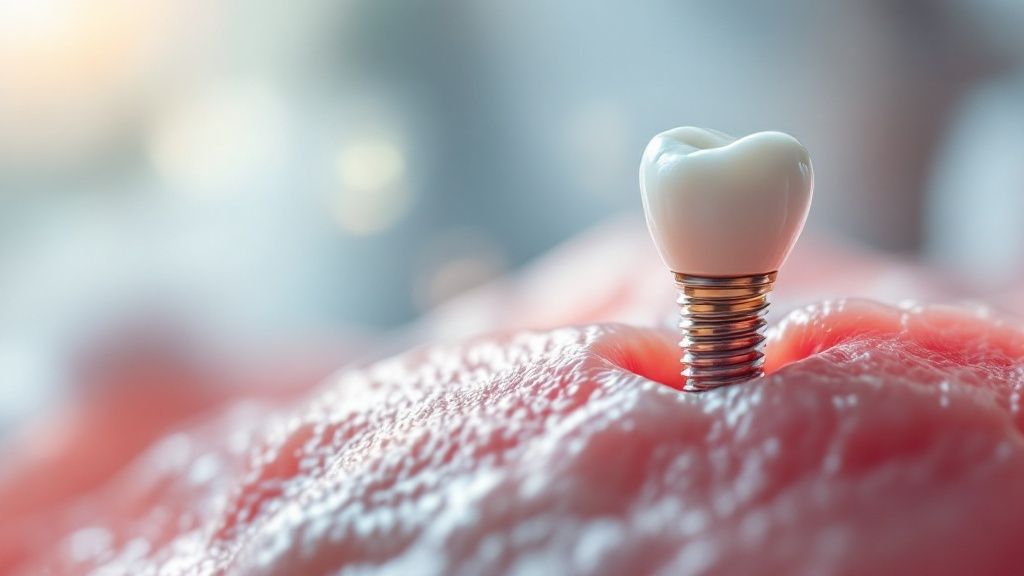
This mountain of scientific evidence is precisely why dentists in San Diego and around the world consider implants the gold standard for replacing missing teeth. The numbers consistently show that the titanium post—the part that actually fuses with your jawbone—has an exceptionally high survival rate over many, many years. This is the bedrock of the entire restoration.
But there’s a critical distinction to make, one that researchers track very carefully: implant survival versus prosthetic survival. They aren't the same thing, and understanding the difference helps set realistic expectations for the long haul.
Implant Survival vs. Prosthetic Survival
Let’s break it down with an analogy. Think of your implant like the foundation of a house. "Implant survival" means the foundation itself—the titanium post—remains solid, stable, and fused to your jawbone. It’s not going anywhere.
"Prosthetic survival," on the other hand, refers to the house built on top of that foundation—the crown, bridge, or denture you see and chew with. The post is the anchor; the crown is the part that does all the daily work.
Here’s what that means for you:
- Implant Survival Rate: This tracks the success of the titanium post. A high number here tells us the core of your new tooth is built to last a lifetime.
- Prosthetic Survival Rate: This measures the lifespan of the visible crown. It’s perfectly normal for this rate to be a bit lower over time due to simple wear and tear.
This distinction is the single most important concept for understanding the true lifespan of a dental implant. The core implant is designed for permanence, while the visible crown is a durable but replaceable component, much like the tires on a car.
Long-Term Success Rates in Clinical Studies
So, what do the numbers actually show? The evidence is overwhelmingly positive. One massive clinical review looked at over 10,800 dental implants across a period of up to 22 years, giving us some powerful insights.
The study found a cumulative implant survival rate of 96.8% at 10 years and 94.0% at 15 years. Those figures speak volumes about the reliability of the implant post itself. At the patient level, the rates were a touch lower, mainly because a patient with multiple implants has a slightly higher statistical chance of one having an issue. You can see for yourself just how durable dental implants are over the long term in the full study.
These incredible success rates are a testament to modern surgical techniques and the unique biocompatibility of titanium. For those considering full-arch solutions, understanding the differences between options like All-on-6 and All-on-4 dental implants is also valuable, as these systems are built on the very same proven principles.
Ultimately, the science confirms it: when an implant is placed correctly and cared for properly, its core is built to serve you for decades to come.
What Determines How Long Your Implants Will Last?
So, why is it that some dental implants seem to last a lifetime, while others run into trouble much sooner? It’s never just one thing. Think of it more like a recipe for success where a few key ingredients have to come together perfectly. Getting a handle on these factors is important because it shows you how much control you, your dentist, and your overall health have in the final outcome.
It really boils down to a partnership. Your body sets the stage, your surgeon handles the intricate construction, and your daily habits are the ongoing maintenance crew. When all three are in sync, you get a beautiful, durable fix for a missing tooth that can stand the test of time.
It All Starts With Your Body's Foundation
The journey to a successful dental implant begins where you can't see it—deep inside your jawbone. For an implant to work, the titanium post needs to fuse directly with the bone in a remarkable process called osseointegration. It's this fusion that gives the implant its incredible strength.
- Jawbone Density and Quality: A strong, healthy jawbone is the absolute cornerstone of a successful implant. If the bone isn't dense or wide enough, the implant simply can't get the solid grip it needs to anchor itself for the long haul. This is often a concern if a tooth has been missing for a while, as bone loss naturally starts to occur.
- Your Overall Health: Your general health plays a surprisingly big role in your mouth's ability to heal. Conditions like uncontrolled diabetes, for instance, can slow down healing and make you more susceptible to infection. Autoimmune diseases and even osteoporosis can also interfere with bone quality and that critical osseointegration process.
Having enough bone to work with is non-negotiable. If a patient has experienced bone loss, we often need to perform a preliminary procedure to build that area back up. You can find out more in our guide to bone grafting essentials.
The Surgeon's Skill and Quality of Materials
The person placing the implant is just as crucial as the foundation it's placed in. The precision of the surgery and the caliber of the materials used lay the groundwork for success right from the very first day.
Surgeon Expertise: An experienced implant surgeon in San Diego knows exactly how to place the implant at the perfect angle and depth. This isn't just about making it look good; it's about making sure it can withstand the daily forces of chewing without putting too much stress on the implant or the bone around it. Proper placement is a huge factor in longevity.
Implant Materials: Let's be clear: not all implants are the same. We insist on using high-quality, biocompatible materials like medical-grade titanium. These have a long, proven track record of integrating seamlessly with bone and resisting wear and tear for decades. At Serena San Diego Dentist, we only partner with the most reputable and scientifically-backed implant manufacturers to give our patients a result that’s truly built to last.
Your Lifestyle and Daily Habits
Once the implant is in and fully healed, the baton is passed to you. How you care for it day-to-day will have a massive impact on its lifespan.
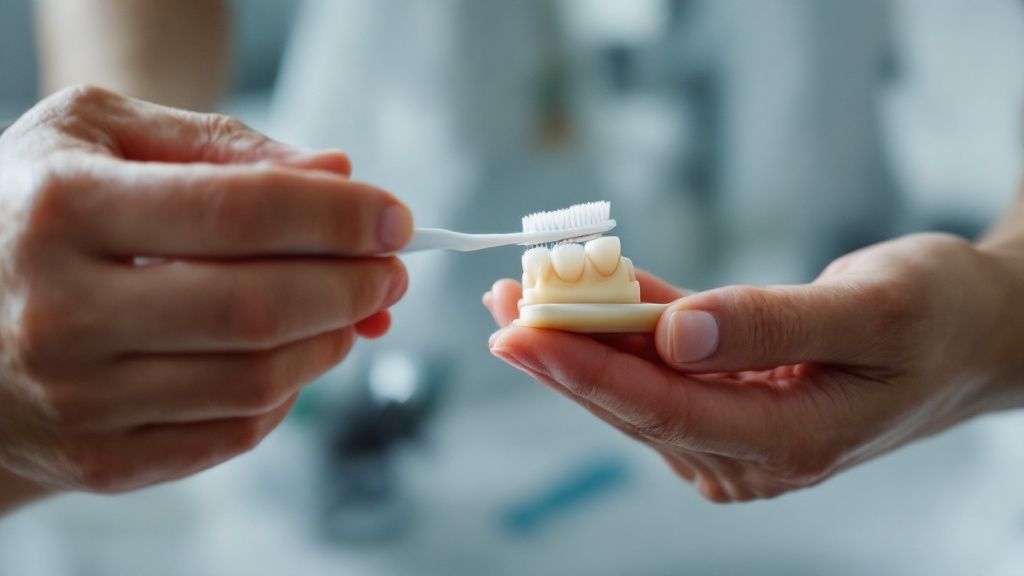
- Oral Hygiene: This is, without a doubt, the most important factor you control. While the implant itself can't decay, the gums around it can get infected. This condition, called peri-implantitis, is the number one enemy of dental implants. If it's not managed, the infection can eat away at the bone supporting the implant, causing it to loosen and fail.
- Smoking and Tobacco Use: Smoking is one of the biggest roadblocks to implant success. It dramatically slows healing by restricting blood flow and cripples your body's ability to fight off infection. This makes a smoker far more likely to develop peri-implantitis.
- Bite Forces and Bad Habits: Do you grind your teeth at night (bruxism)? That constant, heavy pressure can put a huge strain on both the implant and the crown attached to it. Over time, this can cause components to loosen or even break. The same goes for using your teeth as tools to open things or chewing on ice—these habits can easily lead to a fracture.
Protecting Your Investment With Daily Care
Think of your new dental implant like a high-performance vehicle. It's built to last for decades, a marvel of modern engineering. But just like that car, it needs the right kind of routine maintenance to keep running smoothly. Your old habits of simply brushing and flossing won't be quite enough to protect this new investment.
The success of your implant for years to come hinges on an upgraded daily care plan, one that focuses on protecting the delicate gum and bone tissues surrounding it.
Unlike a natural tooth, an implant can't get a cavity. Its biggest enemy is an infection called peri-implantitis. This is a form of gum disease that specifically targets the bone supporting the implant. If it's not kept in check, this infection can eat away at the jawbone, causing the implant to become loose and eventually fail. Preventing this is your number one priority.
Building Your Implant Care Toolkit
To properly clean around an implant, you need to have the right tools for the job. Standard string floss, for example, can sometimes shred or leave behind fibers that can irritate the gums. That's why we recommend a few specialized tools to keep the area perfectly clean.
Your new daily routine should feature:
- A Soft-Bristled Toothbrush: Brushing too hard can damage the sensitive gum tissue around the implant. A soft brush is all you need to gently and effectively remove plaque.
- A Water Flosser (like a Waterpik): This device is a true game-changer for anyone with an implant. It uses a pulsating stream of water to flush out bacteria and debris from those hard-to-reach spots, especially around the base of the crown.
- Interdental Brushes: These look like tiny pipe cleaners and are perfect for getting into the small spaces on the sides of the implant, right where it meets the gum line.
- Implant-Specific Floss: Some types of floss come with a stiffened end, making it much easier to thread under and around the implant bridge or crown.
The real goal isn't just cleaning the shiny crown you see in the mirror. It's about meticulously cleaning the tiny crevice where the crown meets your gum. This is the frontline in the fight against the bacteria that cause peri-implantitis.
Caring for Implants vs Natural Teeth
While your daily oral hygiene will feel familiar, there are a few key differences in the approach. Understanding and adopting these new habits is crucial for making sure your implant lasts a lifetime.
Here's a quick look at how the routines compare:
| Care Routine | For Natural Teeth | For Dental Implants |
|---|---|---|
| Primary Goal | Prevent cavities and gum disease. | Prevent peri-implantitis by cleaning the gum-to-implant seal. |
| Brushing | Standard brushing twice daily. | Gentle, focused brushing with a soft-bristled brush. |
| Flossing | Daily flossing between teeth. | Specialized tools like water flossers or interdental brushes. |
| Check-ups | Routine cleanings every 6 months. | Non-negotiable cleanings and implant health checks. |
Mastering this new routine is the key to long-term success, and our team is always here to guide you. For a more detailed guide on aftercare, feel free to read more about how to properly look after your dental implants and oral health.
Ultimately, your commitment to daily care is the best insurance policy you can have for your beautiful new smile.
How to Spot the Warning Signs of Implant Failure
While dental implant failure is rare, knowing what to look for is the best way to catch problems early and protect your investment. Think of it as being an active partner in your own oral health—understanding these signs helps you keep your implant secure for a lifetime.
Problems can pop up at two very different times. Early failure usually happens within the first few months after surgery and often has to do with how you're healing. Late-stage failure, on the other hand, can appear years down the road and is almost always caused by a preventable infection.
Early vs. Late Stage Implant Issues
It’s helpful to think about implant issues in two distinct phases: the initial healing period and the long haul.
Early Failures (First 3-4 Months): These are typically linked to a hiccup in the osseointegration process, which is just the fancy term for the implant fusing to your jawbone. You might notice the implant feels loose, or maybe you have discomfort that lingers well past what’s considered normal for healing. This is why following your dentist's post-op instructions to the letter is so important.
Late-Stage Failures (Years Later): When an implant fails after years of success, the culprit is usually peri-implantitis. This is basically gum disease for implants—a sneaky, slow-moving bacterial infection that attacks the gum and bone tissue holding your implant in place. If you don't catch it, it can destroy the very foundation your implant relies on.
Key Warning Signs to Watch For
The best defense you have is paying attention to the little changes in your mouth. If you notice any of the symptoms below, don't wait for your next check-up. Call your dentist right away.
Your implant should feel just as solid and comfortable as a healthy natural tooth. Any wiggling, looseness, or nagging discomfort is a clear signal that something isn’t right and needs a professional look.
Here are the most common red flags to look out for:
- Any detectable movement or wiggling of the implant.
- Pain, discomfort, or a dull ache when you chew or tap on the tooth.
- Swollen, red, or tender gums surrounding the implant.
- Bleeding around the implant when you brush or floss.
- Trouble chewing or a feeling that your bite is just "off."
Fortunately, the odds are overwhelmingly on your side. One huge 20-year study that followed 12,500 implants found an incredible 93% survival rate at the 17-year mark. This really shows how reliable modern implants are when you take good care of them. You can find more details about these impressive long-term implant survival rates on blyssdental.com and see for yourself how durable this technology is.
By staying vigilant and keeping up with great oral hygiene, you can make sure your implant is part of that successful majority, giving you a stable, healthy smile for decades to come.
Frequently Asked Questions About Dental Implants
Even after covering the basics, it's natural to have more specific questions pop up. Let's tackle some of the most common things patients in San Diego ask us about what it's really like to live with dental implants.
Do Dental Implants Actually Need To Be Replaced?
This is a great question, and the answer really has two parts. It's important to understand that an implant isn't just one piece.
The titanium implant post itself—the part that integrates with your jawbone—is designed to be a permanent fixture. Once it successfully fuses with the bone, it becomes a new, permanent root that, with good care, should never need replacing.
The dental crown on top, however, is a different story. This is the part that does all the heavy lifting of chewing and grinding day in and day out. Just like natural teeth, it's subject to wear and tear. On average, you can expect a crown to last 10 to 15 years before it might need to be replaced due to chipping, wear, or staining.
So, think of it this way: the foundation is for life, but the visible part of the "tooth" might need a refresh down the road.
Can You Get a Lifetime Warranty on Dental Implants?
A "lifetime warranty" sounds fantastic, but in the real world of dentistry, it's rarely that straightforward. While some clinics or manufacturers do offer warranties, a true, no-strings-attached lifetime guarantee is very uncommon.
When they are offered, they almost always come with strict conditions you have to meet, such as:
- Perfect attendance at every single professional cleaning and check-up, without exception.
- Following a rigorous home care routine exactly as your dentist lays it out.
- Exclusions for accidents, new health conditions that affect healing, or issues caused by poor oral hygiene.
Most of these warranties cover a manufacturer's defect in the implant components, not a failure caused by lifestyle, health, or hygiene. Always get the specific warranty details in writing so you know exactly what’s covered and what’s expected of you.
Are Implants a Better Long-Term Investment Than Bridges?
Looking purely at the upfront cost, a traditional dental bridge is often cheaper. But when you zoom out and look at the bigger picture, dental implants frequently come out on top as the more cost-effective and healthier choice over your lifetime.
A dental bridge usually has to be replaced every 5 to 10 years. What’s more, to place a bridge, the dentist has to grind down the perfectly healthy teeth on either side of the gap to use them as anchors. This can weaken those teeth and make them more vulnerable to problems in the future.
An implant, on the other hand, is a standalone solution that doesn't involve your other teeth at all. Because the implant post can last a lifetime and also helps preserve your jawbone, you avoid the repeated costs and dental work of replacing a bridge. For many people, this makes implants a much smarter investment in their long-term financial and oral health.
Ready to learn if a dental implant is the right long-term solution for your smile? The expert team at Serena San Diego Dentist is here to provide a personalized consultation and answer all your questions.
Schedule your appointment today!