
When it comes to your teeth, the old saying, "an ounce of prevention is worth a pound of cure," couldn't be more true. Preventive dental care is all about being proactive. It's the combination of your daily at-home habits and regular professional check-ups, all working together to stop problems like cavities, gum disease, and enamel wear before they even get started.
Think of it this way: It’s far easier (and cheaper) to keep your smile healthy than to fix it once something has gone wrong.
The Foundation of a Lifelong Healthy Smile
Preventive care is a team effort—a partnership between you and your dental team. In sunny San Diego, where smiles are always on display, consistent oral care helps you avoid major dental issues down the road.
This proactive strategy really breaks down into two key areas:
- Your At-Home Routine: This is your daily frontline defense. It includes essentials like brushing twice a day with a fluoride toothpaste and, yes, flossing every single day.
- Professional Dental Care: These are your regularly scheduled visits for cleanings, exams, and X-rays. This is where your dentist can spot trouble long before you can see or feel it.
When you bring these two parts together, you build a powerful defense system for your teeth and gums. The real goal isn't just about avoiding a toothache; it's about protecting your overall health and keeping your natural smile for a lifetime.
Why Proactive Care Matters
Putting oral health on the back burner can lead to serious consequences. According to the World Health Organization, a staggering 3.7 billion people around the world suffer from oral diseases. In fact, untreated tooth decay is the single most common health condition globally. These aren't just minor inconveniences; they cause pain, discomfort, and can even impact your work and daily life.
This infographic breaks down how simple preventive care really is, showing how your efforts at home and support from your dentist create the best possible outcome.
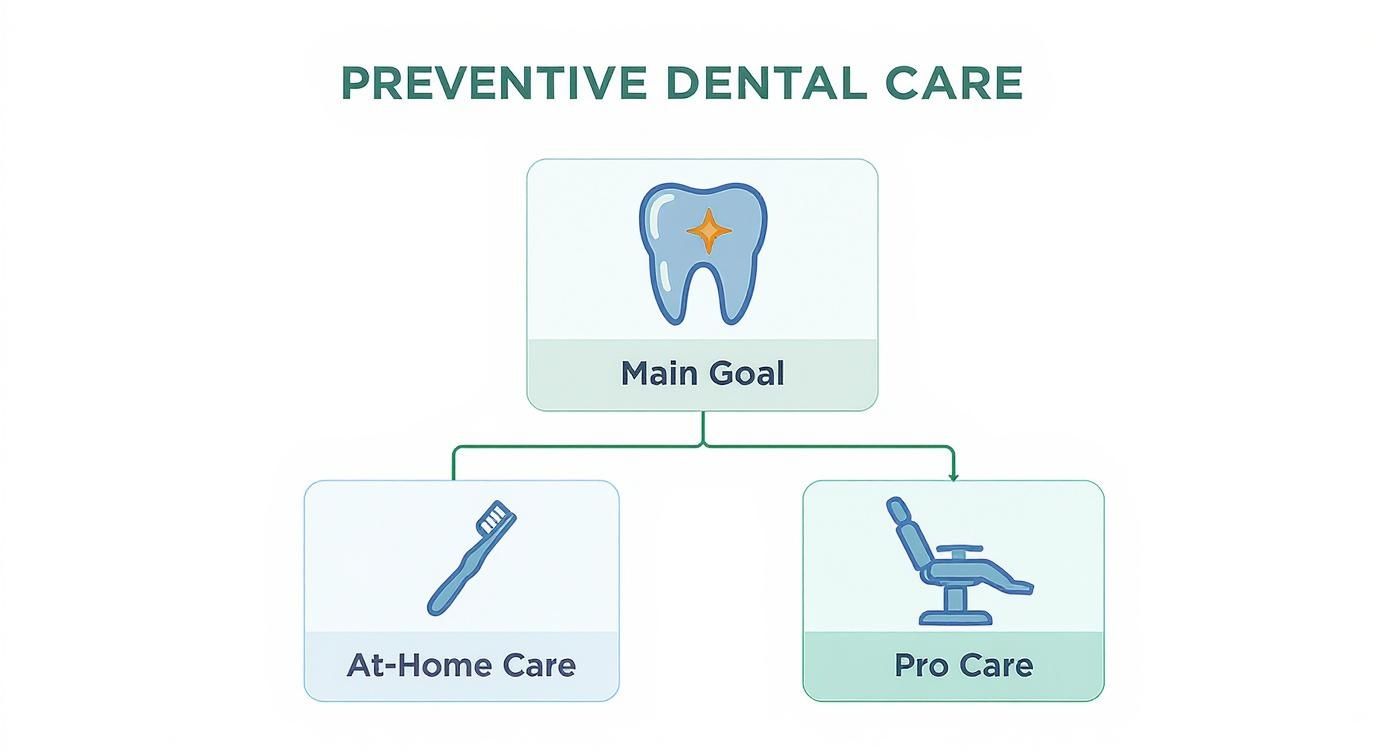
As you can see, your daily habits are the bedrock, but they’re reinforced and strengthened by professional oversight to ensure nothing gets missed.
To help visualize this, here’s a quick breakdown of what a complete preventive routine looks like.
The Pillars Of Preventive Dental Care At A Glance
| Component | Description | Frequency |
|---|---|---|
| Brushing | Use a soft-bristled brush and fluoride toothpaste to remove plaque and food debris from tooth surfaces. | Twice daily for 2 minutes |
| Flossing | Clean between teeth and under the gumline where a toothbrush can't reach, preventing plaque buildup. | Once daily |
| Dental Exams | A professional check-up to screen for cavities, gum disease, oral cancer, and other potential issues. | 1-2 times per year (as recommended) |
| Professional Cleanings | Removal of hardened plaque (tartar) that can't be removed by brushing and flossing alone. | 1-2 times per year (as recommended) |
| Dental X-rays | Diagnostic images that reveal issues invisible to the naked eye, such as cavities between teeth or bone loss. | Typically once per year |
This table shows how each piece of the puzzle—from your daily brushing to annual X-rays—plays a critical role in maintaining optimal oral health.
Building Your Preventive Strategy
A solid preventive plan doesn't need to be overwhelming. It starts by understanding these core practices and making them a consistent part of your life.
The most effective dental care is the care you receive before you think you need it. By the time a tooth hurts, the problem has already progressed. Prevention is about staying ahead of the game.
This idea is the heart of modern dentistry. Your dentist is like a health coach for your mouth, giving you the tools, knowledge, and professional services you need to keep your smile in fantastic shape. These check-ups are essential for catching things you can't see, like the very first signs of a cavity or the start of gum inflammation.
If you’re curious about how often you should be booking those appointments, check out our guide on how often you should see a dentist to keep your smile healthy. Ultimately, embracing preventive care is an investment in your future—one that leads to fewer dental emergencies, lower healthcare costs, and the confidence that comes from a genuinely healthy smile.
Mastering Your At-Home Preventive Routine
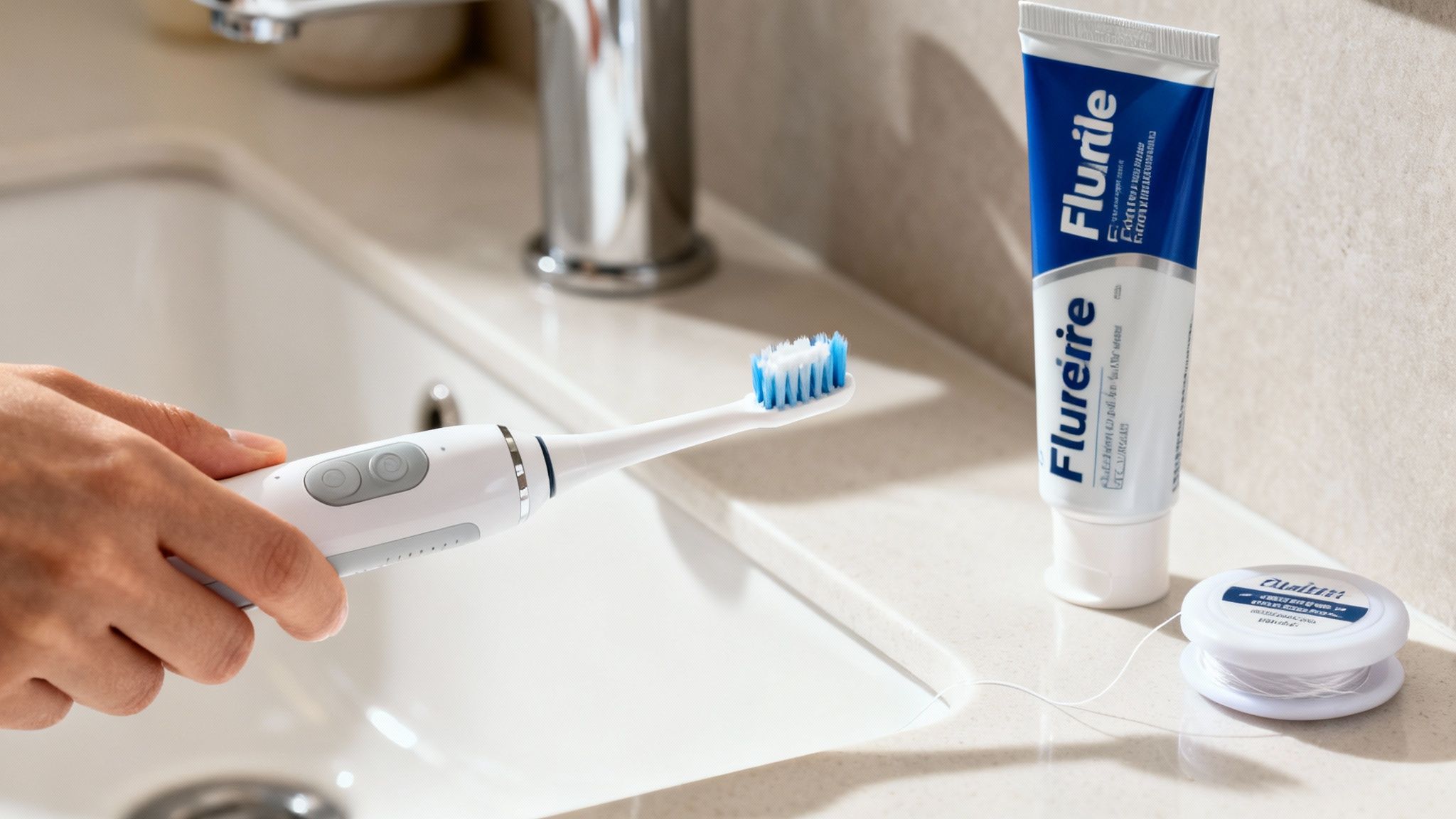
While your dentist plays a huge role in your oral health, the real heavy lifting happens at home. The daily choices you make are the frontline defense against plaque and decay. It’s not about spending hours in front of the mirror; it’s about making every minute count with the right techniques.
Think of it this way: your six-month cleaning is like a deep tune-up for your car. But your daily brushing and flossing? That's the regular maintenance that keeps the engine running smoothly day in and day out.
The Art and Science of Brushing
Brushing your teeth feels second nature, but are you really doing it right? So many of us fall into the trap of aggressive back-and-forth scrubbing, which can actually harm your gums and miss the spots where trouble starts. The goal isn’t to scour your teeth, but to gently and methodically clean them.
A technique we often recommend to patients is the Bass method. It’s specifically designed to target the most critical area: right below the gumline, which is plaque’s favorite hiding spot.
- Get the Angle Right: Hold your brush at a 45-degree angle to your gums. This allows the bristles to slip just underneath the gumline.
- Vibrate, Don't Scrub: Instead of wide strokes, use short, gentle, vibrating motions. You're trying to jiggle the plaque loose, not brush it away with force.
- Work in Sections: Move methodically around your mouth—tackle the outer surfaces, then the inner surfaces, and finally the chewing surfaces. This ensures no tooth gets left behind.
- The Two-Minute Rule: Set a timer and brush for a full two minutes, twice a day. It’s the minimum time needed to be thorough.
This focused approach does more than just polish your enamel; it actively disrupts the plaque buildup that leads to cavities and gingivitis.
Choosing Your Oral Health Tools
Your technique is only half the battle; the tools you use matter just as much. The dental aisle can be overwhelming, but a couple of smart choices can seriously upgrade your routine.
Fluoride Toothpaste is a Must
This isn't just marketing hype. Fluoride is a natural mineral that acts like a coat of armor for your teeth. It actively strengthens enamel to help it resist acid attacks from sugar and bacteria, and it can even help reverse the earliest stages of decay. Using a fluoride toothpaste is one of the simplest, most powerful preventive steps you can take.
Electric vs. Manual Brushes
A manual toothbrush works just fine if your technique is perfect. But let’s be honest, most of us aren't that consistent. An electric toothbrush often provides a superior clean because it does the work for you. The built-in timers ensure you hit the two-minute mark, and the oscillating heads are incredibly efficient at removing plaque with less effort on your part.
Don't Skip the Floss
If there's one habit people love to skip, it's flossing. Yet, it’s a non-negotiable part of what is preventive dental care. Your toothbrush, no matter how great it is, can't clean between your teeth. That area makes up roughly 40% of your tooth's surface area!
When you skip flossing, you’re essentially leaving a "Now Open" sign for bacteria, inviting cavities and gum disease to move in.
The best kind of floss is the one you'll actually use. Whether it's traditional string, a handy floss pick, or a water flosser, find what works for you and stick with it every single day.
If you struggle with string floss, don’t just give up. There are tons of alternatives out there. To see what might work for you, take a look at our guide on how to use dental floss, including its types and materials.
Taking control of your home care is empowering. If you’re already dealing with early-stage issues, there are even great resources on how to treat gingivitis at home. Perfecting these small daily habits isn't just about cleaning your teeth—it’s a powerful investment in your long-term health.
How Your Dentist Champions Preventive Care
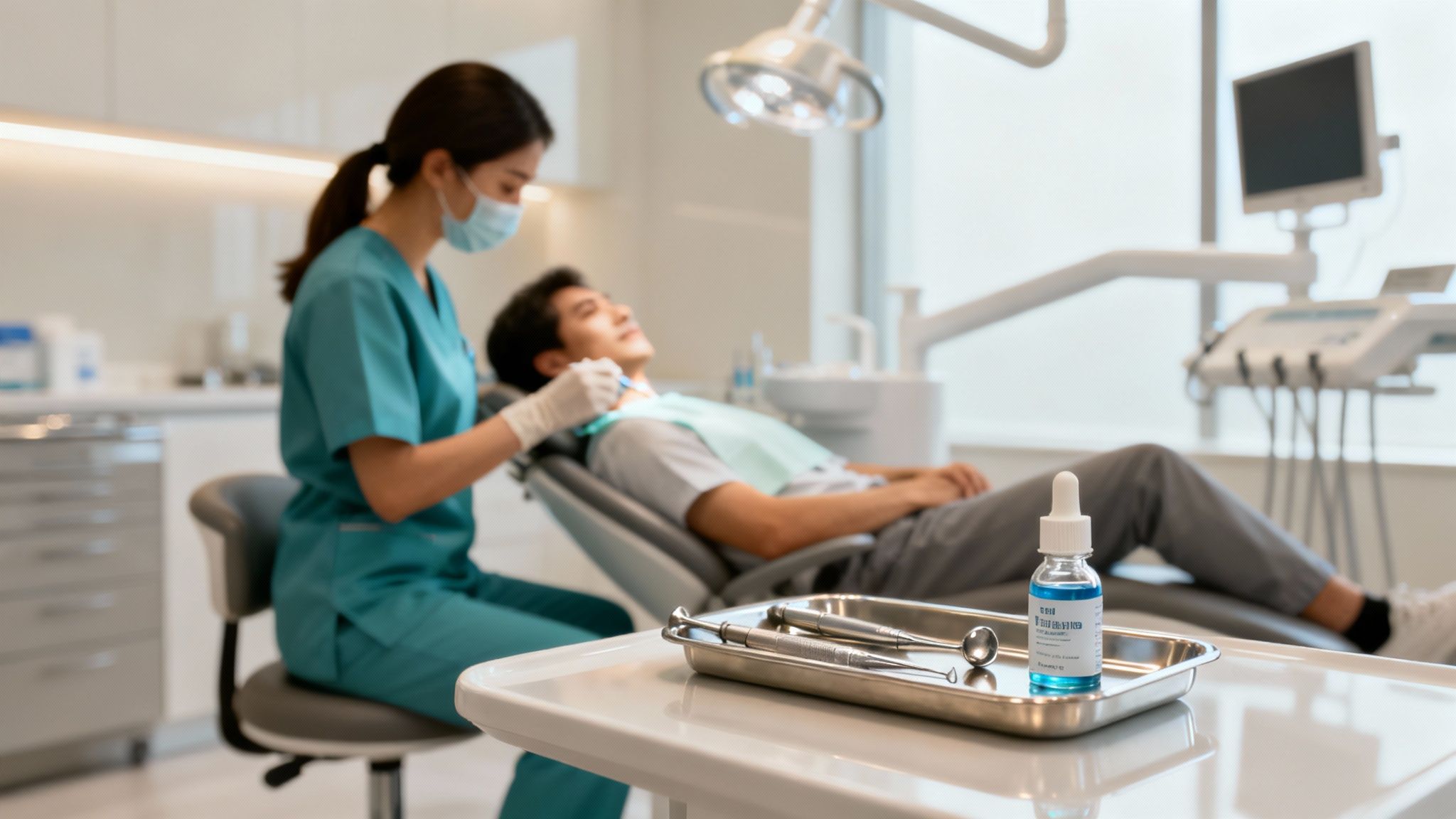
Your daily brushing and flossing are absolutely crucial, but they're only half the story. To truly protect your smile for the long haul, you need to pair your at-home efforts with professional dental care. Think of it as teamwork.
Your dental visit isn't a test or a lecture. It’s a collaborative check-in where an expert can spot things you can't, offer personalized advice, and provide treatments that give your smile’s defenses a serious upgrade.
The Professional Cleaning Difference
Even the most dedicated brusher can’t stop all plaque from hardening into tartar, also known as calculus. Once it forms, this tough, crusty deposit is impossible to remove with a toothbrush and floss. It loves to hang out along the gumline, creating a perfect home for harmful bacteria.
This is where your dental hygienist shines. Using precision instruments, they gently and thoroughly remove every bit of tartar buildup. It’s a vital step in preventing gum disease and cavities. For a deeper dive into this process, check out our guide to a professional dental cleaning.
A professional cleaning accomplishes something you simply can't at home, leaving your teeth incredibly smooth and disrupting the main source of gum inflammation.
The Comprehensive Dental Exam
After the cleaning, your dentist conducts a thorough examination. This is far more than just a quick glance for cavities; it’s a detailed health screening for a host of issues that often show no symptoms in their early stages.
During this exam, your dentist will:
- Check for Tooth Decay: They use their expertise and special tools to spot the very first signs of enamel weakness long before it turns into a painful cavity.
- Assess Gum Health: Your dentist measures the small spaces between your teeth and gums. If these "pockets" are getting deeper, it’s a red flag for gum disease, and early intervention is key.
- Screen for Oral Cancer: This involves a careful look at your tongue, cheeks, throat, and other soft tissues for any unusual spots or changes—a crucial early detection step.
- Review X-rays: These images give your dentist a look beneath the surface to find hidden problems like decay between teeth, bone loss around the jaw, or impacted wisdom teeth.
A routine dental exam is one of the most powerful tools in preventive care. It allows us to find and fix small problems before they become big, painful, and expensive procedures.
Advanced Preventive Treatments
Sometimes, a cleaning and exam are just the beginning. Your dentist might recommend additional treatments to give your teeth an extra shield of protection, especially if you or your children are prone to cavities.
These treatments are a cornerstone of what is preventive dental care and can make a huge difference.
Dental Sealants
Imagine a thin, clear raincoat for your back teeth. Your molars have tiny grooves and pits on their chewing surfaces that are magnets for food particles and bacteria. A sealant is a safe, plastic coating that is painted on to smooth out these surfaces, effectively "sealing" out the things that cause decay. In fact, the CDC reports that sealants can prevent up to 80% of cavities in molars.
Professional Fluoride Applications
The fluoride in your toothpaste is great, but a professional application provides a much more concentrated dose to strengthen and re-mineralize your enamel. This varnish is quickly painted on after a cleaning, giving your teeth a powerful boost to help them fight off acid attacks from bacteria and sugary foods.
Ultimately, this partnership with your dental team is what makes your preventive strategy truly effective. They have the expertise and the tools to catch what you can’t see, remove what you can’t reach, and protect your teeth for years to come.
Your Diet's Impact On Oral Health

True preventive dental care goes far beyond your toothbrush and floss—it starts in your kitchen. What you eat and drink has a direct, powerful impact on the health of your teeth and gums. Every meal and every snack is a choice that either strengthens your smile or helps break it down.
Think of your mouth as a battleground. Some foods arm the bad guys (harmful bacteria), while others provide the reinforcements your teeth need to stay strong. Getting this balance right is a game-changer for your oral health.
How Sugars and Acids Fuel Decay
So, who are the main villains in this story? Sugars and acids. When you snack on sugary foods or sip a sweet drink, the bacteria in your mouth throw a party. As they feast on the sugar, they release acid as a waste product.
This acid is the real troublemaker. It relentlessly attacks your tooth enamel, the tough, protective outer shield of your teeth. With each acid attack, the enamel demineralizes and weakens, eventually leading to a cavity.
Acidic foods and drinks—like soda, sports drinks, and even some citrus fruits—are a double threat. They erode your enamel directly and feed the acid-producing bacteria. For a deeper dive, check out our guide on the most acidic beverages and foods to limit or avoid.
The frequency of sugar exposure is often more damaging than the amount. Sipping on a soda all afternoon creates a constant acid bath for your teeth, which is far worse than drinking it quickly with a meal.
Building Your Smile with Superfoods
Fortunately, your diet can also be your greatest ally. Just as some foods cause harm, others actively protect and fortify your teeth and gums. Think of these as "smile superfoods."
Loading your plate with these foods gives your mouth the raw materials it needs to build strong enamel and maintain healthy gum tissue.
- Calcium-Rich Foods: Dairy like milk, cheese, and yogurt are classics, but don't forget leafy greens and almonds. Calcium is the main building block for your teeth and jawbone.
- Phosphorus-Rich Foods: You'll find this mineral in fish, lean meats, eggs, and nuts. It works hand-in-hand with calcium to remineralize and strengthen tooth enamel.
- Crunchy Fruits and Veggies: Apples, carrots, and celery are nature's toothbrushes. Their fibrous texture helps scrub away plaque while chewing, and they also stimulate saliva—your body’s natural mouth rinse.
- Vitamin C: Power up with bell peppers, broccoli, and kale. Vitamin C is crucial for gum health and helps your body fight off inflammation that can lead to gum disease.
When you need a quick bite for your family, try swapping sugary treats for healthier options like snack bars without added sugar.
To make it even simpler, here's a quick look at the foods that can sabotage your smile versus the ones that support it.
Smile Saboteurs vs. Smile Superfoods
| Foods to Limit (Smile Saboteurs) | Foods to Enjoy (Smile Superfoods) |
|---|---|
| Sugary Candies & Sweets: Lollipops, hard candies, caramel | Crunchy Vegetables: Carrots, celery, cucumbers |
| Sodas & Sugary Drinks: Colas, sports drinks, sweetened teas | Dairy Products: Milk, cheese, plain yogurt |
| Sticky & Dried Fruits: Raisins, fruit leather | Lean Proteins: Chicken, fish, tofu, eggs |
| Starchy Foods: Potato chips, white bread, crackers | Leafy Greens: Spinach, kale, chard |
| Acidic Citrus Fruits & Juices: Lemons, oranges, grapefruit juice | Nuts & Seeds: Almonds, cashews, sunflower seeds |
Choosing more from the "Superfoods" column is a simple but powerful way to invest in your long-term oral health.
Lifestyle Choices Matter, Too
Your diet is a huge piece of the puzzle, but other daily habits play a major role as well. Lifestyle choices like smoking or excessive alcohol consumption can completely undo all your hard work.
Tobacco use is a well-known cause of gum disease and oral cancer. It chokes off the blood supply to your gums, making them vulnerable to infection and hindering their ability to heal. Similarly, heavy alcohol use can lead to a dry mouth, which reduces saliva flow and creates a perfect environment for cavities and gum problems to take hold.
By making smart choices about what you eat and how you live, you support the work you do at home and in the dentist's chair. It's an all-encompassing approach that sets you up for a lifetime of good health, one smile at a time.
Why Preventive Care Is Your Best Investment
When it comes to your health, being proactive is one of the smartest decisions you can make—both for your body and your wallet. Preventive dental care isn't just about dodging cavities; it’s a strategic investment in your future well-being that saves you a world of time, money, and pain down the road.
Think of it this way: your dental health is on one of two tracks. The first is a path of predictable, low-cost maintenance, like getting regular cleanings. The second is a track of sudden, high-cost, and often painful emergencies that always seem to happen at the worst possible moment.
It Just Makes Financial Sense
Let’s talk dollars and cents. A routine professional cleaning and exam is a planned, manageable expense. It’s a small price to pay to keep your smile in great shape.
Now, let's look at the alternative. When a tiny, unnoticed cavity is left to its own devices, it doesn't just sit there. It grows, digging deeper into the tooth until it hits the nerve. The result? An excruciating toothache that requires a root canal and a crown to fix.
That one emergency can easily cost 10 to 20 times more than an entire year of preventive check-ups. The difference is staggering.
- Preventive Care: Low, predictable costs for your regular cleanings and exams.
- Reactive Care: High, unexpected bills for things like root canals, crowns, and extractions.
By committing to regular visits, you're essentially buying insurance against major dental disasters. You’re choosing to handle small issues while they’re still simple and affordable, instead of waiting for them to blow up into painful, expensive emergencies.
Investing in preventive care is like paying a small premium to avoid a massive, unexpected bill later. It's the smartest financial move you can make for your health.
Payment and Accessibility
Even with such clear benefits, many people still put off going to the dentist. While 90% of adults in the U.S. have had at least one cavity and nearly half struggle with gum disease, only about 64% actually saw a dentist in the past year. This gap is why an estimated 25% of U.S. adults are walking around with untreated cavities. At Serena San Diego Dentist, we believe financial concerns shouldn't be a barrier to excellent care. We accept most major insurance plans, including PPOs, for covered services and offer flexible out-of-pocket payment options to ensure everyone in our community can access the preventive care they need. You can explore more dental care statistics on Premier Image Dentistry to see how insurance impacts dental visits.
More Than Money: The Invaluable Health Benefits
The financial savings are a huge plus, but the real return on your investment in preventive care is your health. The true value is in everything you get to avoid: pain, stress, and serious health complications that can affect your entire body.
Keep Your Natural Teeth for Life
Let's be clear: nothing is better than your own teeth. They are stronger and work better than any replacement. Preventive care is your ticket to keeping them for a lifetime, so you can eat, speak, and smile with total confidence, free from worrying about dentures or implants.
Dodge Painful Dental Emergencies
Dental emergencies don't schedule appointments. The blinding pain of an abscessed tooth or a broken crown can derail your work, ruin a vacation, and completely upend your life. Consistent check-ups drastically cut your risk of ever having to deal with that kind of disruption and agony.
Protect Your Overall Health
Your mouth isn't isolated from the rest of your body; it's the gateway. Chronic inflammation from gum disease has been scientifically linked to a higher risk for serious systemic conditions.
- Heart Disease: Bacteria from infected gums can get into your bloodstream, contributing to inflammation in your arteries.
- Diabetes: Gum disease can make it more difficult to control your blood sugar levels.
- Respiratory Infections: It’s possible to inhale oral bacteria into your lungs, which can lead to infections like pneumonia.
By preventing gum disease, you’re not just saving your teeth—you’re actively looking out for your cardiovascular, metabolic, and respiratory health. It’s a powerful, holistic approach to true wellness.
Ultimately, understanding what is preventive dental care is about recognizing it as the ultimate investment in a future with less pain, lower costs, and the unwavering confidence that comes from a genuinely healthy smile. It’s about taking control of your health today to build a better, brighter tomorrow.
Common Questions About Preventive Dental Care
https://www.youtube.com/embed/_RFkk2T4Uow
Even with a good grasp of the benefits, it's completely normal to have some questions pop up as you start thinking more seriously about preventive care. We hear them all the time from our patients here in San Diego. Getting clear answers is the best way to move forward with confidence, knowing you’re making smart choices for your smile.
Let's dive into some of the most common questions we get, breaking them down to clear up any confusion and help you feel in control of your oral health.
How Often Should I Really See The Dentist?
This is probably the number one question we're asked. For years, the go-to advice has been a dental check-up and professional cleaning every six months. And for most people, that's still the perfect rhythm for keeping their smile healthy and catching problems early.
But it’s not a strict rule for everyone. Think of the six-month visit as a great baseline. If you have other factors at play—like a history of cavities, signs of gum disease, or certain medical conditions—we might suggest a more frequent schedule. Coming in every three or four months could be what you need to stay ahead of any issues. It's all about creating a plan that fits you.
Are Dental X-Rays Actually Safe and Necessary?
Yes, and they are one of the most important tools we have. We get it—the word "radiation" can sound a little scary. But the reality is that modern digital X-rays use an incredibly low dose of radiation. To put it in perspective, you'd get more background radiation on a short airplane flight than from a full set of dental X-rays.
Their value is massive because they let us see what the naked eye simply can't. X-rays reveal hidden issues that could turn into major problems if we didn't catch them.
- Decay Between Teeth: They help us spot cavities in those tight spaces long before they become a bigger headache.
- Jawbone Issues: We can assess bone health, which is critical for identifying advanced gum disease.
- Impacted Teeth: They show us wisdom teeth or other teeth that are stuck under the gums and could cause trouble down the road.
Without X-rays, a huge piece of your oral health puzzle would be completely invisible.
If My Teeth Don't Hurt, Do I Still Need a Check-Up?
This question gets to the very heart of what is preventive dental care. The answer is a huge yes. Pain is actually one of the last things to show up when there's a dental problem. So many serious issues, like early-stage cavities, gingivitis, and even oral cancer, often develop silently without any pain at all.
Waiting for pain to tell you something is wrong is like waiting for the smoke alarm to go off after the house is already on fire. Regular check-ups are about finding the smoke before there's even a flame.
These appointments are your chance to catch problems when they are small, painless, and—crucially—much easier and less expensive to fix. By keeping up with your visits, you’re not just reacting to problems; you’re taking proactive steps to protect your health for years to come.
Your smile is one of your greatest assets, and Serena San Diego Dentist is here to help you protect it with exceptional preventive care. Schedule your next check-up today and invest in a lifetime of health and confidence!