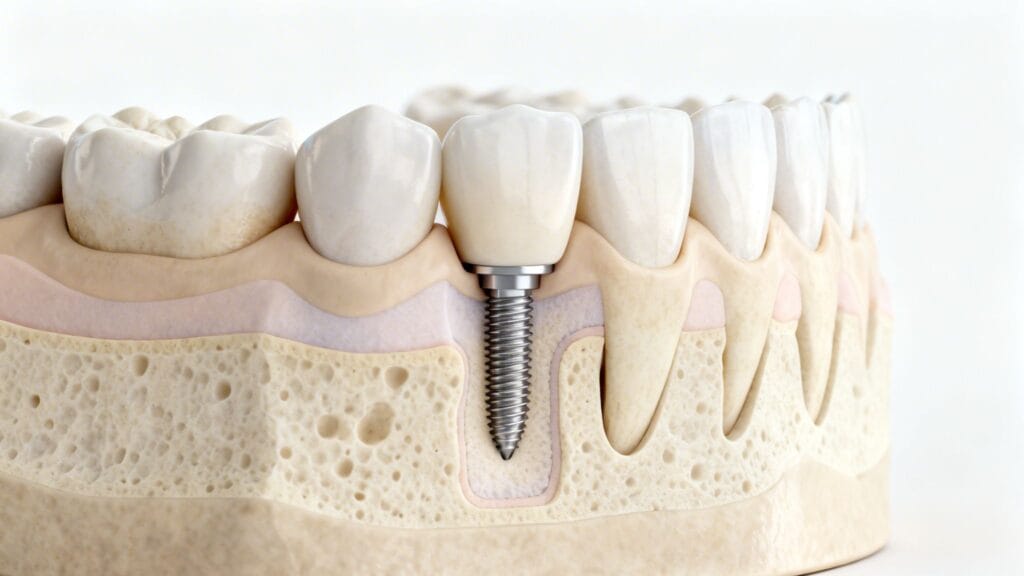
Imagine you're building a house. You wouldn't pour the foundation on soft, shifting sand, right? Of course not. You need solid ground to ensure the house stands strong for decades. A dental implant works on the same principle—it needs a sturdy, healthy jawbone to anchor it for life so you can chew, speak, and smile with total confidence.
This is exactly where bone grafting comes into the picture.
Why Your Jawbone is the Key to a Lasting Implant
When you lose a tooth, the part of your jawbone that once supported it suddenly has nothing to do. Without the stimulation from the tooth's root, the bone starts to shrink and deteriorate. This process, called resorption, can happen surprisingly fast.
Things like advanced gum disease (periodontitis) can make this bone loss happen even faster. You can learn more about how periodontitis can be ruining your oral health in our detailed guide. This creates a real challenge for anyone thinking about dental implants, because the small titanium post needs a certain amount of healthy bone—both in height and width—to lock in securely.
To give you a clearer picture, let's break down the essential concepts in a simple table before we get into the details.
Bone Grafting for Dental Implants at a Glance
This table gives you a quick snapshot of the key ideas we'll explore, helping you understand the basics before we dive deeper into the details.
| Concept | What It Means for You |
|---|---|
| The Problem | Missing teeth or gum disease can cause your jawbone to shrink and weaken. |
| The Solution | Bone grafting rebuilds this lost bone, creating a solid base for an implant. |
| The Goal | To ensure your dental implant has enough strong bone to fuse with and last a lifetime. |
| The Outcome | A stable, secure foundation that makes a successful dental implant possible. |
This process might sound complex, but it’s a very common and straightforward part of preparing for a successful implant.
Building a Foundation for Success
Bone grafting is a surgical procedure that rebuilds this crucial foundation. It's a time-tested technique used to replace bone that has been lost, whether from a tooth extraction, gum disease, or an old injury. Think of it as preparing the perfect site for your new implant.
At Serena San Diego Dentist, we view bone grafting as the first, and often most critical, step for patients on their journey to a permanent smile. It’s not just about filling an empty space; it's about restoring your jaw's natural strength and form.
A Proven and Reliable Procedure
Don't just take our word for it—the success of this approach is backed by extensive research. A major study that looked at 158,824 dental implants found an incredible 97.83% clinical success rate for implants placed in areas where the bone was rebuilt. That's virtually the same success rate as implants placed in naturally perfect bone.
For anyone looking into dental implants, understanding procedures like this is key. You can learn more about dedicated bone grafting services that lay the groundwork for these fantastic results. At the end of the day, bone grafting opens the door for so many more people to become great candidates for dental implants, turning what might seem like a roadblock into a story of lasting success.
Exploring the Different Types of Bone Grafts
When it comes to building a strong foundation for your dental implant, we have several ways to approach a bone graft. It’s not a one-size-fits-all solution. Think of it like a master carpenter selecting the right type of wood for a specific job—the choice of material is tailored to your unique situation.
At Serena San Diego Dentist, we’ll look at how much bone you need, where in your jaw the implant will go, and your overall health to decide on the perfect fit. Let’s walk through the four main types of materials we use.
This chart shows how a bone graft can transform a weak jawbone into the solid, healthy foundation needed for a successful dental implant.

It’s a clear picture of the journey from a compromised starting point to one of reliable strength, which is exactly what makes implant success possible.
Autografts: The Gold Standard
An autograft is widely considered the "gold standard" because it uses your own bone. We typically take a small piece of bone from another part of your body—often the back of your jaw, your chin, or in some cases, your hip.
Because it’s your own tissue, it's a perfect biological match. This means there's virtually no risk of rejection, and it comes packed with your own living cells that actively kickstart the bone-building process. The only real downside is that it requires a second small surgical site to harvest the bone from.
Allografts: A Safe and Common Alternative
An allograft uses bone from a human donor, sourced from a certified tissue bank. Don't worry—this material is put through a rigorous screening, testing, and sterilization process to ensure it’s completely safe and free from any disease.
Allografts are incredibly effective and one of the most common choices. The biggest plus? They eliminate the need for a second surgical site, which often translates to a more comfortable and faster recovery for you. The donor bone acts as a scaffold, providing the framework for your body to build its own new, healthy bone right where you need it.
Xenografts: A Natural Framework
A xenograft uses bone from an animal source, usually a cow (bovine). Just like with allografts, this material goes through a strict purification process that removes all organic material, leaving behind just the mineral structure.
What's amazing is that this mineral framework is remarkably similar to our own. It provides the perfect natural lattice for your bone-forming cells to grab onto and start building. Xenografts have been used successfully for many years in all kinds of dental and medical procedures.
Understanding these options helps you see how personalized your treatment plan will be. Choosing the right material is a critical step in ensuring your dental implant has the strong, stable foundation it needs to last for decades.
The data backs this up. When your natural jawbone isn't quite enough, grafting can rebuild it with incredible success. A huge 2023 review of 41 different studies found that materials like autografts and composite grafts have success rates between 80.9% and 91.5%. Even better, the implants placed in that new bone had survival rates as high as 96.7% after five years. This research really cements bone grafting's role as a cornerstone for long-term implant stability. You can read the full research about these bone grafting success rates to learn more.
Alloplasts: The Synthetic Option
Finally, there are alloplasts—synthetic materials created in a lab. These grafts are typically made from biocompatible substances like calcium phosphate that mimic the mineral part of your natural bone.
Since alloplasts are completely man-made, there is zero risk of disease transmission. They essentially act as a placeholder that stimulates your body to generate its own bone in that space. Over time, your body gradually absorbs the synthetic material and replaces it entirely with your own healthy bone tissue, leaving you with a solid, integrated foundation for your implant.
A Step-by-Step Walkthrough of the Bone Grafting Procedure
Hearing the word “surgery” can understandably make anyone feel a bit nervous. We get it. But knowing exactly what to expect can turn that uncertainty into confidence. At Serena San Diego Dentist, we want to pull back the curtain and walk you through the entire bone grafting process, showing you how our modern, gentle approach makes it a surprisingly smooth experience.
The whole journey is a carefully planned sequence of events, all designed for your comfort and the best possible result.
Step 1: Your Personalized Consultation
Everything starts with a conversation. This is where we sit down with you to understand your goals and assess your unique situation. We don’t guess when it comes to your health; instead, we use advanced 3D CBCT (Cone Beam Computed Tomography) imaging to get a crystal-clear, high-definition map of your jawbone.
This amazing scan lets us see the exact height, width, and density of your bone in three dimensions. With that detailed information, we can pinpoint whether a bone graft is needed and, more importantly, which type of material and technique will set you up for success. This is also your time to ask us anything and everything on your mind.
Step 2: Preparing for a Comfortable Procedure
On the day of your appointment, your comfort is our top priority. We'll chat about sedation options to make sure you feel completely relaxed and at ease throughout the entire process. Options can range from a local anesthetic that thoroughly numbs the area to oral or IV sedation for a deeper level of calm.
Our team will ensure you’re settled and comfortable before we begin. The procedure is handled right here in our modern San Diego clinic as a simple outpatient treatment, so you'll be heading home the same day.
Step 3: The Grafting Process
Once you’re comfortable and the area is completely numb, the procedure itself begins. The exact details can vary a bit from person to person, but the general steps are straightforward and efficient.
- Preparing the Site: Your dentist makes a small, precise incision in the gum tissue to gently expose the bone underneath. We handle this with the utmost care to minimize any disruption to the surrounding area.
- Placing the Graft Material: The chosen graft material—whether it’s from you, a donor, or a synthetic source—is carefully placed right where your jaw needs more volume. Think of this material as a scaffold, providing the perfect framework for your body to build new, strong bone.
- Protecting the Graft: Often, we'll place a special dissolvable membrane over the graft. This acts like a tiny, high-tech bandage, holding the graft in place and preventing gum tissue from getting in the way. It gives your bone cells the protected space they need to work their magic.
- Closing the Site: Finally, the gum tissue is gently repositioned, and the incision is closed with a few small stitches. These are typically the kind that dissolve on their own as you heal, so there's no need for a follow-up removal.
The entire procedure is remarkably precise and usually takes about an hour to complete. Thanks to our focus on gentle techniques, most patients tell us they feel very little discomfort during or after the process.
Step 4: Kicking Off the Healing Process
After your procedure, we'll send you home with a clear set of aftercare instructions to guide you through a smooth recovery. You can also find more great information about what comes next by reading our comprehensive guide on oral surgery explained.
This walkthrough shows that bone grafting is a methodical and patient-focused procedure. The combination of advanced imaging, personalized care, and meticulous surgical technique creates the perfect environment for your body to do what it does best: build a solid, healthy foundation for your future dental implant and a lifetime of confident smiles.
What to Expect During Your Healing and Recovery

Once your bone graft is in place, your body starts an amazing process: it begins transforming the graft material into your own strong, living bone. This isn't an overnight fix. Think of it as a gradual healing journey that usually takes a few months to fully complete. Knowing what to expect during this time makes the whole process much smoother.
Your body is essentially remodeling the area, using the graft material as a natural scaffold to build new, dense bone tissue. This crucial period ensures that when it’s time for your dental implant, it will have the solid, integrated foundation it needs to last a lifetime.
Your First Few Days After the Procedure
The first 24 to 72 hours are the most critical for a successful recovery. It's perfectly normal to see some minor swelling, bruising, and feel some discomfort around the surgical site. This is just your body’s natural response as it sends all its healing resources to the area.
To manage this initial phase, we have a few simple recommendations:
- Use a Cold Compress: Applying a cold pack to your cheek—20 minutes on, 20 minutes off—for the first day or two really helps minimize swelling and soothe the area.
- Take It Easy: For a few days, avoid any strenuous exercise or heavy lifting. Giving your body a chance to rest lets it focus all its energy on healing.
- Keep Your Head Elevated: When you're resting or sleeping, propping your head up with an extra pillow can make a big difference in reducing swelling.
Managing Diet and Oral Hygiene
What you eat and how you care for your mouth are incredibly important during these first few weeks. The main goal is to protect the graft site from any disruption while it heals.
For the first week or so, you’ll want to stick to a soft-food diet. Think smoothies, yogurt, mashed potatoes, lukewarm soups, and scrambled eggs. Stay away from anything hard, crunchy, or spicy that could irritate the surgical site. You'll also need to avoid drinking through a straw, as the suction can disturb the delicate healing process.
Keeping your mouth clean is just as vital for preventing infection.
We’ll send you home with specific instructions, which often include a special antiseptic mouth rinse. You can brush your other teeth like you normally would, just be extremely gentle around the surgical area.
Our guide on what to do after an extraction has some more great tips that apply here, too. You can find more practical advice in our post on what you should do after a tooth removal.
The Full Healing Timeline and Follow-Up Care
While you'll probably feel back to your old self within a week or two, the real work is happening beneath the surface. The entire process of osseointegration—the technical term for the graft fusing with your natural bone—can take anywhere from three to nine months. The exact timing really depends on the type of graft we used and your body's unique healing ability.
This is why your follow-up appointments at our San Diego office are so important. We'll have you come in periodically to monitor your progress, sometimes taking X-rays to see exactly how the new bone is forming. These check-ins allow us to confirm everything is healing perfectly and that your new bone foundation is becoming strong and dense.
Here at Serena San Diego Dentist, our team is with you every step of the way, making sure you feel comfortable and informed as you get ready for the final step: your new dental implant.
Understanding the Success Rates and Long-Term Benefits
It's completely normal to wonder if a dental implant placed in grafted bone will be as strong and reliable as one set in your original jawbone. It’s a question we hear a lot from our San Diego patients. The good news is that the research and clinical results are incredibly reassuring—bone grafting is a proven, reliable path to a lasting smile.
The entire point of the procedure is to build a solid foundation where one no longer exists. Thanks to modern techniques, we can do this with remarkable consistency. With proper care, the success of an implant in a grafted site is nearly identical to one placed in an untouched jawbone. You're not compromising on quality; you're simply creating the conditions needed for success.

Beyond Securing Your Implant: The Long-Term Benefits
While giving your dental implant a stable home is the immediate goal, the benefits of bone grafting reach much further than just that one tooth. Think of it as a proactive investment in your overall oral and facial health.
One of the most important advantages is halting further bone deterioration. After a tooth is lost, the jawbone that once supported it begins to shrink away. A bone graft stops this process cold, preserving the natural structure and strength of your jaw for the long haul.
This structural support has a direct impact on your appearance.
By maintaining bone volume, a graft helps support your facial tissues—like your cheeks and lips—which prevents the "sunken" or prematurely aged look that can happen after tooth loss. It's a procedure that doesn't just restore your bite; it protects your natural facial contours.
A Foundation Built to Last for Decades
Ultimately, a well-executed bone graft creates the perfect base for your dental implant, allowing it to fuse with the bone and function just like a natural tooth. This means you can get back to eating the foods you love, speaking clearly, and smiling with complete confidence because you know your restoration is secure.
The long-term success rates are truly impressive. Modern protocols have given us 95-98% success rates for implants in grafted bone, putting them on par with implants in non-grafted sites. This isn't just an anecdotal observation; extensive reviews back it up. One major analysis found that implant survival rates in augmented bone can be as high as 98.8% for single-tooth replacements.
Even looking way down the road, the results hold up. After 15 years, the survival rate remains strong at 94%, which is practically indistinguishable from implants placed in native bone when the right protocols are followed. To dive deeper, you can explore a detailed guide on the complete timeline and success rates of dental implants with bone grafts.
Achieving Predictable Outcomes in San Diego
Here at Serena San Diego Dentist, our expertise is in carefully planning and performing bone grafting procedures to ensure you get these excellent long-term results. We use advanced imaging and proven techniques to build a foundation that isn’t just functional today, but is built to last for decades to come. Your new smile deserves nothing less than a solid, healthy foundation.
Answering Your Top Questions About Dental Bone Grafting
It’s completely normal to have a few questions before any dental procedure, and bone grafting is no exception. We get it. That's why we've put together straightforward answers to the most common things our patients in San Diego ask us. Let this be your quick guide to getting the clarity and peace of mind you need.
Does a Bone Graft Hurt?
This is usually the first thing on everyone's mind, and the answer is a relief: the procedure itself is not painful. We make sure the area is completely numb with local anesthetic before we even begin, so you won’t feel a thing while we work.
After the numbness wears off, you can expect some soreness and mild discomfort for a few days—think of it as being similar to recovering from a tooth extraction. This is easily managed with standard over-the-counter pain relievers and a cold compress. Our team at Serena San Diego Dentist is absolutely committed to ensuring you’re comfortable every step of the way.
How Long Before I Can Get My Dental Implant?
This is where a little patience really pays off. Your body needs time to work its magic, transforming the graft material into your own strong, new bone. This biological process, called osseointegration, is what creates the solid foundation your future implant needs.
Typically, this healing period takes anywhere from three to six months, though sometimes it can take a bit longer.
Several things influence your personal timeline:
- The type of graft material we used and how much was needed.
- Where exactly in your jaw the graft was placed.
- Your own unique healing capabilities.
We’ll keep a close eye on your progress with follow-up appointments and X-rays. This helps us pinpoint the exact right moment to move forward with placing your dental implant.
Will My Dental Insurance Help Cover the Cost?
Insurance can feel like a maze, but you don't have to navigate it alone. Whether or not your bone graft is covered really comes down to the details of your specific plan and the reason for the graft.
The good news is that in many cases, if the bone graft is considered "medically necessary" to prepare for a dental implant, your dental insurance will often cover a portion of the cost.
Here at Serena San Diego Dentist, we work with most major PPO insurance plans. Our team is fantastic at helping you understand your benefits and will happily review your policy to give you a clear picture of your coverage. We also provide flexible financing options, because we firmly believe that financial hurdles shouldn't prevent you from getting the healthy, confident smile you deserve.
Begin Your Dental Implant Journey in San Diego
You now have a much clearer picture of how bone grafting works to build a solid foundation for dental implants. It’s often the crucial first step toward getting a beautiful, permanent smile you can feel truly confident in. Think of it as preparing the ground before building a house—it’s what makes a successful, long-lasting dental implant possible.
Here at Serena San Diego Dentist, we blend our clinical expertise with genuine, compassionate care. We’ll walk you through the entire process, from start to finish. We know that restoring your smile is a big decision, and our team is committed to supporting you with clear answers and a personalized plan every step of the way.
Making Your Treatment Accessible
We firmly believe that everyone in the San Diego community deserves access to exceptional dental care. We also know that cost is a real and important part of the conversation, so we do everything we can to make treatment fit your life.
We proudly accept most major PPO insurance plans and are happy to help you sort through your benefits to make the most of them. If you don't have insurance or have out-of-pocket costs, we also offer flexible financing options. Our goal is simple: remove the financial stress so you can focus on rebuilding your health and your confidence.
Your journey to a stronger, healthier smile begins with a simple conversation. Taking that first step to learn about your options is the most powerful thing you can do for your oral health.
As you explore your options, you can find local resources for specialized San Diego bone grafting services to learn more from other experts in our area. Once that strong foundation is in place, the possibilities for your smile open up. To get a better sense of the final restoration, take a look at our complete guide on San Diego dental implants.
Ready to rebuild your smile from the ground up? Schedule your personal consultation with Serena San Diego Dentist today and find out how we can help you achieve the strong, confident smile you deserve. Visit us at https://serenasandiegodentist.com.