
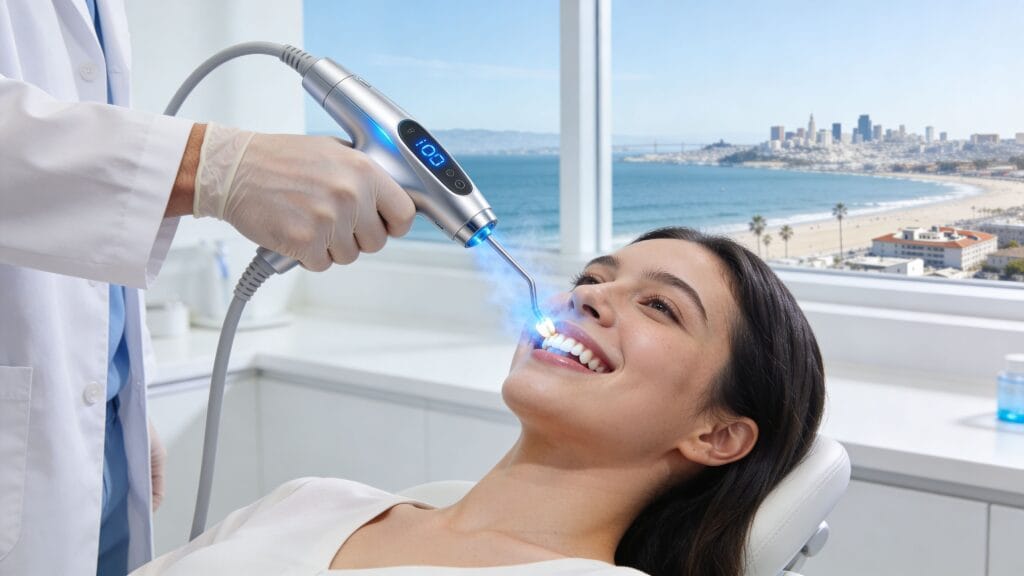
If you're dealing with tender gums, a cavity that seems to come back around, or a mouth that never quite feels fully settled after treatment, you're not alone. Many San Diego patients want dental care that feels precise and modern, but also less aggressive. They want to protect healthy tissue, avoid unnecessary irritation, and support healing instead of just reacting to symptoms.
That’s one reason ozone therapy san diego has become such a frequent question in dental consultations. In a dental setting, ozone is used as a targeted tool to disinfect, calm inflammation, and support tissue recovery. For the right situation, it can make care feel gentler and more biologically minded.
As a dentist, I find that most confusion starts with one simple issue. People hear the word “ozone” and think of outdoor air pollution, or they hear claims online that sound either too vague or too dramatic. However, it is much more practical. Dental ozone therapy is a controlled, localized technique used by trained clinicians for specific oral health goals.
A Gentler Approach to Dental Wellness in San Diego
I often hear the same concern from San Diego patients. Their gums stay tender, one spot keeps flaring up, and they want care that solves the problem without making the rest of the mouth feel beaten up.
That is a reasonable goal.
In dentistry, gentler care does not mean doing less. It means choosing tools that target the problem precisely, protect healthy tissue when possible, and support healing after treatment. For some patients, dental ozone fits that approach well. It is one of several modern options dentists may use to reduce microbial load in a focused area and make treatment feel more conservative.
San Diego patients often ask about this because they are trying to balance comfort, long-term oral health, and cost. They want to know what the visit will feel like, whether ozone can reduce the need for more invasive care in some situations, and where it fits within standard dental practice. Those are the right questions to ask. Ozone is not a cure-all, and it is not used for every diagnosis. It is a clinical tool with specific uses, specific limits, and a practical role in the right hands.
Dental ozone often comes up in the same conversation as other lower-impact technologies, including laser dentistry for precise soft tissue treatment. The shared idea is simple. Treat the area that needs attention while disturbing as little healthy tissue as possible.
Practical rule: The best modern dental tools help your dentist treat the problem more selectively.
What does that mean for a real patient visit? Sometimes ozone is used around irritated gums. Sometimes it is part of a plan for a cavity-prone area, support around endodontic care, or a healing site after treatment. The benefit is not that it replaces diagnosis. The benefit is that, once we know what is happening, we may have a more targeted way to address it while keeping your experience as comfortable and conservative as possible.
What Is Dental Ozone Therapy
At the simplest level, ozone is O3, a molecule made of three oxygen atoms. Regular oxygen is O2. I usually explain the difference this way: if regular oxygen is a calm, steady helper, ozone is the more reactive version that’s designed for a short, focused job.
In dentistry, that job is usually disinfection and healing support.

Why the chemistry matters
Ozone is highly reactive. That reactivity is what makes it useful in a controlled dental setting. When applied locally by a clinician, it can help disrupt unwanted microbes and create a cleaner environment in areas that are inflamed, infected, or at risk of ongoing bacterial activity.
A helpful analogy is this: think of ozone as a brief, targeted reset for a small part of the mouth. We’re not using it broadly. We’re applying it carefully where we want a strong antimicrobial effect without turning to a more invasive step right away.
How dentists apply it
Dental teams can use ozone in a few practical forms, depending on the procedure and equipment:
- Gas application helps target a specific site with precision.
- Ozonated water can be used as part of rinsing or irrigation.
- Ozonated oils may be used in some supportive care settings.
Patients often assume this means a rough or chemical-heavy experience. It usually doesn’t. The point is controlled delivery.
Ozone used in treatment is not the same thing as uncontrolled environmental exposure. In dentistry, the clinician controls the dose, location, and timing.
That distinction matters even more because modern ozone systems are built around precision. In broader ozone care, advanced protocols can repeat the ozonation cycle up to 10 times to deliver a higher dose with technical control, showing how refined this technology has become in clinical settings, according to LIVV Natural’s overview of multi-pass ozone therapy. Dentistry uses localized applications rather than those systemic formats, but the larger takeaway is the same: this is not improvised care. It relies on calibrated equipment and trained use.
What patients usually notice
Most patients don’t experience dental ozone as dramatic. That’s part of the appeal. They often notice that treatment feels cleaner, more conservative, and less mechanically aggressive than they expected.
The biggest benefit is often not what they feel during the appointment. It’s what we’re trying to prevent afterward: lingering bacterial activity, ongoing irritation, and slower tissue recovery.
How Ozone Is Used in Modern Dental Care
Dental ozone becomes easier to understand when you see where it fits chairside. It’s not one procedure. It’s a support tool used in different kinds of treatment where disinfection and tissue response matter.

Early decay and cavity care
When decay is caught early, the goal is to stop bacterial activity while preserving as much healthy tooth structure as possible. Ozone may be used to disinfect the area before the dentist places a restoration, or as part of a conservative strategy in situations where we’re trying to avoid escalation.
For patients, this often means the conversation shifts from “How much tooth do we have to remove?” to “How clean and stable can we make this area?”
Gum disease and periodontal pockets
Gum disease is one of the most practical uses for ozone in dentistry. Bacteria collect below the gumline, tissue becomes inflamed, and the area can be difficult to keep healthy with home care alone.
Ozone can be used to irrigate or disinfect those spaces as part of periodontal treatment. That matters because gum problems aren’t only about plaque on the visible surface. They often involve deeper pockets where bacterial load and inflammation keep feeding each other. If you want a refresher on the conventional side of that process, this guide on deep cleaning teeth explains the basics well.
Scientific research also helps explain why clinicians are interested in ozone for inflamed tissue. A study on psoriasis found ozone could downregulate psoriasis-associated cytokines and block Th17 cell activation, mechanisms that are also relevant to inflammatory processes in gum disease, as described in this published article on ozone and inflammatory pathways.
In plain language, less inflammatory signaling can mean a calmer tissue environment. That doesn’t guarantee a cure, but it helps explain why ozone has a place in periodontal care.
Root canal support
In endodontic treatment, one challenge is disinfecting the inside of the tooth as thoroughly as possible. Ozone may be used as a supportive step to help sterilize the internal space.
This doesn’t mean ozone makes every traditional root canal unnecessary. It means some dentists use it to improve local disinfection and support healing goals in selected cases.
Recovery after procedures
After extractions, periodontal work, or other procedures, soft tissue healing matters. A cleaner site can support a smoother recovery. That’s where ozone may also be part of a post-procedure protocol.
A few examples where patients often appreciate this approach:
- After a surgical visit: The focus is on reducing local microbial burden.
- Around inflamed tissue: Ozone may help create a less irritated environment.
- In biologic treatment planning: It can pair well with a tissue-preserving philosophy.
Ozone Therapy vs Traditional Dental Treatments
When patients compare options, they usually aren’t asking whether older methods are “bad.” They want to know what each treatment feels like, what it’s trying to accomplish, and whether a newer approach might be appropriate for their situation.
For gum disease, the most common traditional treatment is scaling and root planing. That’s a valuable procedure and often necessary. Ozone is best understood as either a complement to that treatment or, in selected cases, part of a less aggressive early approach.
Gum disease treatment comparison
| Feature | Ozone Therapy | Traditional Scaling & Root Planing |
|---|---|---|
| Invasiveness | Localized and generally tissue-conservative | Mechanical cleaning below the gumline |
| Patient comfort | Often perceived as gentler | May involve more pressure and post-treatment tenderness |
| Treatment focus | Disinfection and inflammation support | Physical removal of buildup and contaminated root surface material |
| Chemical use | Often chosen by patients seeking a more biologic approach | Conventional periodontal method |
| Healing experience | Aims to support the body’s own tissue response | Effective, but can feel more intensive during recovery |
Where the comparison gets misunderstood
Ozone doesn’t remove hard tartar deposits the way scaling instruments do. If there’s substantial buildup, mechanical cleaning is still important. That’s why a good dentist won’t frame this as an all-or-nothing decision.
What ozone may offer is a different patient experience and a useful biologic layer of care. In some cases, that helps reduce the need for more aggressive escalation. In others, it improves the quality of a standard procedure by adding targeted disinfection.
Patients also ask whether ozone can help them avoid more involved treatment later, including problems that eventually raise difficult choices about saving or removing a tooth. That question depends on timing, diagnosis, and overall tooth condition. If you’ve ever wondered how dentists weigh those decisions, this explanation of root canal vs extraction gives helpful context.
A fair comparison starts with one truth. Traditional methods and ozone aren’t always competitors. Often, they work best when the dentist knows when to combine them.
A Balanced Look at Safety and Evidence
Patients deserve honesty here. Ozone therapy can sound appealing, but responsible care means separating local dental use, broader medical claims, and regulatory reality.

What the regulatory gap means
One important fact is that ozone lacks FDA approval for systemic medical use in the United States. That gap is worth discussing openly, especially because some online content presents ozone in sweeping terms without enough nuance. This summary of the regulatory gap around ozone therapy makes that point clearly.
For patients, that doesn’t automatically mean every dental use is unsafe. It means you should ask exactly how the treatment is being used, where it’s being applied, and what outcome your dentist expects.
Why context matters in dentistry
Topical and localized dental use is different from broad systemic treatment claims. In a dental office, ozone is typically applied with a narrow purpose, such as disinfecting a cavity preparation, irrigating a gum pocket, or supporting a healing site.
That’s a much more grounded conversation than promising whole-body effects.
A careful consultation should cover:
- Your diagnosis: Is the issue decay, gum inflammation, infection control, or healing support?
- The role of ozone: Is it the main treatment, or an adjunct to something conventional?
- Your comfort and health history: Are there reasons to modify the plan?
Patients who are already cautious about any newer technique often ask the same broader trust question they ask about sedation or surgery: how do I know this is being used responsibly? That’s a smart question, and this article on whether sedation dentistry is safe reflects the same principle. Good care is built on appropriate case selection, informed consent, and clear limits.
Clinical mindset: A trustworthy dentist won’t oversell ozone. They’ll explain where it helps, where it doesn’t, and what the evidence can honestly support.
Your Ozone Therapy Appointment in San Diego
You come in with a sore spot near a tooth or gums, and one of your first questions is practical. What will this visit feel like?
In our San Diego setting, that conversation usually starts with the basics. We examine the area, review your symptoms, and explain whether ozone makes sense for your specific goal, such as reducing bacterial load in a cavity site or supporting irritated gum tissue. Patients often expect something complicated because the name sounds technical. The actual visit is usually much simpler than that.
What the visit usually looks like
Dental ozone is used in a very targeted way. It works like a spot treatment rather than a whole-body therapy. If it fits your case, your dentist applies it only where it is needed, such as around decay, inside a prepared tooth, near inflamed gum tissue, or at another localized treatment site.
That focused approach matters for comfort.
Many patients describe the appointment as quick and low stress. In plain terms, it often feels more like a precise add-on to dental care than a major procedure on its own. If you want to see how one local office presents that option, Serena San Diego Dentist online booking includes ozone therapy among its biological dentistry services for uses such as gum support, cavity disinfection before fillings, and care related to root canal alternatives. That reflects how ozone is commonly used in practice. It is tied to a specific dental problem and a specific treatment area.
Cost and planning questions
Cost is a fair question, and the answer depends on what the ozone is supporting. A brief localized application during cavity treatment is different from using ozone as part of a broader periodontal care plan. In other words, the fee is usually connected to the underlying dental procedure, not treated like a one-size-fits-all service.
Insurance can be a little confusing here. Some plans may cover the main dental treatment while handling the ozone portion differently, so it is smart to ask for a written estimate before you begin. That gives you a clearer picture of what you are paying for and why.
San Diego patients also ask whether more than one visit will be needed. Sometimes ozone is used once during a procedure. Other cases, especially gum-related care, may involve follow-up visits based on how the tissue responds.
A short video can help make the idea feel more familiar before you schedule.
Aftercare and recovery
After localized ozone treatment, patients can usually return to normal activities right away. You may get home care instructions, a follow-up check, or a recommendation for additional treatment if the underlying issue is ongoing.
That last part is important. Ozone can support disinfection and healing, but long-term oral health still depends on good diagnosis, routine care, and the right treatment plan for the problem in front of you.
Frequently Asked Questions About Dental Ozone Therapy
Is dental ozone therapy painful
Most patients find it very comfortable. In many cases, it feels less aggressive than what they expected because the treatment is localized and doesn’t rely on heavy mechanical force.
How many sessions will I need
That depends on the condition being treated. A single area of cavity disinfection is different from ongoing gum therapy. The number of visits depends on the diagnosis, how the tissue responds, and whether ozone is being used alone or alongside another dental procedure.
Is it the same as outdoor ozone pollution
No. That’s a very common confusion. Outdoor ozone exposure is an environmental issue. Dental ozone therapy uses controlled, medical-grade application to a specific area for a specific purpose.
Is dental ozone therapy covered by insurance
Sometimes the underlying dental procedure may be covered, while the ozone component may be handled differently. Coverage depends on your plan and on how the treatment is coded. Your dental office should help you review that before treatment begins.
Is it safe for children or during pregnancy
That answer should always be individualized. A dentist needs to review the patient’s health history, the reason for treatment, and the available alternatives before making a recommendation.
Can ozone replace fillings or deep cleanings
Not automatically. Ozone is a tool, not a universal substitute. Some conditions still need conventional restorative or periodontal treatment. The right question isn’t “Can ozone replace everything?” It’s “Where does ozone improve this specific treatment plan?”
Take the Next Step Toward Healthier Dentistry
If you’ve been looking into ozone therapy san diego, the most useful takeaway is this: ozone is best understood as a precise dental tool. It can help disinfect targeted areas, support tissue healing, and make some treatments feel more conservative. It also deserves a transparent conversation about evidence, limitations, and proper use.
That balance matters. Patients do well when they understand both the appeal and the boundaries. Ozone may be helpful for gum concerns, cavity-related disinfection, root canal support, and post-procedure healing. It isn’t a shortcut around diagnosis, and it shouldn’t be sold as one.
The right next step is a consultation with a dentist who can evaluate your mouth directly, explain whether ozone fits your case, and show you how it would integrate with your broader care plan. If you’ve been putting off treatment because you want something gentler, this may be the conversation that makes dental care feel manageable again.
If you’re curious whether ozone therapy fits your dental needs, schedule a consultation with Serena San Diego Dentist. A personalized exam can clarify whether this approach makes sense for gum care, cavity disinfection, healing support, or a more biologically focused treatment plan.