
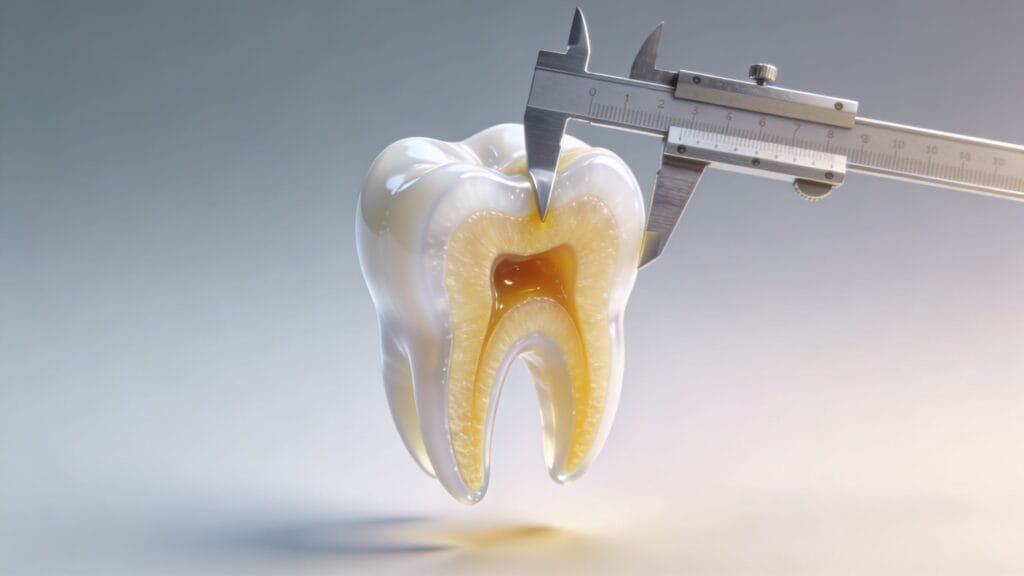
Tooth enamel thickness ranges from about 0.6 mm on front teeth to as much as 2.5 mm on the chewing surfaces of molars. That small layer makes a big difference in how your teeth handle cold drinks, acidic foods, daily biting forces, and cosmetic dental work.
If you’re reading this because one sip of iced water sent a sharp jolt through a tooth, enamel may be part of the story. Patients often assume sensitivity means a cavity, and sometimes it does, but thinning or damaged enamel is also a common reason teeth start reacting to temperature, sweets, or brushing. In San Diego, where coffee, citrus, sparkling water, whitening products, and smile-focused cosmetic dentistry are all part of real life, understanding how thick is enamel on teeth isn’t just trivia. It affects comfort, appearance, and the kinds of treatments that make sense for you.
A lot of people are surprised when they learn enamel isn’t the same thickness everywhere. Your front teeth don’t have the same protection as your back molars, and even one surface of a tooth can be safer to work on than another. That matters if you’re considering veneers, bonding, crowns, orthodontics, or trying to stop sensitivity from getting worse.
That Shock of Pain Why Your Tooth Enamel Matters
Cold sensitivity usually doesn’t start with the nerve. It starts with the loss of protection over it.
Enamel is the outer covering of the tooth. When it stays intact, it helps block everyday triggers like ice water, hot coffee, sour candy, and aggressive brushing. When it wears down, cracks, or thins out, the tooth becomes less insulated and more reactive.
Why that zing happens
Think about what happens when cold hits a tooth that no longer has full protection. The outer shield is thinner, the underlying tooth structure has less coverage, and normal sensations start to feel sharp.
Common situations that can push enamel into trouble include:
- Acid exposure: Sports drinks, soda, citrus, kombucha, and frequent snacking can soften the surface over time.
- Mechanical wear: Hard brushing, abrasive toothpaste, nail biting, and chewing ice can physically wear or chip enamel.
- Grinding and clenching: Nighttime pressure can flatten biting edges and create small fractures.
- Untreated decay: Cavities break through enamel and open the door to deeper sensitivity.
Sensitivity is often a sign to investigate early, not something to keep “waiting out.”
That’s why I tell patients not to focus only on the pain itself. The better question is what changed. Did the tooth lose structure, did the gumline become exposed, or did the enamel surface become roughened or worn?
If you’re trying to sort out whether what you feel sounds like enamel-related sensitivity, this guide on sensitive teeth and how to get rid of it at home gives a helpful starting point. Home care can calm symptoms, but it won’t rebuild enamel that’s already gone.
Why this matters before cosmetic work
Patients looking into whitening, bonding, veneers, or crowns often ask about color or shape first. Fair enough. But enamel quality comes first. A beautiful restoration placed on a tooth with weak, thin, or compromised enamel can become a maintenance problem.
That’s why thickness matters clinically. It helps determine what a tooth can tolerate, what kind of preparation is safest, and when a conservative plan is better than a more aggressive one.
What Is Tooth Enamel and What Does It Do
Enamel is your tooth’s hard outer shell. It acts like a helmet, taking the daily friction of chewing and helping protect the softer, more sensitive structures underneath.

Why enamel is so strong
Tooth enamel is the hardest substance in the human body, composed of 95% minerals. This gives it a hardness ranking of 5 on the Mohs hardness scale, placing it between steel and titanium. However, this high mineralization also creates brittleness, requiring support from the more flexible underlying dentin layer, which has a hardness of 3–4 on the Mohs scale, according to Cleveland Clinic’s overview of tooth enamel.
That balance matters. Enamel is hard, but hard doesn’t mean indestructible. A tile floor is hard too. It still chips if it takes the wrong hit. Teeth work the same way. Enamel resists wear well, but it depends on dentin underneath to absorb stress and reduce fracture risk.
What enamel can’t do
The most important practical fact about enamel is simple. Once it’s gone, your body doesn’t regenerate it.
That doesn’t mean every rough patch leads to a crown. It does mean prevention matters more than many people realize. Dentists can strengthen weakened areas, smooth damage, bond to enamel, and restore teeth with materials that mimic natural structure. But natural enamel itself doesn’t grow back after it has been worn away, dissolved by acid, or drilled away during treatment.
Here’s where many patients get tripped up:
- Fluoride can help strengthen enamel surfaces. It supports remineralization of early weak spots.
- Desensitizing products can reduce symptoms. They don’t replace lost structure.
- Bonding and ceramic restorations can rebuild form and function. They’re repairs, not regeneration.
Practical rule: The best enamel is the enamel you never had to replace.
If you want a preventive overview of how professional fluoride fits into that strategy, this article on what effects can fluoride treatment have on your teeth is worth reading.
Why this matters in everyday life
Enamel protects against more than cavities. It also helps maintain:
| Function | Why it matters |
|---|---|
| Temperature insulation | Reduces sensitivity to hot and cold foods |
| Wear resistance | Helps teeth tolerate chewing every day |
| Shape and contour | Supports natural-looking edges and smooth surfaces |
| Stain resistance | A healthier surface is easier to keep clean |
| Support for dentistry | Strong enamel improves bonding for many restorations |
When enamel is healthy, the tooth usually feels quiet. Patients don’t notice it, and that’s the point.
A Tour of Your Mouth How Enamel Thickness Varies
Enamel isn’t spread evenly across your mouth. Some teeth are naturally built with less protection, and some zones on the same tooth are safer than others.

Front teeth versus back teeth
The simplest answer is this. Incisors are thinner, molars are thicker.
The verified measurements show that tooth enamel thickness ranges from approximately 0.6 mm on incisors to as much as 2.5 mm at the cusps of molars. More specifically, incisor enamel is between 0.60 and 0.84 mm, while molars reach between 1.26 and 1.44 mm, with the thickest enamel at the cusp and the thinnest at the cementoenamel junction, as described in this enamel thickness reference.
That helps explain why front teeth tend to show wear, transparency, and edge chipping sooner, while back teeth are built to tolerate grinding forces.
Average enamel thickness by tooth type
| Tooth Type | Average Enamel Thickness (mm) |
|---|---|
| Incisors | 0.60 to 0.84 |
| Canines | More than 1.0 |
| Premolars | More than 1.0 |
| Molars | 1.26 to 1.44 |
| Molar cusp tips | Up to 2.5 |
Thickness also changes across each tooth
It’s not just tooth type. Surface location matters too.
The chewing anatomy of a molar can have strong zones and thin zones only millimeters apart. Distal surfaces are also consistently thicker than mesial surfaces, which means a dentist has to think in three dimensions, not just front tooth versus back tooth.
A practical way to picture it:
- Biting edges of front teeth: thin and prone to chips
- Cusp tips on molars: thicker and built for heavy contact
- Near the gumline: the enamel gets very thin
- Between teeth: thickness differs by surface and location
Thin enamel near the gumline and on incisal edges tends to announce itself early through sensitivity, chipping, or visible wear.
Why patients should care about the map
This anatomical variation changes treatment decisions. If a patient wants cosmetic improvement on a front tooth, the available enamel may be limited from the start. If a back molar needs restoration, the chewing surface might look solid overall while still having a thin spot that needs careful handling.
That’s one reason experienced treatment planning matters so much. “The tooth” isn’t one uniform block. It’s a structure with different strengths in different places.
The Clinical Impact of Thin Enamel
Thin enamel doesn’t stay theoretical for long. Patients feel it, see it, and often change their habits around it.

A common pattern goes like this. A person notices cold sensitivity first. Then the edges of the front teeth look a little less crisp. Maybe the tooth starts looking more yellow than the one next to it, or a small chip appears after biting something that never used to be a problem.
What patients usually notice first
When enamel thins, these are the complaints I hear most often:
- Cold sensitivity: Ice water, smoothies, or cold air trigger a quick sharp response.
- More yellow tone: As the outer layer gets thinner, the tooth can look warmer or darker.
- Edge wear and chips: Front teeth may flatten, roughen, or lose their smooth outline.
- Higher cavity risk: A weaker surface is easier for decay to penetrate.
If you’re wondering whether a dark spot, rough area, or changing texture is more than “just a stain,” this guide on what does a cavity look like and cavity symptoms you should never ignore can help you tell the difference.
Thin spots create real treatment limits
The chewing surface of a molar is a good example of why precision matters. In first molars, enamel thickness can be less than 1.0 mm in the central fossa, and preparation depths exceeding 1.0 to 1.2 mm in that area risk dentin exposure, while staying below that depth preserves over 80% of the occlusal enamel surface, based on this published enamel thickness analysis.
That means a tooth can look sturdy from the outside and still have an area where removing a little too much structure changes the whole plan. Once dentin is exposed, sensitivity often increases and bonding conditions change.
Here’s a helpful visual explanation of enamel wear and sensitivity before you read further:
When pain might be more than enamel
Not every painful tooth is an enamel problem. Deep decay, a crack, or infection can create similar symptoms. If pain is throbbing, lingering, or associated with swelling, the issue may be farther inside the tooth. In those cases, a patient may also want to understand complications such as an abscess after root canal treatment, especially when symptoms don’t settle the way they should.
If sensitivity is brief, enamel loss is a common suspect. If pain lingers, wakes you up, or comes with swelling, think beyond enamel and get it examined.
How Enamel Thickness Influences Dental Treatments in San Diego
Cosmetic and restorative dentistry works best when the dentist respects the enamel that’s still there. That sounds obvious, but it’s where good treatment planning separates itself from overly aggressive dentistry.
Veneers, crowns, and the conservation question
Patients often ask whether veneers or crowns are “better.” The right answer depends in part on enamel quantity, enamel quality, and where the tooth has already lost structure.
In broad terms:
- Veneers work best when there is enough healthy enamel to support bonding and when shape or color changes don’t require full coverage.
- Crowns make more sense when the tooth is heavily restored, structurally weak, cracked, or missing substantial form.
- Bonding can be a strong conservative choice for smaller corrections, especially when preserving natural enamel is the priority.
That’s especially relevant in image-conscious cities like San Diego, where patients want natural aesthetics but also durability. A treatment can look beautiful on day one and still be the wrong choice if it sacrifices enamel unnecessarily.
The hidden detail most patients never see
Enamel isn’t just a smooth shell. It has a microstructure made of tightly packed rods, and that structure behaves differently depending on direction. Enamel is composed of tightly packed rods, creating directional properties. Its hardness is higher parallel to the rod axis, and beveling and preparation angles must account for rod orientation to minimize microcracking and chip fractures during restorative procedures like crowns and veneers, as explained in this overview of tooth enamel structure.
That matters clinically because preparation isn’t just about removing a certain amount. It’s also about how the enamel is cut, where margins are placed, and whether the remaining tooth will hold up under function.
Conservative dentistry isn’t only about doing less. It’s about doing the right amount, in the right place, at the right angle.
For patients who want to understand what that planning looks like in a crown case, this walkthrough of dental crown procedure steps gives a practical overview.
What tends to work and what doesn’t
What works:
- Thoughtful case selection
- Minimal removal when possible
- Respect for enamel margins
- Matching treatment to the tooth’s actual condition
What doesn’t work:
- Choosing a treatment based only on trend or cost
- Ignoring wear patterns from grinding
- Treating every front tooth as if it has the same enamel reserve
- Assuming a strong-looking tooth is thick everywhere
That’s why a careful exam matters before cosmetic work starts. The decision should be based on structure, not just appearance.
A Special Note for San Diego Parents Enamel on Baby Teeth
Parents are often surprised to learn that baby teeth don’t have the same enamel protection as permanent teeth. They’re smaller, thinner, and easier to damage with decay, erosion, or aggressive wear.

Why baby teeth need faster attention
Verified pediatric data shows that enamel on primary teeth can be as low as 0.028 mm on certain surfaces, and buccal enamel in maxillary primary central incisors averages 0.402 mm, according to this study on enamel thickness in primary teeth.
That’s one reason a small cavity in a child can move faster than parents expect. There’s less structure available before decay reaches deeper layers.
For families in San Diego, Clairemont Mesa, and La Jolla, this shows up in real life when a child has:
- White or chalky spots near the gumline
- Rapid changes after frequent juice, milk at bedtime, or snacking
- Sensitivity during brushing
- Visible breakdown on front baby teeth
What parents can do at home
You can’t make baby enamel thicker, but you can reduce the stress on it.
- Use age-appropriate fluoride toothpaste: Ask your dentist how much to use for your child’s age.
- Keep drinks simple between meals: Water is easier on enamel than frequent juice or sweetened drinks.
- Don’t let food linger overnight: Bedtime bottles and after-brushing snacks are a common problem.
- Watch for early color changes: White, dull, or rough spots deserve attention before they become cavities.
Baby teeth matter because they hold space, support speech, and help children eat comfortably. “They fall out anyway” is not a safe plan.
If your child already has visible spots or decay, this guide on whether you should treat cavities in baby teeth explains why early treatment often prevents bigger problems.
Protecting Your Smile Prevention and When to See a Dentist
Enamel protection is a daily habits issue more than a single-product issue. Most damage happens gradually. So does prevention.
What helps protect enamel
Start with the basics and do them consistently.
- Brush gently with fluoride toothpaste: Use a soft-bristled brush and stop scrubbing like you’re cleaning grout.
- Limit repeated acid attacks: It’s not only what you drink, but how often. Sipping acidic beverages all afternoon keeps teeth under constant pressure.
- Rinse with water after acidic foods or drinks: That simple step helps reduce how long acid stays in contact with enamel.
- Wear a nightguard if you grind: Clenching and grinding can flatten and crack enamel without you noticing.
- Don’t chew ice or hard non-food objects: Pens, fingernails, and ice all win more often than patients think.
- Keep regular exams and cleanings: Dentists can spot thinning enamel, chipping, and bite-related wear before symptoms get worse.
What doesn’t help
Patients often try to solve enamel problems with shortcuts. Some of them backfire.
Avoid relying on:
| Habit | Why it can be a problem |
|---|---|
| Hard-bristled brushing | Can wear already vulnerable areas |
| Frequent whitening without guidance | May worsen sensitivity in compromised teeth |
| Abrasive charcoal or harsh “polishing” products | Can roughen the surface |
| Ignoring mild sensitivity | Early signs are easier to manage than advanced damage |
When it’s time to schedule a dental visit
Don’t wait for severe pain. Get checked if you notice any of these:
- Sensitivity that keeps coming back
- Front teeth that look more transparent, rough, or chipped
- A yellower appearance in one area
- Pain when biting
- Small grooves near the gumline
- A cavity, crack, or dark spot that seems to be changing
If you’re considering cosmetic work, this matters even more. Veneers, bonding, and crowns all depend on the condition of the tooth underneath. A proper exam can tell you whether the best move is prevention, a small repair, or a more complete restoration.
For many San Diego patients, cost and access are part of the decision too. A good office should explain what’s covered under major PPO plans for medically necessary care, what cosmetic work is typically out of pocket, and whether flexible financing is available. That makes it easier to move from “I’ve been meaning to deal with this” to an actual plan.
The bottom line is simple. Enamel is thin, valuable, and nonrenewable. If your teeth have started talking to you through sensitivity, roughness, chips, or color changes, it’s worth listening early.
If you’re dealing with sensitivity, worn edges, discoloration, or you’re trying to decide between bonding, veneers, or crowns, Serena San Diego Dentist can help you understand what your enamel will safely support. The practice offers thorough exams, cosmetic and restorative treatment planning, and guidance for patients using insurance or flexible out-of-pocket payment options. If you want a clear, personalized answer instead of guesswork, schedule a consultation and get a plan built around your teeth, your bite, and your goals.