
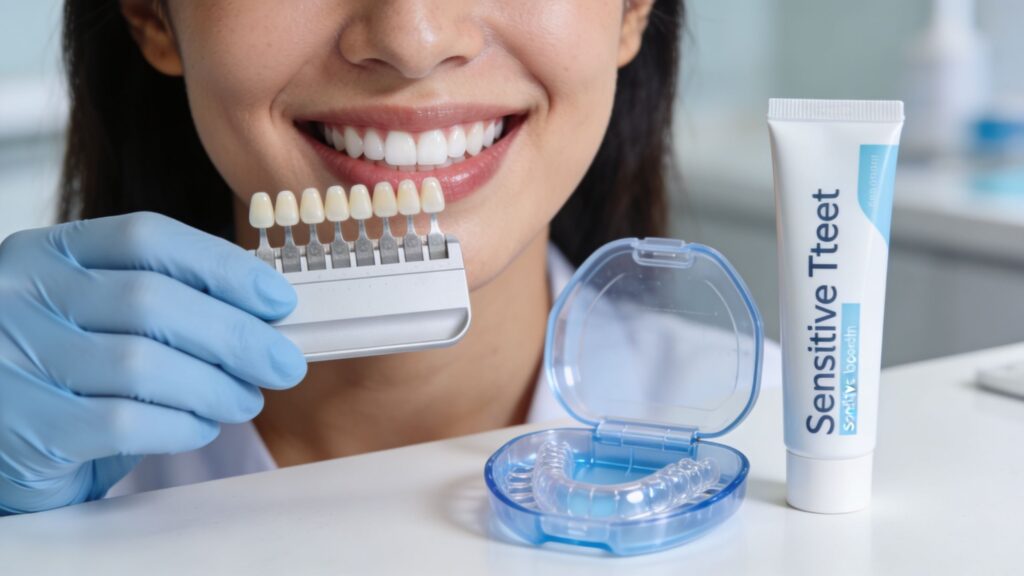
You want whiter teeth, but you don't want that sharp cold-air jolt that can follow the wrong whitening product. That hesitation is reasonable. Many people in San Diego have already tried strips, whitening toothpastes, or a trendy kit they found online, then stopped halfway because their teeth felt irritated.
I see the same pattern often. Someone wants a brighter smile for work, photos, dating, or because they’re tired of looking at coffee or wine stains in the mirror. But they’re also carrying a memory of sensitivity from a past whitening attempt, or anxiety from stories that whitening always hurts. If dental treatment already makes you tense, fear of pain can stop you before you start. If that sounds familiar, these tips to cope with dental anxiety can help make the process feel more manageable.
The best way to whiten sensitive teeth usually isn't the strongest product on the shelf. It's the approach that balances stain removal, comfort, and control. For some people, that means starting very gently. For others, it means skipping over-the-counter products and using a dentist-guided plan from the start.
A brighter smile shouldn't come at the cost of avoidable pain. The actual question isn't "what whitens fastest?" It's "what gives me a visible result without setting my teeth on fire for the next two days?"
The Dream of a Bright Smile vs the Fear of Pain
A lot of people arrive at whitening the same way. They have an event coming up, they notice yellowing in photos, or they feel their smile no longer matches how polished they want to look. Then the second thought hits. "What if my teeth can't handle it?"
That fear isn't overreacting. Sensitive teeth change how you shop, how you eat, and how you think about cosmetic dentistry. A product that sounds simple to someone else can feel risky if you've ever had that sudden electric "zing" after a cold drink or after using whitening strips.
Why people hesitate
For most patients, the hesitation comes from one of three places:
- A bad past experience: They used a whitening strip or gel before, and their teeth felt sore afterward.
- Everyday sensitivity already exists: Ice water, citrus, or cold air already bother them, so whitening feels like pushing their luck.
- They don't know which options are gentler: The market is full of products, but labels don't always explain what matters most.
Whitening should feel planned, not guessed at.
In a city like San Diego, where your smile is part of how you show up socially and professionally, people often want cosmetic improvement without the drama. That's a smart goal. Sensitive teeth don't mean you're excluded from whitening. They mean you need a smarter sequence.
What a better approach looks like
The best whitening plan for sensitive teeth starts with restraint, not intensity. It respects your enamel, your dental history, and your tolerance level. It also accepts a reality many ads ignore. Fast and comfortable don't always come in the same box.
That trade-off matters. Some methods are cheap upfront but frustrating over time. Others require more planning but create a more predictable experience. Once you understand where the pain comes from, the decision gets easier.
Understanding the Zing Why Whitening Can Hurt
Whitening sensitivity feels mysterious until you understand what's happening inside the tooth. The simple version is this. Whitening gels use peroxide to break apart stain molecules. That same ingredient can travel through enamel and irritate the inner part of the tooth.

Think of dentin like tiny open channels
Under the enamel is dentin. Dentin contains microscopic tubules that lead toward the nerve. If enamel is thinner, roots are exposed, or the tooth is already reactive, whitening ingredients can trigger that classic quick jolt.
If you'd like a plain-language primer on understanding tooth sensitivity from Newtown Dental, it's a useful companion to this topic. For practical home care strategies, this guide on sensitive teeth and how to get rid of it at home also helps patients reduce daily irritation.
Concentration matters more than marketing
The biggest factor isn't whether the box says "advanced," "professional," or "extra white." It's peroxide strength. Tooth sensitivity during whitening affects a substantial portion of patients, with reported incidence ranging from 30% to over 78%, and the main driver is peroxide concentration according to this review of whitening sensitivity incidence and peroxide strength.
That same source notes an important clinical point. Treatments using 35% hydrogen peroxide or more caused sensitivity in virtually all patients, while lower-concentration options reduced that risk significantly.
If your teeth are sensitive, the wrong whitening system isn't just uncomfortable. It's the predictable result of too much peroxide too quickly.
Why the discomfort usually fades
The good news is that whitening sensitivity is usually temporary. It tends to peak shortly after treatment and then settle down, often within a short window after the session. That doesn't make the pain pleasant, but it does mean most whitening-related sensitivity is manageable when the method is chosen carefully.
The practical takeaway is simple. The best way to whiten sensitive teeth is usually not to avoid whitening entirely. It's to control concentration, contact time, and application.
Comparing Whitening Methods for Sensitive Teeth
Not all whitening options fail for the same reason. Some are too weak to justify the effort. Others work well but create unnecessary sensitivity because they aren't suited for your teeth. If you're trying to decide what makes sense, compare methods by four things: control, comfort, speed, and long-term value.
| Whitening method | Typical concentration or profile | Sensitivity risk | Main trade-off | Best fit |
|---|---|---|---|---|
| Whitening toothpaste | Mild surface-stain approach | Low | Safe but limited brightening | Minor stains or maintenance |
| OTC strips | 3% to 10% peroxide | Moderate | Convenient, but fit and exposure are less controlled | Mild to moderate staining |
| Professional take-home trays | 10% to 22% peroxide | Low to moderate | Slower than one-visit whitening, but more precise | Sensitive patients who want strong results |
| Customized low-dose protocols | 5% to 15% peroxide | Lower for sensitive users | Requires patience and consistency | People who need a gentler pace |
| In-office whitening | 25% to 40% peroxide | High unless modified | Fastest visual change, highest sensitivity concern | Non-sensitive patients or carefully supervised cases |
The concentration ranges above come from this overview of whitening risk by peroxide level.

Whitening toothpaste
This is the least intimidating place to start. Sensitivity-focused toothpastes can help with surface stain maintenance and may include ingredients commonly used for sensitivity support. They also fit easily into daily life.
The limitation is obvious. Toothpaste is not a dramatic whitening tool. If your discoloration is deeper or you've been disappointed by "whitening" products before, this may feel like a very slow treadmill.
Best for:
- Surface stains
- Maintenance after a stronger treatment
- People who need the lowest-risk starting point
Over-the-counter strips and gels
Strips are popular because they feel simple. Peel, place, wait. The problem for sensitive teeth is that convenience doesn't equal precision. A strip doesn't know where your enamel is thinner, where a tooth is restored, or whether one side of your smile is more reactive than the other.
The peroxide range in over-the-counter strips falls into a moderate-risk category for sensitivity. Coverage can also be uneven if the strip doesn't sit perfectly.
A useful outside perspective on Choosing your ideal whitening option from Grand Parkway Smiles explains why at-home convenience often comes with compromises in control. If you've used strips repeatedly, it's also worth reviewing whether DIY whitening can harm your teeth before trying another round.
Custom trays from a dentist
For many people with sensitivity, custom trays make the balance finally start to make sense. These trays fit the shape of your teeth, which means the gel sits where it's supposed to sit and is less likely to flood the gums. That improved fit matters.
Professional take-home kits also allow more flexibility. Wear time can be shortened. Strength can be lowered. The whole protocol can be slowed down without abandoning the goal of visible whitening.
Practical rule: Sensitive teeth usually respond better to controlled whitening over time than to a single strong push.
In-office professional whitening
This option gives the fastest visible result, but it's also where caution matters most for people who already know they're sensitive. Higher-concentration in-office systems can be too aggressive unless the plan is modified.
That doesn't mean in-office whitening is automatically off the table. It means it needs judgment. Some patients do well with a staged plan, a lower-dose approach, or a combination of office treatment and gentler home maintenance. The best way to whiten sensitive teeth isn't always one method by itself. Sometimes it's the right sequence of methods.
Your Desensitizing Protocol Before and After Whitening
Good whitening starts before the whitening gel ever touches your teeth. If you want comfort, don't treat sensitivity as an afterthought. Treat it as part of the plan.

Before whitening
Dental guidance for sensitive teeth favors custom-fitted trays with lower-concentration gels, and many dentists also recommend a pre-conditioning phase with desensitizing products. Here's the sequence I generally want patients to think about:
- Start with a sensitivity toothpaste. Look for one that contains potassium nitrate or fluoride. Use it consistently before whitening, not just after you feel discomfort.
- Get your brushing under control. A soft-bristled brush and lighter pressure reduce avoidable enamel wear.
- Avoid stacking irritants. If your teeth are already reacting to cold drinks, whitening strips on top of that irritation usually won't go well.
- Choose a gradual schedule. Sensitive teeth often tolerate shorter sessions better than a marathon approach.
A fluoride-based support plan can also be useful before treatment. If you're wondering how that works, this overview of what effects fluoride treatment can have on your teeth gives helpful context.
After whitening
Most post-whitening discomfort is temporary, but the first day matters. The goal is to calm the teeth rather than challenge them.
- Skip temperature extremes: Very cold drinks and very hot foods can trigger fresh sensitivity.
- Keep your toothbrush gentle: This isn't the time for aggressive scrubbing.
- Pause if needed: If a product is making your teeth angry, forcing yourself through another session rarely ends well.
- Use your desensitizing products consistently: They work better as part of a routine than as a rescue move.
This short video gives a helpful visual overview of comfort-focused whitening habits:
What works better than pushing through pain
People often assume sensitivity means the whitening is "working." That's not the standard you should use. Results matter, but so does tissue health and your willingness to complete the treatment.
Stop judging whitening by how intense it feels. Judge it by whether you can follow the plan comfortably enough to finish it.
The Real Cost of a Whiter Smile A Long-Term View
The cheapest whitening product is often the one that costs you the most over time. That's especially true for sensitive teeth, where people bounce from one toothpaste, strip, pen, or gel to another, hoping the next one will finally work without hurting.

The OTC cycle adds up
There is a real financial trade-off here. Professional whitening sessions range from $300 to $800, while sensitivity toothpastes typically cost $8 to $15 per tube, and repeated purchases over 12 months can easily exceed the cost of a professional session without delivering comparable results according to this analysis of cost and ROI for whitening sensitive teeth.
That doesn't mean every person should jump straight to professional care. It means "cheaper" should be measured over time, not at checkout.
What you're actually buying
When patients buy whitening products over and over, they're usually paying for three things:
- Another attempt: The previous product didn't do enough, or hurt too much.
- More maintenance: The result faded or never got where they wanted it.
- More uncertainty: They still don't know which ingredient or format their teeth can tolerate.
Professional whitening changes that equation because the treatment can be matched to your sensitivity profile. You're not just buying gel. You're buying selection, fit, pacing, and oversight. If your goal is a meaningful improvement rather than a perpetual maintenance loop, that distinction matters.
A professional option can also make more sense if you're already considering stronger cosmetic upgrades later. For example, people who are trying to improve yellowing before future aesthetic treatment often look at how professional whitening helps with yellow teeth as part of the broader investment.
A whitening plan is more like a treatment strategy than a beauty impulse purchase. The upfront price only tells part of the story.
When to See a Dentist Before You Whiten
Sensitive teeth aren't all sensitive for the same reason. That's why generic whitening advice breaks down so quickly. One person has mild enamel wear. Another has exposed root surfaces from gum recession. Someone else has a small cavity they don't know about yet. All three might describe the same symptom. They should not use the same whitening product.
Cases that need evaluation first
A full oral exam matters because whitening can aggravate problems that should be treated first. This review on when a dental exam should come before whitening notes that cavities or gum disease need to be ruled out, and that dentists can distinguish between sensitivity that still allows whitening and cases that require restoration first.
Situations that deserve a dental visit before whitening include:
- Gum recession
- Possible enamel erosion
- Persistent or spontaneous tooth pain
- Old restorations or multiple fillings in front teeth
- Sensitivity that feels severe rather than occasional
Not every patient should use peroxide
Some patients react poorly even to lower-peroxide formulas. In those cases, alternatives such as PAP (phthalimidoperoxyhexanoic acid) may be considered by a dentist. That's useful because it opens another lane for people who assumed whitening was no longer an option.
The essential value of a dental visit isn't permission. It's diagnosis. Once the cause of your sensitivity is clear, whitening becomes a clinical decision instead of a gamble.
Your Personalized Whitening Plan at Serena San Diego Dentist
A patient sits in my chair after trying strips, whitening pens, and one online kit that promised fast results. Her teeth are still not as bright as she wants, but the cold sensitivity is worse, and she has already spent more than she expected. That pattern is common. For sensitive teeth, the best plan is rarely the cheapest box on the shelf. It is the one that gets a safe result without forcing you to keep buying products that underperform or hurt.
Professional guidance matters here. Dental guidance supports custom-fitted trays with lower-concentration whitening gel for sensitive patients because they keep the gel where it belongs, limit contact with the gums, and allow the pace to be adjusted if teeth start to react, as summarized in this review of safe whitening options for sensitive teeth.
What a sensible plan includes
A good whitening plan for sensitive teeth should match four things:
- Your teeth today: the type of staining, enamel condition, gum health, and whether visible teeth have fillings, bonding, or crowns
- Your sensitivity pattern: whether you react to cold, sweets, air, brushing, or a past whitening product
- Your timeline: whether you want gradual brightening over time or need a controlled plan before photos, a wedding, or another event
- Your maintenance costs: how to hold the result with fewer retreatments instead of slipping into a steady cycle of strips, pens, and impulse buys
At Serena San Diego Dentist, whitening options include professionally supervised treatment plans and custom take-home trays designed for precise gel placement. That precision matters. Less gel on the gums means less irritation. A better tray fit also helps avoid the uneven coverage and wasted product that often come with one-size-fits-all trays and strips.
I also look at return on investment. A customized plan can cost more upfront, but many sensitive patients spend that amount anyway by repeating over-the-counter trials that never quite deliver the result they want. Paying once for a diagnosis, the right gel strength, and a tray that fits often turns out to be the less expensive path over time.
What tends to work
Sensitive patients usually do well with controlled application, lower-strength gel, shorter wear times, and planned desensitizing support.
What drives problems is inconsistency and overcorrection. A patient uses strips for a few days, gets zingers, stops, waits, then buys a different kit and starts over. That cycle costs money and keeps the teeth in a constant state of irritation without producing a stable result.
The better standard is simple. Choose the method you can finish safely, maintain predictably, and repeat only when you need it.