
Think of your tooth enamel as your smile's personal bodyguard. It’s the hardest substance in the human body, a tough outer shell that protects the sensitive inner parts of your teeth from everything you put them through—chewing, crunching, and extreme temperatures. But this armor has an Achilles' heel: acid.
Enamel erosion happens when acids—from foods, drinks, or even your own stomach—start to dissolve this protective layer. The tricky part is, unlike a bone that can heal, once tooth enamel is gone, it's gone for good. Your body can't grow it back. This permanent loss leaves the softer, more sensitive dentin layer underneath exposed, which can lead to significant dental problems. If you're tired of sensitivity or worried about the long-term health of your smile, understanding how to prevent enamel erosion is the first critical step.
What Is Enamel Erosion and Why It Matters
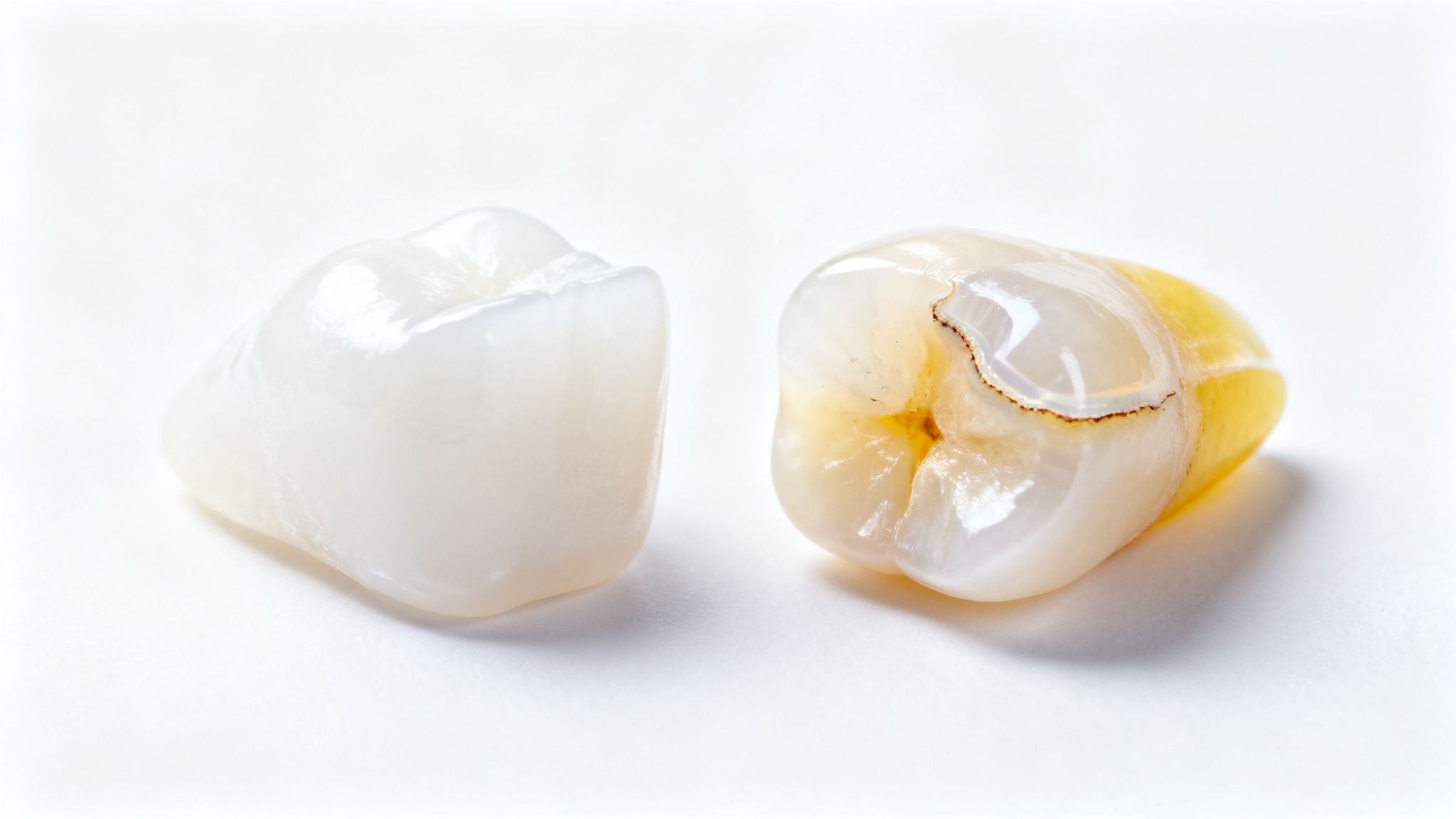
The Domino Effect of Lost Enamel
When your enamel starts to thin, you’ll notice changes that are more than just cosmetic. The symptoms often build on each other, getting progressively worse if you don't intervene. Addressing these early can make a world of difference.
- Sudden Tooth Sensitivity: That sharp pain you feel with hot coffee, ice cream, or even a sweet treat? That's a classic sign. The exposed dentin has tiny pathways leading straight to the tooth's nerve, making it incredibly sensitive.
- Yellowing Teeth: As the bright white enamel wears away, the naturally yellowish dentin underneath shows through, giving your teeth a duller, discolored appearance.
- Visible Wear and Tear: In more advanced cases, you might actually see the damage. Look for small cracks, chips, or little indentations (what dentists call "cupping") on the chewing surfaces. The edges of your front teeth might even look translucent or rounded.
- Increased Cavity Risk: Enamel is your first line of defense against decay-causing bacteria. Without it, your teeth are much more vulnerable to cavities.
Getting to the root cause is the first step. While some people may have genetic conditions that result in weaker enamel, like enamel hypoplasia, the main culprits for most of us are hidden in our daily routines. If you're wondering whether your enamel issues are from erosion or a developmental condition, we have a helpful guide on understanding enamel hypoplasia.
A Quick Look at the Primary Causes and Early Warning Signs
To help you connect the dots between your habits and potential symptoms, here's a simple breakdown of what to watch for.
| Everyday Causes | What to Look For |
|---|---|
| Frequent consumption of soda, fruit juices, and sports drinks. | A sudden sharp pain when you eat or drink something hot, cold, or sweet. |
| A diet high in acidic foods like citrus fruits, tomatoes, and vinegar. | Teeth that appear yellow or dull, even with regular brushing. |
| Medical conditions such as acid reflux (GERD), bulimia, or chronic dry mouth. | Small chips, cracks, or indentations (cupping) on the surfaces of your teeth. |
| Brushing too hard or using a hard-bristled toothbrush, especially after an acid attack. | The edges of your front teeth looking see-through or uneven. |
Recognizing these early signs is crucial because it gives you the chance to act before the damage becomes severe.
A Modern-Day Dental Dilemma
Enamel erosion isn't some rare problem—it's a massive global health concern, largely fueled by modern diets packed with acidic and sugary products. The statistics are eye-opening. A major review found that dental erosion impacts a staggering 30.4% of children and teens worldwide.
It's not just kids, either. The prevalence among adults in developed nations can be as high as 45%, with nearly 30% of young adults already showing signs of enamel wear. These numbers aren't just statistics; they're a clear signal that being proactive about protecting your enamel is essential.
Protecting your enamel isn't just about keeping a white smile. It's about maintaining the very structure of your teeth for life. Your best defense is making small, conscious choices every single day.
The good news? You have a ton of control. By understanding the triggers and adopting smarter habits, you can effectively shield your smile from acid attacks. In this guide, we'll walk you through practical, real-world strategies to keep your enamel strong and healthy for the long haul.
Your Diet: The First Line of Defense Against Acid
While your toothbrush and floss are non-negotiable, the most powerful tool you have to prevent enamel erosion is what’s on your plate and in your glass. Every single meal, snack, and drink is a chance to either protect your teeth or weaken them. Think of it as a constant chemical battle happening right inside your mouth.
The two things that matter most in this fight are pH levels and frequency of exposure. Anything with a low pH is acidic, and when it hits your teeth, it softens the enamel, leaving it weak and vulnerable. The more often you expose your teeth to that acidic environment, the more damage you’ll see over time.
Identifying The Acidic Culprits
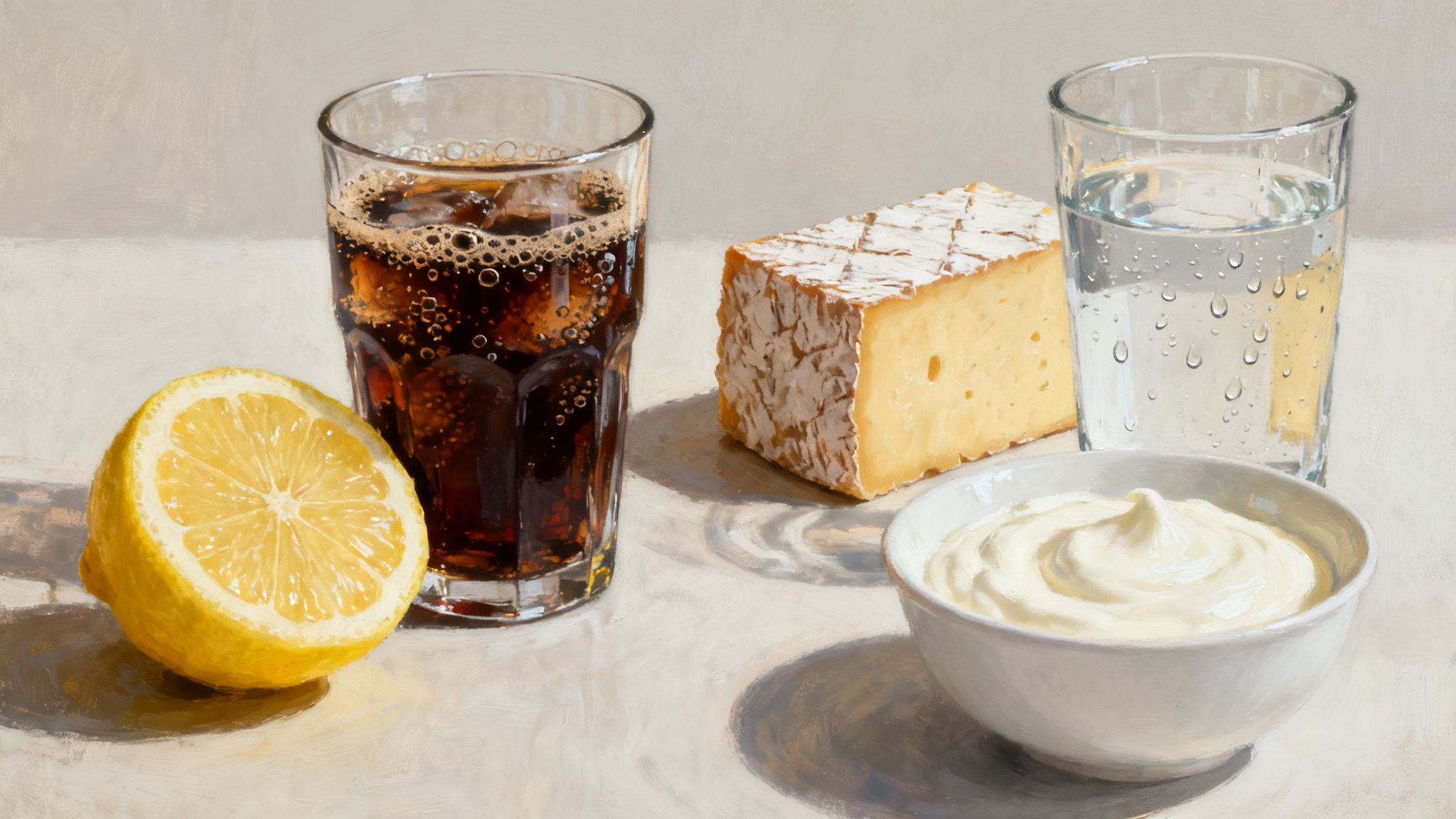
You already know the obvious offenders. Sodas, sports drinks, and citrus fruits are practically legendary for their high acid content. A can of cola, for example, can have a pH as low as 2.5—which is uncomfortably close to battery acid on the pH scale.
But the list doesn't stop there. A lot of seemingly "healthy" foods and drinks can also pose a serious risk if you're not careful. These sneaky sources include:
- Fruits and Juices: Lemons, limes, grapefruits, and even healthy apples can be surprisingly acidic.
- Tomatoes and Vinegar: These are in everything from pasta sauces to salad dressings, making them a common, often overlooked, source of acid.
- Wine: It's no secret that both red and white wine are acidic and can wear down enamel with regular consumption.
- Kombucha and Seltzer: These trendy bubbly drinks, even the unsweetened kinds, can be quite acidic thanks to the carbonation process.
The goal isn't to banish these foods from your life. It's about being smarter about how and when you enjoy them. For a much deeper dive, take a look at our complete guide on acidic beverages and foods to limit or avoid.
Smart Strategies To Minimize Acidic Damage
Protecting your enamel is all about balance and building better habits, not about depriving yourself. Just a few simple tweaks to your routine can make a massive difference.
1. Don't Let Acid Linger
After you’ve had something acidic—like your morning orange juice or a salad with vinaigrette—swish your mouth out with plain water. It’s a simple move, but it helps neutralize the acid and wash it away, cutting down the time it has to attack your enamel.
2. Time Your Brushing Carefully
This one feels backward, but it’s critical: never brush your teeth right after an acidic meal or drink. Your enamel is in a temporarily softened, vulnerable state. Brushing at that moment literally scrubs away the enamel. Instead, wait at least 30-60 minutes. This gives your saliva a chance to work its magic and remineralize the tooth surface before you brush.
3. Use a Straw for Acidic Drinks
When you're enjoying an iced tea, soda, or sports drink, a straw is your best friend. It helps the liquid bypass most of your teeth, dramatically reducing the direct acid exposure to your enamel.
4. Pair Acidic Foods with Neutralizers
Create a buffer by eating acidic foods as part of a complete meal. When you pair them with enamel-friendly foods like cheese, milk, or yogurt, you help neutralize the acid right away. For instance, ending a meal with a small piece of cheese can actually raise the pH level in your mouth.
Small, consistent dietary choices are the foundation of strong enamel. By managing both the pH of what you eat and how often your teeth are exposed, you're building a powerful, long-term defense against erosion.
Building a strong defense also means looking at your overall nutrition. For example, understanding the benefits of Vitamin K2 for your dental health is a game-changer; this vitamin helps your body get calcium to where it belongs—your teeth and bones.
Ultimately, what you eat is the cornerstone of preventing enamel erosion. With erosion impacting 20-40% of children and 30-50% of adults worldwide, simple preventive steps are more important than ever. By being mindful of your diet, you take direct control over the health and future of your smile.
Smart Oral Hygiene Habits to Protect Your Enamel
Your daily brushing and flossing routine is the bedrock of good oral health, but it's surprising how small, unintentional mistakes can sabotage your efforts to protect your enamel. It’s not just about if you brush, but how and when. Fine-tuning your technique can transform a simple habit into a powerful enamel-preserving ritual.
One of the most common mistakes our dentists see is people brushing way too aggressively. Using a hard-bristled brush to scrub your teeth doesn't get them any cleaner; it just physically wears down the enamel over time. This kind of mechanical abrasion is especially damaging right after your enamel has been softened by an acidic meal.
Mastering the Art of Brushing
Proper brushing technique is all about being gentle yet effective. The real goal is to remove plaque without harming your teeth or gums in the process.
- Go Soft: Your most important tool is a soft-bristled toothbrush. Honestly, anything firmer is unnecessary and can be abrasive to both your enamel and your gums.
- Angle for Success: Always position the brush at a 45-degree angle to your gum line. This lets the bristles gently sweep away plaque from the tooth surface and just underneath the gum line where it loves to hide.
- Gentle Does It: Use short, gentle, circular strokes. Think of it more like massaging your teeth, not scrubbing a dirty floor with a harsh back-and-forth sawing motion.
- Take Your Time: A full two minutes, twice a day, is the gold standard. We often tell patients to mentally divide their mouth into four quadrants and spend 30 seconds on each one to make sure every surface gets the attention it needs.
A great tip for heavy-handed brushers: many modern electric toothbrushes have a built-in pressure sensor. It’ll actually alert you if you’re pushing too hard. This feature is a real game-changer for breaking that habit.
The Power of Fluoride
Think of fluoride as your enamel's best friend. It’s a natural mineral that does two critical things: it strengthens your teeth and makes them far more resistant to acid attacks. When acid starts to strip minerals from your enamel (a process called demineralization), fluoride swoops in to help rebuild it (remineralization).
Making sure you get enough fluoride is simple but non-negotiable. Always choose a toothpaste that contains fluoride and has the American Dental Association (ADA) Seal of Acceptance. That seal is your guarantee that the product has been scientifically tested and proven to be both safe and effective.
For an extra layer of defense, think about adding a fluoride mouthwash to your routine. Rinsing just once a day can help fortify those weakened spots your toothbrush might have missed.
Timing Is Everything
Now for one of the most critical—and most overlooked—rules for protecting enamel: wait before you brush.
Right after you eat or drink something acidic, your enamel is temporarily softened and incredibly vulnerable. If you brush immediately, you're essentially grinding that acid directly into the weakened surface, which just accelerates the erosion.
Instead, get into this simple habit:
- After an acidic meal or beverage, rinse your mouth thoroughly with plain water.
- Wait at least 30 to 60 minutes before you even think about picking up your toothbrush.
- This waiting period gives your saliva a chance to do its job—neutralizing the acids and starting the natural remineralization process to harden your enamel back up.
This small delay can make a monumental difference in the long-term health of your smile. You can explore more ways to improve your daily routine by reading our guide on ten tips to step up your oral hygiene. By combining the right tools, smart timing, and the power of fluoride, you create a robust daily defense against enamel erosion.
Professional Treatments That Shield Your Smile
While your daily diet and oral hygiene habits are the bedrock of enamel protection, sometimes you need to call in the professionals. Your at-home care is crucial, but it can only go so far. In-office treatments offer a concentrated, powerful defense that gives your teeth a much-needed boost, especially if your enamel is already showing signs of weakening.
Think of these treatments as a security detail for your smile. They’re specifically designed to halt erosion in its tracks and provide a durable shield against future acid attacks. At Serena San Diego Dentist, we prioritize making these protective treatments accessible. We accept most major insurance plans for covered services and offer flexible payment options to ensure you can get the care you need without financial stress.
The Power of Professional Fluoride Applications
You already know fluoride is important, but a professional application is in a league of its own. It’s nothing like the amount you get from your toothpaste or mouthwash. A professional fluoride varnish delivers a highly concentrated dose that actually adheres to your teeth for hours.
This extended contact time allows the fluoride to work its magic, penetrating deep into the enamel to supercharge the remineralization process. It’s a quick, painless procedure that makes your tooth surface significantly more resistant to acid. We cover more about the profound effects fluoride treatments have on your teeth in our detailed guide.
Innovative Protection with Silver Diamine Fluoride
One of the most effective modern tools we have for stopping dental erosion is Silver Diamine Fluoride (SDF). This remarkable liquid combines the antimicrobial power of silver with the remineralizing strength of fluoride, creating an incredibly robust protective layer on your teeth.
SDF has proven to be a game-changer at the microscopic level. One study exposed teeth to an acidic substance like Coca-Cola, and the enamel's strength plummeted from 125 GPa to a mere 13 GPa. But when treated with SDF first, the strength barely budged, only dropping from 215 GPa to 205 GPa. That's because SDF creates a durable barrier that actively shields the tooth from demineralization.
Expert Insight: SDF doesn't just protect; it actively halts early-stage erosion. By creating this powerful barrier and strengthening the enamel, it offers a superior defense against persistent acid exposure.
Sealing Out Trouble with Dental Sealants
While fluoride treatments protect the entire tooth surface, dental sealants offer targeted protection for the most vulnerable spots—the chewing surfaces of your back teeth. Your molars and premolars have deep grooves and fissures that are tough to clean, making them prime real estate for food particles and acid-producing bacteria.
A dental sealant is a thin, protective coating that we paint right onto these surfaces. It flows into the tiny grooves and hardens, creating a smooth, impenetrable barrier that "seals out" plaque and acid. It's a simple, non-invasive procedure that provides years of protection.
Deciding which professional treatment is best depends on your specific needs and the current state of your enamel. This table breaks down the options to help you see what might be a good fit.
Comparing Your Professional Treatment Options
| Treatment | How It Works | Best Suited For |
|---|---|---|
| Professional Fluoride Varnish | A highly concentrated fluoride gel or varnish is applied directly to the teeth, where it stays for several hours to promote deep remineralization. | General prevention for all patients, especially those with early signs of weakening enamel or high-acid diets. |
| Silver Diamine Fluoride (SDF) | A liquid solution combining silver and fluoride is painted onto affected areas to stop decay and erosion in its tracks. | Patients with active, early-stage erosion or cavities, or those who may have difficulty with more invasive treatments. |
| Dental Sealants | A thin, plastic-like coating is painted onto the chewing surfaces of back teeth to seal the deep grooves and prevent acid and plaque buildup. | Children, teens, and adults who have deep fissures in their molars and are prone to cavities on their chewing surfaces. |
Each of these treatments serves a unique purpose in the fight against enamel erosion. A quick chat with your dentist can help pinpoint which one will give you the most benefit.
This simple guide helps visualize the golden rule of brushing—timing is everything after consuming something acidic.
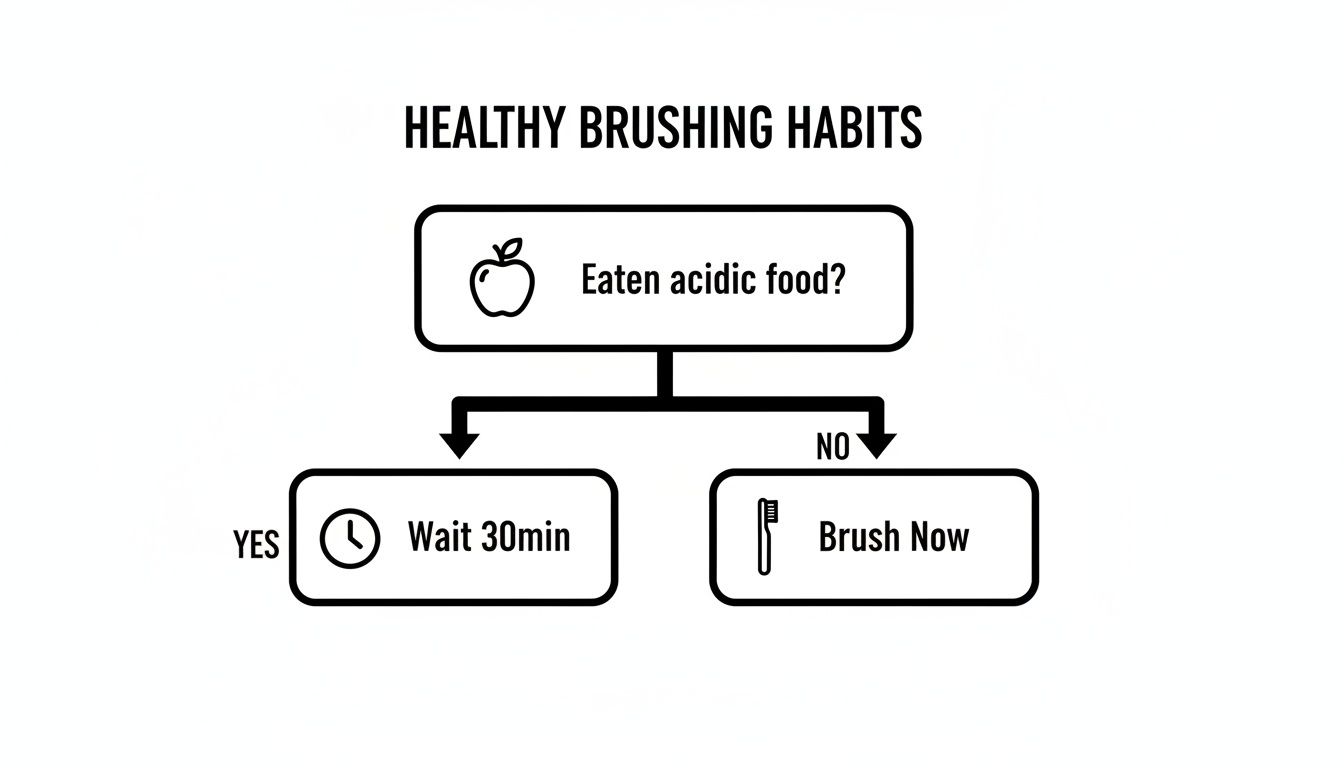
The key insight here is that giving your saliva time to neutralize acids before you brush is a non-negotiable step to keep your enamel strong.
If you live here in sunny San Diego, combining your excellent at-home habits with these professional treatments is the best way to ensure your smile stays brilliant for a lifetime.
When to See Your Dentist About Enamel Erosion
Knowing how to protect your enamel involves more than just good habits at home; it's also about recognizing when you need to call in a professional. Your body is pretty good at sending out warning signals when your enamel is in trouble. The key is to listen to those cues and act on them quickly before a small issue snowballs into a much bigger, more expensive problem.
If you wait until you're in significant pain or see major changes in your teeth, the damage has likely already set in. Catching it early is always the best strategy, as it opens the door to simpler, less invasive treatments.
Telltale Signs That Warrant a Dental Visit
Think of these symptoms as your mouth's early warning system. If you start experiencing any of them, it's a clear signal that it's time to schedule an appointment.
Sudden Sensitivity to Temperatures and Sweets: This is often the first red flag. If you feel a quick, sharp twinge of pain when you sip a hot coffee or eat a bowl of ice cream, it’s probably because your thinning enamel is exposing the sensitive dentin layer underneath. It's easy to brush this off as just "sensitive teeth," but it’s a symptom that definitely needs to be investigated.
A Change in Tooth Color: Does your smile seem a little less bright lately, even though you're brushing regularly? As the white, translucent enamel wears away, the naturally yellowish dentin beneath it starts to show through. This can give your teeth a dull or yellowed look that has nothing to do with surface stains.
Visible Changes in Tooth Shape: Get up close to the mirror and take a good look. Do you see small, shiny indentations or "cups" on the chewing surfaces of your back teeth? Have the edges of your front teeth started to look a bit rounded, shorter, or almost see-through? These are classic physical signs that your enamel has been slowly wearing down.
Spotting these signs early can be the difference between a simple fluoride treatment and needing more complex work like bonding or even crowns.
Your regular dental check-ups are for so much more than just a cleaning. They are your single best opportunity for early diagnosis. A trained professional can spot the subtle signs of erosion long before you can, setting you up for successful prevention.
The Critical Role of Regular Check-Ups
It's a common mistake to think you only need to see a dentist when something hurts, but that's a purely reactive approach to your health. By the time enamel erosion causes real pain, significant damage has already occurred. This is why those twice-a-year visits are so important—they're your front line of defense.
During a routine exam, your dentist is doing far more than just polishing your teeth. They are actively screening for the earliest indicators of problems like enamel erosion. They can measure the extent of any wear, talk to you about potential causes based on your diet and habits, and recommend professional treatments to stop it from getting worse.
Taking Action in San Diego
Ignoring the early signs of enamel erosion is a gamble with your long-term oral health. The sooner you get a professional opinion, the more options you'll have to protect and preserve your smile for years to come. In sunny San Diego, where smiles are always on display, taking proactive care is essential.
If any of these symptoms sound familiar, or if you're just concerned about your risk, don't put it off. At Serena San Diego Dentist, we can assess the health of your enamel, create a prevention plan that works for you, and help you keep your teeth strong and healthy for life. Schedule a consultation today to take the first step in safeguarding your smile.
Common Questions About Enamel Erosion
Let's tackle some of the questions our dentists hear all the time about enamel erosion. Getting clear, practical answers is the first step toward protecting your teeth and feeling confident in your daily routine.
Can I Reverse Enamel Erosion Once It Starts?
This is a big one, and the honest answer is no—not in the way you might think. Once enamel is physically worn away, your body can't grow it back. It's gone for good.
But here's the crucial part: you can absolutely stop it in its tracks. Even better, you can repair the very earliest stage of damage, a process called demineralization. Think of this as a "soft spot" before a real cavity or wear spot forms.
This is where fluoride is your best friend. It helps rebuild those weakened areas by drawing minerals like calcium and phosphate back to the tooth surface, essentially hardening and patching it up. That's why catching erosion early is so incredibly important.
Are Electric Toothbrushes Bad for Enamel?
Quite the opposite, actually—as long as you're using them the right way. Many modern electric toothbrushes are a huge asset for protecting enamel, mainly because they have built-in pressure sensors.
These little sensors are a game-changer because they light up or buzz when you're brushing too hard, which is a common way people accidentally wear down their enamel. It trains you to be gentler. Whether you use a manual or electric brush, the core principles for protecting your enamel are the same:
- Always use a soft-bristled head. Anything harder is just too abrasive for daily use.
- Choose a gentle, non-abrasive fluoride toothpaste. You don't need grit to get your teeth clean.
- Let the brush do the work. Guide it from tooth to tooth instead of aggressively scrubbing.
Technique is everything. A gentle approach is what saves your enamel in the long run.
How Do I Know if My Tooth Sensitivity Is from Enamel Erosion?
That quick, sharp "zing" you get from a cold drink or a sweet dessert is a classic sign. When it comes to erosion, this happens because the protective enamel has thinned out, exposing the layer underneath called dentin.
Dentin is porous and filled with microscopic tubes that lead directly to the nerve of the tooth. When something hot, cold, or sweet hits those exposed tubes, you feel it instantly.
While sensitivity is a major red flag, it's often paired with other clues. Look for teeth that appear slightly more yellow (that's the darker dentin showing through) or notice subtle changes in their shape, like little chips or rounded edges. If you see these signs together, erosion is a very likely cause.
Key Takeaway: While these signs strongly suggest enamel erosion, they can also point to other dental issues. Only a dentist can provide a definitive diagnosis and recommend the best course of action.
Getting a professional opinion is the only way to know for sure what's going on and get the right help.
Don't wait for sensitivity to become a constant problem. At Serena San Diego Dentist, our team can assess the health of your enamel and create a personalized plan to protect your smile for the long term.
Schedule your consultation in San Diego today!