
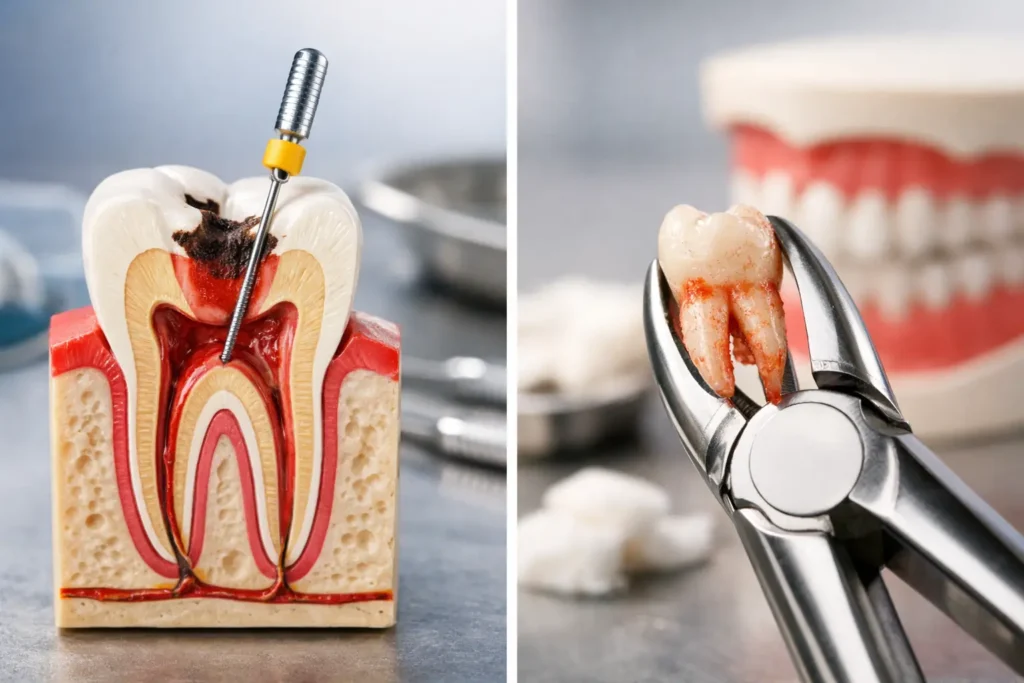
A severely painful tooth can make a routine lunch, a client meeting, or a night of sleep feel impossible. When the diagnosis is serious, the root canal vs extraction decision is rarely just about getting out of pain. It is about preserving your bite, protecting your appearance, and choosing a treatment that supports your oral health for years to come.
The right answer depends on one central question: can the tooth be predictably restored? A detailed exam, digital imaging, and a close look at the tooth structure and surrounding bone allow your dentist to make that recommendation with confidence.
Root Canal vs Extraction: The Core Difference
A root canal is a tooth-saving treatment. It is recommended when infection, deep decay, or trauma has reached the pulp – the soft tissue inside the tooth that contains nerves and blood vessels. During treatment, the dentist removes infected tissue, carefully cleans and disinfects the canals inside the roots, then seals the space to prevent reinfection. In most cases, the tooth is restored with a custom crown afterward.
An extraction removes the entire tooth from the mouth. It may be the healthiest choice when a tooth has fractured below the gumline, has extensive decay that cannot hold a restoration, has severe periodontal disease, or has an infection that cannot be treated predictably. Removing the tooth addresses the immediate problem, but it also creates a space that should be thoughtfully managed.
Neither option is automatically better. A root canal is generally preferred when a natural tooth has a strong long-term prognosis. Extraction can be the more responsible recommendation when keeping the tooth would involve repeated treatment with limited odds of success.
When Saving the Tooth Is Usually Worth It
Your natural teeth are uniquely designed for your bite. They help maintain jawbone volume, keep neighboring teeth in position, and distribute chewing forces naturally. For these reasons, preserving a tooth is often the first choice when the remaining structure, roots, and surrounding bone are healthy enough.
A root canal may be an excellent option if the infection is confined to the pulp or around the root tip, the tooth has adequate healthy structure above the gumline, and there is no major vertical root fracture. A crown can then protect the treated tooth from further cracking and restore a natural-looking result.
Front teeth and visible premolars can be especially important to preserve when possible. Although modern replacement options are highly aesthetic, maintaining a healthy natural tooth can simplify treatment and protect the continuity of your smile.
That said, a root canal does not make a tooth invulnerable. Teeth that have lost significant structure may remain more prone to fracture without a protective crown. Success also depends on excellent home care, healthy gums, and regular dental visits.
What Root Canal Treatment Feels Like
Many patients arrive expecting a root canal to be the painful part. In reality, the infection is often what causes the most intense discomfort. With modern local anesthesia, careful techniques, and a comfort-focused approach, root canal treatment is commonly comparable to receiving a filling.
You may experience mild soreness or pressure for a few days afterward, particularly if the tooth was badly infected before treatment. This is usually manageable with the guidance of your dental team. Once healing begins, patients are often relieved to be able to bite, sleep, and function without the persistent pain that brought them in.
When Extraction May Be the Better Choice
There are situations where saving a tooth is not in a patient’s best interest. A deeply split tooth, a root fracture extending vertically, or decay that reaches far below the gumline may leave too little stable tooth structure for a crown to hold. Repeated infection after prior treatment can also change the prognosis.
Extraction may also be considered when advanced gum disease has significantly reduced the bone supporting the tooth. In those cases, root canal treatment may address infection inside the tooth but cannot restore the periodontal support needed to keep it stable.
Choosing extraction is not a failure. It can be a planned step toward a stronger, more predictable restoration. The key is to discuss what will replace the tooth before it is removed, especially in areas that affect chewing or smile aesthetics.
Why Replacing an Extracted Tooth Matters
After an extraction, neighboring teeth can gradually shift toward the open space. The opposing tooth may also move out of position because it no longer has a tooth to bite against. Over time, these changes can affect your bite, create cleaning challenges, and place uneven pressure on other teeth.
The jawbone in the extraction area also begins to remodel after a tooth is removed. For some patients, a bone graft placed at the time of extraction can help preserve the ridge for a future dental implant. This can be particularly valuable in the visible smile zone or when implant placement is part of the treatment plan.
A dental implant is often the closest replacement to a natural tooth because it replaces the root as well as the visible crown. Depending on your goals and oral health, a bridge or removable option may also be appropriate. The best choice depends on bone quality, adjacent teeth, budget, timeline, and cosmetic expectations.
Comparing Pain, Healing, Cost, and Time
Both treatments are performed with anesthesia, and neither should be approached as something you simply have to endure. The level of discomfort before treatment is often a greater indicator of urgency than the procedure itself. Swelling, fever, a facial abscess, or trouble swallowing requires prompt dental attention.
Root canal treatment may take one or more visits, depending on the tooth and the extent of infection. A final crown is often placed after the tooth has stabilized. Extraction itself can be completed in one appointment, but healing continues for several weeks, and implant treatment may require additional planning and time.
The initial cost of extraction can be lower than root canal treatment followed by a crown. However, that comparison is incomplete if the tooth needs to be replaced. Extraction plus a bone graft and implant restoration may become a more substantial investment than saving a restorable tooth. Conversely, paying to treat a tooth with a poor prognosis can be more costly and frustrating if it later needs to be removed.
Your dentist should explain the expected outcome of each option, not just the fee for the first appointment. Ask how long the restoration is expected to last, whether a crown is necessary, what happens if treatment does not succeed, and what replacement plan would be recommended after extraction.
The Details That Change the Recommendation
The same diagnosis can lead to different recommendations for different patients. A back molar with limited structure may still be worth saving for a patient with strong bone support and a healthy bite. That same tooth may be less predictable for someone who clenches heavily, has untreated gum disease, or cannot maintain the restoration around it.
Cosmetic priorities matter as well. Replacing a front tooth requires careful attention to gum contours, tooth shade, and facial harmony. In these cases, preserving a restorable natural tooth can be appealing, while a well-planned implant can provide an excellent outcome when preservation is not possible.
A thorough consultation should include an assessment of the tooth, roots, gums, bone level, bite, and adjacent teeth. Advanced diagnostics help reveal cracks, hidden infection, and bone changes that may not be visible from the surface alone. This level of planning prevents rushed decisions based solely on short-term pain relief.
Do Not Wait for a Tooth Infection to Settle Down
Dental infections do not reliably resolve on their own. Pain may temporarily fade when the nerve inside a tooth stops responding, but the infection can remain and spread into the surrounding tissues. Early evaluation may expand the options available to save the tooth and reduce the complexity of treatment.
If you have a cracked tooth, persistent sensitivity, swelling, pain when biting, or a pimple-like bump on the gums, schedule an evaluation promptly. For San Diego patients, Serena Family and Cosmetic Dentistry can provide a clear diagnosis and a personalized plan focused on comfort, function, and the long-term appearance of your smile.
The best decision is the one that gives you a healthy, stable result you can trust. A timely examination turns an uncertain and painful situation into a treatment plan built around your tooth, your goals, and your future smile.