
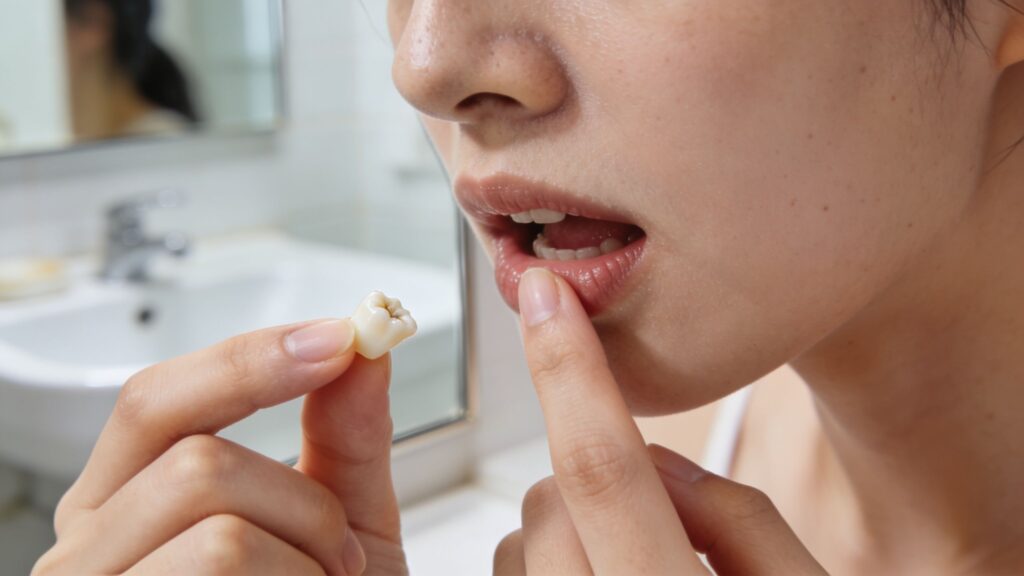
You notice it with your tongue first. A sudden rough edge. A little crater where a filling used to be. Sometimes the filling is sitting in your mouth or on the napkin after a meal. Sometimes you only realize something is wrong when cold water hits the tooth and sends a sharp jolt through it.
That moment can feel unsettling. Two questions frequently come to mind: Is this an emergency, and what should I do right now?
The reassuring answer is that a lost filling is usually manageable if you act promptly. Fillings typically last 5 to 15 years on average, so this is a common problem, and it’s one many adults will face at some point. It’s also usually not an emergency, but waiting is a mistake because the exposed tooth can collect bacteria and develop new decay. In over 30% of untreated cases within months, that exposed area can progress to new problems, according to GoodRx’s review of what happens when a filling falls out.
That Unmistakable Feeling A Filling is Gone
A lost filling rarely happens at a convenient time. It happens during lunch, after popcorn at the movies, or when you’re brushing your teeth before bed and suddenly feel that hollow spot. The usual reaction is mild panic, followed by uncertainty about whether to ignore it, cover it, or call someone immediately.
The first thing to know is this: don’t panic, but don’t put it off. A tooth with a missing filling may feel fine at first. It may also feel sensitive, sharp, or oddly “open.” All of those reactions are possible because the protected part of the tooth is now exposed.
What this usually means
A lost filling often means one of three simple things. The restoration has reached the end of its lifespan. The tooth has changed underneath it. Or biting pressure finally loosened a filling that had been under stress for some time.
That doesn’t automatically mean you need a major procedure. In many cases, a dentist can clean the area and place a new restoration without much trouble, especially when the tooth is evaluated quickly.
Practical rule: If the tooth isn’t swollen and you’re not bleeding uncontrollably, stay calm and focus on protecting the area until you can be seen.
What deserves quick attention
You should move faster if the tooth is very painful, if the edge feels sharp enough to cut your tongue, or if the area traps food every time you eat. The opening left behind can be small and still become a problem because bacteria now have easier access to the tooth.
A lot of people hesitate because it “doesn’t hurt that much.” That’s where trouble starts. A painless lost filling can still turn into a more complicated repair if debris and bacteria sit in the cavity for too long.
For anyone searching what to do when a filling falls out, the right mindset is simple: treat it like an urgent repair, not a crisis.
Your First 60 Minutes A Step-by-Step Response
The first hour matters because it sets you up to avoid contamination, irritation, and extra damage before your appointment.

Start with these three actions
A useful home protocol includes retrieving the filling, rinsing with warm saline, and contacting your dentist within 48 hours. Warm saline rinsing can reduce plaque in the exposed area by 40% to 60%, and delaying contact beyond that window is associated with a 35% increased risk of progression to more serious pulpitis, according to Mackie Dental’s step-by-step guidance for a lost filling.
Take the filling out of your mouth if it’s loose
If you can remove it easily with clean fingers, do that. Don’t leave it floating around while you talk or chew. Put it in a clean container or small plastic bag. Your dentist probably won’t reuse it, but seeing the material can still be helpful.Rinse gently with warm salt water
Use warm, not hot. Swish gently and spit. The goal is to flush out debris without irritating the exposed tooth.Call your dentist
Don’t wait to “see how it feels tomorrow.” Get on the schedule. Even if discomfort is minor, the tooth needs to be examined.
What to say when you call
Keep it short and specific:
- Name the problem clearly: “A filling fell out.”
- Mention symptoms: “It’s sensitive to cold,” or “It’s not painful, but there’s a hole.”
- Say if the tooth is sharp or cracked: That helps the team judge urgency.
If you need a little more help while you wait, this guide to tooth pain home remedies covers practical ways to stay more comfortable without making the tooth worse.
Here’s a quick visual overview of the same first-response steps:
What not to do in that first hour
Some mistakes create more problems than the missing filling itself.
- Don’t probe the hole with a toothpick, tweezers, or a fingernail.
- Don’t glue anything in place with household adhesive.
- Don’t chew on the tooth to “test it.”
- Don’t assume no pain means no risk.
Get the area clean, keep pressure off it, and let a dentist decide what the tooth needs.
Managing the Tooth Do's and Don'ts
Once the first hour has passed, your job is to keep the tooth quiet and protected until you’re seen.

Do these things
- Brush gently: Keep the tooth clean with a soft toothbrush. Plaque sitting in an open cavity is never helpful.
- Use warm salt water rinses: This helps clear food debris after meals.
- Use pharmacy temporary dental cement if needed: A temporary material can sometimes reduce sensitivity and cover the opening until your visit. Follow the package instructions carefully.
- Take an over-the-counter pain reliever if appropriate for you: If you normally tolerate these medicines, they can help take the edge off.
- Choose soft foods: Scrambled eggs, yogurt, soup that isn’t too hot, oatmeal, mashed vegetables, and smoothies are easier on the tooth. If chewing feels awkward, Pain and Sleep Therapy Center's nutrition tips are also useful for building a short-term soft-food plan.
Don’t do these things
- Don’t chew on that side: That’s one of the fastest ways to crack already-weakened tooth structure.
- Stay away from sticky and hard foods: Caramel, nuts, hard candy, and crunchy chips can pack into the opening or fracture the tooth.
- Don’t keep pressing on it with your tongue: People do this all day without realizing it. It can increase irritation.
- Don’t try to seat the old filling back yourself: It won’t bond properly and can trap debris.
- Don’t improvise with wax, gum, or random products: If you’ve used protective materials in your mouth before, this article on using dental wax the right way helps explain where wax can help and where it can’t.
A simple way to think about it
Use this short guide while you wait:
| Situation | Better choice | Avoid |
|---|---|---|
| Eating | Soft, mild foods | Crunchy, sticky, sugary foods |
| Cleaning | Gentle brushing and rinsing | Scraping at the hole |
| Pain control | OTC relief if appropriate | Delaying care because symptoms come and go |
| Covering the area | Temporary dental cement | DIY repair attempts |
The best temporary care is boring care. Keep it clean, keep it covered if needed, and keep pressure off it.
Why Fillings Fail and How to Prevent Future Problems
A lost filling is usually a symptom of something else going on in the tooth. Sometimes the filling has reached the end of its service life. In other cases, the tooth around it has changed enough that the restoration no longer has solid support.

The most common reason
The problem I see most often is recurrent decay. That means new decay has formed at the edge of an older filling, where bacteria and plaque can work into a tiny gap over time. A filling can still look intact from above while the seal at the margin has already broken down.
Material fatigue matters too. Fillings live in a tough environment. Heat, cold, chewing pressure, acidic drinks, and years of expansion and contraction can weaken the bond between the filling and the tooth. Small changes add up.
The pressure problem
Bite force is another major reason fillings fail early. Night grinding, daytime clenching, nail biting, chewing ice, and using teeth to open packages put repeated stress on a restoration that may already be thin at the edges. That stress does not always cause instant pain. Sometimes the first sign is a loose filling or a piece of tooth that breaks with it.
If you have never connected daily habits to restoration damage, this article on chewing ice and other harmful habits that are ruining your teeth explains the pattern clearly.
What helps prevent the next one
Prevention is usually straightforward, but it works best when it matches the reason the filling failed.
- Keep routine exams and X-rays on schedule: Early edge leakage, wear, and hidden decay are easier to treat before the filling loosens.
- Clean the margins well: Brushing and flossing consistently matter most where the tooth meets the filling.
- Protect the tooth from overload: If grinding or clenching is part of the story, a nightguard can reduce the pressure that shortens the life of fillings.
- Be honest about habits: Ice chewing, hard candy, pens, and similar habits can turn a small weak spot into a broken tooth.
- Use pain medicine carefully: If you are relying on stronger medication while waiting to be seen, this acetaminophen and codeine guide offers general background, but your dentist or physician should decide what is appropriate for you.
What not to do matters here too. Do not assume replacing the filling alone solves the problem if the underlying issue is decay underneath, a cracked cusp, or heavy bite pressure. If the cause is missed, the replacement often fails for the same reason.
That is why a good dental visit focuses on both the repair and the reason the first filling came out.
What to Expect at Your Serena San Diego Dentist Visit
You arrive with a rough spot on the tooth, a little sensitivity, and one big question. Is this a quick refill, or did the tooth break in a way that needs more support?

At a modern San Diego dental visit, the appointment usually starts with diagnosis, not drilling. That matters because the right repair depends on what failed. Sometimes the filling wore out. Sometimes decay formed underneath it. Sometimes the filling came out because part of the tooth fractured, and putting another small filling back into a weak tooth would be the wrong move.
The exam and imaging
The first step is a careful look at the tooth and the bite. The dentist checks whether the cavity is still cleanly shaped, whether the remaining walls are strong enough to hold a new filling, and whether the nerve may be irritated. We also look for what patients often miss. A cracked cusp, decay under the old margins, or a bite problem that kept overloading the tooth.
X-rays are often part of that process because some problems are hidden between teeth or below the visible opening. Burlington Center Dental’s overview of a lost filling visit notes that imaging is commonly used to check for decay, fracture, or deeper involvement before treatment is chosen. If the tooth is very sensitive to temperature or pressure, additional testing may be needed before any final restoration is placed.
The likely treatment options
If the tooth still has enough healthy structure, the usual treatment is straightforward. The area is cleaned, any decay is removed, and a new filling is bonded into place. Long-term clinical data supports this approach in the right case. A systematic review published in the Journal of Dentistry found high survival for direct posterior composite restorations over time, especially when the remaining tooth structure is sound and case selection is appropriate (Opdam et al.).
A crown becomes more likely when the missing filling is only part of the problem. If one or more cusps are thin, undermined, or already cracked, a larger restoration may fail again because the tooth itself is no longer strong enough. In those situations, covering the tooth is often the safer long-term choice. Evidence reviews from the Journal of the American Dental Association have shown strong long-term survival for single-unit crowns, which is why dentists often recommend them for teeth that need more structural protection (JADA evidence review on crown survival60229-2/fulltext)).
Here is the practical way to view the situation:
| If the tooth looks like this | The usual direction |
|---|---|
| Small to moderate loss, strong remaining walls | New filling |
| Large break, weak cusps, or a filling that failed because the tooth is flexing | Crown |
| Lingering pain, pressure pain, or signs the nerve is involved | More testing before the final repair |
What not to do during the visit is just as important. Do not push for “the cheapest quick fix” if the tooth is already telling us it needs more support. A replacement filling in a badly weakened tooth can break out again, sometimes taking more tooth with it.
Payment and accessibility
Cost worries are real, and they do affect decisions. Ask for a clear breakdown before treatment starts. That usually includes the exam, any needed X-rays, and the restoration options if there is more than one reasonable path.
If you have dental insurance, the front desk can usually help estimate what your plan may cover. If you are paying out of pocket, ask about phased treatment only if it is clinically safe to do so. Delaying a crown for a short time may be reasonable in some cases. Delaying treatment on a tooth with active decay, a fracture, or nerve symptoms often is not. If you want a better sense of how these repairs are done, Serena’s expert tooth filling services page explains the treatment approach in more detail.
What the appointment should feel like
A good visit feels calm and specific. You should leave knowing what failed, what the tooth can still support, what you should avoid until treatment is finished, and why one option is better than another.
That clarity lowers anxiety. It also helps prevent the next mistake. The goal is not just to replace what fell out. The goal is to restore the tooth in a way that protects it from another fracture, another lost filling, or a bigger repair a few months from now.
Your Next Step to a Restored, Healthy Smile
A filling that falls out feels alarming, but it’s usually very manageable when you respond the right way. Clean the area gently. Keep the filling if you find it. Avoid chewing on that side. Use temporary dental cement only as a short bridge if you need it. Then get the tooth evaluated promptly.
That sequence matters because exposed teeth don’t protect themselves. Once the filling is gone, the tooth is more vulnerable to sensitivity, debris, and a bigger repair than you started with. Fast action gives you the best chance of keeping treatment simple.
If you’re still unsure whether you’ll need another filling or a crown, the answer depends on how much healthy tooth remains. In some cases, a replacement filling is enough. In others, a full-coverage restoration is the safer long-term move. This overview of dental crown procedure steps can help you understand what happens if the tooth needs more support.
The main thing is not to wait for the tooth to “declare itself” with major pain. Many lost fillings begin subtly. The people who do best are usually the ones who act before the tooth gets worse.
If you’re in San Diego, Clairemont, or La Jolla and you’ve just lost a filling, the next step is simple. Call a dentist, describe what happened, and get the tooth looked at as soon as possible. A short appointment now can prevent a much longer one later.
If you need prompt help with a lost filling, Serena San Diego Dentist can help you take the next step toward a comfortable, protected tooth again. Reach out to schedule an evaluation, ask about insurance and payment options, and get clear guidance on whether you need a new filling or a crown.