
A missing tooth changes more than your smile. It affects how you chew, how confidently you speak, and often how much strain neighboring teeth have to carry. When patients ask about dental bridge vs implant, they are usually not looking for a textbook definition. They want to know which option will feel better, last longer, and make the most sense for their health, schedule, and budget.
The right answer depends on what is happening below the surface. Bone levels, the condition of nearby teeth, the location of the missing tooth, and your long-term goals all matter. A bridge can be an excellent restoration in the right case. An implant can be the most conservative and durable choice in another. The best treatment is the one that fits your mouth, not just the one that sounds most advanced.
Dental bridge vs implant: the core difference
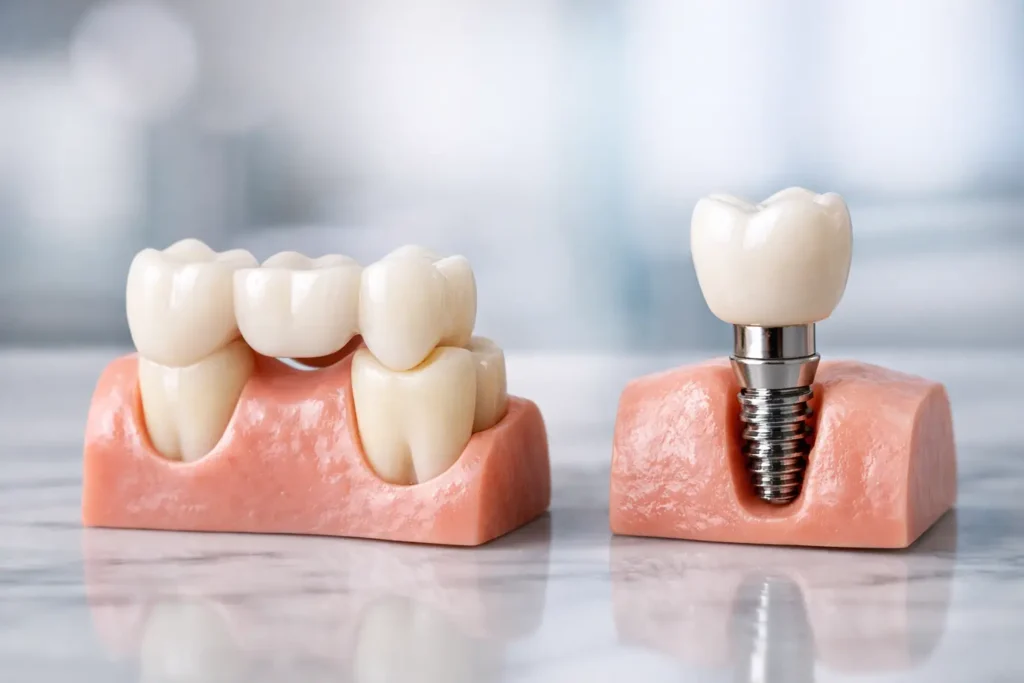
A dental bridge replaces a missing tooth by anchoring an artificial tooth to the teeth on either side of the gap. In many cases, those neighboring teeth are shaped and covered with crowns so they can support the restoration.
A dental implant replaces the missing tooth at the root level. A small titanium post is placed in the jawbone, where it functions like an artificial root. Once it integrates with the bone, a custom crown is attached on top.
That difference matters because a bridge relies on adjacent teeth, while an implant stands independently. From a restorative and preventive standpoint, that often shapes the entire decision.
When a dental bridge makes sense
A bridge can be a very practical solution when the teeth next to the missing space already need crowns. If those neighboring teeth are heavily filled, cracked, worn, or structurally compromised, using them as support may be efficient and clinically appropriate.
Bridges also tend to have a shorter overall timeline. In many cases, treatment can be completed faster than implant therapy because there is no surgical healing period for a post to integrate with the bone. For patients who want a fixed replacement quickly, that can be appealing.
There are also situations where a patient is not an ideal surgical candidate, or where they prefer to avoid a procedure involving the jawbone. In those cases, a bridge may provide a strong esthetic result and restore function predictably.
That said, a bridge has trade-offs. Because it connects to neighboring teeth, it can place additional stress on them over time. It also does not replace the root, which means the bone underneath the missing tooth can gradually shrink.
When an implant is the stronger option
An implant is often considered the closest replacement to a natural tooth because it restores both the visible crown and the support beneath it. That root-level support helps preserve jawbone and keeps neighboring teeth from shifting into the gap.
One of the biggest advantages is that the adjacent teeth usually do not need to be reduced. If the teeth on either side of the space are healthy and untouched, preserving them is often a major benefit.
Implants also tend to feel more natural to many patients once fully healed. Because they are anchored in bone rather than suspended between teeth, they can offer excellent stability when chewing and speaking. For image-conscious adults who want a restoration that looks refined and functions confidently, that independence is often a deciding factor.
Still, implants are not instant treatment. They require planning, imaging, and healing time. If bone loss is present, grafting may be recommended before or during placement. That longer process is worth it for many patients, but not everyone wants or needs that path.
Cost is important, but value matters more
For many patients, the first practical question is cost. A bridge often has a lower upfront cost than an implant. On paper, that can make it look like the easier decision.
But upfront cost is only part of the picture. A bridge may need replacement sooner than an implant, especially if decay develops around a supporting tooth or one of the anchor teeth weakens. If a problem affects either side of the bridge, the restoration as a whole can be compromised.
An implant usually costs more initially, but it often delivers stronger long-term value because it preserves bone and avoids involving neighboring teeth. That does not mean an implant is always the better financial choice. It means the real comparison should be based on lifespan, maintenance, and the condition of the surrounding teeth, not just the first estimate.
Appearance and comfort
Both bridges and implants can look beautiful when designed well. In a modern cosmetic and restorative practice, materials, shade matching, and digital planning play a major role in creating a natural result.
An implant often has the advantage when it comes to mimicking the emergence of a natural tooth from the gums, particularly in visible areas of the smile. Because it occupies the space independently, the final crown can often look more like an individual tooth rather than part of a connected unit.
Comfort can be more nuanced. A bridge is fixed and stable, which many patients appreciate immediately. An implant may feel more natural in the long run because it functions more like a separate tooth. But early comfort depends on the treatment phase. A bridge can be less invasive at the start, while an implant requires surgical placement and healing.
Longevity and maintenance
If longevity is a priority, implants often have the edge. With proper planning, good oral hygiene, and regular professional care, implants can last many years and often much longer than alternative restorations.
Bridges can also perform very well, but they are more vulnerable to issues involving the supporting teeth. If plaque collects around the margins or flossing is difficult, the anchor teeth may be at higher risk for decay or gum problems.
Maintenance is different for each option. A bridge requires careful cleaning under the artificial tooth, often with floss threaders or other tools. An implant still needs excellent hygiene, but the cleaning pattern is more similar to caring for a single crown. Neither option is maintenance-free, and both benefit from consistent exams and cleanings.
Bone loss changes the conversation
One reason dentists often lean toward implants when possible is bone preservation. When a tooth is lost, the jawbone in that area begins to shrink because it no longer receives stimulation from the root.
A bridge does not stop that process. It fills the visible gap, but the bone underneath can continue to resorb. Over time, that can affect the contour of the gums and the overall appearance of the area.
An implant helps stimulate the bone and can limit that collapse. For patients thinking beyond the next year and looking at the long-term architecture of their smile, this is a meaningful advantage.
Who is a good candidate for each?
A bridge may be a strong choice if you want a fixed restoration without implant surgery, need a faster solution, or already have neighboring teeth that would benefit from crowns.
An implant may be ideal if you have healthy adjacent teeth, sufficient bone support, and want the most independent and long-lasting replacement possible. It is especially appealing for patients focused on preserving oral structures and achieving a highly natural result.
There are also gray areas. Some patients are excellent implant candidates medically but prefer the shorter bridge timeline. Others would like an implant, but bone loss, smoking history, or uncontrolled health conditions make treatment more complex. This is why diagnostics matter. Digital imaging and a thorough restorative evaluation can reveal which option is truly built for long-term success.
Dental bridge vs implant for front teeth and back teeth
The location of the missing tooth matters more than many people expect. In the front of the mouth, esthetics are often the top concern. Gum shape, smile line, and symmetry become especially important, and implants can offer excellent cosmetic potential when bone and soft tissue are favorable.
In the back of the mouth, biting force becomes a bigger issue. Both bridges and implants can work well here, but an implant may better distribute pressure without recruiting neighboring teeth to carry the load.
That said, there is no universal rule that front teeth should always get one treatment and back teeth another. The condition of the surrounding teeth, the bite, and the amount of available bone often matter more than location alone.
Choosing the right treatment with confidence
Patients rarely regret asking better questions before deciding. How healthy are the neighboring teeth? Is there bone loss already? How long do you want this solution to last? Are you solving today’s problem only, or planning for the next ten to twenty years?
At a technology-forward practice like Serena Family and Cosmetic Dentistry, those answers come from detailed imaging, careful exam findings, and a treatment plan shaped around your priorities, not a one-size-fits-all recommendation. Some smiles are best served by a beautifully crafted bridge. Others benefit more from the strength and independence of an implant.
If you are weighing dental bridge vs implant, the goal is not choosing the more popular option. It is choosing the restoration that protects your health, supports your confidence, and feels right every time you smile, speak, and eat.