Living with a missing tooth often affects more than your bite. People tell me they start covering their mouth when they laugh, choosing softer foods without realizing it, or smiling a little less in photos. In San Diego, where life is social and active, that missing space can feel bigger than it looks.
Dental implants are designed to solve that problem at the root level. Instead of sitting on top of the gums like a removable option, an implant replaces the missing tooth from the jawbone up. That’s why many patients see it as the closest thing to getting their own tooth back.
If you’ve been asking what is the process of getting dental implants, the good news is that it’s not one mysterious event. It’s a sequence of clear stages: planning, preparing the area, placing the implant, allowing it to heal, and restoring it with the final tooth. Each step has a purpose. Each step builds on the one before it.
Some people arrive ready to begin right away. Others need a little groundwork first. Both are normal. A helpful outside resource for understanding dental implant costs and process can give you added context if you’re comparing treatment paths.
If you’re still weighing implants against removable options, this overview of dental implants vs dentures can also help clarify the big-picture differences in feel, stability, and maintenance.
Your Journey to a New Smile Starts Here
A lot of patients think the implant journey begins in the surgical chair. It doesn’t. It begins when you decide you’re tired of working around a missing tooth.
One patient might notice food catching in the gap every day. Another might have an old bridge that never quite felt natural. Someone else may have lost a back tooth years ago and finally wants a permanent replacement. Different stories, same goal: eat comfortably, speak naturally, and stop thinking about that space.
Why implants feel more like a complete solution
A dental implant replaces the part you see and the part you don’t. The visible tooth matters, of course, but the hidden support under the gum is what gives the restoration its stability.
The process is akin to replacing a tree, not just tying a branch where one used to be. You want support below the surface so the final result has strength.
A good implant case feels orderly, not rushed. Patients do better when they understand what happens first, what happens later, and why healing time matters.
The journey is personal, not one-size-fits-all
Two people can both need a single implant and still have different treatment plans. One may have healthy bone and move through the process smoothly. Another may need treatment first because the site has changed since the tooth was lost.
That’s why implant care works best as a collaboration. You bring your goals, health history, schedule, and concerns. The dental team brings imaging, planning, surgical precision, and a restoration that matches your smile.
Here’s the simplest way to think about the full process:
- Step one is diagnosis: your mouth is evaluated carefully before anything is scheduled.
- Step two is preparation: if the area needs support, that happens before the implant goes in.
- Step three is placement: the implant post is positioned in the jawbone.
- Step four is healing: your bone bonds to the implant in the background.
- Step five is restoration: the connector and final crown complete the tooth.
For most patients, the process feels less stressful once they can see the map.
The Critical First Step Consultation and Planning
A patient often walks into this visit with one simple question: “Can I get a dental implant?” By the time the appointment ends, the better question is usually, “What is the safest, smartest path for my mouth?”

At this stage, your dentist is building a blueprint before anyone starts building the house. The goal is to understand your health, your bite, your bone, and your priorities so the implant is planned for long-term success, not just short-term convenience.
What happens at this visit
A good implant consultation covers more than the empty space where the tooth used to be. Your dentist reviews your dental and medical history, checks your gums, examines how your teeth come together, and studies detailed imaging of the area.
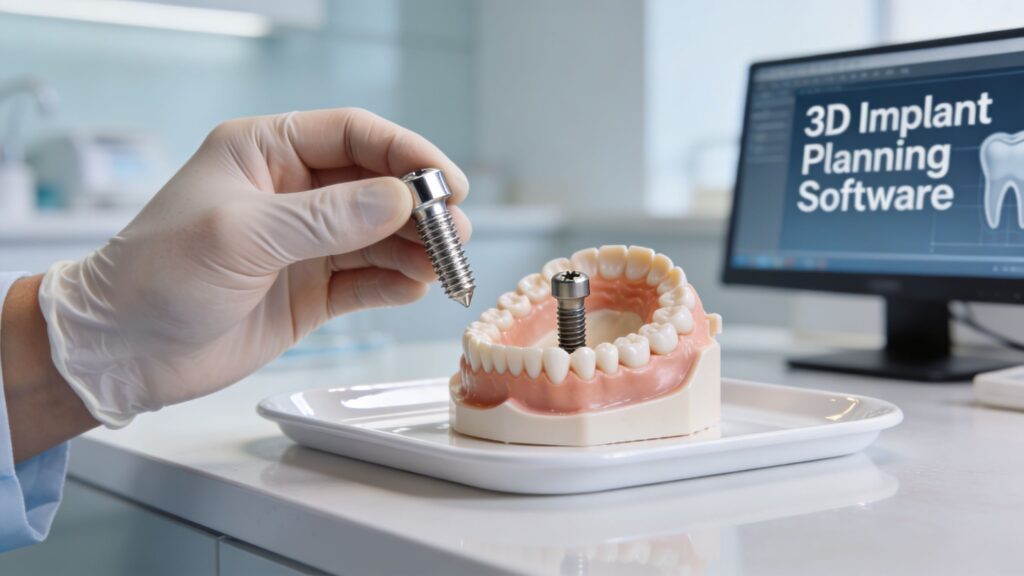
That imaging matters because implants need precise placement. A 3D CBCT scan can show the width and height of available bone, the position of nearby structures such as nerves or sinuses, and whether the site looks ready now or needs treatment first. Digital impressions can also help the team study your bite and design a restoration that fits your smile naturally.
At Serena San Diego Dentist, planning is meant to be collaborative and patient-centered. You are not being rushed through a checklist. You are getting a personalized plan based on what your mouth can support and what outcome you want.
The questions your dentist is answering
Patients sometimes assume the consultation is only about whether there is “enough bone.” Bone matters, but it is only one piece of the picture.
Your dentist is also asking:
- Is the gum tissue healthy enough to support healing?
- Is the bone shape favorable for stable implant placement?
- Are there habits, such as clenching, that could overload the future implant?
- Does the timing make sense now, or would a staged plan protect the result better?
- Will the final tooth look and function naturally with your bite and smile line?
This kind of planning helps prevent surprises later.
What if you are not a candidate right now
This is one of the most important parts of the process, and many articles skip it. Not every patient is ready for an implant on day one. That does not automatically close the door.
A better way to view it is this: candidacy can change. Bone can often be rebuilt. Gum disease can often be treated. Medical concerns can sometimes be coordinated with your physician so treatment is safer.
As noted in Delta Dental’s overview of the dental implant procedure, good oral health, healthy jawbone, and stable medical conditions all play a role in implant success. What patients also need to hear is that a delay often means your dentist is protecting the final result, not denying care.
Common reasons a plan may need to pause or be modified include:
- Bone loss at the missing tooth site
- Active periodontal disease or gum inflammation
- A failing tooth that needs to be removed first
- Medical conditions that need better control or physician clearance
- Bite forces, grinding, or hygiene habits that raise the risk of complications
For many people in San Diego, the most reassuring part of the consultation is hearing, “You may need a few steps first, and here is exactly why.” That clarity matters. It turns uncertainty into a plan.
If you want to see where that kind of imaging, exam, and treatment coordination happens, this overview of the Serena San Diego dental office gives a practical look at the setting where your implant plan is mapped out.
Preparing the Foundation for Your Implant
If the first visit shows that the site isn’t ready yet, preparation becomes the next smart step. Patients sometimes hear “bone graft” or “extraction” and think something has gone wrong. Usually, it means the team is doing the work required to make the final implant more stable.
Why foundation matters
A dental implant needs supportive bone around it, the same way a house needs firm ground under its foundation. If the base is weak, the structure above it has less support.
That’s why preparatory treatment isn’t a detour. It’s part of the build.
Some cases involve removing a damaged tooth that can’t be saved. Others involve adding bone where the ridge has become too thin or too shallow after tooth loss. In upper back areas, a sinus lift may be discussed when anatomy limits the available height.
Common preparation steps
These steps vary by patient, but they often include:
- Tooth extraction: if a failing tooth is still present, it may need to come out before the implant plan can continue.
- Bone grafting: graft material helps rebuild volume where the jaw has shrunk.
- Gum treatment: inflamed or infected tissue needs attention before an implant is asked to heal in that environment.
- Bite planning: if forces in the mouth are uneven, your dentist may adjust the plan so the future implant isn’t overloaded.
A useful way to think about it is this: the visible crown gets the attention, but the hidden support decides how well that crown performs years later.
Patients are often relieved once they understand that preparatory treatment is meant to prevent problems, not create extra steps for the sake of it.
If you want a closer look at why grafting is sometimes recommended, this guide to bone grafting essentials and facts explains the role it plays before implant placement.
What preparation feels like emotionally
This phase can test your patience more than your comfort. People are ready for the final smile, so any extra step can feel frustrating at first.
But careful implant treatment respects biology. Your jawbone and gums set the pace. The long-term result is usually better when the site is built correctly rather than rushed.
The Implant Placement Surgery Explained
Surgery day usually feels more straightforward than patients expect. By this point, the planning work is already done, the site has been prepared if needed, and the team knows exactly what they are trying to accomplish. At Serena San Diego Dentist, that visit is treated like a carefully mapped procedure, not a guessing game.

What happens on surgery day
First, the area is thoroughly numbed with local anesthesia. Some patients also choose sedation, especially if they feel anxious or if the treatment is more involved. The goal is simple. You should feel pressure and vibration more than pain.
Once you are comfortable, the dentist makes a small opening in the gum and prepares the space in the jawbone for the implant. The implant itself is then placed into that prepared site with careful control. It works like setting a post into a well-measured pilot hole. If the fit is right and the position is right, the foundation starts out stable.
In some cases, a healing cap is placed on top right away. In others, the implant is covered under the gum for protected healing. That choice depends on your bone, your bite, the location in the mouth, and whether the site needs a quieter healing environment.
Why precision matters so much
An implant is small, but its position affects everything that comes after it. A few millimeters can influence how the final crown looks, how easy it is to clean, and how forces travel into the bone when you chew.
That is why digital planning and guided placement can make such a difference. The process works like using architectural blueprints before pouring a foundation. Your dentist studies the available bone, nearby structures such as nerves or sinuses, and the ideal angle for the future tooth, then uses that plan during surgery instead of relying on estimation alone.
For patients, this usually means a more controlled procedure, a more conservative approach to the surrounding tissues, and better alignment between the implant and the final restoration.
A short video can make this stage easier to picture:
What the implant is actually made of
The implant post is typically made of a biocompatible material such as titanium or a titanium-based alloy. That material is used because the body generally accepts it well, and bone can heal closely around it over time.
After placement, you usually will not see the implant itself. It sits below the gumline and takes over the job that a natural tooth root used to do. The visible tooth is added later, after healing has progressed.
Questions patients commonly ask before surgery
Many concerns sound different on the surface, but they usually come back to comfort, safety, and recovery.
| Concern | What patients usually mean |
|---|---|
| Pain | Will I feel the procedure itself, or mainly pressure and movement? |
| Safety | How does the dentist stay clear of nerves, sinuses, and thinner areas of bone? |
| Recovery | How sore will I be after, and how quickly can I get back to normal routines? |
Those are reasonable questions. Clear imaging, careful planning, and a gentle surgical approach do a lot to answer them before the procedure even begins.
Some patients are also surprised to learn that implant surgery is not always the same from one person to the next. A single-tooth implant, a front-tooth implant, and a full-arch case can follow different surgical designs because the goals are different. If you are comparing full-arch options, this guide to the differences between All-on-6 and All-on-4 dental implants in San Diego can help you see how planning changes when several teeth are being replaced at once.
For many patients, the biggest relief comes after the appointment is over. They realize the procedure felt organized, monitored, and more manageable than they had feared.
Healing and Osseointegration The Quiet Phase
After the implant is placed, the most important work happens where you can’t see it. This stage is called osseointegration, which means the bone gradually bonds to the implant surface.
The easiest analogy is a tree root settling into soil. At first, the root is placed there. Over time, the surrounding ground grips it more firmly. An implant heals in a similar way, except the bond forms between bone and the implant surface.
Why this healing period matters
This phase can feel uneventful because there isn’t a dramatic daily change. That’s normal. Your body is doing slow, careful reconstruction.
The verified implant process summary describes osseointegration as the critical fusion phase. It notes that bone remodeling occurs through osteoblast attachment to the implant’s roughened surface, with 60 to 70% bone-to-implant contact by 3 months in the mandible and a slower 4 to 6 months in the maxilla. That same overview also notes monitoring with ISQ above 65 on resonance frequency analysis devices during a 3 to 6 month healing period, with biweekly check-ups used to detect early failure from overload.

The Osseointegration Journey Healing After Implant Placement
Here’s a plain-language view of the timeline patients usually experience:
| Stage | What’s happening |
|---|---|
| Initial healing | The gums begin closing and calming around the surgical area. |
| Early bone growth | New bone cells begin forming around the implant surface. |
| Osseointegration | The bond between bone and implant becomes stronger and more stable. |
| Abutment placement | A connector piece is attached once the implant is ready. |
| Final restoration | The custom crown is secured to complete the tooth. |
Healing can feel slow from the patient side. From a biological standpoint, that waiting period is the treatment.
What you’ll be asked to do
This stage is quiet, but it isn’t passive. Patients still have a job to do.
- Keep the area clean: follow the home-care instructions exactly as given.
- Protect the site from pressure: don’t chew aggressively on the healing area if your dentist tells you to avoid it.
- Attend follow-ups: these visits let the team confirm that healing is progressing as expected.
- Speak up early: if something feels off, call. Small issues are easier to manage when they’re addressed quickly.
Placing Your Abutment and Final Crown
Once the implant has bonded securely with the bone, the process becomes more visible again. This is the stage where the hidden foundation starts turning into a finished tooth.
The abutment is the connector
An abutment is the small piece that links the implant below the gums to the crown above. Patients sometimes think the implant and crown connect directly, but the abutment acts as the middle component.
In some cases, placing the abutment is a simple follow-up appointment. The gum tissue is shaped so the final tooth can emerge naturally and cleanly, rather than looking bulky or artificial.
The crown is where science meets aesthetics
The crown is custom-made to match your smile. Shade, shape, height, and contour all matter. A back tooth has to handle chewing force. A front tooth has to blend with neighboring teeth in a way that looks effortless.
This is one of my favorite moments in implant treatment because patients often realize the process is no longer theoretical. They can see the tooth. They can test how it feels. They can compare it to the natural teeth around it.
A well-made implant crown should aim to do four things:
- Look balanced: it should fit the smile, not stand out from it.
- Feel comfortable: the bite shouldn’t feel high or awkward.
- Allow easy cleaning: good design supports healthy gums around the restoration.
- Restore confidence: many patients stop thinking about the missing tooth at this point.
A successful implant crown shouldn’t draw attention to itself. It should let the rest of your smile look complete.
The “reveal” isn’t just cosmetic. It’s functional. Patients often describe the biggest win as returning to normal, eating, smiling, and talking without mentally compensating for a gap.
Protecting Your Investment Costs and Aftercare
Once your implant is complete, the goal shifts from building it to protecting it. The good news is that implant aftercare is usually straightforward. You care for it much like a natural tooth: consistent brushing, thoughtful flossing, and regular dental visits.
Daily habits matter more than fancy tricks
Long-term success usually comes down to ordinary routines done well. Plaque still matters. Gum inflammation still matters. Skipping checkups still matters.
That means your aftercare plan may include:
- Brushing thoroughly: keep the crown and gumline clean every day.
- Cleaning between teeth: use the tools your dentist recommends around the implant area.
- Watching your bite habits: if you clench or grind, protection may be recommended.
- Keeping recall visits: implants need monitoring just like natural teeth do.
If you want practical guidance on home maintenance, this article on dental implants and oral health care is a useful place to start.
What affects the total cost
Patients almost always ask about cost, and they should. The total investment depends on the specifics of your case, not just the implant itself.
Factors that commonly influence the overall fee include:
| Cost factor | Why it changes the plan |
|---|---|
| Number of missing teeth | A single implant is different from multiple implants or full-arch treatment |
| Preparatory procedures | Extractions, grafting, or gum treatment may be needed first |
| Restoration design | A crown, bridge, or larger prosthetic changes the final scope |
| Complexity of the case | Bone shape, bite forces, and esthetic demands all affect planning |
The most helpful cost conversation is one tied to your imaging and treatment plan, not a generic number from the internet.
Insurance and payment options
Coverage for dental implants varies by plan. Some PPO plans may contribute to portions of care, while other parts may remain out of pocket. Many patients also choose out-of-pocket payment because it gives them more flexibility in timing and treatment decisions.
If you’re comparing options, ask practical questions:
- What parts may be covered by my PPO plan?
- Are diagnostics, extraction, grafting, or the crown handled differently?
- Are financing or phased treatment options available?
- Can the plan be sequenced if I want to spread treatment over time?
What matters most is clarity. You should know what’s being done, why it’s being recommended, and how the financial side will be organized before treatment begins.
Dental implants are a process, not a single appointment. But for many patients, that process leads to something simple and valuable: a tooth that feels stable, looks natural, and lets them stop thinking about what’s missing.
If you’re ready to talk through your options, ask candidacy questions, or get a personalized plan for replacing a missing tooth, schedule a consultation with Serena San Diego Dentist.