Missing a tooth in La Jolla can feel bigger than it sounds on paper. You might notice it when you smile in photos, when food catches in a gap, or when you start chewing on one side because the other side doesn’t feel reliable anymore. Some people come in because a tooth has already been lost. Others are dealing with a cracked tooth, a failing bridge, or a denture that never quite feels secure.
That uncertainty is usually what bothers people most. They want to know what a dental implant is, whether it hurts, how long it takes, and whether it’s financially realistic. Those are reasonable questions. Dental implants can be life-changing, but they’re easier to understand when you see the process in plain language instead of dense dental jargon.
Your Complete Guide to Dental Implants in La Jolla
A common story goes like this. Someone loses a back tooth and thinks, “It’s not visible, so I can probably leave it alone for now.” Then they start chewing differently. A front tooth can feel even more personal. People cover their mouth when they laugh, avoid close-up photos, or keep postponing treatment because they’re worried about pain, cost, or making the wrong decision.
That hesitation is understandable, but you’re far from alone. The American Academy of Implant Dentistry reports that 30 million people in the U.S. live with missing teeth, while 3 million people already have dental implants, and that number grows by about 500,000 each year because implants show a 95 to 98 percent success rate in appropriate cases, according to this implant overview citing the American Academy of Implant Dentistry.

Why implants feel like the closest thing to getting your tooth back
A dental implant is designed to replace the root of a missing tooth, not just the visible part above the gumline. That matters because a root gives a tooth stability. Without it, a replacement can look fine but still feel less secure.
People often hear implants described as the gold standard for tooth replacement because they’re fixed in the jaw and built to support daily function. You can smile, chew, and speak without the movement that many patients associate with removable appliances.
Why patients in La Jolla often ask about them first
In a place like La Jolla, where people value both appearance and long-term health, implants appeal to patients who don’t want a temporary-feeling solution. They want something that feels integrated into their life, not something they have to constantly work around.
Practical rule: If your main goal is to replace a missing tooth in a way that feels stable and natural, an implant is often the option patients ask about first.
You may also be comparing an implant to a bridge or denture. That’s smart. The best choice depends on your bone, gums, bite, and goals. If you want a broad overview before a consultation, this guide on San Diego dental implants and what to know before treatment gives helpful background.
How Dental Implants Recreate a Natural Tooth
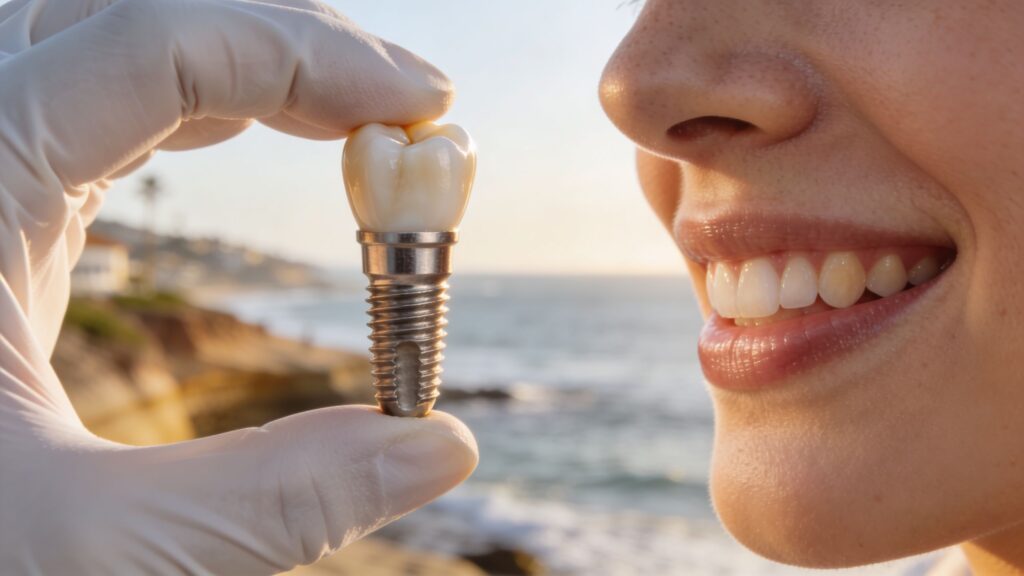
Most confusion about implants comes from one simple issue. People think the implant is the whole tooth. It isn’t. It’s a system with three parts, and once you understand those parts, the process makes much more sense.
The three parts that work together
The implant post sits in the jawbone. This is the part that replaces the root of the missing tooth.
The abutment is the connector. It links the implant post below the gumline to the visible restoration above it.
The crown is the part you see. It’s shaped and shaded to look like a natural tooth.
If you think of a lamp mounted securely on a wall, the crown is the visible fixture, the abutment is the connecting hardware, and the implant post is the anchor hidden inside the wall. Without the anchor, the visible part won’t have the same stability.
What osseointegration actually means
The reason implants can feel so secure is a process called osseointegration. That sounds technical, but the idea is straightforward. Your jawbone heals around the implant and bonds to it.
According to this explanation of implant healing and jawbone fusion, the jawbone’s osteoblast cells fuse directly with the biocompatible titanium post over 3 to 6 months, creating a bond as secure as a natural tooth root.
The implant isn’t just placed in the bone. Your body has to accept it, heal around it, and turn it into a stable foundation.
That healing period is why implants aren’t usually a one-visit procedure from start to finish. The biology matters as much as the dental work.
Why titanium is commonly used
Titanium is widely used in implant dentistry because it’s biocompatible. In plain terms, the body generally accepts it well. That lets the implant serve as a dependable anchor once healing is complete.
Daily care still matters after placement. If you want practical maintenance advice, this resource on looking after implants and supporting oral health long-term covers the habits that help keep them clean and stable.
Your Dental Implant Journey from Start to Finish
Knowing the order of events often brings a sense of calm. The implant process is detailed, but it’s not mysterious. It follows a clear sequence, and each phase has a job.

Step one starts with planning
Your first visit is about diagnosis, not drilling. The dentist examines your teeth, gums, bite, and jaw structure. Imaging is used to see how much bone is available and where important anatomical structures sit.
This planning stage answers the questions patients care about most:
- Can the tooth be saved: If a failing tooth can be predictably restored, that should be discussed.
- Is there enough bone: Bone volume affects implant stability and may influence whether grafting is needed.
- What is the final goal: One tooth, several teeth, or a full arch replacement all require different planning.
If your jawbone needs additional support, bone grafting before implant placement may be part of the treatment plan.
Step two is the implant surgery
The surgery itself is usually shorter than patients expect. Verified implant guidance notes that placement often takes about 1 to 2 hours and is performed with sedation or anesthesia during the surgical appointment, with total treatment commonly spanning 6 to 9 months from placement to final crown.
That doesn’t mean you’re in the chair for months. It means the body needs time to heal between the active treatment stages.
Here’s a visual overview of the sequence many patients find helpful before their consult:
Step three is healing and integration
After the implant is placed, the body does the slow, important work. The gum tissue heals. The bone begins integrating with the implant. During this phase, patients are usually asked to follow instructions carefully, eat softer foods for a period, and keep the area very clean.
Healing time isn’t wasted time. It’s the stage that turns an implant from a placed device into a functional foundation.
Some patients receive a temporary restoration during treatment, depending on the location of the implant and the stability achieved at surgery.
Step four completes the visible tooth
Once healing is confirmed, the dentist attaches the abutment and then the final crown. That crown is designed to match the surrounding teeth in shape, bite, and color.
By that point, the goal is simple. The implant shouldn’t feel like a workaround. It should feel like a dependable part of your mouth that lets you eat, speak, and smile without second-guessing it.
Who Is an Ideal Candidate for Dental Implants
Not everyone starts in the same place, but many people who assume they’re “not a candidate” are surprised during a proper evaluation. Implant candidacy is less about having a perfect mouth and more about having the right conditions for healing and long-term support.

The main things a dentist evaluates
A dentist usually focuses on a few core factors:
- Bone support: The implant needs enough bone for stable placement.
- Gum health: Active gum disease can interfere with healing and long-term success.
- Overall health history: Certain medical conditions or medications may affect timing, healing, or surgical planning.
- Bite forces and habits: Clenching, grinding, or an uneven bite can influence how the restoration should be designed.
- Daily home care: Implants need consistent brushing, cleaning between teeth, and regular professional maintenance.
These aren’t pass-fail boxes. They’re planning factors. If one area needs work first, that doesn’t automatically rule implants out.
Age usually isn’t the deciding factor
A lot of older adults assume they’ve missed their chance. In reality, age by itself typically isn’t the issue. The more important question is whether the bone and gums can support treatment and whether the patient can heal predictably.
That’s why a healthy older adult may be a better implant candidate than a younger person with uncontrolled gum disease or heavy smoking habits.
Common concerns patients bring up
Patients often ask about these situations:
- I’ve had a missing tooth for years. You may still be a candidate, but the bone in that area has to be checked carefully.
- I’ve been told I have bone loss. Bone loss matters, but it doesn’t always end the conversation. Some people may need additional preparation.
- I smoke. Smoking can raise the risk of complications, so honesty matters. Dentists use that information to plan safely.
- I have diabetes or another health condition. Medical conditions don’t automatically prevent treatment, but they do need to be reviewed.
A good implant consultation isn’t about selling you a procedure. It’s about determining whether your mouth and your health can support a predictable result.
Dental Implants vs Other Tooth Replacement Options
Choosing between implants, bridges, and dentures isn’t only about appearance. It’s also about stability, maintenance, and what happens to the rest of your mouth over time.
Where each option fits
A bridge can be a practical fixed option when the teeth next to the gap already need crowns. A denture can replace multiple missing teeth and may be the first step for patients who want a removable solution. A dental implant is often considered when the goal is to replace a missing tooth without relying on neighboring teeth for support.
One of the biggest clinical differences is this: a bridge depends on adjacent teeth, while an implant stands on its own.
Implant vs Bridge vs Denture Comparison
| Feature | Dental Implant | Dental Bridge | Denture |
|---|---|---|---|
| Support | Anchored in the jawbone | Supported by neighboring teeth | Rests on gums or attaches to existing structures |
| Effect on nearby teeth | Usually leaves adjacent teeth untouched | Often requires preparation of neighboring teeth | Doesn’t usually require preparing adjacent teeth in the same way as a bridge |
| Stability | Fixed and generally feels closest to a natural tooth | Fixed, but relies on support teeth | Removable options can shift during eating or speaking |
| Bone preservation | Helps maintain function in the jaw where the root was lost | Doesn’t replace the root in the bone | Doesn’t replace the root in the bone |
| Cleaning routine | Requires careful brushing and cleaning around the implant | Requires cleaning under or around the bridge area | Requires removal and cleaning if removable |
| Best fit for | Single or multiple tooth replacement where support conditions are right | Patients who want a fixed option and have suitable neighboring teeth | Patients replacing several teeth or looking for a removable option |
Why many patients still lean toward implants
Implants usually appeal to patients for three reasons.
- They don’t depend on neighboring teeth. That can be a major advantage when the teeth beside the gap are healthy.
- They feel secure. Many people want a replacement that doesn’t move when they chew or talk.
- They replace more of the missing structure. The restoration starts below the gumline, not just above it.
For a deeper side-by-side look at one of the most common alternatives, this guide on dental implants versus dentures can help you think through the tradeoffs in everyday terms.
Understanding Dental Implant Costs and Financing in La Jolla
Cost is often the reason people delay treatment, even when they already know they want an implant. The hesitation usually isn’t just about the fee itself. It’s about not knowing what insurance might help with, what financing is available, and whether the long-term value justifies the upfront commitment.
What influences the final cost
Verified local guidance notes that implant treatment in San Diego commonly averages $5,000 per implant, with the final total varying by complexity, restoration needs, and case specifics, according to this San Diego implant cost overview.
A treatment plan may include more than the implant post alone. The full fee can depend on factors like:
- Preparatory treatment: Tooth extraction, gum treatment, or bone grafting if needed
- Type of restoration: A single crown, bridge, or full-arch solution
- Materials and planning: Imaging, custom fabrication, and surgical precision
- Case complexity: Front tooth esthetics and bite issues often require extra detail
How PPO insurance and financing can help
Many patients often face challenges with financing. A local financing-focused source states that a 2025 survey by the California Dental Association found 68 percent of patients in coastal areas like La Jolla delay implants because financing information is unclear, and it notes that PPO plans may reimburse up to 50 percent when the implant is documented as a functional restoration, while financing options such as CareCredit can help bridge the gap, as described in this La Jolla implant consultation resource discussing coverage and financing.
That doesn’t mean every plan covers every part of treatment. Insurance often separates the surgical phase, the abutment, the crown, and any grafting into different benefit categories. That’s why a pre-treatment estimate is so useful.
Ask for a written breakdown before treatment starts. Patients feel far more confident when they know which parts may be billed to insurance and which parts may be out of pocket.
If you’re planning to use tax-advantaged funds, it also helps to compare HSA vs FSA eligibility and rules before you commit, especially if you want to time treatment around annual contribution limits or reimbursement requirements.
Why the long view matters
An implant can feel expensive at first glance. But many patients aren’t just buying a crown-shaped object. They’re investing in a stable replacement that can restore function and reduce the compromises that come with looser or tooth-dependent alternatives.
If you want a practice-specific breakdown of what may affect your estimate, this page on dental implant pricing and treatment variables is a useful place to start before calling for a consultation.
Taking the Next Step with a La Jolla Implant Expert
By the time most patients finish learning about implants, their questions become more practical. They’re no longer asking, “What is an implant?” They’re asking, “Am I a candidate, what will my scan show, and what would treatment look like in my case?”
That’s the right shift. Implants aren’t one-size-fits-all treatment. They work best when planning is specific, bone support is evaluated carefully, and the final restoration is designed with your bite, gumline, and smile in mind.
What to look for in a provider
If you’re comparing implant providers in La Jolla, keep your checklist simple:
- Technology: Look for 3D imaging and careful diagnostic planning.
- Clarity: You should get plain-language explanations, not vague promises.
- Complete care: Ask how the office handles grafting, temporaries, final restorations, and follow-up.
- Financial transparency: You should understand insurance coordination, financing options, and out-of-pocket expectations before moving ahead.
- Comfort and communication: The best treatment plans are the ones patients feel ready to follow through on.
A good consultation should leave you feeling informed, not pressured. You should know your options, understand the sequence, and have a realistic sense of cost and healing.
If you’ve been putting this off because it felt confusing, that’s fixable. Most of the anxiety around dental implants comes from uncertainty. Once the process, biology, and finances are explained clearly, the next step usually feels much more manageable.
If you’re ready to talk through your options for dental implants La Jolla, Serena San Diego Dentist can help you understand candidacy, treatment timing, and payment pathways in a clear, low-pressure consultation. If you’re replacing one tooth or exploring a more complex restoration, the goal is simple: give you a plan that feels medically sound, financially understandable, and designed for your smile.